Showing posts with label Travel. Show all posts

1.3.12

A Return to Spanish Time: Canary Islands Tour Diary

A Return to Spanish Time


Though we sit just north in the tropics, it is not a very warm evening. Much warmer than where we came from, but brisk nevertheless. I tug my blazer tighter over my shoulders and bring my tea cup to my lips. Amy bears up under the cold relatively well, however. She hates cold, which is why we’re here. We flew to Gran Canaria to escape February’s dregs. An upgrade from daytime freezing to evening briskness makes the briskness that much more bearable.

In the air another attraction floats upon the breeze. The vacation we’re taking commemorates Carnival. Carnival marks, hypothetically, the last gasp of hedonism before Lent and the aesthetic run-up to the Catholic Easter. The U.S.A. only finds Carnival in full form in New Orleans for Mardi Gras, but across the Caribbean, South America, Europe, and scads of other places, it offers parades, street parties, dancing, booze, and purported joy. I have never been through a Carnival (skipping out on New Orleans a couple weeks before Mardi Gras hit last year), but Amy has years of experience from her time in South America. I feel like I’ve been through several of them myself, having heard Amy’s stories and (sometimes fuzzy) recollections many times over. 

We sit at a café in Parque San Telmo in Las Palmas, Gran Canaria, and wait for the Carnival to roll in. My cell phone reads 8:30. The Parade is due to make its final turn at our corner at 8:30, finishing just below the second-floor balcony of our hotel room. When we checked in earlier that day, our initially taciturn receptionist could hardly contain his excitement over how perfect our spot was, looking over the park and the grand finale. We feel contained excitement as we sit and wait for our waiter to bring us the bill; I am the retiring, boring type and so don’t imagine I’ll make it through much of a Carnival if it goes late, and Amy is conditioned to believe that Brazil > everywhere else, especially regarding Carnival, the country’s finest annual celebration. The parade is tardy; Spanish time is usually an approximate thing, biased towards the later side of any announced time. The parade’s tardiness doesn’t surprise us so much as reassure us, the warm embrace of an old friend.

We walk out to the corner. The sound of synchronized drums draws us closer. The crowd at the corner is relatively insignificant, no more than one or two deep at any given point on the road. The first group marches through, a group of drummers and instrumentalists, almost like a group from your small-town Memorial Day Parade, except all dressed in green. After them came a few more dancing Krewes (the New Orleans term, meaning the dancing group that marches in the parade), a few tawdry floats carrying the Queen, 1st through 4th Ladies, Grand Dame, and Drag Queen of the Carnival, respectively, and then a couple semi-trucks.


At last Amy feels excitement, as the trucks recall Brazil’s Carnival. The trucks are probably an evolution from the floats and walking krewes of yesteryear Carnivals. They operate like themed-party buses, everybody on board dressed in a matching costume – Flintstones, Superheroes, Cats – while a DJ bumps the tunes to a thundering level. Everybody on the truck is meant to be dancing and merrymaking, though most of the truck people are drinking and yelling instead. 

A few trucks pass and at 9:15 a lull sets in. We decide we’ve seen enough.  We return to our room, still dressed but at least freed of the burden of other people. I stand out on the balcony and watch the crowd of people below. Earlier, there was a preponderance of Superman and Wonderwoman outfits, mostly of skimpy nature, as well as a lot of men dolled up in women’s costumes, also of a skimpy nature. Now, I cannot pick out any specific dominant theme, mostly just stragglers from the krewes and trucks that have already passed.


As we stand out on our balcony, Spanish time reasserts itself with a vengeance. The parade hit a lull, a delay, but resumes beneath our eyes. The semis roll one or two down our street at a time. The truck turns the corner 200 meters away from us, its melody reaches our ears a truck length after that, and then the truck crawls past our balcony, stopping at the intersection 50 meters to our left. If lucky, the truck can soak in the spotlight and play its music for another 15-30 seconds, but as the night wears on, the cops instructing them to cut the sub-woofers and move it along get there quicker and quicker. Meanwhile, the next truck or two has already reached our point on the street, the sound systems overlapping, waves falling atop one another, us locked beneath those waves, struggling for air.

Or dancing. Mostly dancing. So we dance. We dance along together, the most we’ve ever danced together, the most Amy has ever allowed me to dance in her presence. That’s because my dancing is rhythmic but uncoordinated, unreasonable and uncontrolled, imagined fluidity replaced by spastic movements and rigid meandering over the 4/4 time signatures. The sort of thing I’m not to do in public in her presence. But here, it’s Spanish Time, it’s Carnival, we’re up on a balcony, and all we can do is take pictures and laugh about it. No one can see us anyway.


Except that some of the people on the trucks are taking our photos. We’re creating quite the little scene, it seems. Some of those drunks down there are cheering, waving, snapping. We wave back. We dance. I add a bounce or two to my moves. We laugh. Carnival roars.

This goes for an hour, and then it things peter out again. No more semis. We stop dancing, stop sweating. The noise in the street and in the park below persists but on a lower level, without the foreground clamor of the music. We stay out on the balcony and watch and glow. 


On the edge of the street below us, a girl kicks a bottle. She is maybe 10 years old and dressed in what looks like a “traditional” costume; long purple skirt and white shirt, her black hair flows down her shoulders even as it is tied in a knot. She kicks the glass bottle along the street curb. The bottle rolls, banks off the curb once or twice, giving way to her soft power. She kicks it one time too many, and it shatters.

The girl retreats across the street. Her mother and other relatives are talking in a circle there. They don’t pay much attention to her, don’t notice her. She flits in and out of the group, walks behind a tree in the park, and then returns to our side of the street. She’s found another glass bottle. She’s kicking it again. Predictably, after a few paltry efforts, she breaks it again.

We are too far away and too foreign besides to say anything as the girl starts kicking her third bottle in the same area. People stand on the other side of the curb railing with the glass breaking just below them. At the 3rd, pattern-confirming bottle, they speak up, sharing our shock. They tell the girl to stop kicking the bottle. She stops. The bottle remains intact. The girl scurries back to her mother’s circle. The mother stomps over to the scene of the crime and yells at the people who spoke up to her daughter (the mother stands conspicuously closer to the middle of the street, away from the broken glass). The people, an older couple and another older man, yell back. The man peels off and finds a police officer. The mother gives not an inch. Her husband, dressed in a washer woman’s outfit with the top of a Christmas tree or a really funky hat on top of his head, acts as a moderating presence and also speaks to the daughter. No one takes him very seriously.

The police officer arrives. Some sort of resolution is reached – your daughter can’t kick any more glass bottles tonight, you need to leave this family alone, none of you can call one another a stupid puta, etc. No arrests are to be made in this situation, and there’s not much else to do. The plaintiffs, or else the street’s defenders, leave their post along the curb to try to revivify their Carnival joy. The cop and the girl’s parents continue to talk with much more laughter. The tumult dies down. The night and the Carnival continue to flow, softly.


And then, as we sleep, Spanish Time rears its head twice or thrice more; the semis circle back through the park once and again, just as loud as the first time. The noise threatens our sleep. I, exhausted from the flight, sleep through most of it, though I swear that at quarter to 4 I’m awakened by the thumping tunes one last time. Amy sleeps fitfully through the Carnival iterations, perhaps suffering for her Brazil-based hubris. She says that I’m wrong about the last cycle taking place that late. 

Spanish time, ladies and gentlemen.

Beeping into the Blind on the GC-200


The thing about it is, the more dangerous something is, the more thrilling. The more we have to risk to achieve something, the more it appears worth it. Life is founded on the principle of efficiency, arbitrage, and that idea; we will risk only as much as a reward merits. So, for a greater reward, we will risk more.

With risk come fear and a chance of failure. Amy – cowering and half-hyperventilating in the passenger seat, picturing us crashing through the fragile guard rail and plummeting over the cliff into more rocks and chasms and eventually the ocean, telling me to go slower, laughing at my beeping, and squeezing in dramatic scenery photos with her new camera all the while – decided the mountain drive only deserved to be risked once.

                “San Nicolas isn’t much to see in and of itself, but this trip is about the journey, not the destination. A 30km drive through the coastal mountains is one of the prettiest settings you will ever go through.”

So said our guide (I’m paraphrasing). The drive began at the foot of the hill where we were staying in Agaete, on the Western coast of Gran Canaria. We had been there for a day and already were succumbing to island fever. With nothing else to do, a beautiful drive down to the touristy but picturesque Puerto Mogan struck us as a winning proposition.  (San Nicolas is about the halfway point between Agaete and Puerto Mogan).

We left around noon. Google Maps told us it would be a 1h20m trip, which would have us in Puerto Mogan in time for a late lunch. Our car was a Toyota Auris, a small 4-door with an incongruous 6 gear manual transmission. On the highway driving to Agaete two days earlier, I hit 6th a couple of times, coasting at 100 Km/Hr, until the dashboard light quickly suggested I shift down to 5th as we hit a hill. There might be a use for the Toyota Auris’s 6th gear on flat highways and long stretches, but it would be completely unnecessary on this trip.


We entered GC-200, the road that would take us the 65 kilometers to Puerto Mogan, unsuspectingly. The road began with a slight incline and a few lazy bends. There was a white line dividing us from the other side of the road. All was calm. Amy began taking photos out the window of Agaete below, of the coastline coming into view, of the mountains in front of us. Gran Canaria is considered something of a “mini-continent”, with a varied landscape; the coastline features quaint towns and pebbly or coarsely sanded beaches, while the interior has more of the rugged look, with mountains stretching up to 5,000 feet and the reddish-brown visage of the barren hills that can be found in Spain, Morocco, or New Mexico.

Rugged mountains and narrow “highways”. After a few easy kilometers, we were climbing up and down the mountain, driving through blind curve after blind curve, and finding that there was no more dividing line painted on the road. The beauty out the window, plentiful, was now obscured. Blocking our beauty was not the scenery, not the mountains getting in the way of anything else, but the fact that I was driving and couldn’t look too much at the scenery, and Amy was panicking because I was driving.


The GC-200 offers an ideal setting for car commercials. There are car commercials that take place in green rolling hills on roads with hairpin turns and endless switchbacks; there are car commercials that emphasize the open road and the plains and the thrill of adventure – the GC-200 offers neither of these. It provides a third possible setting: rugged coastal mountains with frequent turns and undulations, with the promised land of water and sun and fun just around the next (blind) corner. It is really a beautiful drive.

The problem is that I am no car commercial driver, and no commercial for the Toyota Auris will feature such driving. I have never been confused for a good driver. Amy has never been confused for a person who relinquishes control in such crucial circumstances easily. The Toyota Auris does not handle uphills very well, and on this drive I rarely achieved even 4th gear, let alone 6th. We were also tourists, and obvious ones, not sure where we were going and ignorant of which way the road would curve when.

"At least if we crashed, the ocean would douse the flames..."
All of which led to the scene I began with: Amy panicking at my side while I tried to maintain a balance between cool consideration and competence. When going up, I would get the car up to about 40-50 km/h (roughly 25-30 mph) in 2nd or 3rd gear; when going down, I would let the car coast at about 50-60 km/h, riding heavy on the brakes. As we were tourists, and timid ones, we would often get passed. Passing on a narrow mountain road isn’t easy; there’s hardly space for two cars on the road as is, and then if a foolhardy driver tries to do it on a curve, they risk getting smashed by a car coming the other way. We found a way to be passed, though, because there are few trivial things worse than having someone riding on your ass on a narrow road where you can’t help but feel sorry for them since after all you’re the one going half as fast as everybody else: I would pull on to the rare shoulders or to the little bubbles on the road where a car might stop to get a picture of the view, or else edge towards the right on a stretch of road where we could see no one was coming the other way and wave my hand so that the car tailing me started heading me instead. We were passed by bolder tourists, by eye-rolling locals, and even by runaway buses who handled the curves like they were so many city streets, with abandon. “Those poor bus passengers,” said Amy time and again, thinking of how bad she felt just sitting in our car.

"And if we crash, at least this photo will be evidence that I didn't have a heart attack first..."
We learned a technique from the cars that passed us. Some of the drivers, at least, when nearing a curve, would begin to beep. At first I thought the beeping was directed at me, being sensitive to criticism. Then I realized they were short, staccato, friendly beeps. Warning beeps. Beeps to announce one’s presence on the road, bursts of noise and self-affirmation.


This being a trick that could only help our safety, beeping quickly fell into my arsenal on the GC-200. As we approached a curve, I would beep once sharply, then twice more for a follow-up. Some of the curves kept going, with no end to the blindness in sight, and so I kept beeping every couple of seconds. I felt like a satellite drifting out in space, sending signals out to alert other intelligent beings of my presence. The scariest thing, of course, would be to receive a signal in return.

Nothing scarier happened to us than almost running into one pickup truck barreling around a curve fairly on (going 40 km/h allows for a fair deal of reaction time, at least). We also stopped towards the end at “El Balcon”, a scenic viewpoint. A man ran a concessions stand there, and he found my initial parking job unsatisfactory, requiring me to back out on the road across both lanes of traffic and straighten up. I had visions of rolling backwards forever. Amy was so flustered she spoke with the man in English first as she got out of the car; when she switched to Spanish, he in turn grew flustered, saying “Coño, hablas español?”  And yet, we survived.


We survived the whole drive, of course. The 1h20m stretched into two hours, what with the crawling speeds and the stops. We received very few beeps in return, but we made it to Puerto Mogan, where our finest meal of the vacation awaited us, with smooth vegetable paella and the best croquetas I had all trip. We took nice photos. Somehow, it was all worth it.

And then we went back around the island the other way, taking the highways. It took less time than the trip through the mountains. The drive was not worth a second trip through the mountains, and anyway, Amy’s heart and my ears wouldn’t stand it. Coño, indeed.


7.5.11

The Art of Wearing Yourself Out as a Way to Feel Your Best (Really)

I begin this post sitting at a gate in Ben Gurion Airport on my way to Chicago, via Warsaw. I mention it only to provide a setting, to allow the reader to picture me sitting with my oversized laptop on my lap frying my future children, beat up headphones resting over the ears in a general fashion, guitar curled up at my feet and ready to trip unsuspecting elderly folks who don't look down to notice and scold me in time, hypothetically of course. This setting finds the writer, me, weary but confident, cocky even, about the flight to come, about managing the jet lag and the long flight, strutting over a reasonably comfortable Israeli airport security experience, full of hubris over life and love and all the rest of it. Take what follows, then, aware of my comfortable perch, in a metaphysical if not literal sense.

To catch up with the plot, I returned to Israel to work as a long-term sub for the last quarter of the school year, a span of 2+ months. To be more specific, three weeks ago, I flew to Israel from Michigan. My return ticket is for June 11th. In the best case scenario, it takes two flights that involve about 14 hours of air time and roughly 20 hours of travel time when factoring in layovers, getting to the airport early, and travel to/from the airport. For this very flight (i.e. not the one that brought me to Israel three weeks ago or that will bring me back to Michigan in June), my total travel time, including the train to Michigan, is somewhere around 28 hours. On the return flight in two weeks, it'll be about 38 hours.

I will presume that for the few (two?) people who have waded through the previous paragraph, a few questions might occur. Allow me to suggest the following:

"What are you, nuts?"

"Why the hell are you flying back to the states in the middle of a 2 1/2 month assignment in Israel?"

"Do you keep talking about yourself because you're incredibly self-centered, or just extremely so?"

"How do you manage to travel all that way without feeling terrible?"

Let's stop there. Let's say that I can't really answer the 1st and 3rd questions except to say, "Yes," and "Incredibly" respectively. That leaves us with the why and how of this trip. The why is the most frequently asked, the how more interesting to me at the moment, even if I don't usually go into the mechanics of traveling. So allow me to address those questions, the former with a brief, seemingly unrelated anecdote, the later with the rest of the post to follow.

The Anecdote

Freshman year of college, I returned to school shortly after Christmas to be with the wrestling team. I wasn't competing then, taking a redshirt year at time (i.e. I didn't compete and just worked out with the team), but I wanted to be around the team when they traveled to dual meets in Columbus, Ohio (obviously, I just wanted to be at Ohio State; incidentally this took place just about when they won the Fiesta Bowl against Miami in a great game. But I digress). The whole story about that trip can be told another time, including the part about my pouting about the matches despite not wrestling, and the time we went snow tubing in West Virginia on the way back and our ailing 125-pounder, Mr. Tommy Hoang, miraculously recovered from the back ailments that kept him out of his last three matches the day before to not only ride on a snow tube, but to do so standing up and doing spins and so forth. For our belated purposes, one small moment from that trip will suffice.


On a drive that trip, I'm fairly certain this the night after the matches, we stopped at a gas station. As is my wont, owing to my sweet tooth, I went to the gas station store and bought a snack, almost assuredly a Reese's related product. Our coach, not being fond of poor eating habits, only let me pass because he wasn't watching when I bought it and got into the car. Instead, my triumph was aborted when, alerted by my backstabbing teammates of the possibility I had transgressed, coach's two middle kids, ages 7 and 8 roughly, climbed to the back of the van where I sat and inspected my possessions, successfully ferreting out my hoard of sweets.

Chagrined, I sat in the rump of the van as the butt of the jokes. I have served a long and distinguished career as butt of the jokes, but it does not come without its bad days. That day, annoyed about the totalitarian nature of the food inspection, I had to listen as one of my teammates, the aforementioned Hoang, decided to speculate on what I would be like in a relationship. Since I had only been in one dating situation of 1 month in high school, there was plenty to speculate about.

"Shortman is going to be so whipped," he said to quiet laughter and sleepy heads. "Can't you just see him running to his girl, doing what she commands, wearing what she tells him to wear, being just what she wants him to be?"

"Shut up, Tommy," I may have replied, thinking about how I would someday be a good partner, not a whipped one. Also that his back should have hurt too much to joke like this.

"Shortman, what are you going to do when she starts taking away the things you like?" Tommy continued on this bent for a while, all mostly in good fun, but based as all good humor on reasonably accurate observations. "What are you going to do when she takes away your sweets?" he said finally.

Chagrined, tired, riding the balance between playing along and getting annoyed, I buckled, replying in a somewhat unreasonable though hardly offensive fashion, throwing out a last, pleading rejoinder.
"She'll never take my sweets," I muttered, as most of the van passengers settled into the somber silence of a bumpy nighttime ride, Tommy cackling as he picked up on this feeble response.

I end the scene there, resuming my writing from the cozy casa violeta in small town Michigan, a day and a half removed from a 29 hour in total trip back to the states, to this home. I write hopefully that you will have caught the reason for the insertion of that anecdote, that you will grasp why I have gone from Ben Gurion to la CV, that some of this will make sense. The next step is to explain how I've managed to get up at Amy's silly early hours of 8:30 and 7 am, respectively over the past two days.

(And we will pass over the incident a few weeks ago where a mild dispute between the two of us led to me stomping on a Reese's Big Cup, and what that implies for "my sweets". Quickly.)

The Strategy - How to stay standing after a 6-8 time zone flight

(The reader is advised to consider that my age is 26. I.e., as much as I'd like to tout my strategy and experience and know-how and whatnot, youth may be the key ingredient.)


The westbound trip across 7 time zones is the easier one. If you have control over your itinerary, the best move is to fly in the morning, sometime around 10. Factoring in a stopover or two, you should be able to get to any destination Chicago or eastwards by 6 in the evening, on the late side. Factor in being at the airport 2-3 hours early, taking an hour or two to get through the airport and home if you live a reasonable distance from the airport, and you're looking at a, on the high end, door-to-door time of 21-22 hours. (My trip was longer because I finished it with a train ride and didn't have the ideal times, as will be explained).

Dealing with this travel and the jet lag, then, is fairly straightforward. Sleep a slightly less than full night's sleep, owing to waking up early and staying up late packing and being nervous about the trip. Get to the airport full of adrenaline, which wears off by the first meal on the plane. Then doze for a couple hours. Endure the rest of the day, with maybe one more short nap, arrive at your destination feeling like it's 4 in the morning and you've been up all day, go to bed shortly thereafter, and eccola!, you feel a little weary but more or less in gear.

As an example, on this last trip west to the states (I resume my writing already returned to Israel), I didn't get as much sleep as I'd like on the night before, due to going to bed later than necessary. I didn't sleep as well as I'd like on my first flight, a 4-hour flight to Warsaw, due to the two Russian Israelis behind me who were having a lovely but loud conversation about everything under the sun (they were strangers). I stayed awake for most of the flight from Warsaw to Chicago correcting tests and watching Bolek i Lolek, a Polish cartoon from the 50's (at least, I hope it's that old). The adrenaline rush from my only having an hour and a half to get from plane seat to train seat in Chicago reinvigorated me - and was also needless, as the train was delayed by an hour - and then I finally succumbed and dozed a little on the train ride to Holland, Michigan. That said, I lasted through a door-to-door trek of some 28 hours and had only one really sluggish day to follow, and no nights where my body thought it was 9 in the morning. Success.


(I can add here that while I am young enough to endure days like this, I have never been a natural sleeper, one of those who can nod off at any moment, on a bench, in a car, on a plane, etc. I've trained myself to be a better sleeper (i.e. I've aged?), but it's not an automatic process for me.)

Go Eastward, young man! (See, even the phrase is harder)

Indeed, going east is in its way more difficult. I find as a strategy, staying awake for a 30 hour day easier to adapt than what one has to do going east. To travel east further than a direct overnight to Europe, you have to go through a combo platter: not only does success ride on staying up for long hours on low sleep, but you're best off sleeping on the plane too. If you can't manage that, it's trouble. And if it's a direct flight to your destination, even then it can be tricky.

That is to say, take a typical transatlantic flight. Flying from an East Coast destination, NYC or Boston for example, to Paris is tough because the flight leaves in the early evening, so the traveler is coming off a partly abbreviated day. Still, travel adrenaline makes it hard to nod off right away. The flight will only end up being 7-8 hours. Not feeling like it is time to sleep until the plane is somewhere over the Titanic wreck, the traveler will get a mere 3 hours sleep, piled on top of the fatigue of the travel process. They will arrive to a bright morning, getting to their hotel/friend's home/apartment around 10:00 am. Exhausted, this person will decide they need to take a nap. I will watch this person (you?). I will scream, internally of course, "NOOOO!!!!"

The problem with this scenario, which is just as likely in the longer trips from deeper in the states or to deeper locations in Europe or the east, is that the type of person who thinks taking a nap immediately after a trip, when it's 10:00 am (or just 10:00, since we're in Paris now and there's not necessarily am/pm), is also the type of person who will say, "I'm just going to take a nap, wake me up at 11:30," and not budge until 3 or 4 pm. At that point, feeling almost completely refreshed, that person will stay up at least until midnight if not later. A typical  rhythm, a workday rhythm at least, will be hard to find for a few days yet.

So, as Lenin and Chernishevsky both posed, Что Делать?, or in other words, what to do? Revolt against capitalism? Anger Vladimir Nabokov?

No, the solution is not so drastic. I propose two different approaches to handling an eastbound plane, if no help for a downbound train.

1. Mess up with your rhythm a little before the trip. Namely, don't sleep very much the night before. I've long believed something told to me when I was a wrestler, that the sleep you get two nights before is what affects your energy more than the sleep you get the night before. Adrenaline, grit, and determination can carry you through the day after. Two days later, your body has to pay the check, and is out of energy currency in its savings account (earned through sleep) to pay it, leaving you to suffer.

When traveling, sleeping little the night before shouldn't ruin your day. If you're traveling from burbs like, say, Grand Rapids, and you need to fly twice just to get to the NYC flight that will take you transatlantic, that might ruin your day, but one bad night's sleep shouldn't. It should allow you to fall asleep after the first meal served on the plane, though, which will allow for the necessary six or so hours of sleep to get through the next day, if groggily. Again, one long day to endure and then another to adjust the other body rhythms, and the traveler is back in gear.

2. As the clever reader might guess, the other trick is to just suck it up after the fact and endure through that desire to take a nap, then go to bed as early as reasonable. 19:00? 20:00? Whatever.

Again, an example, though one filled with mistakes or exceptions. For my return to Israel, I again went via Chicago and Warsaw. I didn't go to bed early enough the night before (largely Don Draper's fault) and only got six hours. While this looks like a strategy #1 prescription, it left me with a mild headache. I didn't sleep on the train at all, and then was active for a 6-hour layover in Chicago. Next, the flight to Warsaw, on which I got adequate sleep. I arrived in the airport a little fatigued, further exhausted by the long line to go through passport control, and found myself with 12 hours in Warsaw and a fading interest to go into the city as I had planned.

Instead, I dozed on an airport floor for about a half hour, hung out in the airport cafes and worked, pushing through my day as if a warm bed and normalcy awaited me. They didn't exactly await me. I still had a four hour flight that night. For which, though tired and blessed with a whole row of seats to myself (as was the case going the other way from Tel Aviv to Warsaw), I couldn't quite sleep enough. I only got maybe 90 minutes instead of 3 hours like I would have liked. Though I did have my last Lot Airlines meal, complete with a "salad" of one piece of lettuce, one slice of tomato, one of pepper, and two of ham.

All the same, I had no choice but to splice strategy #1 (the short sleep while still in Michigan) with strategy #2 (pushing through short sleep once on the ground in the eastern clime), as I had to go to work about an hour and a half after I arrived home in a cab (door-to-door travel on this trip ended up being 39 hours, give or take a few minutes). Youth and providence won out one more time, however, as I had a light load at work, and so by the time I got home at 4 pm, relatively relaxed, all I had to do was stay awake until 7 before I could have a full night's sleep. That was Monday; Tuesday was fine and by Wednesday I was more or less back to normal.

To summarize the message in this post, which is meant to share one of the few concrete skills I have certainly acquired over the past few years, traveling well, I say the following: sleep less before you go on a trip that spans 6-7 time zones, sleep little on the trip if you're going west and as much as you can if going east, and then do everything you can to stay awake for a full day before you go to bed in your new location at local night time.

Or be young. Either one.

9.11.10

The Long, Hard, and Stupid of It

A1: I'm a stubborn person.

Sure, I can be easy going. I don't seek conflict. I find it easier to agree with someone on topics that are not near and dear to my heart, or even topics that are, than to argue with them in situations where there's nothing to gain by arguing. I consider myself, all in all, kind of a softie. And a nice guy too, I hope.

That said, when somebody tells me I can't do something I don't want to do, or when someone tells me I'm an idiot for trying a certain path rather than another, easier path, or when I set my mind on a cool plan that is less than practical, well, it'll take a hell of a lot of persuasion, browbeating, and good logic to dissuade me from sticking to my plan. Actually, it will take clever, quiet diplomacy; the browbeating is only going to make me all the more likely to keep to my foolishness.

Qs: Dan, why did you decide to take the bus across the United States instead of flying? Why did you do this without a phone? Why do you make things so difficult? Why do we grow old? What's it all for?

Other possible answers:

A2: I was struck with a two week fear of cell phone signals and flying.

A3: My time in Rwanda inspired me to do more with less - this is also the reason I ate nothing but rice, beans, and potatoes (occasionally garnished with rabbit) on the trip and why I slept four to a room every night, which boy let me tell you created some weird situations.

A4: I did not have a bicycle, nor a unicycle suitable to such a journey.

A5: I thought it would be a good way to get a quick catch-up course on the country, the most practical way to visit the people I wanted to visit scattered across this great land, and an interesting story full of peculiar anachronistic circumstances that might say something about where I am in the 21st century, if not anybody else on a broader scale.

A6:


(As always, take Answer 6)

Whatever the case may be, I took the second half of October and traveled across the U.S.A., following the following likely route: Burlington MA-Boston MA-New York City-Washington D.C.-Durham N.C.- Nashville-San Diego-Los Angeles-San Francisco. The longest stop was a four day conclusion in San Francisco. I was blessed enough to have people to visit in all those cities (well, I guess I wouldn't have stopped by Nashville if I didn't), seeing 16 people in all from various phases of my life, not including assorted spouses, partners, friends, roommates and hangers on who welcomed me just as well as the people I visited. I traveled on this route without a phone (but with a Skype-equipped laptop), on a bus (except for a morning cruise up the California coast from San Diego to Los Angeles), and with no urgent priorities in my life except to get to the next place and to let the people who care know that I was still crazy.

As I hope you can imagine, there were interesting things that happened to me, and interesting things I noticed about our country and various people contained therein on the trip. I would like to share these things. Without further ado and no specific order, some of the notable occurrences:

- Arriving in downtown Washington, DC on a Saturday night in the middle of October is a cold experience, a collection of wide, empty streets deserted for the weekend, a surprising jolt after the bustle of New York. An ill omen perhaps for a city I may someday soon work in.


 Cold D.C. Street.

- In Nashville, on Broadway downtown, on a warm Wednesday afternoon around 3, you can find almost every single bar, country-themed of course, hosting a musician hopeful of finding a career in music city, strumming out a tune on their acoustic guitar; some of the musicians had somebody else to accompany them, some of the musicians had nice voices: none of the musicians had an audience of more than three or four people, including the bartender. There was something about this that was both depressing and life-affirming.


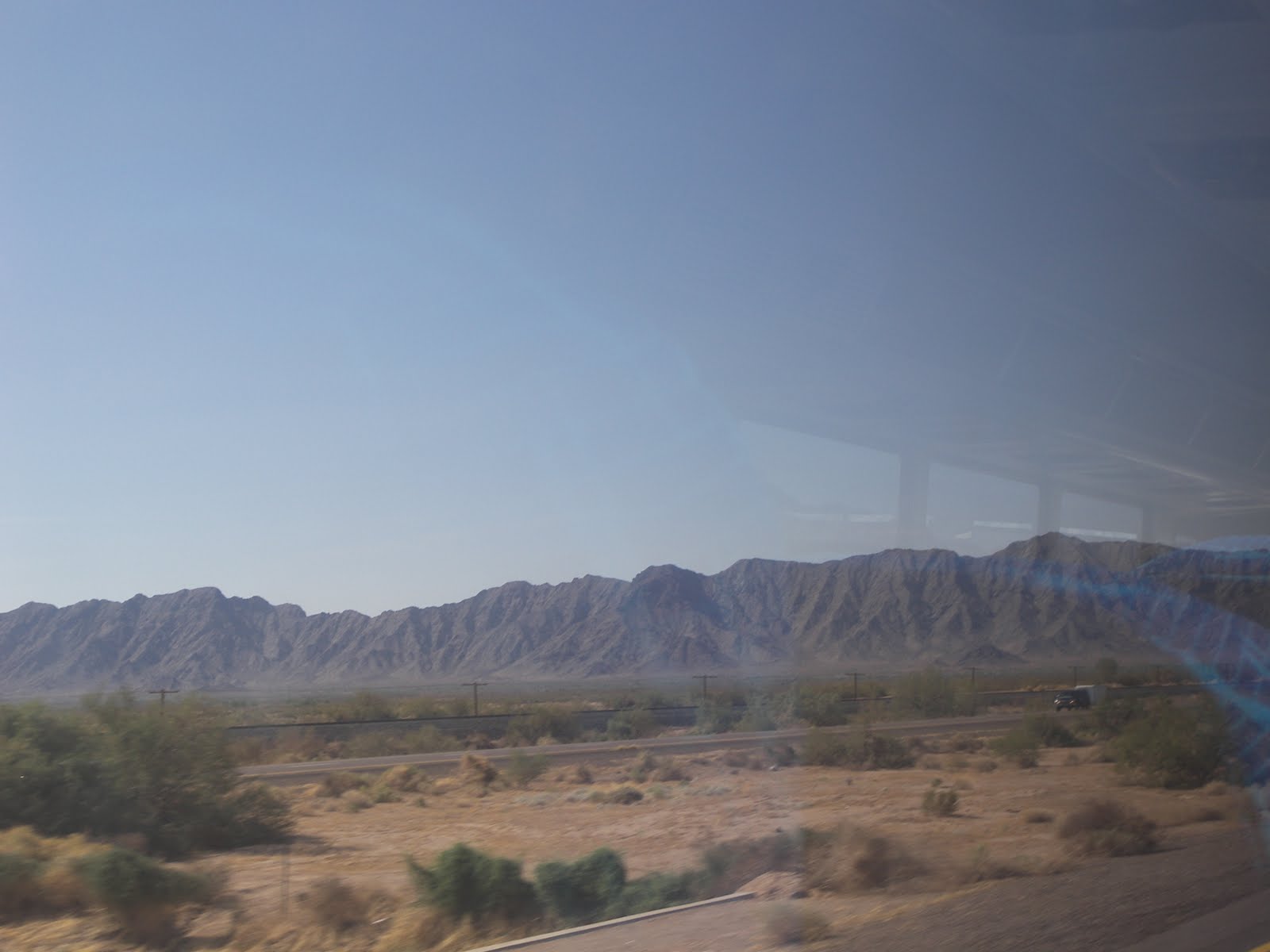
 - The Colorado River is dry at the border of Arizona and California. I believe I read about this before. I don't know that it's a good thing.

- Also in Arizona-related observations: in that fine state there exists a town called Gila Bend.

- One way to stand out as a weirdo in New York, no small feat, is to walk around the city with your towel wrapped around the handle of your suitcase. Even if this is a perfectly reasonable way to air out and dry your towel before putting it in your suitcase without it stinking up your suitcase, people will look at you strangely. Or at least, your NYC implanted cousin will.


- The bus system in Winston-Salem, NC carries ads for Rush Radio 94.5, featuring Rush Limbaugh, Glenn Beck, and Sean Hannity.

- The Museum of Modern Art in New York City has free entrance on Fridays, sponsored by Target. The line stretched down 53rd, up 6th, and back up 54th. A bakery gave out free food, their girls dressed in a zebra-striped outfit with orphan Annie red hair. Also, Max Beckmann's Family Picture was the only painting name I wrote down in my notebook besides the classic, hallmark works (Picasso's Les Mademoiselles D'Avignon, Chagall's I and the Village, Van Gogh's Starry Night).

Here's a set of observations specifically tied to riding the bus. For those interested, I rode Fung Wah to NYC, Megabus to DC, then Greyhound the rest of the way (except, as mentioned above, the Amtrak train from SD to LA):

- The Fung Wah stopped after the exit leaving the Mass Pike. The driver pulled us over to the right side of the road. I read my book. He pulled us over to median. I continued reading my book. A din of confused voices rose around me as we sat on the median for two, three, four minutes. I looked up and noticed our driver running back to our bus from the other side of the highway, where there was another Fung Wah bus. He entered our bus, shook himself off and took off his jacket, and returned the bus to the road. The Fung Wah.

- I rode with this guy from Durham to Nashville. He was probably about 5'10'', and had a pretty solid frame with a little extra layering. He was probably about my age, wore his brown hair in a pony tail, and wore a wispy goatee to go with it. He wore just a wife beater most of the time, unless he went outside and it was on the colder side, in which case he added a sweatshirt. He offered me fish which he had brought for his three day journey from coast to coast. Boasted of the healthy nature of his fish, too, and how he used to bodybuild, but that these days he just lifted a few weights that were in his yard every day.

  This is not the guy I'm talking about. Just a funny sign in Waynesville.    

This guy was an interesting one, and very much displayed some of the common behaviors and attitudes of Greyhound customers. He kept his bag splayed out on the seat next to him in hopes of dissuading anybody from sitting next to him: they would have to ask him for the seat, and his imposing stature and affected scowl would prevent that. Except that somewhere between Asheville and Knoxville, the bus filled up, making it impossible for him to achieve his objective of no neighbor. When somebody did sit down with him at last, a young man, he was nothing less than courteous in conversation and in offering his treats to his new neighbor. In fact, for all his stature and intimidating looks, he was bursting to talk, looking around with his big brown eyes to find anybody he could open up to about his trip to Phoenix, or the fact that his half-brother died somewhere in the Appalachian Mountains, or about what he thought about things. To wit: "TV brainwashes people, it brainwashes you, I don't watch any of it."

He also told me, upon seeing me reading, that, "I read books. I got a stack of 'em."

You don't get that on the plane, I tell you what.

- You also don't get cologne on sale in the men's bathroom on the plane. You do get this in the men's bathroom of a rest stop gas station somewhere in eastern Oklahoma.

- On my first Greyhound leg, from D.C. to Durham, I paid $3 to a vending machine to get a Nestle Crunch bar. That is, I paid $1.50 for a bar, received no bar as the ring in front of the selection was empty, which I did not recognize beforehand, and so I paid another $1.50. Needless to say, the candy bar was worth it.

- On that same trip, we had a last stop before Durham in Raleigh. I needed to use a phone, so I got off the bus. My ticket suggested we might change buses, so I went to the driver to make sure that I didn't have to get my suitcase or anything, leading to this beatific statement: "It's going to Durham." He said it with a laugh, with an incredulous smile, as if he told me that I would be getting a Christmas turkey after all. "You don't have to change buses, it's going to Dur-ham." I thought I saw his wizened head bathed in light.

- On the leg from Oklahoma City to Albuquerque, there at some point coalesced an earnest group of young men who had a serious discussion about just what the pot laws were in different states, and what implications those laws had for their lives.


- I also sat next to a guy from Flagstaff to Phoenix who told me quite a bit about his life as a pot farmer. He reported that, living in California and growing weed on six prescriptions, his life would not change either way with the coming referendum on marijuana laws in CA. He said that he had been a bricklayer in Arizona ("That place has ridiculous laws,") but that he lost his job after 7 years to illegal immigrants, and this was the best option left to him. "I don't like society too much," he said, "I try to keep to myself as much as I can." He was thoughtful and well-spoken.

- For one short stretch, I think from Knoxville to Nashville but I could be remembering wrong, I found myself without a seat and had to ask a guy if I could sit next to him.

"Shit, I was waiting for a pretty woman,"

Seeing as there were not really any other seats available, all I could think to say was, "Well, I can smile nice, if that helps." He ended up being nice enough to me, anyway.

- There was another afternoon stretch where I was sitting alone when a young mother joined me. Here four year old or so boy sat across the aisle from her. They were clearly a Hispanic family, so I stewed in my seat, thinking of how to ask her in Spanish whether or not she'd like to sit with her child. I finally stammer, "Quiere sedir...do you want to sit with your child?" She said yes, gladly.

Somehow, the burn I felt for my cultural patronization equaled out whatever good feelings I had for my deed for a while. It's strange to be back in a land where English is the language, I guess.

- One has to get used to waves of smells passing over one's breathing space. Most of these smells are unpleasant. Such is life in the bus.


- The Ft. Smith, Arkansas Greyhound station was probably the cutest I saw on the trip, adorned with paintings depicting the consequences of and reasons against drinking and driving.

- In the southwest (Texas and beyond), each state has a border office. It feels like you're entering a new country, to a degree. In response, I presume, to frequent drug trafficking and illegal immigration, these states set up inspection booths and have border guards on patrol. In California, two border guards actually got on our bus and checked passports; I said I was from the U.S. and they trusted me, meaning I didn't need to flash my passport. Little did they know...


                                                                An illegal immigrant in Calexico.

- The one incident that led to trouble on my long trip happened on the first day, before we entered Tennessee. One man of pickled complexion and wearing bad cowboy-style attire (a yellow button-down shirt with red lines and cactus tree designs that screamed the southwest, and big ol' boots) had a bottle of wine and a little stereo. He allegedly improperly touched the teenage girl he sat next to. A few other, bigger passengers stepped in to encourage him to sit at the front of the bus, alone. We stayed a little bit longer than planned at our next stop in Waynesville, and he found himself confronted by a police officer at the front of the bus.

He stayed in Waynesville.

Some 30 hours later, I saw the same man in the bus station in Memphis, holding the same stereo, dressed in the same clothes. He had caught the same bus schedule a day later. While he didn't necessarily look any more sober, he looked glummer, in the least.

- Speaking of the Southwest, apparently Albuquerque is a major depot for drug trafficking. Our merry bus driver warned everybody that the bus would be searched during our layover there. "If anybody has anything they don't want found, better give 'em to me!" he said. All joking aside, several of my companions on the bus were quite unnerved. We passed through Albuquerque without incident, however.


- The scariest thing I heard came right before Nashville. Sitting behind me were two kids who were in either high school or college and appeared reasonably intelligent.

They were discussing Microsoft Office 2010, and specifically some of the new features on Word.

"Yeah, when I write my papers on Word, now," one said, "I can just copy-paste into the document, and then you go and you right-click on it, and you can paraphrase!"

"Oh, dude, that's sweet!" the other replied.

I shed a couple tears in my seat for my educator friends and my student days.

- In my whole time on the bus, logging something like 80 hours total including the final leg to San Francisco, I only peed on a moving bus twice. The first time was in New York, where my cousin rushed me to the bus after deciding that we didn't have time to stop somewhere. The other time was a cheapie in Gallup, New Mexico; the bus driver had earlier announced a stop, scheduled for about 2:20 am, but at the station itself we made an in and out two-minute quickie stop, hardly enough time to pee legally.

I figured we weren't going to get a chance, so I lodged myself in the bathroom, did what I had to do, and ambled back out to my seat...just in time to get up as we stopped at a KFC/McDonalds gas station site. Ahh, sigh.

- Between Memphis and Little Rock overnight, one woman in her 30s or 40s, black, full-bodied, and pretty, spoke to a younger girl straddling the ages of 18 and 22, skinny, less pretty, also black, about finding God and getting out of her troubles. There was something in her speech about the various plagues of lesbians and homeless youth. Eventually, when either one got off the bus or when one of them decided to go to sleep, the older woman pledged to continue the conversation on Facebook.

- The one bit of funny business I had to pull was getting on the bus in Nashville. I arrived just 15 minutes before the scheduled departure, and waited in line behind a minor who needed permission to buy a ticket, its own mess, pushing me dangerously close to being late for my bus.

At last, he finished his business and the attendant at the counter was ready for me. After printing my boarding ticket, she insisted I weigh my bag to make sure it met the 50 lb. limit. Despite my efforts to play with the weight, ultimately it was 6 pounds over. With no time to make it go run laps, I took out a few books and put them in my backpack until I made the weight. She printed my info and I was on my way to San Diego.

Except that I had enough time to go to the bathroom, brush my teeth, and conveniently switch back all the books I had just added to my backpack. No problems for the rest of the trip.

- I was late for one bus all trip: the last one, from LA to San Francisco. No one's perfect.

- I should mention that Megabus has wi-fi on their buses. This felt like a big deal at the time.


View Directions to 797 Cole Street, San Francisco, CA in a larger map

- On that Megabus from NYC to DC, I was lucky enough to sit next to a one Miss Shania. Shania was probably about 4 years old, a cheery little girl who taught me how to draw. Specifically, she shared with me her technique for the Pollock-esque masterpieces she churned out page after page: grab the pen (in light blue, pink, or green for boys), and go like this (bring the pen up and down the page in varying thicknesses and no discernible pattern, just an endless sprawl of lines) and you can do it. She was considerably prouder of having taught me to draw that than she was to have learned to draw a heart from me.

- And as a subset of interesting bus events, here are all the things I had to do to make phone calls without a cell phone:

1. Buy a pretzel from a street vendor across the street from the New York Public Library to get the change needed to call my cousin from a pay phone.

2. Call from Skype numerous times, most memorably using the wi-fi of the Megabus.

3. As DC's streets were void of pay phones as well as people, I ended up having to ask my cab driver for a phone to call my friend. This turned out well, as my cab driver wasn't sure how to get to my friend's house.

4. Using pay phones along the road at various times, with mixed success. Many of the pay phones in Greyhound stations are a little bit more expensive. Many more do not offer a long-distance coin option; you can only call locally or collect. You cannot call cell phones collect. I was mostly calling cell phones. This caused problems.

5. In one of those tricky situations, I ended up borrowing a fellow traveler's phone, after asking a few other fellow travelers for phones who didn't happen to have one.

6. It goes without saying that I borrowed my friends' phones very frequently on the trip.

7. In LA's Union Station, I had the microcosmic phone experience that summed up my macrocosmic trip. I needed change, so instead of asking someone for change, I bought something. Since I needed at least 40 cents to make it to a dollar, I bought gum, even though I don't chew gum. I thought it would be an ok sacrifice. I went to the pay phone, now with about $1.10 of change.

The pay phone required $2.00. I only found this out after I tried the first two of four payphones, which did not have a dialtone, and the third payphone, which did not accept coins, and then at last put my dollar in the fourth payphone. The return didn't work.

I went to a ticket counter, where I received a polite $2.00 in change. Change I could have received at step 1. Not my best traveling moment.


- But despite the bumps, and despite the moments where I spent more than I might have - a flight purchased in advance between almost any of my destinations, and certainly for the long distance ones would have been cheaper than the bus fare - the trip had a sense to it, and a reason. Beyond seeing the soft dew hovering above the grass on the side of the road in the Arkansas morning, and beyond realizing that Texas's skinniest part is 170 miles across, and beyond having the time to read and write or not have to fly on a plane or have the freedom to eat just peanut butter sandwiches, bananas, and the occasional candy bar for two days on a bus.

I can't imagine doing this same trip eastwards. It could be that I am an easterner, and any journey that way would feel like going home, which one does not want to do on a bus. It could be that going west gave me a chance to open a new world, to experience new places in a way that going east would not have.

The trip, the bus trip, hit its logic after Texas. There was our descent into the sunset, a sense of oneness descending back onto me. After Phoenix, crossing through the desert in the morning, ripping through a new barren scenery that was not so distant from Jordan or Israel, for example, but still new; and then entering California and seeing how the landscape slowly grew gray and then green as the road emptied out to the valley before San Diego and the sun falling in front of us; there made itself felt every justification for taking the long way, the hard way, the stupid way.


Here's to the Long Way.

Here's to the Hard Way.

Here's to the Stupid Way.

2.11.10

Three Last Thoughts on Rwanda

I don't pretend to be able to summarize in a few pithy words what my/our trip to Rwanda was like. Actually, I can easily pretend to be able to do it, I just don't feel like it. Enough internet ink has been spilled on this site about the trip to Rwanda, I think: this post will bring me over 14,000 words. So anybody who is reading this and cares about what my overall impressions on the trip were should be able to pull something together based on the seven (including this one) posts and all that is contained therein.

At the same time, I want to write one more post about Rwanda. Not only because I promised it in the first post on Rwanda (more to myself than to anyone else), but because there is more I can say. And more I want to tell. So in lieu of any grand conclusions about the trip or huge statements, I give to you three little snapshots, events from the trip that encapsulated much of what happened as a whole, while also providing some entertainment. These events are not in chronological order.

Live at Gisenyi

Lake Kivu the morning after the storm.

The trip was harrowing; twice I have mentioned the thundering rains that could have ended our trip prematurely. We rode 10 passengers in a van designed to carry 14 passengers max in theory, but a van with bulky but thin cushions that did little to hide the feel of the steel bars beneath, a van with seats too close together so that there was no leg room even for the midgets like me, a van that had a multi-colored lamp inside that could do the disco rotation as needed, and a van that came from Dubai, where it was apparently the van for a hair salon. Riding in the van for four hours already that day (with stops), we were worn out as it was, and in no condition to weather the storm peacefully. We were saved by the steady driving of our main man Pascal, a driver who switched on to our group with the new van and who, on his first day, wore a bowling shirt with the name "Baker Hughes" stitched on the back. Maybe a code name? Or his bowling nickname, ala The Jesus?

In any case, the trip was harrowing. It led to our only night out of Kigali, a small hotel on a hill overlooking Lake Kivu, a Great Lake (Africa style, obviously) on the border with the Democratic Republic of Congo. We arrived shortly after dusk and, after divvying up rooms and unpacking, a few of us went out on the porch and talked and watched the lightning storm. I brought my guitar out and provided quiet and (I hoped) non-intrusive background music to the more serious conversations around me.There was an uneasy beauty of the moment.

We went to a relatively lame hotel restaurant by the water, mosquitoes infiltrating the overpriced dining hall, but our bonds were tight and the chocolate mousse cake I ordered (for dinner) good. Indeed, though I was weary from the car ride and the trip in general, hitting its 11th and 12th days, and though this trip marked the final high water mark before travel and group fatigue wore on my experience, we were at a high water mark at that restaurant, and the glow of our mzingu bubble on Kivu preserved that positive feeling.

We returned to the hotel just shy of midnight. I was most interested in going to sleep, but there was a general clamor for some music. And so I pulled out my guitar and played some tunes, pulling from the back catalog of hits ("Barcelona," "Ain't No Minivan Mama"), the fruitful summer of 2010 writing I had done ("Cellulite", "Stuck at the Start"), and the two Rwandan-inspired tunes I had written ("Any Given Day," "Hey, Mzingu", and yes, I did just cite a bunch of my own songs that most people have never heard. It's my blog, roll with it). My lovely audience that I would have liked to take home supported and enjoyed cigars, waragi, tequila, and the company, as well as the scenic backdrop, one of the nicest I will ever play in front of in my amateur musician career. The beauty here was easier, more exhausted, but joyous, a true cap on the high water experience.

An hour and a half later, I woke up in my bed in the hotel room to the evil sound of a nearby buzzing mosquito. My roommate was not on anti-malaria pills and had avoided vaccinations and in general was doing things all naturally to protect his body (we enjoyed watching him put together his herbal cocktail each morning at breakfast). No problem; I had all the respect in the world. And when we roomed together in Gisenyi, with two beds but only one mosquito net, I said, "No problem, you take it. Mosquitoes don't like me much anyway." My macho stubbornness striking again, as you see.

So when the mosquito woke me, I lay still for a few minutes, thinking I could wait it out. I slapped at the air aimlessly as well, or not aimlessly since I could hear him, but with very poor accuracy. The quiet desperation of hearing a mosquito buzzing around you and knowing there is nothing you can do to stop her, and knowing that the noise (definitely the noise and not so much the fact that she will bite you) would not let you sleep, and that sleep is the thing you most need to preserve your calm, your patience, and your sanity, this quiet desperation set in for me.

My roommate, fortunately, is a good sleeper. Fortunate, because my solution was to turn on the lights, sit as still as possible in a poor lotus position, and kill as many mosquitoes as necessary to allow me to sleep. There is always the illusion, after all, that it's only one mosquito that is buzzing around your head; their buzzes sound the same. I killed one mosquito. A buzz returned. I was not fooled. I killed another mosquito. I swung and missed at a few more. Somehow, my roommate stirred but did not wake. I imagined myself to be a modern day Mr. Miyagi with a lower hit-rate. Much lower.

In the end, I killed about 10 mosquitoes over 20-30 minutes, turned out the lights, and pulled the sheet over my head. I slept soundly if incompletely until the morning.

The World's (or at least Rwanda's) finest football pitch (Or backdrop)

A group photo of the memorable pitch.

East Rwanda, on one of the rare spaces in the country flat enough and big enough for a football (i.e. soccer) pitch, with 25 some-odd (we played about 13 v 13) boys aged from 16-24 or so who were ostensibly sophomores in high school, all orphaned or made vulnerable by the genocide, in the sunny but fading late afternoon light, with a beautiful vista to the east that suffered not at all for the fact that we wouldn't be able to see the sunset over it.

That was the scene. We were visiting the Agahozo Shalom Youth Village, and as part of our visit, we got to play football with the kids (or basketball, or volleyball, but I chose the footie). The village is an oasis, of sorts, for the aforementioned vulnerable and/or orphaned population of Rwanda, operating as a high school for these kids. So far they have 250 students, admitting a new freshman class of 125 students each year to hit a maximum of 500 students in two more years.

But enough about the technicalities. On the pitch, the kids are about what you would expect them to be: talented, able, but lacking savvy, teamwork, or foresight that comes with coaching and paying attention to sports. Understandable, of course, considering they have a lot more important things to deal with than being good at football; this isn't a factory or even a competitive high school. It's just a place for kids to play the game.

So a couple of us joined in the game, running up and down, making a couple plays here and there and getting frustrated from time to time. I learned the appropriate words to call for the ball, "Karibu" (meaning "welcome") and "he-he" (short e's; the word means "here"), and called for the ball plenty, but didn't really get many touches - there were a couple sweet crosses I made that didn't lead to goals, but ah well, I screwed up plenty times too. Meanwhile, the light grew hazier and the beauty rose to match it.

And then we had to leave. The game was still going, and we had to leave. My unfortunate response was to fall into "Cheese Fries or nothing" mode*. I ignored the first several calls. Then I turned in and gave up, gathering my t-shirt, walking sulkily off the field and probably spitting to the side a few times more than necessary. I entered the car and, making sure to voice my frustration, said, "Tha's some bullshit."

After a pause, somebody asked what this so-called "bullshit" was.

I hemmed and hawed as I got the words out, then said, "When will we ever get a chance to play on a field like that in a setting like that? We can eat in Mzingu restaurants for the rest of our life," in reference to our rush back to Kigali.

Well then.

Another lost temper. Another blown fuse. And though I won the battle this time - I got the cheese fries, so to speak - I lost the war, failing to make it two weeks without losing my cool. Haval, as we would say. Haval.

But it was a good line. And a pretty place.

Our Redemption From the Children


The scene as I first saw it.

I sat in Nyamata church, the second of two churches on the day. We had been to the Nyabarongo River earlier, where genocidal killers dumped their victims' bodies to "send them back to Ethiopia", via Lake Victoria. We had been to Ntarama church, of the bloodied Sunday school wall of the previous post. Whatever one might say about the reasons for our trip, the futile nature of it, the inability we faced in plumbing the depths of our or others' trauma, it can at least be conceded that we had not had the most pleasant day.

After writing a poem in my journal and sitting inside the church on my own for a few minutes, I heard a harmonica play. Evan was blowing out a tune; "Love Me Do" it sounded like. In an otherwise solitary and silent moment, it made for a pleasant break. I went outside to see where he was.

When I got outside, I found that Evan was not just playing on his harmonica, but playing on his harmonica for twenty or more schoolchildren. Others from our group were out there dancing and smiling and talking to the kids, taking pictures and then showing the kids their image on the camera. No better balm in this world did God invent than the smile and laughter of a curious child.

We spent the next hour walking around the village, chasing after different groups of schoolchildren and picking them out, spinning them around, hugging them, and laughing with them. We drank over-sugared Coke and broke into sprints after the over-cute kids. We alternately terrorized and brightened everyone's day. On my trip in Europe,

Ben made the point, in Hamburg, that no matter how unsuccessful we were in achieving our objectives, or how annoying our requests might have been, we certainly made everyone's day a little bit more unusual and, dare I say it while trying to avoid sounding arrogant, more special. Well, that was at least ten times as true in Rwanda, and even more true in Nyamata village.

But we, of course, were the bigger beneficiaries. I talked about the dissonance between visiting terrible sites and experiencing beautiful people and scenery: this was the greatest dissonance we felt, and the loveliest. It was the most special moment we had on the trip, I feel, and I doubt my companions would protest too much.


Ah hell, one more bonus note from Rwanda - the last night


Our going away party featured a long round of speeches from everybody we managed to rope into our goodbye circle from our friends in Rwanda - potential sugar daddies, sons of reggae stars, good friends we had met in Israel, our friendly hostel security guard, our guides, friends from our blog we weren't as close to - and from us. Then I played on my creaky guitar, loud enough over the roar of the fire to bother the other guests in the hostel and lead us to leave the hostel and go to a nearby traffic circle. Where, after waking up the guard on duty sleeping in the fountain itself (no running water), we proceeded to run through a few more songs. Then a few more goodbyes. Then a giddy, solemn march back to the hostel, I on an improvise-ready little riff with Evan accompanying on his harmonica to a little ditty while the others reveled in the beautiful possibility and sadness of Kigali's night sky, together for the last time. The trip was everything it was supposed to be, even when it wasn't. It was every happiness we could hope for even when we were sad, every calm realization we sought even when we (I) lost our cool. It was certainly a success, a victory, an experience, and something to remember. And, almost a month later, I can still say with certainty that I don't think it'll be a last time, either in Africa or Rwanda. No, one way or another, this was just a beginning.


The Chorus of the other Rwanda related song I wrote, by the bonfire.