Showing posts with label Islands. Show all posts

16.8.12

On an Island - The Ride Bike Rides in Bretagne, Pt. 6


06/08                                     19:33                     In front of Lampaul’s Chapel

This piece centers on two main questions. The larger: why does one go to an island? The more specific: What would one find on l’île d’Ouessant, or what happens if one goes there?

One goes to an island to escape. To vacate, hence an island vacation. The visitor seeks to escape the daily rigors and horrors of mainland life, and to step off of those well-worn ruts that continentals dig for ourselves. As if by leaving the actual ground where one has dug those rooted ruts in a physical sense, one can find a way to escape. And so it is.

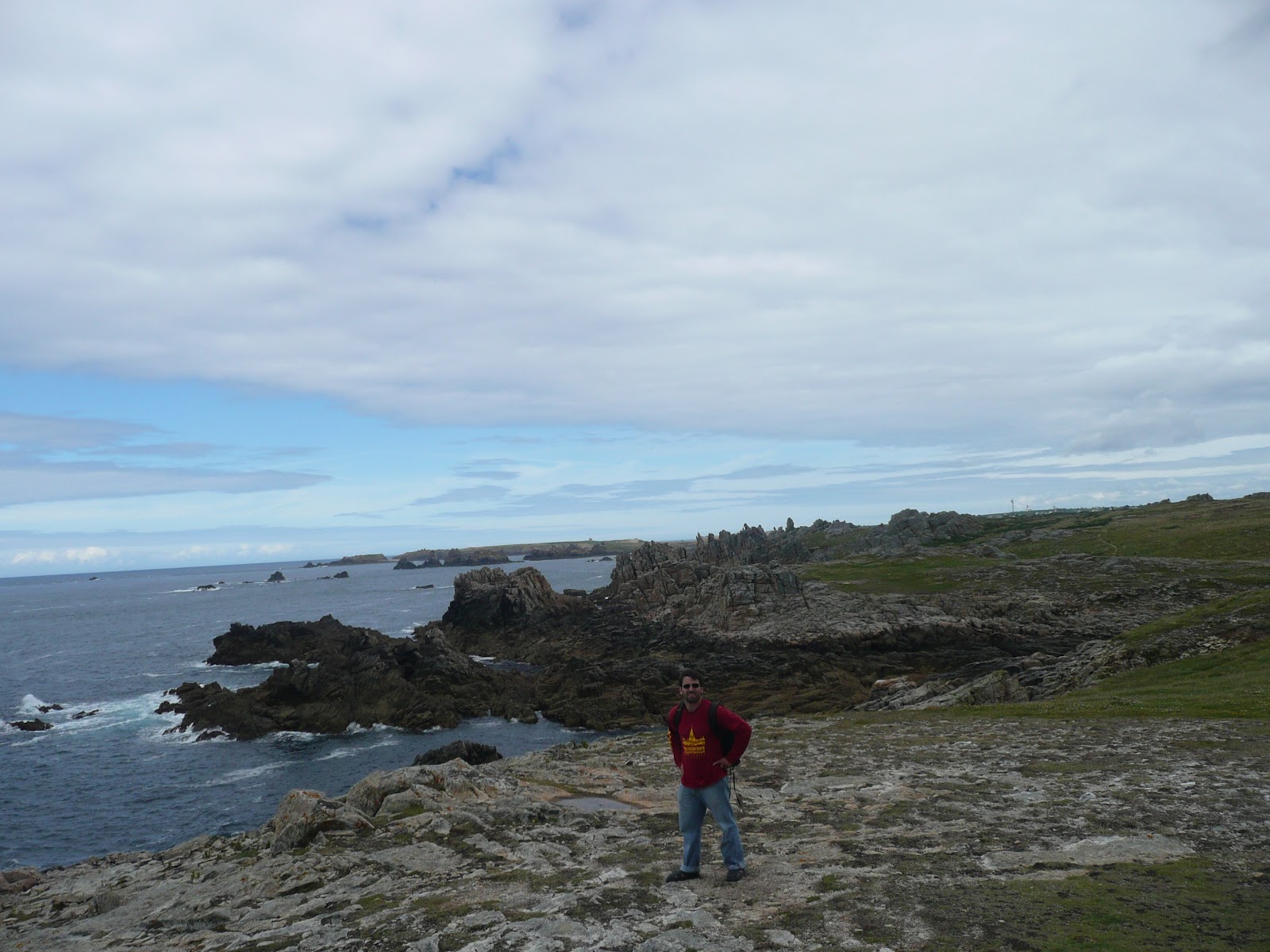
The Île d’Ouessant, “Isle of terror” in Breizh, sort of the word for “Western Isle” in French, and Ushant in English, sits just off continental France’s westernmost tip. Two hours by ferry from maritime capital Brest (home to France’s nuclear submarine arsenal) and one hour from Le Conquet, the town on that westernmost tip, l’île is an attractive, quiet, and impressive destination. The island offers everything one can ask for on an island.

As mentioned, one takes the ferry to arrive (or a 15-minute plane ride if one is a philistine, or one’s own boat if extravagant). Imagine leaving from Le Conquet, the westernmost tip of France and of the Finisterre department. Finisterre means end of the world, though the region’s propaganda reminds that in Breizh, “Penn Ar Bed” also means beginning of the world, one sign so bold as to make the Promethean claim that man first had fire in his hands here. One wonders what the Breizh words for “3rd degree burns” are.

From this far-flung jumping point, the ferry ride is rather calm. A half hour to a smaller island of Molene, another half hour to Ouessant. If one is worried that French children are much better behaved than American children or any other brand of children, this ride furnishes much evidence to disprove that notion, but the ride is calm and easy all the same.

The ferry arrives in Port du Stiff, on the eastern side of the island. Most visitors stay in or near Lampaul, the one “bourg” on the island, a little past the center, three or so kilometers away from Stiff. Several bike rental options crowd the road leading from the port, as well as a crêperie “d’arrivée”. Minibuses also run passengers to the city. The D81 road that traverses the island starts off uphill before peaking halfway, making for an agreeable coast into Lampaul. Gîtes and chambres d’Hôtes – Bed and Breakfasts – idle on the roadside, as well as a large campground and many sheep.

On arrival in the town, the visitor may well be hungry. If it is the first Sunday night in August, the choices may be limited to two crêperies. Crêperie du Stang is well and good and serves Breizh cola, but the open setting allows one to gather further evidence that French children are just as big a set of misbehaving bastards as the rest of ‘em and that French parents are no less indulgent than American ones. Crêperie Ti a Dreuz,  “the slanting house” offers a cozier, friendlier ambience, better crepes with a top-notch soubise (creamy onions) topping, and a great glass of lemonade.

On any given summer night, one can wander along the nearby beaches and coasts, seeking sunset and cool breezes: the island is unsurprisingly full of sunset and cool breezes. If it is the first Sunday night in August 2012 and one wants to watch Usain Bolt run 100 meters, the only recourse is the Fromveur, a bar that serves Belgian beers and Kinder Bueno chocolate bars. The local tippler may, when not spitting vomit over his shoes, getting kicked out of the bar, or causing a ruckus outside worthy of police attention after getting kicked out of the bar, obsess over buying and giving away these chocolate bars to anyone within arm’s reach. The bar rejoices over Bolt’s win, and also the Frenchman taking second in the 3000 meter steeplechase.

In the daytime, one finds the solitude needed from an island. The thing to do on l’île d’Ouessant is to hike the coast. 45 kilometers of rocky shore, spongy short grass paths, decaying lighthouses, and goats. Bikers too, but the population of the island is listed as 878 habitants, and if that many people come and go each day in the summer, at most, there is still plenty of open space to hide in. For example, while hiking, the cautious and watchful visitor (at least the male ones) can pee up to three times in a five-hour period without causing a stir or looking out of place, by feigning a dignified attention to certain more sheltered rock formations or port landings.

The lighthouses are something to see, if perhaps not the museum dedicated to them. Many a ship have wrecked of Ouessant’s shores on their way to the English Channel or elsewhere. So the French built the Phare du Creach, the world’s most powerful lighthouse. Actually quite ordinary in the day, at night it sends two rotating beams every ten seconds with a power to haunt one’s sleep, should one fear light. Other, older lighthouses loiter off shore and offer better daytime visuals.

Bikers circle the island, and one hears Italian, a little Spanish, but mostly French. And why not? l’île d’Ouessant is quite far away from most of France – six hours away from Paris, another two to three hours at least from the south and east of the country by fast train. Ouessant’s town twin is not from another country but merely the other side of France – Obenheim, next to the German border in the Alsace.

To avoid the bikers, one heads for the grassier coastal paths. Bikes are not allowed on these paths, though some still find their way there. On these paths, solitude and stone surround the visitor. If one is inclined to walk barefoot, theses paths offer a perfect bed for the soles, soft and giving. Beware of muddy areas and little purple and lavender flowers whose beauty is protected by fierce thorns.

Animals dot the island. Ouessant is known for its black sheep and wool. Goats lurk in shrubby fields, barely seen but for their horns and ear tags. Sea gulls of course gull out their lungs going to and from the island. Horses can be found – according to a placard for one abandoned fog siren, horses bred on the island in the 19th century tended to be small, and few people had more than one of them. If one is staying at the friendly Auberge de Jeunesse, there is the chance on the short walk into town to peer into a yard were a coterie of cats hang out, six or seven, fully grown and of several colors – white, black, gray, and mixed.

Weather on the island is predictably unpredictable. The first Monday in August may feel like an October day, though the air is lighter. Out on the path, one can get sun burnt and rained on in two, three, four successive cycles. The sky changes quickly, and one can see the gulf stream make its final push towards Europe, washing over the island inattentively.

At night on the first Monday in August, after eating again crepes, one can attend a concert at the local church, a string and piano quartet playing two pieces as part of the “les musiciennes d’Ouessant” festival. The ladies play well and the well-trained crowd only claps after the 3rd and 4th movements of each piece. The stained glass windows are adorned with French captions that may simplify Biblical language a touch: “Jesus threatens the winds and tells the sea, “shut up!” The end of the concert proves insufferable – the crowd of nearly 100 cheers and cheers, demanding an encore, hoping to prove how sophisticated they are and how non-rural, non-isolated the island can be. The quartet, an ad hoc group no doubt, cannot do but to repeat a few choice parts of the second piece. The crowd howls for more, clearly not having paid enough attention the first time (or so starved for culture they cannot let go? Or just wanting full money’s value for their 18 euro ticket?). One is advised to sneak out before a third encore is possible.

If the truest adventure of our times is away from technology, from phones, computers, the internet, connection, Ouessant provides for this adventure as well. Not that those monsters do not reach the island; one can be connected here. But with the small size of the island and its limited population, there is no need for connecting. Everything one needs to know about the island can be found out through the ancient search engine of asking a local. And if one’s phone battery dies, depriving one of all time-telling devices, the church offers a large clock face and an hourly bell to keep one from becoming completely unstuck in time.

Yes, such is l’île d’Ouessant. All one needs to escape the mainland, to extricate oneself from normalcy, all that can be found on the island. On the ferry to and from the island, one is as if entering a chamber of isolation, preparing for the island and then again for the return. An hour to unshackle the mind and another to reshackle it.


Ahh, but the one thing one cannot escape on an island ? Oneself. All that solitude, space, and isolation forces one in on oneself. One must dig through consciousness, through thought, to deal with the fact that in solitude, one is with oneself. The freedom from other concerns becomes a sentence to explore the base of one’s inner space. The island’s shores limit physical movement but erase mental boundaries.

One can hide in daily life’s distractions. When going to an island, one seeks to escape distractions and relocate oneself. True of all travel, this tendency sharpens on an island. One goes to lose one’s quotidian life and to find oneself.


1.3.12

A Return to Spanish Time: Canary Islands Tour Diary

A Return to Spanish Time


Though we sit just north in the tropics, it is not a very warm evening. Much warmer than where we came from, but brisk nevertheless. I tug my blazer tighter over my shoulders and bring my tea cup to my lips. Amy bears up under the cold relatively well, however. She hates cold, which is why we’re here. We flew to Gran Canaria to escape February’s dregs. An upgrade from daytime freezing to evening briskness makes the briskness that much more bearable.

In the air another attraction floats upon the breeze. The vacation we’re taking commemorates Carnival. Carnival marks, hypothetically, the last gasp of hedonism before Lent and the aesthetic run-up to the Catholic Easter. The U.S.A. only finds Carnival in full form in New Orleans for Mardi Gras, but across the Caribbean, South America, Europe, and scads of other places, it offers parades, street parties, dancing, booze, and purported joy. I have never been through a Carnival (skipping out on New Orleans a couple weeks before Mardi Gras hit last year), but Amy has years of experience from her time in South America. I feel like I’ve been through several of them myself, having heard Amy’s stories and (sometimes fuzzy) recollections many times over. 

We sit at a café in Parque San Telmo in Las Palmas, Gran Canaria, and wait for the Carnival to roll in. My cell phone reads 8:30. The Parade is due to make its final turn at our corner at 8:30, finishing just below the second-floor balcony of our hotel room. When we checked in earlier that day, our initially taciturn receptionist could hardly contain his excitement over how perfect our spot was, looking over the park and the grand finale. We feel contained excitement as we sit and wait for our waiter to bring us the bill; I am the retiring, boring type and so don’t imagine I’ll make it through much of a Carnival if it goes late, and Amy is conditioned to believe that Brazil > everywhere else, especially regarding Carnival, the country’s finest annual celebration. The parade is tardy; Spanish time is usually an approximate thing, biased towards the later side of any announced time. The parade’s tardiness doesn’t surprise us so much as reassure us, the warm embrace of an old friend.

We walk out to the corner. The sound of synchronized drums draws us closer. The crowd at the corner is relatively insignificant, no more than one or two deep at any given point on the road. The first group marches through, a group of drummers and instrumentalists, almost like a group from your small-town Memorial Day Parade, except all dressed in green. After them came a few more dancing Krewes (the New Orleans term, meaning the dancing group that marches in the parade), a few tawdry floats carrying the Queen, 1st through 4th Ladies, Grand Dame, and Drag Queen of the Carnival, respectively, and then a couple semi-trucks.


At last Amy feels excitement, as the trucks recall Brazil’s Carnival. The trucks are probably an evolution from the floats and walking krewes of yesteryear Carnivals. They operate like themed-party buses, everybody on board dressed in a matching costume – Flintstones, Superheroes, Cats – while a DJ bumps the tunes to a thundering level. Everybody on the truck is meant to be dancing and merrymaking, though most of the truck people are drinking and yelling instead. 

A few trucks pass and at 9:15 a lull sets in. We decide we’ve seen enough.  We return to our room, still dressed but at least freed of the burden of other people. I stand out on the balcony and watch the crowd of people below. Earlier, there was a preponderance of Superman and Wonderwoman outfits, mostly of skimpy nature, as well as a lot of men dolled up in women’s costumes, also of a skimpy nature. Now, I cannot pick out any specific dominant theme, mostly just stragglers from the krewes and trucks that have already passed.


As we stand out on our balcony, Spanish time reasserts itself with a vengeance. The parade hit a lull, a delay, but resumes beneath our eyes. The semis roll one or two down our street at a time. The truck turns the corner 200 meters away from us, its melody reaches our ears a truck length after that, and then the truck crawls past our balcony, stopping at the intersection 50 meters to our left. If lucky, the truck can soak in the spotlight and play its music for another 15-30 seconds, but as the night wears on, the cops instructing them to cut the sub-woofers and move it along get there quicker and quicker. Meanwhile, the next truck or two has already reached our point on the street, the sound systems overlapping, waves falling atop one another, us locked beneath those waves, struggling for air.

Or dancing. Mostly dancing. So we dance. We dance along together, the most we’ve ever danced together, the most Amy has ever allowed me to dance in her presence. That’s because my dancing is rhythmic but uncoordinated, unreasonable and uncontrolled, imagined fluidity replaced by spastic movements and rigid meandering over the 4/4 time signatures. The sort of thing I’m not to do in public in her presence. But here, it’s Spanish Time, it’s Carnival, we’re up on a balcony, and all we can do is take pictures and laugh about it. No one can see us anyway.


Except that some of the people on the trucks are taking our photos. We’re creating quite the little scene, it seems. Some of those drunks down there are cheering, waving, snapping. We wave back. We dance. I add a bounce or two to my moves. We laugh. Carnival roars.

This goes for an hour, and then it things peter out again. No more semis. We stop dancing, stop sweating. The noise in the street and in the park below persists but on a lower level, without the foreground clamor of the music. We stay out on the balcony and watch and glow. 


On the edge of the street below us, a girl kicks a bottle. She is maybe 10 years old and dressed in what looks like a “traditional” costume; long purple skirt and white shirt, her black hair flows down her shoulders even as it is tied in a knot. She kicks the glass bottle along the street curb. The bottle rolls, banks off the curb once or twice, giving way to her soft power. She kicks it one time too many, and it shatters.

The girl retreats across the street. Her mother and other relatives are talking in a circle there. They don’t pay much attention to her, don’t notice her. She flits in and out of the group, walks behind a tree in the park, and then returns to our side of the street. She’s found another glass bottle. She’s kicking it again. Predictably, after a few paltry efforts, she breaks it again.

We are too far away and too foreign besides to say anything as the girl starts kicking her third bottle in the same area. People stand on the other side of the curb railing with the glass breaking just below them. At the 3rd, pattern-confirming bottle, they speak up, sharing our shock. They tell the girl to stop kicking the bottle. She stops. The bottle remains intact. The girl scurries back to her mother’s circle. The mother stomps over to the scene of the crime and yells at the people who spoke up to her daughter (the mother stands conspicuously closer to the middle of the street, away from the broken glass). The people, an older couple and another older man, yell back. The man peels off and finds a police officer. The mother gives not an inch. Her husband, dressed in a washer woman’s outfit with the top of a Christmas tree or a really funky hat on top of his head, acts as a moderating presence and also speaks to the daughter. No one takes him very seriously.

The police officer arrives. Some sort of resolution is reached – your daughter can’t kick any more glass bottles tonight, you need to leave this family alone, none of you can call one another a stupid puta, etc. No arrests are to be made in this situation, and there’s not much else to do. The plaintiffs, or else the street’s defenders, leave their post along the curb to try to revivify their Carnival joy. The cop and the girl’s parents continue to talk with much more laughter. The tumult dies down. The night and the Carnival continue to flow, softly.


And then, as we sleep, Spanish Time rears its head twice or thrice more; the semis circle back through the park once and again, just as loud as the first time. The noise threatens our sleep. I, exhausted from the flight, sleep through most of it, though I swear that at quarter to 4 I’m awakened by the thumping tunes one last time. Amy sleeps fitfully through the Carnival iterations, perhaps suffering for her Brazil-based hubris. She says that I’m wrong about the last cycle taking place that late. 

Spanish time, ladies and gentlemen.

Beeping into the Blind on the GC-200


The thing about it is, the more dangerous something is, the more thrilling. The more we have to risk to achieve something, the more it appears worth it. Life is founded on the principle of efficiency, arbitrage, and that idea; we will risk only as much as a reward merits. So, for a greater reward, we will risk more.

With risk come fear and a chance of failure. Amy – cowering and half-hyperventilating in the passenger seat, picturing us crashing through the fragile guard rail and plummeting over the cliff into more rocks and chasms and eventually the ocean, telling me to go slower, laughing at my beeping, and squeezing in dramatic scenery photos with her new camera all the while – decided the mountain drive only deserved to be risked once.

                “San Nicolas isn’t much to see in and of itself, but this trip is about the journey, not the destination. A 30km drive through the coastal mountains is one of the prettiest settings you will ever go through.”

So said our guide (I’m paraphrasing). The drive began at the foot of the hill where we were staying in Agaete, on the Western coast of Gran Canaria. We had been there for a day and already were succumbing to island fever. With nothing else to do, a beautiful drive down to the touristy but picturesque Puerto Mogan struck us as a winning proposition.  (San Nicolas is about the halfway point between Agaete and Puerto Mogan).

We left around noon. Google Maps told us it would be a 1h20m trip, which would have us in Puerto Mogan in time for a late lunch. Our car was a Toyota Auris, a small 4-door with an incongruous 6 gear manual transmission. On the highway driving to Agaete two days earlier, I hit 6th a couple of times, coasting at 100 Km/Hr, until the dashboard light quickly suggested I shift down to 5th as we hit a hill. There might be a use for the Toyota Auris’s 6th gear on flat highways and long stretches, but it would be completely unnecessary on this trip.


We entered GC-200, the road that would take us the 65 kilometers to Puerto Mogan, unsuspectingly. The road began with a slight incline and a few lazy bends. There was a white line dividing us from the other side of the road. All was calm. Amy began taking photos out the window of Agaete below, of the coastline coming into view, of the mountains in front of us. Gran Canaria is considered something of a “mini-continent”, with a varied landscape; the coastline features quaint towns and pebbly or coarsely sanded beaches, while the interior has more of the rugged look, with mountains stretching up to 5,000 feet and the reddish-brown visage of the barren hills that can be found in Spain, Morocco, or New Mexico.

Rugged mountains and narrow “highways”. After a few easy kilometers, we were climbing up and down the mountain, driving through blind curve after blind curve, and finding that there was no more dividing line painted on the road. The beauty out the window, plentiful, was now obscured. Blocking our beauty was not the scenery, not the mountains getting in the way of anything else, but the fact that I was driving and couldn’t look too much at the scenery, and Amy was panicking because I was driving.


The GC-200 offers an ideal setting for car commercials. There are car commercials that take place in green rolling hills on roads with hairpin turns and endless switchbacks; there are car commercials that emphasize the open road and the plains and the thrill of adventure – the GC-200 offers neither of these. It provides a third possible setting: rugged coastal mountains with frequent turns and undulations, with the promised land of water and sun and fun just around the next (blind) corner. It is really a beautiful drive.

The problem is that I am no car commercial driver, and no commercial for the Toyota Auris will feature such driving. I have never been confused for a good driver. Amy has never been confused for a person who relinquishes control in such crucial circumstances easily. The Toyota Auris does not handle uphills very well, and on this drive I rarely achieved even 4th gear, let alone 6th. We were also tourists, and obvious ones, not sure where we were going and ignorant of which way the road would curve when.

"At least if we crashed, the ocean would douse the flames..."
All of which led to the scene I began with: Amy panicking at my side while I tried to maintain a balance between cool consideration and competence. When going up, I would get the car up to about 40-50 km/h (roughly 25-30 mph) in 2nd or 3rd gear; when going down, I would let the car coast at about 50-60 km/h, riding heavy on the brakes. As we were tourists, and timid ones, we would often get passed. Passing on a narrow mountain road isn’t easy; there’s hardly space for two cars on the road as is, and then if a foolhardy driver tries to do it on a curve, they risk getting smashed by a car coming the other way. We found a way to be passed, though, because there are few trivial things worse than having someone riding on your ass on a narrow road where you can’t help but feel sorry for them since after all you’re the one going half as fast as everybody else: I would pull on to the rare shoulders or to the little bubbles on the road where a car might stop to get a picture of the view, or else edge towards the right on a stretch of road where we could see no one was coming the other way and wave my hand so that the car tailing me started heading me instead. We were passed by bolder tourists, by eye-rolling locals, and even by runaway buses who handled the curves like they were so many city streets, with abandon. “Those poor bus passengers,” said Amy time and again, thinking of how bad she felt just sitting in our car.

"And if we crash, at least this photo will be evidence that I didn't have a heart attack first..."
We learned a technique from the cars that passed us. Some of the drivers, at least, when nearing a curve, would begin to beep. At first I thought the beeping was directed at me, being sensitive to criticism. Then I realized they were short, staccato, friendly beeps. Warning beeps. Beeps to announce one’s presence on the road, bursts of noise and self-affirmation.


This being a trick that could only help our safety, beeping quickly fell into my arsenal on the GC-200. As we approached a curve, I would beep once sharply, then twice more for a follow-up. Some of the curves kept going, with no end to the blindness in sight, and so I kept beeping every couple of seconds. I felt like a satellite drifting out in space, sending signals out to alert other intelligent beings of my presence. The scariest thing, of course, would be to receive a signal in return.

Nothing scarier happened to us than almost running into one pickup truck barreling around a curve fairly on (going 40 km/h allows for a fair deal of reaction time, at least). We also stopped towards the end at “El Balcon”, a scenic viewpoint. A man ran a concessions stand there, and he found my initial parking job unsatisfactory, requiring me to back out on the road across both lanes of traffic and straighten up. I had visions of rolling backwards forever. Amy was so flustered she spoke with the man in English first as she got out of the car; when she switched to Spanish, he in turn grew flustered, saying “Coño, hablas español?”  And yet, we survived.


We survived the whole drive, of course. The 1h20m stretched into two hours, what with the crawling speeds and the stops. We received very few beeps in return, but we made it to Puerto Mogan, where our finest meal of the vacation awaited us, with smooth vegetable paella and the best croquetas I had all trip. We took nice photos. Somehow, it was all worth it.

And then we went back around the island the other way, taking the highways. It took less time than the trip through the mountains. The drive was not worth a second trip through the mountains, and anyway, Amy’s heart and my ears wouldn’t stand it. Coño, indeed.