Showing posts with label Europe. Show all posts

12.8.12

All Lost in the Forest & The Trees - The Red Bike Rides in Bretagne, Pt. 2

01.08        20:30  Restaurant in Ploërmel


“Raise High the Roof Beam, Carpenters,” a novella that makes up the first half of the last book J.D. Salinger published and my favorite of his books, though certainly not the best, begins with a fable of purportedly Buddhist or other East Asian religious origin (Salinger probably made it up). In the fable a man asks a religious figure for help picking a horse. The priest (or whatever) sends him to the local horse-picker. The man goes and gives the horse-picker details on what horse he wants: size, gender, color, etc. He returns to the priest and complains that the horse completely fails to meet his specifications. This delights the priest, who says, “I didn’t realize he was so far along.”
The story, whether Salinger’s or authentic, is bullshit, implying that the true core overrides the details, but in a trivial manner. It’s irrepressible bullshit, irrepressible because intentional, Salinger serving all of his own indulgences and none of his readers’, already long in recoil from his Catcher in the Rye fame. His joy at frustrating us is a delight.

Anyway, the story’s essence is about seeing past the details and to the core. Bullshit as I find it as a story, the moral is certainly worth remembering while traveling. Open to the possibilities and seeking the core experience, the traveler may find his/her trip fall far from the original plans and be all the better for it.

Me, I’m a stickler for planning. Even on this trip, with nothing written down or paid for in advance for eight days of the ten, I have a plan, and it’s hell for me to break it. My travel experience thus emerges in a very Western, American twist on this Eastern idea: a goal is set, and then all the fun is in overcoming all the silly things that get in the way to achieve that goal. Never flexible, I fight for what I’ve planned and believe should be mine.

Stupid? For sure. But just as with that horse-picker, I often find exactly what I’m looking for, just in the complete opposite direction. I look and do not find. I do not look and find. I am farther along than I think, but I’ve no idea how I got there.

It all started in Rennes. Bretagne starts in its eastern capital. I started my trip there and the first ten hours were fine – I arrived close to midnight, found my hotel empty but with my name and room number written on a board, and that was that. I woke up just after 9, the earliest I’ve risen since I returned to the continent five days prior, I found reception, asked where the nearest boulangerie was, and all was well.

Except the nearest boulangerie was closed, leading me on a 45-minute walk around our non-central neighborhood to find a mall with a supermarket and the chain bakery Brioche Doree. Ok, no big deal, I can do local another time.

I got out of the hotel and then out of town at 12. My destination would be the Forêt de Paimpont, known as the Brocéliande. My guidebook reported that it is said to be the forest whence Arthur pulled Excalibur (though in the next phrase, the book says the story probably came from Celtic settlers and is thus a hoax). Also that it was enchanting. And about 40km southwest of Rennes. That was as good a direction to me as any, so I settled on that as my first stop. All I knew was to head west and then turn southwest. Seemed simple, enough so that I never looked directly as a map with sufficient detail to know where I was going.

Water Mill along the étang
My first detour from the straight western track was along a stream, an étang, a pond. Quiet water flow, green bush, the grasshopper orchestra strumming, and I riding on a dirt path, unsure. The path ended once, but alongside another path continued. I came upon water mills and old stone houses, and eventually to a road again. The étang path continued on the other side of the road, but I thought I should go west again.

All signs west led to Le Rheu. Part of my plan was to find signs for the forest, a big deal around here, I imagined. Le Rheu, though, was not on my vague guidebook map. I found the village sleepy, the town hall closed. In the supermarket parking lot, an older man flagged me down. He was bald and short and round and shook constantly, and he needed money for something, I couldn’t understand why. I had only change that might go toward buying a map, and so told him I had none. “The third person who’s told me that,” and he flagged down somebody else.

The next town was Cintré. The last town connected to Rennes by the city bus system, Cintré had a center street with a tabac/bar shop and a church. I parked at the church and walked into the shop and asked for directions to the forest. A woman and a man pointed me to the next two towns on the way. I returned outside, had some of my baguette, and took off. I had covered about 15 km so far.

The ride took me mostly through flat fields of wheat or corn in varying stages of ripeness: some had the grain already baled up, others were green or brown but unreaped, and I beheld one tractor harvesting. Cows, horses, and sheep made appearances, though not as often as in Luxembourg. There was not much in terms of people, no gas stations and few stores. This was hardly a typical tourist path. 


I biked through Talensac and my first big hill in Bretagne, than Montfort. At a key intersection, Montfort being the second of the two towns I needed, I asked a road worker for directions. He sent me to St. Meen, which I heard as “San Maw” thanks to French pronunciation rules. I turned onto a country road and biked through Montfort, a quiet town with a widely-advertised supermarket.

In the center of Monfort, I found frustration. A map showed St. Meen de la Grand on it, but the direction was northwest. Further, Talensac was southeast of Monfort. That didn’t seem right. The sun hung behind the clouds, but it was already three and I had no idea where it should be by then. The wind howled in my face, slowing my meagre speed to a crawl. Fighting through wind to go the wrong way was not sustainable from a spiritual standpoint. I was lost.

A crossroads. A sign with 11 written next to St. Meen de la Gd. 11 Km is a long way to go the wrong way. I got off the bike and stared at the signs, hoping to divine a direction through pure hope. I had my instincts and strangers’ directions to rely on; my directional instinct is poor and the strangers’ directions were either bad or misunderstood. I am great at following maps. I had no map that showed these towns, these St. Meens and Montaubans and Iffendics and Montforts. I was lost.

A biker arrived at the crossroads. I called out to him, hiding my desperation. He was in his 60’s, bald with glasses and full biker’s gear – helmet, spandex top, and bottom. I had just the helmet. Even among weirdos, I stick out. Anyway, he pointed me to Iffendic. “Bof,” he said, “there’s a hill,” indicating with his hand how big it was. “Where are you from?” he asked, and then, “come to see the great interior of Bretagne?” with ironized pride. I praised the area reflexively and learned he was from Montauban. “Bonne route,” he wished me, and we parted.

Iffendic was another small town, but big enough to have a “centre commercial” – a supermarket, a bar, and a pharmacy. The supermarket had a little map of the region, and the bar had a bigger map on the wall, which the barmaid allowed me to study. Reoriented, I decided to discard the biker’s post-Iffendic directions with its grand hill and to light out for the D31. I trust maps, and so felt found.

From there, the challenge transferred from finding oneself to fighting the wind. It may not have actually been blowing directly in my face, but it felt like it. I thrashed. A spandex-clad biker passed me and shouted, “It’s tough, isn’t it?” Nothing is worse than wind for biking. Rain encourages one to speed up to get “home” sooner, but wind tells you, “the harder you try, the more I’ll hurt you.” Wind and rain are, of course, the purest distillation of evil for the biker. But this wind did not let up until the forest.

I came up to St. Malon and read a map: lo and behold, I was already in the Pays de Brocéliande and had been for a long time. I may not have reached the forest yet, but I was found.


Not the way to Excalibur, I think
And found at last in the forest. Green trees on both sides of me, thickets and limited sunlight (the clouds did their part as well). Except for the rare car or caravan driving by (one driver asked me for directions unsuccessfully), no sound did I hear but my pedaling, grunting, and singing. The forest was achieved internally and externally. But I found neither Merlin’s tomb nor Excalibur’s former home, both said to be in this forest.

The forest and its accompanying silence ended in the namesake town of Paimpont. Actually an abbey with a parking lot full of caravans ended my silence. It was 17:30. I had to decide on my destination for the night. My first choice in the area, Le Petit Keriquel, did not answer or return my call. Campgrounds were bad options without a tent. I called the last phone number on my list, Le Thy in Ploërmel. Beyond finding an available room, the phone call revealed two things: their reception closed at 20:00, and they did not tell me how far Ploërmel was from Paimpont.

I had a choice again. Push on or look for something here in the town. No doubt I could find a decent room at a reasonable enough price and end my day, 50+ km in. But any kilometers I covered today would be deducted from tomorrow’s requirement. And I knew it was only 50 euros for Le Thy. And I had my plan set…


Thought process: "No," and "Way"
Not long through Paimpont center, I saw the sign: 22 km to go to Ploërmel. Not looking for it, I finally found the hill the biker had warned me of – I walked it. My fourth wind came in time to get me through the next few hills and to steer out of the way of a tractor – the roads were, as Mr. Salinger might say, lousy with tractors. This last push, this last wind, could not help me against the rain, however.


I was wet, especially in Campénéac. The last real town before Ploërmel, about 10 kms away, had several hotels. I could have easily found a bed, a hot shower, and dinner. Instead, I thrust forward one last time. With well-advertised gas stations, help of two more strangers’ directions, and my cooperative, beleaguered bike, I made it.

Mural in Campénéac. Almost enough to make me want to stay.

And then, without looking for it, I found: a lively but quiet little city; an agreeable hotel with a lovely older couple as owners; an ATM I could get money from for free (not invaluable); a quality restaurant with crepes and Breizh cola and the Olympics on the TV; a pleasant set of bluestone-laid city streets to wander in; a store to buy a map from in the center, a sense of satisfaction; and even, most surprisingly, the sun, which didn’t go away until it set at 22:00.

In other words, without looking for it, I found everything I wanted on this trip. Maybe there is something to that horse-picking story.

That shirt is much lighter-colored when dry.

(Oh, and I slept like a king). 

11.8.12

Fear And Biking In La France - The Red Bike Rides in Bretagne, Pt. 1

30/07 - 19:35, train to Paris
Weather - Wind closer to mild than obnoxious
Mostly cloudy, 3 drops fell on me in Thionville
20 degrees - cool for summer, but sunless and fine for biking
Distance Biked - 30km

Fear filled me as 16:00 approached. It filled me the way poisonous gases fill a room, slowly and unremarkably, until it's too late to save oneself.

I could not explain the fear. It surprised me. I arranged my backpack, cleaned the kitchen, attended to the computer, and waited for my time of departure to arrive, and while waiting, I noticed I was not alone, or not myself. I was with fear.
"Relax," I told myself, "it's just anxiety." As if renaming it could diminish its power. One can call a hurricane a storm, but the winds and rain hurl about all the same.
"You're just anxious about going alone. You haven't done this in a long time. You've never taken a trip like this before. You should be anxious. It's fine."

I remembered things I had not thought about. Maybe I should write directions down for my first day riding in Bretagne. Won't I need at least a 4th pair of underwear? Why did I forget to put money on my phone?

Hemming, hawing, redoing, rechecking, fearing, I left behind schedule. Now there was a chance I would miss my train, a 2-hour bike ride away. That, at least, was a concrete thing to fear. The rest of it lingered in my soul, unnamed and unknown, as I set off. It was about 16:20.

***

The great thing about individual physical activity - like biking - is that it must be done. In doing the activity, the actor may still think, may still fear even, but feelings held earlier dissipate. Exertion, its required attention, and its corresponding hormones flush the mind and the soul of all residue. The feelings that fill this void can vary, can even recall the earlier feeling, but only after new stimuli spike, only with a reason.

By the time I reach France, I feel good. It is about 17:30 and I have two hours to ride to Thionville, one hour away. So far, the weather, my back, and my bike are all holding up. The weather is gloomy and cool but has not burst. On my back sits the fullest backpack I've ridden long distance with. Its contents include: 3 notebooks, five pencils, one large guide book, two slim French books, one huge book by an author nobody I know knows, four apples, 1 peanut butter sandwich, a pair of jeans, a t-shirt, a pair of shoes, four pairs of underwear, three pairs of socks, toothbrush, toothpaste, deodorant, 4 train ticket printouts, two bottles of water, a camera, a USB key, my wallet, passport, phone, keys, and the lock for my bike, all to last me 10 days. Writing this, I remember biking in Israel with notebooks, books, and a huge canvas bag in my backpack on my commute to work and grad school. I'm in better biking shape now, and this load is lighter.

And as for my bike? Let's leave off talking about it, in hopes that it doesn't come up. It's hard to do a big bike trip without a bike, after all.

***

My plan is to cruise around Bretagne for 8 days or so on my bike, riding where the wind and the road take me (the other two days involve getting there). Why Bretagne? No clear idea; maybe I've heard of the region before in some positive light. The teacher who led my trip to Japan when I was 13 was named Mr. Breton, so maybe I wanted to close as circle (How?). Maybe because its last region is called "Finisterre," the end of the world. Or maybe because I grew fond of the Rennes football team. It's not a must-see region like Provence, nor a nearby one like Alsace, and Amy probably wouldn't choose it as a trip for the two of us, so why not?

As for why I decided to leave from Thionville, that's simpler. I'll say it's because I wanted to warm up for my trip, having not biked during a 2-week sojourn in the states. I might throw in the kid I saw, 8 or 10 years old, walking with his friend. He had glasses and spiky hair and carried two baguettes in his arms that, end-to-end, would have stood as tall as he.
"Salut," he shouted, all wise ass attention seeking.
"Salut," I mumbled.
"Ca va?"
"Ouais," I said, passing him by and hearing he and his friend chatter to fill in our abbreviated conversation.
Both of these elements - physical preparation and French charm - factored into my decision to bike the first 30 KM instead of takin the train from Luxembourg, but the main reason I made it harder on myself?
It was 20 euros cheaper. Duh.

***

My fear actualizes itself at the train station. As is often the case, its embodiment takes the form of a grouchy Frenchman.
"Bonjour," I say in intermediate French. "I'd like to add a place for my bike on the train."
"Mais non, you can't do that. You have to book the bike space when you buy the ticket."
"But I emailed someone from SNCF (the train company) and they told me I could."
"But that's not possible. Non."
"What would you advise me to do?" I practically cry.
"You can't do this."
A long line has formed behind me and I recognize a man who will not be swayed. Three hours into the trip, and already my first battle. I step away and regroup.

In the waiting hall I sit down on a bench. Across from me, a man with a pocked face sleeps, his head drooping nearly to his crotch. A nicer-looking woman seated the bench behind him eyes me suspiciously.

I eat my sandwich and consult my guide. Indeed, it states that a bike place must be reserved when buying a ticket for the TGV and other big trains, and cannot be so reserved online. Did I misunderstand the email then? What am I to do?

The train leaves at 19:30, in 15 minutes. I go outside. I will attack my usual way: directly. I will just try to get on the train, let the chips fall where they may. If necessary, the "I'm a foreigner" ignorance card sits in my back pocket, but I hate playing the dumb American.

Around me, the sleeping neighbor ambles, clearly still half-awake. A conductor approaches me, a station worker in tow. They don't want me to park my bike on the stair rails.
"I'm taking the bike," I say.
"You can just put it over there," the conductor says, indicating.
"But I'm taking it to Paris with me," I say unsubtly.
"You can take it up the ass, just don't leave it here."
"Oh, ok, gotcha. That'll be the last time."

I smile and he smiles and I walk to the platform (did I mention my French is intermediate? I might not have got all of that right). The train conductor was decent to me. Train conductors are good, salt of the earth people. Not like Monsieur Asshole inside.

Still, I wait at the platform unsure. The sleeper floats by, makes a remark about my bike, and I smile. I sit and wait. People fill the platform, and I wonder how full this train might get. Can I fold my bike? I begin to unscrew the central bolt and choke on the rust that floats up. Better not try it.
The train arrives. I linger, not seeing the car with the bike stencil on it. Do I look for that on the car my ticket is for? Why didn't I buy insurance for my ticket? Should I just ditch the bike and make this a train tour? A walking on my hands tour? A Russian Dance tour?
A conductor approaches. "What car are you?"
"13."
"Did you reserve a place for your bike?"
I turn to direct defense. "What I did is email someone who said..."
"Got it," he interrupts. "We'll deal with it on the train. Go to the last car, #11."
"And hurry," says the conductor who talked to me earlier.
I rush to that ultimate 11 car, not clear how this will turn out. Well, I'm on the train, at least.

On the car waiting for me was Mr. Sleeper. I sat, he sat. I moved my bike so he could lay on the four adjacent seats. He ranted about something in a mumbling, indecipherable French, gesturing with his hand on forearm to show how they done him wrong too. He had neither all of his teeth nor, I suspect, all his marbles. I think he was trying to sneak on the train until Paris, or at least Champagne - he waited in the bathroom while the train stopped at Metz and then went down the train when he saw our car filled up.

I shuffled about guiltily and awkwardly among the other passengers, not yet changed out of my bike clothes, worried about taking someone's seat or otherwise encumbering on their voyage. My fate was still partly unknown no less. I moved to the row of seats aside my bike. I wrote, and waited.

At last, the conductor came. He punched everybody else's ticket in the car - there were about 8 in the 12 allotted seats. He turned to me, scanned my ticket. He said, "So, adding a bicycle, are we?" "Yes," I squeaked. He punched keys on his scanner, waited, frowned, and then showed the screen to me. 20 euros.
Relieved, I gladly paid, even though a bike pre-reserved is supposed to cost 10 euros to add. I asked him if this was the best way to go about things.
"Uh no."
Well then. We chatted on the topic a bit, and then he moved on. I sat patiently, wondering what price I'd have to pay to get out of doing the same thing twice the next day.

One of the reasons for my trip is to speak French, to confirm my year of studying the language. Another is to test myself alone again, to discover what I want to do when I'm alone, and to try new things. So far, so ok.

I got off the train in Paris at 21:30. The train conductor said goodbye. The fear was mostly forgotten. And so I was off.

1.3.12

A Return to Spanish Time: Canary Islands Tour Diary

A Return to Spanish Time


Though we sit just north in the tropics, it is not a very warm evening. Much warmer than where we came from, but brisk nevertheless. I tug my blazer tighter over my shoulders and bring my tea cup to my lips. Amy bears up under the cold relatively well, however. She hates cold, which is why we’re here. We flew to Gran Canaria to escape February’s dregs. An upgrade from daytime freezing to evening briskness makes the briskness that much more bearable.

In the air another attraction floats upon the breeze. The vacation we’re taking commemorates Carnival. Carnival marks, hypothetically, the last gasp of hedonism before Lent and the aesthetic run-up to the Catholic Easter. The U.S.A. only finds Carnival in full form in New Orleans for Mardi Gras, but across the Caribbean, South America, Europe, and scads of other places, it offers parades, street parties, dancing, booze, and purported joy. I have never been through a Carnival (skipping out on New Orleans a couple weeks before Mardi Gras hit last year), but Amy has years of experience from her time in South America. I feel like I’ve been through several of them myself, having heard Amy’s stories and (sometimes fuzzy) recollections many times over. 

We sit at a café in Parque San Telmo in Las Palmas, Gran Canaria, and wait for the Carnival to roll in. My cell phone reads 8:30. The Parade is due to make its final turn at our corner at 8:30, finishing just below the second-floor balcony of our hotel room. When we checked in earlier that day, our initially taciturn receptionist could hardly contain his excitement over how perfect our spot was, looking over the park and the grand finale. We feel contained excitement as we sit and wait for our waiter to bring us the bill; I am the retiring, boring type and so don’t imagine I’ll make it through much of a Carnival if it goes late, and Amy is conditioned to believe that Brazil > everywhere else, especially regarding Carnival, the country’s finest annual celebration. The parade is tardy; Spanish time is usually an approximate thing, biased towards the later side of any announced time. The parade’s tardiness doesn’t surprise us so much as reassure us, the warm embrace of an old friend.

We walk out to the corner. The sound of synchronized drums draws us closer. The crowd at the corner is relatively insignificant, no more than one or two deep at any given point on the road. The first group marches through, a group of drummers and instrumentalists, almost like a group from your small-town Memorial Day Parade, except all dressed in green. After them came a few more dancing Krewes (the New Orleans term, meaning the dancing group that marches in the parade), a few tawdry floats carrying the Queen, 1st through 4th Ladies, Grand Dame, and Drag Queen of the Carnival, respectively, and then a couple semi-trucks.


At last Amy feels excitement, as the trucks recall Brazil’s Carnival. The trucks are probably an evolution from the floats and walking krewes of yesteryear Carnivals. They operate like themed-party buses, everybody on board dressed in a matching costume – Flintstones, Superheroes, Cats – while a DJ bumps the tunes to a thundering level. Everybody on the truck is meant to be dancing and merrymaking, though most of the truck people are drinking and yelling instead. 

A few trucks pass and at 9:15 a lull sets in. We decide we’ve seen enough.  We return to our room, still dressed but at least freed of the burden of other people. I stand out on the balcony and watch the crowd of people below. Earlier, there was a preponderance of Superman and Wonderwoman outfits, mostly of skimpy nature, as well as a lot of men dolled up in women’s costumes, also of a skimpy nature. Now, I cannot pick out any specific dominant theme, mostly just stragglers from the krewes and trucks that have already passed.


As we stand out on our balcony, Spanish time reasserts itself with a vengeance. The parade hit a lull, a delay, but resumes beneath our eyes. The semis roll one or two down our street at a time. The truck turns the corner 200 meters away from us, its melody reaches our ears a truck length after that, and then the truck crawls past our balcony, stopping at the intersection 50 meters to our left. If lucky, the truck can soak in the spotlight and play its music for another 15-30 seconds, but as the night wears on, the cops instructing them to cut the sub-woofers and move it along get there quicker and quicker. Meanwhile, the next truck or two has already reached our point on the street, the sound systems overlapping, waves falling atop one another, us locked beneath those waves, struggling for air.

Or dancing. Mostly dancing. So we dance. We dance along together, the most we’ve ever danced together, the most Amy has ever allowed me to dance in her presence. That’s because my dancing is rhythmic but uncoordinated, unreasonable and uncontrolled, imagined fluidity replaced by spastic movements and rigid meandering over the 4/4 time signatures. The sort of thing I’m not to do in public in her presence. But here, it’s Spanish Time, it’s Carnival, we’re up on a balcony, and all we can do is take pictures and laugh about it. No one can see us anyway.


Except that some of the people on the trucks are taking our photos. We’re creating quite the little scene, it seems. Some of those drunks down there are cheering, waving, snapping. We wave back. We dance. I add a bounce or two to my moves. We laugh. Carnival roars.

This goes for an hour, and then it things peter out again. No more semis. We stop dancing, stop sweating. The noise in the street and in the park below persists but on a lower level, without the foreground clamor of the music. We stay out on the balcony and watch and glow. 


On the edge of the street below us, a girl kicks a bottle. She is maybe 10 years old and dressed in what looks like a “traditional” costume; long purple skirt and white shirt, her black hair flows down her shoulders even as it is tied in a knot. She kicks the glass bottle along the street curb. The bottle rolls, banks off the curb once or twice, giving way to her soft power. She kicks it one time too many, and it shatters.

The girl retreats across the street. Her mother and other relatives are talking in a circle there. They don’t pay much attention to her, don’t notice her. She flits in and out of the group, walks behind a tree in the park, and then returns to our side of the street. She’s found another glass bottle. She’s kicking it again. Predictably, after a few paltry efforts, she breaks it again.

We are too far away and too foreign besides to say anything as the girl starts kicking her third bottle in the same area. People stand on the other side of the curb railing with the glass breaking just below them. At the 3rd, pattern-confirming bottle, they speak up, sharing our shock. They tell the girl to stop kicking the bottle. She stops. The bottle remains intact. The girl scurries back to her mother’s circle. The mother stomps over to the scene of the crime and yells at the people who spoke up to her daughter (the mother stands conspicuously closer to the middle of the street, away from the broken glass). The people, an older couple and another older man, yell back. The man peels off and finds a police officer. The mother gives not an inch. Her husband, dressed in a washer woman’s outfit with the top of a Christmas tree or a really funky hat on top of his head, acts as a moderating presence and also speaks to the daughter. No one takes him very seriously.

The police officer arrives. Some sort of resolution is reached – your daughter can’t kick any more glass bottles tonight, you need to leave this family alone, none of you can call one another a stupid puta, etc. No arrests are to be made in this situation, and there’s not much else to do. The plaintiffs, or else the street’s defenders, leave their post along the curb to try to revivify their Carnival joy. The cop and the girl’s parents continue to talk with much more laughter. The tumult dies down. The night and the Carnival continue to flow, softly.


And then, as we sleep, Spanish Time rears its head twice or thrice more; the semis circle back through the park once and again, just as loud as the first time. The noise threatens our sleep. I, exhausted from the flight, sleep through most of it, though I swear that at quarter to 4 I’m awakened by the thumping tunes one last time. Amy sleeps fitfully through the Carnival iterations, perhaps suffering for her Brazil-based hubris. She says that I’m wrong about the last cycle taking place that late. 

Spanish time, ladies and gentlemen.

Beeping into the Blind on the GC-200


The thing about it is, the more dangerous something is, the more thrilling. The more we have to risk to achieve something, the more it appears worth it. Life is founded on the principle of efficiency, arbitrage, and that idea; we will risk only as much as a reward merits. So, for a greater reward, we will risk more.

With risk come fear and a chance of failure. Amy – cowering and half-hyperventilating in the passenger seat, picturing us crashing through the fragile guard rail and plummeting over the cliff into more rocks and chasms and eventually the ocean, telling me to go slower, laughing at my beeping, and squeezing in dramatic scenery photos with her new camera all the while – decided the mountain drive only deserved to be risked once.

                “San Nicolas isn’t much to see in and of itself, but this trip is about the journey, not the destination. A 30km drive through the coastal mountains is one of the prettiest settings you will ever go through.”

So said our guide (I’m paraphrasing). The drive began at the foot of the hill where we were staying in Agaete, on the Western coast of Gran Canaria. We had been there for a day and already were succumbing to island fever. With nothing else to do, a beautiful drive down to the touristy but picturesque Puerto Mogan struck us as a winning proposition.  (San Nicolas is about the halfway point between Agaete and Puerto Mogan).

We left around noon. Google Maps told us it would be a 1h20m trip, which would have us in Puerto Mogan in time for a late lunch. Our car was a Toyota Auris, a small 4-door with an incongruous 6 gear manual transmission. On the highway driving to Agaete two days earlier, I hit 6th a couple of times, coasting at 100 Km/Hr, until the dashboard light quickly suggested I shift down to 5th as we hit a hill. There might be a use for the Toyota Auris’s 6th gear on flat highways and long stretches, but it would be completely unnecessary on this trip.


We entered GC-200, the road that would take us the 65 kilometers to Puerto Mogan, unsuspectingly. The road began with a slight incline and a few lazy bends. There was a white line dividing us from the other side of the road. All was calm. Amy began taking photos out the window of Agaete below, of the coastline coming into view, of the mountains in front of us. Gran Canaria is considered something of a “mini-continent”, with a varied landscape; the coastline features quaint towns and pebbly or coarsely sanded beaches, while the interior has more of the rugged look, with mountains stretching up to 5,000 feet and the reddish-brown visage of the barren hills that can be found in Spain, Morocco, or New Mexico.

Rugged mountains and narrow “highways”. After a few easy kilometers, we were climbing up and down the mountain, driving through blind curve after blind curve, and finding that there was no more dividing line painted on the road. The beauty out the window, plentiful, was now obscured. Blocking our beauty was not the scenery, not the mountains getting in the way of anything else, but the fact that I was driving and couldn’t look too much at the scenery, and Amy was panicking because I was driving.


The GC-200 offers an ideal setting for car commercials. There are car commercials that take place in green rolling hills on roads with hairpin turns and endless switchbacks; there are car commercials that emphasize the open road and the plains and the thrill of adventure – the GC-200 offers neither of these. It provides a third possible setting: rugged coastal mountains with frequent turns and undulations, with the promised land of water and sun and fun just around the next (blind) corner. It is really a beautiful drive.

The problem is that I am no car commercial driver, and no commercial for the Toyota Auris will feature such driving. I have never been confused for a good driver. Amy has never been confused for a person who relinquishes control in such crucial circumstances easily. The Toyota Auris does not handle uphills very well, and on this drive I rarely achieved even 4th gear, let alone 6th. We were also tourists, and obvious ones, not sure where we were going and ignorant of which way the road would curve when.

"At least if we crashed, the ocean would douse the flames..."
All of which led to the scene I began with: Amy panicking at my side while I tried to maintain a balance between cool consideration and competence. When going up, I would get the car up to about 40-50 km/h (roughly 25-30 mph) in 2nd or 3rd gear; when going down, I would let the car coast at about 50-60 km/h, riding heavy on the brakes. As we were tourists, and timid ones, we would often get passed. Passing on a narrow mountain road isn’t easy; there’s hardly space for two cars on the road as is, and then if a foolhardy driver tries to do it on a curve, they risk getting smashed by a car coming the other way. We found a way to be passed, though, because there are few trivial things worse than having someone riding on your ass on a narrow road where you can’t help but feel sorry for them since after all you’re the one going half as fast as everybody else: I would pull on to the rare shoulders or to the little bubbles on the road where a car might stop to get a picture of the view, or else edge towards the right on a stretch of road where we could see no one was coming the other way and wave my hand so that the car tailing me started heading me instead. We were passed by bolder tourists, by eye-rolling locals, and even by runaway buses who handled the curves like they were so many city streets, with abandon. “Those poor bus passengers,” said Amy time and again, thinking of how bad she felt just sitting in our car.

"And if we crash, at least this photo will be evidence that I didn't have a heart attack first..."
We learned a technique from the cars that passed us. Some of the drivers, at least, when nearing a curve, would begin to beep. At first I thought the beeping was directed at me, being sensitive to criticism. Then I realized they were short, staccato, friendly beeps. Warning beeps. Beeps to announce one’s presence on the road, bursts of noise and self-affirmation.


This being a trick that could only help our safety, beeping quickly fell into my arsenal on the GC-200. As we approached a curve, I would beep once sharply, then twice more for a follow-up. Some of the curves kept going, with no end to the blindness in sight, and so I kept beeping every couple of seconds. I felt like a satellite drifting out in space, sending signals out to alert other intelligent beings of my presence. The scariest thing, of course, would be to receive a signal in return.

Nothing scarier happened to us than almost running into one pickup truck barreling around a curve fairly on (going 40 km/h allows for a fair deal of reaction time, at least). We also stopped towards the end at “El Balcon”, a scenic viewpoint. A man ran a concessions stand there, and he found my initial parking job unsatisfactory, requiring me to back out on the road across both lanes of traffic and straighten up. I had visions of rolling backwards forever. Amy was so flustered she spoke with the man in English first as she got out of the car; when she switched to Spanish, he in turn grew flustered, saying “Coño, hablas español?”  And yet, we survived.


We survived the whole drive, of course. The 1h20m stretched into two hours, what with the crawling speeds and the stops. We received very few beeps in return, but we made it to Puerto Mogan, where our finest meal of the vacation awaited us, with smooth vegetable paella and the best croquetas I had all trip. We took nice photos. Somehow, it was all worth it.

And then we went back around the island the other way, taking the highways. It took less time than the trip through the mountains. The drive was not worth a second trip through the mountains, and anyway, Amy’s heart and my ears wouldn’t stand it. Coño, indeed.


27.12.11

All Lost in the Christmas Markets

 Strasbourg Christmas Market
What’s the difference between life in Europe and in the U.S.A.? It’s a common question, especially when talking to one’s grandparents on Skype. It comes up in expat-American conversations from a number of angles.

The difference is, in general, not large. Our life in Europe does not differ greatly from our life in America, no more than life in New York City differs from life in Ludington, Michigan, or life in Paris differs from life in Esch-sur-Sûre, Luxembourg.

Differences exist, but mostly mundane, everyday ones: e.g. European pencils are skinnier (I speak from personal experience). There are countless petty differences on this order. On a deeper level, there’s always the generic freedom of living abroad, the ability to lose oneself in the local language (languages in Luxembourg), and the daily challenge of making oneself understood. All of these things are great, but they have to do more with being abroad than where one is, or than Europe.

For all that, one thing that stands out in Europe is the rhythm to which the Old World sways. Europe, or at least the Northwestern continental corner (i.e. the upper half of France, Germany, and Benelux) appears to have an established approach to traversing the year, one based on weather, tradition, religion, ancient harvest rituals, and a dash of modern industry.

The year begins with New Year’s celebrations and the leftover Christmas season holidays (Epiphany). That last burst of holiday joy and as many cords of wood as a household can manage sustain homes through the next six or so weeks, a grim period where “sunlight” lasts about 7-8 hours a day, mostly appearing in grim, gray-white cloudy form. Winters are dreary, cold, and rainy, with a surfeit of snow to lighten the spirit. Everybody likely tucks their heads into their coats, stays inside as much as possible, and bears witness to the relation between the word “hibernate” and the French word for winter, “hiver”.

Carnival, that last bastion of sinning on the Catholic calendar before Lent, offers the first upbeat of excitement. Whîle much of this region has Catholic roots, if reformed religious views, the impetus to celebrate probably comes as much from cabin fever as anything else. The celebration takes place in mid-to-late February, spring lurking around the corner. As such, a week of festivities leads to a shorter, more excited waiting period for the return of warmth and the sun.

Spring sets its own rhythm, with Easter, nature’s own resurrection, and the joy of returning to outdoors activities and longer days overtaking the continent. Spring will be lovely and summer no less so, though in August, everybody goes away on vacation. September marks the return to work and school, but also the beer and harvest festival season; one can find a festival every weekend until mid-November. It makes it difficult to schedule other activities with beer connoisseurs.

And in mid-November, the rhythm beats with Christmas Markets, to be described here forth.

Les Marchés de Noël

Strasbourg street
Annual market festivals of modern times emerge from basic traditions of people coming together to sell their goods. In Luxembourg there is the annual end of summer Schueberfouer, a fair that has its roots in the late Middle Ages, with this year having been the 671st celebration.

The idea of having a market around Christmas time appears to date back to a similarly late medieval date, at least as far back 13th or 14th century. While I didn’t find unequivocal evidence for where and when they began, most sources and intuition suggest this to be an originally German institution. The small wooden cabins that house each vendor and his/her wares, the ruddy nature of the fare and the people, and the adaptation to cold weather all suggest Germany: the markets feel like prefab portals into a Grimm Brothers tale.

I knew naught of these markets before coming to Luxembourg. As an American Jew whose main prior abroad experience was in Israel, I might not be expected to know much about Christmas. Christmas as a child meant three things: 1. Watching movies; 2. going to my best friend David’s house to see what he got for the holiday that I could share in – mostly, I hoped for video games; 3. a day off from wrestling practice. In college, I would be home for only about 5-7 days centered on Christmas, and in addition to that sense of homecoming, I had to maintain my weight for a tournament that awaited me on my return to the South. After college, I spent two Christmases in Israel, which became a time where Amy would go home and I could relax in our apartment. All in all, Christmas hasn’t been on my radar.

The Christmas Markets, however, arrested my attention. Les Marchés de Noël (the French name, which is easier to type than Christkindelmärik), do more than just propagate the big 3 C’s – Christianity, Commercialism, and Capitalism. They also provide a vibe, a sense of community, and a chance to drink hot beverages and interact with people in other languages. This mixture sucked in my interest as a secular, American Jew, and draws thousands of other people as well.

First, a Christmas Village in Belgium
 
On what we in the U.S. call Black Friday, where stores put on grand deals and people frantically fight over those deals, Les Marchés de Noël open here. It was on the Saturday after, following a Thanksgiving celebration in Luxembourg the night prior, that Ben and I stumbled on our first Christmas market, in Belgium.

We were visiting Liège, a proud, independent city in east Belgium, just barely a part of the French-speaking half of the country, Wallonia. The brick-laden city stood as an industrial powerhouse, and remains twice the size of Luxembourg, with just under 200K residents. There’s a grand view to be had after climbing300 some-odd steps to the Citadel, and the author George Simenon, creator of the Inspector Maigret series,was a native of the city. We decided on Liège as our weekend destination for all these things, and because it was the best we could do for one day and a less than 3 hour train ride.

"I don't see a 'She-Wolf', do you?"
It was to our surprise that, after we dumped off our bags and began our cruise through the center of the city, we stumbled upon a bunch of the wooden houses and a skating rink. There at Place St. Paul we found booths and waffles and chocolates galore, as well as modern dance music that can be found anywhere (read: Shakira). Europeans enjoy taking things outdoors as much as possible, and Les marchés provide another example. With mobile heaters set up and an array of hot chocolate and hot wine stands surrounding the rink, people congregated to exchange holiday cheer and body warmth.  

Having tasted a bit of the holiday spirit, we continued through the pedestrian streets of the city center and round a corner, whereupon we discovered another market. This market was officially a “Village de Noël,” though despite their website’s explanation, I can’t really say there’s a difference between the two.

The village held the real action, in any case. Held on Place St. Lambert (the site of a recent violent attack), the village offers a Ferris wheel, large slide to ride down, food booths, trinket and ornament vendors, a large brass band playing marches, and all the glühwein, hot chocolate, and beer one could ask for – truly the heart of the Liège Christmas festivities.

The Chocolate and Marzipan in action. Photo by Benjamin Chang.
Being in Belgium, we decided to do as the Belgium tourists do. I bought a cornet of fries, drenched in Andalusian sauce, but our chocolate choices were more noteworthy. Ben couldn’t resist a large slab of white marzipan at the Charlemagne chocolatiers’ booth (Charlemagne’s purported birthplace is close to Liège). We stopped there to pick up the slab and buy some gift chocolates. As we deliberated and worked through language barriers, a local cut us in line, picking a bag of chocolates unhesitatingly and demanding the right to pay. The woman behind the booth muttered her apologies to us, eyes wide with helplessness. The man, a swarthy fellow, remained unabashed, however: “I tell everyone when they come to Liège, they must come for the chocolate. That’s why you come to Liège!” He faded back into the crowd, but his words, or at least his breath, left the impression that he had come for the glühwein as well.

We returned at night, the best time to visit the markets. The glow of lights; the ongoing excitement found in the way people walk and talk in waves and spikes and streams and rambles; the defiance of the weather and the earlier and earlier onset of night, all this brings out the best of Europe and of Les marchés. Well, that and the hot chocolate and waffles we munched on from Galler, who have a factory in the town.

The Humble Home Front

Luxembourg’s Christmas market is a more humble affair. Everything in Luxembourg is a more humble affair, except maybe the approach to global finance. The city of Luxembourg sets up two marchés, one on the Place de Paris near the train station, and one in the center on the Place d’Armes. The central marché is the main one. Four rows of 5-10 booths snake across the square. Various local bands and artists play carols at the gazebo on the west end, though in their absence a DJ is liable to spin some modern takes on the season’s songbook – I’m pretty sure I heard an Mariah Carey Christmas song in there.

Luxembourg’s market, like most of its social life, is sort of rinky-dink, but with a few special items. First, they sell grompelkichelchen, which are crepe-sized potato cakes, and quite tasty. Also, the Luxembourg marché, like most other marchés, sells Glühwein, the mulled wine specialty of les marchés. Glühwein translates into French as vin chaud, which translates into English as hot wine, which gives you the essence of the stuff. It’s wine, usually red, that is heated, spiced, and sweetened. (The second meaning of “to mull” is “to heat, sweeten, and flavor with spices for drinking, as ale or wine,” which also captures the essence of the stuff. I did not know that definition).

I had my only full cup of glühwein in Luxembourg. To drink glühwein in Luxembourg, one pays 3 euros for the wine and another 2 euro deposit for the mug; I drank mine out of a Christmas shoe shaped mug. Despite the charm, the sticky sweetness was a little bit too much for me. Some on the internet call glühwein the German winter version of sangria, but somehow what I had didn’t work for me the same way.

The last nice thing about Luxembourg is a shared quality with other markets, but significant. Placed in the center, the market serves as a universal meeting point. Anybody can come in, check out the booths, drink a glühwein, and soak in the atmosphere. The center of that center square features a set of tables, so that the main food booths look on each other and people gather under the glow of those heaters and act merry and cold and like themselves, but the best part of themselves. I’m not sure Black Friday allows for the same behavior.

Le Capitale de Noël

The largest decorated Christmas Tree in the world (or so they say).
Last for this tale is the market in Strasbourg. Strasbourg, a French city of 280K residents on the border of Germany, is significant for many things, but those things belong in a different article

The important thing to know here is that Strasbourg is the self-dubbed “Capital of Christmas.” Here I thought I visited the capital of Christmas when I went to Bethlehem for Christmas 2008, but no. What right does Strasbourg have to the title of Christmas Capital, trumping Bethlehem’s renown as Jesus’ birthplace? Well, as best as I can tell it rests on three claims, all of dubious veracity.

11.  Strasbourg, according to one of my French teachers but not most other people, held the first Christmas market. Strasbourg’s market dates to 1570, meaning it’s pretty damn old, but as noted earlier, probably not the oldest.
22.     Strasbourg is the birthplace of the Sapin de Noël, i.e. the Christmas tree. The Internet renders this debate more unclear. Some sources say yea, verily, and others claim that the Christmas tree was first added to the end of the year festivities near either Riga or Tallinn. Both claims pin the innovation in the 16th century, so at least half-credit to this claim so far for Strasbourg.
33.       Strasbourg has a really cool set of Christmas markets and celebrations.

This last claim could only be verified in person. Amy, A. (a friend of ours), and I took a weekend trip to scope out the situation. We arrived by train on a rainy Friday evening, rented a car, ate dinner, and then headed out of the city to our village B&Bs; we got lost, confused in the rain, angry at each other, and then eventually inside late enough to wake the proprietors of the inns. Les marchés would be a Saturday thing.

Also part of the promise - Christmas-themed pastries.
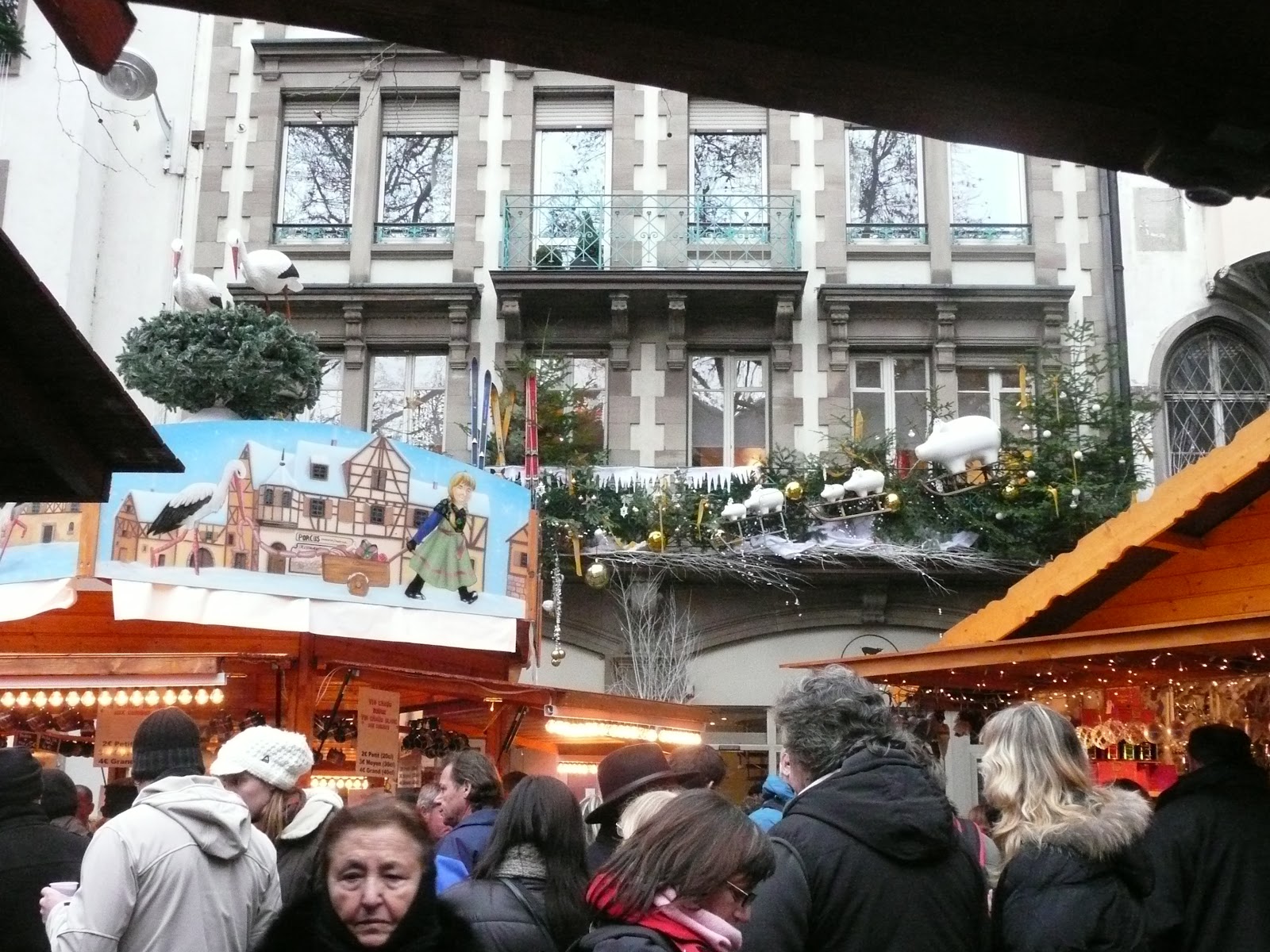
On Saturday, we arrived in the city to visit the markets just after noon. Strasbourg’s center is called “Grande île”, or the big island. It’s an apt name, as the center is an island surrounded by the Ill River, which feeds into the Rhine River a few kilometers farther east. The whole island is a UNESCO World Heritage site, with a grand Cathedrale de Notre Dame its heart. That World Heritage site held at least 9 separate markets (two others are off the island). This is Strasbourg’s Christmas promise – a series of markets in different places and with different themes strewed across the dense city center, so that in one day one can experience a full array of Christmas in the heart of Europe.

We started by getting off the tram in the center and walking to Place Kleber. The market there was unspectacular, but we got a hot chocolate, the initial rush of the crowds and street musicians to be found everywhere in the city, and Le Grand Sapin de Noël. Strasbourg claims that their Christmas tree is the tallest decorated tree in the world. Whether or not that’s the case, it’s pretty grand, standing there in the middle of Place Kleber, an open square capable of hosting such a big Christmas tree.

Romance has its downsides.
After the tree, we stopped in an ornate chocolate shop, where the ladies bought gifts. I watched as a two-story, two-horse cart clomped along a curving street, leaving a string of photographing tourists and, well, horse shit behind them. This throwback transportation guided us to the Place du Temple Neuf, a smaller square that is normally a parking lot, but did well in providing a couple places for vendors to vend. I did most of gift shopping here, but we also tried some chestnut and blueberry jams.

Rue des Hallebards
This prologue led us to the Rue de Hallebards, over which hung a series of chandeliers enclosed in glass cases. This striking decoration forewarned us of the main attraction of the city one block to the south, the Cathedrale. The crowds thronged in 10 person-wide waves spanning the street, cresting in the market at the foot of the crazy Cathedrale, the center of the Capital of Christmas.

Impressively, the crowds and the markets almost obscured the huge building behind, as the eye naturally fell on the red and brown of the booths, on the accordion players sitting street level, on the people, the people.  We wended our way through the crowds, lost one another, reunited, and then decided to split up, the ladies one way and I another.

My wandering took me to the south side of the Cathedrale, where Strasbourg had set up their skating rink, less central than the one in Liège but still popular. I then drifted down to the river, left the markets for a little bit, strolling through the east side of the Grande Île, but I didn’t wander long: the girls sent out the bat signal, too cold to continue shopping in the marchés and eager to get indoors to some old-fashioned modern stores. I rejoined them, helped them install themselves in a café, one with no room for me, and went back on the walk.

I turned to the western section of the city, knowing a well-touted literary café awaited me in that direction. I walked past the village for children, a tent that housed games and activities at the foot of another pink sandstone church (pink sandstone the most available building material for the city). The waves of crowds thinned and grew less frequent as I found the river again and walked along it to the Petite France district. There I found the former industrial heart of Strasbourg, set on a few fingers of land in the middle of the river. Restaurants serving endless variety of sauerkraut dishes, as well as a good share of pig knuckle, surrounded a market touting local crafts. I finished my gift shopping here and at another market of local Alsatian flavors around the corner: cognac-flavored egg liquor was my big find.

That ended the daytime Christmas market touring. Though tired, burdened by the fruits of our successful day of shopping, and wary of our half-hour commute to the inn, we still had the night ahead of us. We still had the best of the markets to look forward to.

Petite France at night (Market on the right)
I met the girls at the Place Kleber, where we took the necessary photos of the tree at night. From there, we returned to the Petite France area. Though we didn’t find a prompt, authentic eatery that could satisfy each of our culinary concerns, we did get to wander about in the cold, through the continuing crowds, amidst the glow of the market, and with sips from Amy’s cup of Glühwein. While we were stressed and cold and not overly warmed by the wine and the Christmas cheer, it was cute all the same.

After at last finding a grand Thai meal, we drifted back to the river on our walk to the tram that would take us to our car. Christmas decorations lit up both banks of the river. The red and yellow and green stoplight glare of Christmas bathed in the pink sandstone tint of the city harmoniously. The river lapped at the bank as we trundled along with our booty, past amorous couples, families, and groups of students. The relief of a full day’s end washed over us.

***


Hot wine 'neath the Cathedral. Just as the pope would like, I'm sure.
Our ride home was probably not all that different from one we would have taken if the three of us had gone shopping in, say, the Mall of America in A.’s home state of Minnesota. We would have felt the same relief from finishing our gift-buying. In either situation we would have had stories to tell about the people we saw and the encounters we had. Inevitably, in our core we would have faced the paradox of feeling good about buying gifts for others and feeling bad about feeding the consumerist colossus and the endless need for more and more stuff (or maybe that was just me).

Maybe Les marchés de Noël is just a grand gimmick, capitalism disguised as quaint nostalgia and doused in hot wine. Tradition or not, the idea of the markets is that they are markets; venues to sell products. Many of those products are unnecessary. The Christmas market is just hype.

But then, gimmick or not, the feeling is different. Bringing people together, placing them outside, putting them on a map in a location together, removed from the stronger waves of modern advertising, modern technology, modern post-modern detachment from the world, this still stands as a difference from the malls and the Walmarts and the consumer is king mentality of the U.S.

Europe still doesn’t really bring Christmas any closer to the original idea of celebrating Jesus. I’m not close to becoming a convert to the Christmas season (nor to Christianity, natch). But if one has to choose to take part in the Christmas season, one can do worse than to go to the markets, and to get outside on the streets, together.