Showing posts with label Foreign Languages. Show all posts

13.8.12

A Series of Ordinarily Extraordinary Events - The Red Bike Rides in Bretagne, Pt. 3

02.08                      23:00              Hostel Room in Quiberon
Weather: The sun overcomes, the wind still blows fierce
Distance biked: 75 km yesterday, 45-50km today

Jeff was the 3rd most extraordinary thing that happened to me today. He approached me as I sat at a table in a bar. The bar was not crowded; five to seven locals joked around the bar, and I sat alone, half a floor away. I sat crouched over this very journal, finishing yesterday’s entry. My bike helmet sat on the table in front of my beer. I wore my “civilian”, non-bike clothes, but no doubt still stank. Beneath me lay my bursting backpack. As always, I must have cut a strange figure.
“Where from?” he asked me. He had been walking back from the bathroom. I told him, in French.
A simulation of our linguistic struggles
“Who you?” he continued in English. I don’t mean to brag in saying it, but I will: my French was better than his English. Certainly more fluid.
“Je m’appelle Daniel,” I said.
“Oh, I’m Jeff.” We shook hands. He had long curly brown hair and bright blue eyes and facial hair all over.
He asked me what I was doing, why I was in Bretagne, and where I was staying. He stuck to the English. Rarely am I out-stubborned over which language to use, but I had to hand it to him. I ended up throwing some English in.
“You’re going to Quiberon tonight? Do you have number?” He meant phone. He proceeded to offer me a place to stay at his house. He wouldn’t be there that night, but his girlfriend would. He then told me to see the Côte Sauvage and take pictures (he mimed taking pictures with his hand). By the time we ended our conversation, he had told me work was good in the tourist season – the summer – but not for the rest of the year, that he was from Nantes, and the Breizh (Breton) word for “see you soon” at our parting (Something like Quenavoohoo). We also exchanged a second, more elaborate handshake.

I don’t know why they always come to me, but they do.
(I was not bold enough to take Jeff up on his offer).

***

The fourth most extraordinary thing today was biking through Elven. The town was nothing special, but its name is Elven! (An Elven in Breizh. Vannes is Gwened in Breizh. Pretty cool).

As I said, Bretagne has Celtic roots. Breizh is related to old Celtic languages, with lots of gw, q, k, and ac sounds – the most familiar Breton name to Americans I Kerouac (also Bretagne – Brittany in English – is related to Grande Bretagne in French – you guessed it, Great Britain).

For me, Celtic roots mean nerdy fantasy worlds I ate up as a kid. First Lloyd Alexander’s Prydain Chronicles, then of course Tolkien’s books. I was not terribly sad about missing Merlin’s tomb, but if you told me where the village Beren and Luthien passed the end of their days, I’d be there yesterday (that’s a Silmarillon reference, uber-nerdy Tolkien stuff). 

If the shoe fits...(though really, I'm more hobbit-like)
Part of the excitement and majesty of this trip for me is to explore a related setting. I trek through forests and wide wheat fields, past mysterious ponds and quiet stone hosues, over hills and to windswept coasts. The interior of Bretagne enchants, and towns named Elven only add to the fun.

Not all of Elven was fun, however…

***

The most dually frustrating and positive thing today was that I bought a map. The map kept me on track – no zigzagging today. The only diversion was when I found a bike path that took me along the canal between Nantes and Brest. This was great, and I only wish it could have been more on my way to Vannes. Biking on flat, quiet bike paths by water is hard to beat.

The frustration is twofold. First, when I have a map, I look at it. A lot. Like every time I come to a significant intersection or a new town. My memory is good but not for pictures, and doubt is strong in me. Most often this is seen in the many photos of me traveling, with a backpack on and my nose in a book. It’s usually a guidebook, and I’m usually checking a map.

More physically frustrating was that my map showed no topography. I had no idea when hills were coming. The ride through Elven felt like one long uphill with brief flat pauses and the rarest of dips in the road. I pride myself on being tough, but 100 km in two days and hill after hill is enough to knock the tough out of me. One of my cycling maxims (I’ve at least two) is that every uphill is rewarded and every downhill paid for. It sure didn’t feel like I was rewarded today. Only on the last 10 kms did I rediscover my gumption and gut it out. A few downhills helped.

***

A few pettily extraordinary things:

-          I’m staying in a hostel. The only thing I don’t like about hostels is sharing my room with strangers. I’ve not done so in a long time, maybe four years. Still, for this trip I thought I could deal with it. What the hell, I want to go cheap. Them’s the breaks.

I showed up at 21:30, a half-hour before reception closed. I got placed in a room with four beds. Alone. Hot damn.

-          I showed up so late due to finally conceding on the train front. I had to take the train one stop before transferring to a train for this peninsula. The earlier train that went was a TGV, the one where you have to pay.
I could have said fuck it, snuck on, and hoped I wouldn’t have to deal with anybody for the ten minutes before I changed. Instead? I took a ticket for a later regional train and went for a drink and dinner in Vannes (meeting Jeff in the process). Maturity, I guess.

-          As mentioned, the sun came out. Ruins my joke that the one thing in my backpack I could do with out is the sunscreen. I did wear my long-sleeved shirt tonight.

-          I kept my Olympics streak alive, watching the women’s gymnastics tonight in the common room. I don’t think I’ve ever watched them so much, at least not since I was a kid – in ’08 I had just moved to Israel (no tv), in ’04 I worked two jobs, etc. Growing up, the Olympics were just about the only really-approved sports programming in our house. My mother liked the gymnastics, swimming, skiing, and figure skating.

-          While writing this, I finished my survival pack for the day – bread already gone, I ate an apple and finished my bar of chocolate. The chocolate only had half a row left. “Who’s been eating my chocolate?” I thought. I always eat it row by row, and the only way I would have left it like that is if I had been interrupted.
I checked in my back pack. There on the bottom was the rest of the chocolate, broken off. Good thing I checked.

***


The second most extraordinary thing I came across today was the beach. I’m staying in a hostel just north of Quiberon, on a narrow peninsula (Jeff described the people here as close-minded, “Quiberon for Quiberon” types, saying that 15 km out in the water, the mentality is bizarre). The beach is right there. So after checking in and claiming my room, I threw on my long sleeves and walked over, hoping to catch a glorious sunset.


There was no sun to be seen, though at 21:35 it was still light out. Plenty of other things demanded attention. I reached the sand and saw little white specks jumping all over. I thought at first that they were specks of trash blown about that looked like bugs. On further inspection, they were bugs. Leaping little whit erratic maggots or something. They popped left and right and up and down like excited gas molecules, with only rare periods of considered crawling. Barefoot and otherwise, I found the buggers all over my feet and ankles. They covered the whole dry sand area, especially congregating around seaweed and such clumps.

The wet sand area was the biggest I’ve seen. Wide as a football filed, the smooth sand was covered with a slim layer of water, not enough to stick up your nose or drown in. It represented a large tidal variation.

I walked barefoot out to the water’s edge. The water chilled me though gulls braved it. I skipped a few stones before my weak shoulder ached. The ocean roar drowned out my singing. Down to my left, on the south of the peninsula, a few lights shone, Quiberon’s agglomeration. Two couples sauntered on the wet sand. 


And then I turned around. Rising above the tree line, not visible closer to the shore, was the full moon. Orange and ripe like the whiffs of stinky cheese I bumped into en route, the moon hung over as if ready to swallow the peninsula. With such a narrow base and 15 kilometers out into the water, with all this as normal, it’s hard to imagine how the locals could have anything but a bizarre mentality.

The most extraordinary thing today? That breath filled my lungs, blessings my life, and that I was able to take part in all of it. And that I have another day to tackle tomorrow.

12.8.12

All Lost in the Forest & The Trees - The Red Bike Rides in Bretagne, Pt. 2

01.08        20:30  Restaurant in Ploërmel


“Raise High the Roof Beam, Carpenters,” a novella that makes up the first half of the last book J.D. Salinger published and my favorite of his books, though certainly not the best, begins with a fable of purportedly Buddhist or other East Asian religious origin (Salinger probably made it up). In the fable a man asks a religious figure for help picking a horse. The priest (or whatever) sends him to the local horse-picker. The man goes and gives the horse-picker details on what horse he wants: size, gender, color, etc. He returns to the priest and complains that the horse completely fails to meet his specifications. This delights the priest, who says, “I didn’t realize he was so far along.”
The story, whether Salinger’s or authentic, is bullshit, implying that the true core overrides the details, but in a trivial manner. It’s irrepressible bullshit, irrepressible because intentional, Salinger serving all of his own indulgences and none of his readers’, already long in recoil from his Catcher in the Rye fame. His joy at frustrating us is a delight.

Anyway, the story’s essence is about seeing past the details and to the core. Bullshit as I find it as a story, the moral is certainly worth remembering while traveling. Open to the possibilities and seeking the core experience, the traveler may find his/her trip fall far from the original plans and be all the better for it.

Me, I’m a stickler for planning. Even on this trip, with nothing written down or paid for in advance for eight days of the ten, I have a plan, and it’s hell for me to break it. My travel experience thus emerges in a very Western, American twist on this Eastern idea: a goal is set, and then all the fun is in overcoming all the silly things that get in the way to achieve that goal. Never flexible, I fight for what I’ve planned and believe should be mine.

Stupid? For sure. But just as with that horse-picker, I often find exactly what I’m looking for, just in the complete opposite direction. I look and do not find. I do not look and find. I am farther along than I think, but I’ve no idea how I got there.

It all started in Rennes. Bretagne starts in its eastern capital. I started my trip there and the first ten hours were fine – I arrived close to midnight, found my hotel empty but with my name and room number written on a board, and that was that. I woke up just after 9, the earliest I’ve risen since I returned to the continent five days prior, I found reception, asked where the nearest boulangerie was, and all was well.

Except the nearest boulangerie was closed, leading me on a 45-minute walk around our non-central neighborhood to find a mall with a supermarket and the chain bakery Brioche Doree. Ok, no big deal, I can do local another time.

I got out of the hotel and then out of town at 12. My destination would be the Forêt de Paimpont, known as the Brocéliande. My guidebook reported that it is said to be the forest whence Arthur pulled Excalibur (though in the next phrase, the book says the story probably came from Celtic settlers and is thus a hoax). Also that it was enchanting. And about 40km southwest of Rennes. That was as good a direction to me as any, so I settled on that as my first stop. All I knew was to head west and then turn southwest. Seemed simple, enough so that I never looked directly as a map with sufficient detail to know where I was going.

Water Mill along the étang
My first detour from the straight western track was along a stream, an étang, a pond. Quiet water flow, green bush, the grasshopper orchestra strumming, and I riding on a dirt path, unsure. The path ended once, but alongside another path continued. I came upon water mills and old stone houses, and eventually to a road again. The étang path continued on the other side of the road, but I thought I should go west again.

All signs west led to Le Rheu. Part of my plan was to find signs for the forest, a big deal around here, I imagined. Le Rheu, though, was not on my vague guidebook map. I found the village sleepy, the town hall closed. In the supermarket parking lot, an older man flagged me down. He was bald and short and round and shook constantly, and he needed money for something, I couldn’t understand why. I had only change that might go toward buying a map, and so told him I had none. “The third person who’s told me that,” and he flagged down somebody else.

The next town was Cintré. The last town connected to Rennes by the city bus system, Cintré had a center street with a tabac/bar shop and a church. I parked at the church and walked into the shop and asked for directions to the forest. A woman and a man pointed me to the next two towns on the way. I returned outside, had some of my baguette, and took off. I had covered about 15 km so far.

The ride took me mostly through flat fields of wheat or corn in varying stages of ripeness: some had the grain already baled up, others were green or brown but unreaped, and I beheld one tractor harvesting. Cows, horses, and sheep made appearances, though not as often as in Luxembourg. There was not much in terms of people, no gas stations and few stores. This was hardly a typical tourist path. 


I biked through Talensac and my first big hill in Bretagne, than Montfort. At a key intersection, Montfort being the second of the two towns I needed, I asked a road worker for directions. He sent me to St. Meen, which I heard as “San Maw” thanks to French pronunciation rules. I turned onto a country road and biked through Montfort, a quiet town with a widely-advertised supermarket.

In the center of Monfort, I found frustration. A map showed St. Meen de la Grand on it, but the direction was northwest. Further, Talensac was southeast of Monfort. That didn’t seem right. The sun hung behind the clouds, but it was already three and I had no idea where it should be by then. The wind howled in my face, slowing my meagre speed to a crawl. Fighting through wind to go the wrong way was not sustainable from a spiritual standpoint. I was lost.

A crossroads. A sign with 11 written next to St. Meen de la Gd. 11 Km is a long way to go the wrong way. I got off the bike and stared at the signs, hoping to divine a direction through pure hope. I had my instincts and strangers’ directions to rely on; my directional instinct is poor and the strangers’ directions were either bad or misunderstood. I am great at following maps. I had no map that showed these towns, these St. Meens and Montaubans and Iffendics and Montforts. I was lost.

A biker arrived at the crossroads. I called out to him, hiding my desperation. He was in his 60’s, bald with glasses and full biker’s gear – helmet, spandex top, and bottom. I had just the helmet. Even among weirdos, I stick out. Anyway, he pointed me to Iffendic. “Bof,” he said, “there’s a hill,” indicating with his hand how big it was. “Where are you from?” he asked, and then, “come to see the great interior of Bretagne?” with ironized pride. I praised the area reflexively and learned he was from Montauban. “Bonne route,” he wished me, and we parted.

Iffendic was another small town, but big enough to have a “centre commercial” – a supermarket, a bar, and a pharmacy. The supermarket had a little map of the region, and the bar had a bigger map on the wall, which the barmaid allowed me to study. Reoriented, I decided to discard the biker’s post-Iffendic directions with its grand hill and to light out for the D31. I trust maps, and so felt found.

From there, the challenge transferred from finding oneself to fighting the wind. It may not have actually been blowing directly in my face, but it felt like it. I thrashed. A spandex-clad biker passed me and shouted, “It’s tough, isn’t it?” Nothing is worse than wind for biking. Rain encourages one to speed up to get “home” sooner, but wind tells you, “the harder you try, the more I’ll hurt you.” Wind and rain are, of course, the purest distillation of evil for the biker. But this wind did not let up until the forest.

I came up to St. Malon and read a map: lo and behold, I was already in the Pays de Brocéliande and had been for a long time. I may not have reached the forest yet, but I was found.


Not the way to Excalibur, I think
And found at last in the forest. Green trees on both sides of me, thickets and limited sunlight (the clouds did their part as well). Except for the rare car or caravan driving by (one driver asked me for directions unsuccessfully), no sound did I hear but my pedaling, grunting, and singing. The forest was achieved internally and externally. But I found neither Merlin’s tomb nor Excalibur’s former home, both said to be in this forest.

The forest and its accompanying silence ended in the namesake town of Paimpont. Actually an abbey with a parking lot full of caravans ended my silence. It was 17:30. I had to decide on my destination for the night. My first choice in the area, Le Petit Keriquel, did not answer or return my call. Campgrounds were bad options without a tent. I called the last phone number on my list, Le Thy in Ploërmel. Beyond finding an available room, the phone call revealed two things: their reception closed at 20:00, and they did not tell me how far Ploërmel was from Paimpont.

I had a choice again. Push on or look for something here in the town. No doubt I could find a decent room at a reasonable enough price and end my day, 50+ km in. But any kilometers I covered today would be deducted from tomorrow’s requirement. And I knew it was only 50 euros for Le Thy. And I had my plan set…


Thought process: "No," and "Way"
Not long through Paimpont center, I saw the sign: 22 km to go to Ploërmel. Not looking for it, I finally found the hill the biker had warned me of – I walked it. My fourth wind came in time to get me through the next few hills and to steer out of the way of a tractor – the roads were, as Mr. Salinger might say, lousy with tractors. This last push, this last wind, could not help me against the rain, however.


I was wet, especially in Campénéac. The last real town before Ploërmel, about 10 kms away, had several hotels. I could have easily found a bed, a hot shower, and dinner. Instead, I thrust forward one last time. With well-advertised gas stations, help of two more strangers’ directions, and my cooperative, beleaguered bike, I made it.

Mural in Campénéac. Almost enough to make me want to stay.

And then, without looking for it, I found: a lively but quiet little city; an agreeable hotel with a lovely older couple as owners; an ATM I could get money from for free (not invaluable); a quality restaurant with crepes and Breizh cola and the Olympics on the TV; a pleasant set of bluestone-laid city streets to wander in; a store to buy a map from in the center, a sense of satisfaction; and even, most surprisingly, the sun, which didn’t go away until it set at 22:00.

In other words, without looking for it, I found everything I wanted on this trip. Maybe there is something to that horse-picking story.

That shirt is much lighter-colored when dry.

(Oh, and I slept like a king). 

11.8.12

Fear And Biking In La France - The Red Bike Rides in Bretagne, Pt. 1

30/07 - 19:35, train to Paris
Weather - Wind closer to mild than obnoxious
Mostly cloudy, 3 drops fell on me in Thionville
20 degrees - cool for summer, but sunless and fine for biking
Distance Biked - 30km

Fear filled me as 16:00 approached. It filled me the way poisonous gases fill a room, slowly and unremarkably, until it's too late to save oneself.

I could not explain the fear. It surprised me. I arranged my backpack, cleaned the kitchen, attended to the computer, and waited for my time of departure to arrive, and while waiting, I noticed I was not alone, or not myself. I was with fear.
"Relax," I told myself, "it's just anxiety." As if renaming it could diminish its power. One can call a hurricane a storm, but the winds and rain hurl about all the same.
"You're just anxious about going alone. You haven't done this in a long time. You've never taken a trip like this before. You should be anxious. It's fine."

I remembered things I had not thought about. Maybe I should write directions down for my first day riding in Bretagne. Won't I need at least a 4th pair of underwear? Why did I forget to put money on my phone?

Hemming, hawing, redoing, rechecking, fearing, I left behind schedule. Now there was a chance I would miss my train, a 2-hour bike ride away. That, at least, was a concrete thing to fear. The rest of it lingered in my soul, unnamed and unknown, as I set off. It was about 16:20.

***

The great thing about individual physical activity - like biking - is that it must be done. In doing the activity, the actor may still think, may still fear even, but feelings held earlier dissipate. Exertion, its required attention, and its corresponding hormones flush the mind and the soul of all residue. The feelings that fill this void can vary, can even recall the earlier feeling, but only after new stimuli spike, only with a reason.

By the time I reach France, I feel good. It is about 17:30 and I have two hours to ride to Thionville, one hour away. So far, the weather, my back, and my bike are all holding up. The weather is gloomy and cool but has not burst. On my back sits the fullest backpack I've ridden long distance with. Its contents include: 3 notebooks, five pencils, one large guide book, two slim French books, one huge book by an author nobody I know knows, four apples, 1 peanut butter sandwich, a pair of jeans, a t-shirt, a pair of shoes, four pairs of underwear, three pairs of socks, toothbrush, toothpaste, deodorant, 4 train ticket printouts, two bottles of water, a camera, a USB key, my wallet, passport, phone, keys, and the lock for my bike, all to last me 10 days. Writing this, I remember biking in Israel with notebooks, books, and a huge canvas bag in my backpack on my commute to work and grad school. I'm in better biking shape now, and this load is lighter.

And as for my bike? Let's leave off talking about it, in hopes that it doesn't come up. It's hard to do a big bike trip without a bike, after all.

***

My plan is to cruise around Bretagne for 8 days or so on my bike, riding where the wind and the road take me (the other two days involve getting there). Why Bretagne? No clear idea; maybe I've heard of the region before in some positive light. The teacher who led my trip to Japan when I was 13 was named Mr. Breton, so maybe I wanted to close as circle (How?). Maybe because its last region is called "Finisterre," the end of the world. Or maybe because I grew fond of the Rennes football team. It's not a must-see region like Provence, nor a nearby one like Alsace, and Amy probably wouldn't choose it as a trip for the two of us, so why not?

As for why I decided to leave from Thionville, that's simpler. I'll say it's because I wanted to warm up for my trip, having not biked during a 2-week sojourn in the states. I might throw in the kid I saw, 8 or 10 years old, walking with his friend. He had glasses and spiky hair and carried two baguettes in his arms that, end-to-end, would have stood as tall as he.
"Salut," he shouted, all wise ass attention seeking.
"Salut," I mumbled.
"Ca va?"
"Ouais," I said, passing him by and hearing he and his friend chatter to fill in our abbreviated conversation.
Both of these elements - physical preparation and French charm - factored into my decision to bike the first 30 KM instead of takin the train from Luxembourg, but the main reason I made it harder on myself?
It was 20 euros cheaper. Duh.

***

My fear actualizes itself at the train station. As is often the case, its embodiment takes the form of a grouchy Frenchman.
"Bonjour," I say in intermediate French. "I'd like to add a place for my bike on the train."
"Mais non, you can't do that. You have to book the bike space when you buy the ticket."
"But I emailed someone from SNCF (the train company) and they told me I could."
"But that's not possible. Non."
"What would you advise me to do?" I practically cry.
"You can't do this."
A long line has formed behind me and I recognize a man who will not be swayed. Three hours into the trip, and already my first battle. I step away and regroup.

In the waiting hall I sit down on a bench. Across from me, a man with a pocked face sleeps, his head drooping nearly to his crotch. A nicer-looking woman seated the bench behind him eyes me suspiciously.

I eat my sandwich and consult my guide. Indeed, it states that a bike place must be reserved when buying a ticket for the TGV and other big trains, and cannot be so reserved online. Did I misunderstand the email then? What am I to do?

The train leaves at 19:30, in 15 minutes. I go outside. I will attack my usual way: directly. I will just try to get on the train, let the chips fall where they may. If necessary, the "I'm a foreigner" ignorance card sits in my back pocket, but I hate playing the dumb American.

Around me, the sleeping neighbor ambles, clearly still half-awake. A conductor approaches me, a station worker in tow. They don't want me to park my bike on the stair rails.
"I'm taking the bike," I say.
"You can just put it over there," the conductor says, indicating.
"But I'm taking it to Paris with me," I say unsubtly.
"You can take it up the ass, just don't leave it here."
"Oh, ok, gotcha. That'll be the last time."

I smile and he smiles and I walk to the platform (did I mention my French is intermediate? I might not have got all of that right). The train conductor was decent to me. Train conductors are good, salt of the earth people. Not like Monsieur Asshole inside.

Still, I wait at the platform unsure. The sleeper floats by, makes a remark about my bike, and I smile. I sit and wait. People fill the platform, and I wonder how full this train might get. Can I fold my bike? I begin to unscrew the central bolt and choke on the rust that floats up. Better not try it.
The train arrives. I linger, not seeing the car with the bike stencil on it. Do I look for that on the car my ticket is for? Why didn't I buy insurance for my ticket? Should I just ditch the bike and make this a train tour? A walking on my hands tour? A Russian Dance tour?
A conductor approaches. "What car are you?"
"13."
"Did you reserve a place for your bike?"
I turn to direct defense. "What I did is email someone who said..."
"Got it," he interrupts. "We'll deal with it on the train. Go to the last car, #11."
"And hurry," says the conductor who talked to me earlier.
I rush to that ultimate 11 car, not clear how this will turn out. Well, I'm on the train, at least.

On the car waiting for me was Mr. Sleeper. I sat, he sat. I moved my bike so he could lay on the four adjacent seats. He ranted about something in a mumbling, indecipherable French, gesturing with his hand on forearm to show how they done him wrong too. He had neither all of his teeth nor, I suspect, all his marbles. I think he was trying to sneak on the train until Paris, or at least Champagne - he waited in the bathroom while the train stopped at Metz and then went down the train when he saw our car filled up.

I shuffled about guiltily and awkwardly among the other passengers, not yet changed out of my bike clothes, worried about taking someone's seat or otherwise encumbering on their voyage. My fate was still partly unknown no less. I moved to the row of seats aside my bike. I wrote, and waited.

At last, the conductor came. He punched everybody else's ticket in the car - there were about 8 in the 12 allotted seats. He turned to me, scanned my ticket. He said, "So, adding a bicycle, are we?" "Yes," I squeaked. He punched keys on his scanner, waited, frowned, and then showed the screen to me. 20 euros.
Relieved, I gladly paid, even though a bike pre-reserved is supposed to cost 10 euros to add. I asked him if this was the best way to go about things.
"Uh no."
Well then. We chatted on the topic a bit, and then he moved on. I sat patiently, wondering what price I'd have to pay to get out of doing the same thing twice the next day.

One of the reasons for my trip is to speak French, to confirm my year of studying the language. Another is to test myself alone again, to discover what I want to do when I'm alone, and to try new things. So far, so ok.

I got off the train in Paris at 21:30. The train conductor said goodbye. The fear was mostly forgotten. And so I was off.

7.11.11

Between the tower and the café - Seeking Balance on a week in Paris


We took the shorter line to the elevator at the West leg of the Eiffel Tower. I held my umbrella gingerly above our heads, nevertheless poking one or two of the taller gentlemen joining us in line. At the ticket control, we showed our pre-ordered tickets, receiving compliments from the agent for the green paper that served as our tickets’ backing. Within minutes, we crammed into the elevator and climbed to the second floor. And so I was here again, on Monsieur Eiffel’s beautiful monstrosity.

The view from the Trocadero Gardens the day before we climbed

This past week, Amy and I visited Paris for fall break. The week off from school, due to Luxembourg’s observation of All Saints’ Day, provided the perfect opportunity for Amy to visit Paris for the first time. It wasn’t my first time. I had visited thrice in the past five years, and on my one childhood foray to Europe, a two-week trip with family 16 years ago.

On one’s first visit to Paris, or to anywhere really, one is a tourist and must do tourist things, the Eiffel Tower standing above all other items on the tourist list. I visited the Eiffel Tower on my first trip to Paris – one of my strongest memories of that trip is the shame and fear I felt as I tiptoed up the open-air stairs to the second floor while my younger brother raced ahead of me with not a hint of hesitation. I also visited the Eiffel Tower in 2006, on my best friend’s first knowing visit to Paris, and in 2009, while leading a school trip for many high schoolers who had never been to Paris, which made this the fourth time ascending through the metal crosses and bars, with the fourth virgin companion (counting myself the first time).

There are a few ways to explore a city. One can follow the tried and true approach of guide books and tourist sites. One can search for the forgotten corners of a city, those considered out of fashion now. Or one can seek out the new, the untouched, the mythically authentic.

In a world capital like Paris, especially in Paris, the latter approaches are all but ridiculous. In seven days, one can either follow the tried and true or flay themselves in the self-righteousness particular to experienced travelers, those who “refuse to conform” and “blaze their own trail.” I am not above self-flagellation, especially of this nature, but it gets silly, and when there’s the moderating force of a reasonable traveling partner alongside, I find it best to succumb to my inner tourist and push the traveler’s ego aside.

Finding it best doesn’t mean submitting willingly, nor easily. Throughout the week, I tried to find the balance between seeing what must be seen and feeling at least a bit liberated from the standard, from the road well taken. Not (only) to wage a futile battle instead of enjoying a vacation, but to heighten the enjoyment, to enrich it. At least, I tell you that.

Meanwhile, we climbed the second elevator and ascended into the clouds. When looking for novel inspiration, we humans often look skywards. I comforted myself with the idea and took in the cityscape below.

***

Our fundamental circumstances made this a different trip than the previous ones I had taken to Paris. For the first time, I visited Paris as one should, with a lover (considering my “bounteous” history of lovers, I know that’s surprising). For the first time, we visited by train, the TGV regional fast train that made the 230-mile journey from Luxembourg in just over 2 hours. For the first time, we spoke a modicum of French, at least a little bit more than “bonjour,” and “merci.” And for the first time, we stayed in one of the hipper neighborhoods of the city.

La Butte Aux Cailles, Quail Hill, is a small city hill in the 13th arrondisement (district) of Paris, in the Southeast of the city, near Place d’Italie. The hill, the tallest point in the city according to the “official” website -, actually takes its name from a businessman named Cailles, who bought the hill and set up a vineyard there in the 16th century. The district became an area of workers and rag collectors (chiffonniers), and then the setting for a major battle in the counterrevolution against the Paris Commune of 1871 (the Commune lost). Until the 1990s, the hill remained a local haunt, insignificant, before at last a mayor of the area decided to build up the bar and leisure scene to welcome the tourists and hipsters. Et, voila, we arrived.

Credit to Monsieur Jacques Bousiquier. I'm not sure what's going on with the pink sky.

A nice article in the New York Times tipped me off to its existence, and shortly after I booked our stay in a hotel there, located right below the Place de la Commune de Paris. Our suspicions that the area was hip were confirmed twofold: first, by the abundance of bars, restaurants, and cute tea salons that we passed each morning and night; secondly, by my friend C., a Frenchman who for me epitomizes young Parisian cool, and who often chooses these bars to visit when he comes into the city from his suburban home. 

Of course, Amy and I are far from hip when it comes to our night lifestyle; we would note how the hill buzzed each night around 9 or 10pm as people started to fill the bars, while we like pumpkins returned home to our hotel to go to sleep. For while the neighborhood was a plus on the whole, well located, interesting, and with a hotel that was cheaper than its quality would fetch in the center, it was also not super close to the center, not close enough that we could easily return to the hotel before dinner. With one exception, our days were long affairs, morning till evening of touring and shopping and sitting in cafés, and then at last of dining and returning home, with no interest in joining the buzz. At least we two are compatible in our unhipness, and we enjoyed our hill all the same, and said we’d be glad to live there if we ever move to Paris. 

So each night and morning, at least, we shared in a new place.

***

Kids Hanging out in the shadow of the Sacre Coeur's dome
Our touring was long, hard, and fruitful. All the places I wanted to return to or visit for the first time, we reached. I hadn’t been to Montmartre in 16 years, and so gladly climbed up the steps to the Sacre Coeur and walked around the winding roads, re-informed both by Amelie and this fine book on the hill’s beauty, and its artistic and cultural history, respectively. I missed out on the Musée d’Orsay five years ago and hadn’t been since my philistine youth either, and so we made sure to stroll through the Impressionist Gallery and check out the big Toulouse-Latrec paintings. I wanted to visit the Musée de l’Orangerie, home to famous art dealer Paul Guillaume’s collection of 1900-1920 Parisian-milieu paintings, Modigliani and Soutine and all the rest, and we detoured into here after finding a much too long line at the Louvre on Halloween (we did make it to the Louvre three days later). 

The last museum was our favorite, or at least mine (Amy waffled on choosing a favorite), of the three. It is most known for its holding of 8 giant paintings by Monet of his beloved water lilies, separated into two rooms of four paintings. While I remembered that as a child, I held Monet’s fascination with his water lilies as the prime example of why art was lame when I argued with my parents about going to museums, I could appreciate his effort to bring stillness to the center of the city (the museum is located on the edge of the Jardin des Tuileries along the right bank, between the Place de la Concorde and the Louvre). A temporary exhibit on turn of the 20th century Spanish painters also suited Amy’s and mine interest perfectly, and we especially appreciated “La Granadina”, a piece by Hermen Anglada-Camarasa. 

Human Lily in Contemplation of Water Lily

Modligani's portrait of Guillaume's elegance
Monsieur Guillaume’s collection most excited me, however. Very fine works from my favorite art period included Picasso and Matisse, Renoir and Cezanne, Derain after his fauvist fame, but also Henri Rousseau, Maurice Utrillo, and Chaim Soutine, all well displayed. Amedeo Modigliani, one of my favorite painters, had several paintings represented in Guillaume’s collection. Beyond this joy of old favorites, my happiest discovery was the work of Marie Laurencin, a French woman I knew nothing about before and plan to learn much more about afterward. What better can art, writing, or museums do than inspire new learning?
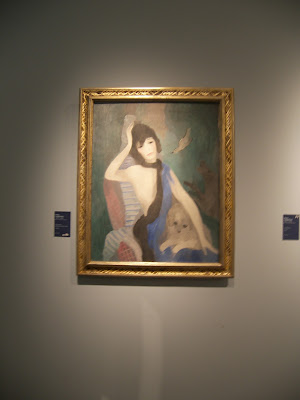
Chanel 1923, by Laurencin

We also lucked into choosing the right days to go into the museums, weather-wise; Tuesday and Thursday, the worst days Paris threw at us, with rain and wind and a trace of the dismal European gloom that had settled into Luxembourg two weeks before, found us in the Orsay and the Louvre, respectively. The rest of the time, we marveled at the sun, the yellow leaves, and the buzz in the streets. Before we left, I postulated that early November is the time to catch Paris in its most natural element, and this week only confirmed my guess. Not yet plagued the cold of winter, nor the emptiness of August, but instead imbued in the perfect distillation of the grays, browns, and blues that represent the breadth of the city’s palette, tinted now with those yellows and oranges on the trees.

In that color template we took strolls through the Jardin Des Tuileries and the Jardin du Luxembourg, the latter on Sunday morning, as formal and informal groups of tai chi practitioners rotated their hips and arms on the fallen leaves. In the Tuileries, we stopped to watch people feeding seagulls and ducks in the pond, and then the seagulls and ducks fighting like needy children, the seagulls louder and more insecure, in larger packs; the ducks more centered, zen even, focused on beating the seagulls back only as a means to food, and not an assertion of ego or pride.

Those Jardins gave us the necessary space and contemplation to brave the human maze beneath the pyramid in the Louvre, or the bustle of the Champs des Elysees, if not for long, and to squeeze into the Arc de Triomphe and the Notre Dame. We climbed neither of the heights in those two sites, nor the dome of the Sacre Coeur, glad just to register and check the sites off our list. And on our last day, Friday, after checking off most of our sights, we took the clichéd but still worthwhile boat cruise, receiving a nice summary of all the places we had been along the Seine. Plus, the guide had an amusing bit going in both French and English, which can be fun for an hour.

All these things on our list were necessities, unavoidable for any tourist coming to Paris. We didn’t avoid them. We tried to do them smartly, I guess, but we went to all these things. To take the long view, going through all these tourist sites, we ran the baptismal gauntlet, the initiation process that will allow us to be mere visitors next time we go to Paris, and not tourists. I did score one major victory on this front, at least: we did not attend the Moulin Rouge. The once and present cabaret, now home to a tacky Vegas-style revue (www.moulinrouge.fr) along the red-light district street bordering Montmartre, gave off an aura of tackiness and gaudy crudity, such that Amy decided she didn’t need to shell out 100 euros for the show. A big relief.

Enough madness in Montmartre for us

***

About to explore the Latin Quarter. Reading as ever. It gets irritating sometimes.

 Outside of the touring though, we explored Paris as well as one can on foot over seven days. Amy and I unveiled our patented travel strategy, tested in smaller cities (and not really when we visited New York this summer, because we were busy and only there for 4.5 days), and lo, it worked wonders in Paris! Or maybe not wonders, but we got to see a lot of the city, just the way each of us likes to see a new place.

To wit: on four different days, after blundering around under my guidance towards or through a neighborhood, sometimes eating lunch, one day gawking at the Pompidou (Amy hated it), we found a café. Once settled in the café, respective bladders empty, we went about our tasks: Amy went out shopping, while I sat there and read, wrote, and studied French, meanwhile sipping tea. So we settled into Montmartre on our first full day, I nestled in the corner of a café near the Place des Abbesses, as the radio played cheesy French pop songs, while Amy explored the artsy boutiques and shops, picking out a new purple coat for winter. So again in the Latin Quarter, me first at the relatively corporate Malongo and then the neighborhood El Balto, where I enjoyed the soft indie-sounding music and the cute bartender, as well as the eclectic gathering of customers, while Amy held long conversations with clerks in luxury boutiques about their lives to date, and also bought clothes. 


Brass band clearing the street on Ile de St. Louis
We explored Le Marais and Île de St. Louis this way, areas I hadn’t been to before. The former, part of the broader Bastille district, houses the Jewish quarter and a number of intriguing alleys and shops. The latter is the island behind the Notre Dame and boasts a great collection of mansions and private homes, but also a long street for shopping that, due to the high buildings on each side of it, does at least somewhat feel separate from the rest of the city. There I found a salon de thé called La Charlotte de l’Île. The woman behind the bar was actually behind a bar of keys, plucking out a beautiful etude on a piano. The two customers, a middle-aged man and a girl my age, chatted, she talking about how this was her only day in Paris, he about how he hated American coffee. I sat in a corner opposite totem-like pieces of art on the wall, unpacked my backpack, and got to work, while Amy put a bow upon her shopping efforts, buying gifts for friends and family, and for herself too.
La Charlotte's Wall

***

While that sort of traveling wasn’t explicitly “Parisian”, we made sure that our culinary experience was authentic. Or rather, I made sure. Amy’s taste is not for the heaviness of French food, and so we catered to that some nights – Thai, Mexican, Moroccan, and macrobiotic veggie restaurants all appeared on our dinner docket, and Amy found fish two other nights.

But, as stated, I ensured that at least one of us tasted the best French cuisine had to offer. Twice I ate steak tartar - raw beef, essentially, served looking like an uncooked burger but tarted up with onions, capers, and other spices on these two versions that I hadn’t had before, making this the best steak tartar I ever ate; I had French onion soup several times; a croque madame and a croque monsieur once each (elegant ham and cheese sandwiches, the first one with an egg on top); we both ate crepes twice, once for dinner dessert, once for lunch; one day for lunch I ate rabbit; and the coup de grace, as it was, the best meal of the trip for me, was the foie gras/pot au feu combination, or in other words, goose liver paste and then a beef stew. This eaten on our second to last night, in a restaurant called Le Tresor, the Treasure, in Le Marais. Something about the way the fig marmalade offset the sticky texture of the bitter paste, how it all melted in my mouth, how it all revolted Amy on three different levels, made for a delightful Parisan meal.

I'm not sure what part of that could gross anyone out. Mmmm.
***

There’s a lot I love about traveling, much of which was covered on this trip. I love planning for trips. I love taking the train. I love seeing new places. I love feeling like a foreigner, and I love blending in to the anonymous crowd at the same time. All these things, and those covered above, the food, the sites, the exploration, all are part and parcel of getting on the road.

But I also love that feeling of displacement, that mentality that one must adopt to travel. The feeling of not being where one belongs. This displacement opens one up to see ordinary things as extraordinary, to regain an awareness of the world’s strangeness. Standing back from the fishbowl of everyday life, the traveler can glimpse the little things that add up to make life whatever life is, in all its weirdness and tragedy and joy and glory.

These little things, they appear in moments, in encounters, in quiet spaces. We found the moments most when eating, where our most direct contact with others came. In the macrobiotic restaurant, we sat in tight quarters next to an American and his French female companion. He had white hair stretching back into a pony tail and down into a full facial beard, and he stretched his conversation to talk about his political views, favorite French directors, traveling itineraries, ex-girlfriends’ tattoos, and down into the finest detail. His companion took it all in far more grace than we managed to, I starting to break out laughing right towards the end of dinner as he pulled out series of magazines he brought with him when he traveled to show her.

Or there was Halloween night. Dia de los Muertos, as we went to a Mexican restaurant recommended by our Mexican-American friend in Luxembourg. Both of us were somewhat sick, each in our own way, and the Mexican disappointed. What didn’t disappoint was the performance of the two girls sitting behind me. Young girls, about my age, Mexicans, clearly good friends, they spent the whole dinner looking at their phones. Texting, checking email, updating facebook, I don’t know. If there’s a set of circumstances that sums up the world we, Amy and I, live in, it’s sitting in a Mexican restaurant in Paris, feeling ill, while two Mexican girls living in Paris spend their whole dinner on their phones. Sigh.

Not all of these moments were happy ones. As we went to cross Place de St. Michel, we heard a thud and then saw a man fall down on the sidewalk. A bus stopped in front of him. We missed the collision, but it appeared that the man walked into the bus which had tried to run the light. There was no Jordan Baker around to explain what happens when two careless people crossed paths. Anyway, we stood and watched and wondered while others attended to the man, who appeared to have suffered a blow but was moving all his hands and legs, and with no signs of bleeding. We crossed the streets with much greater caution for the rest of the week.

But then there are moments of silly confusion, rather than the grim sort. The group of elderly Italians in the metro station who couldn’t figure out the tickets, and so we spoke broken Italian to them, they spoke broken French and English to us, and finally, unable to find a complete Italian sentence beneath my French, I showed them that the ticket machine actually worked in Italiano. “Bravo!” said a joyous man in the group, and he cupped my right cheek in gratitude. The cheek glowed in warmth for the rest of our metro ride.

Or like the middle-aged American who came on to Amy at the Musee d’Orsay.
“Vous etes Parisienne?” he asked.
“Non, je suis Americaine,” she responded with a smile. I walked back over to her at this point. He saw me, broke into a grin, and said, “Oh, me too. You know, I picked the wrong person, but gotta practice that French.” We encouraged him to keep working on the French.

Really though, when I talk about moments, I don’t mean any of this. I mean the opening into a peace of mind, into a harmony with the breath and with the air around, a quiet space. Many people find their quiet space through spirituality, or through rural towns, or through nature.

For example, a slice of nature in the middle of the Seine
I am fond of those things. I can appreciate those things, and include them in my life. For me, however, the quiet space is to be found in a city, among the convenience, the noxiousness, the bustle, the rush, the bums, the haughty elitists, the overpriced stores, the touristy areas and the undiscovered nooks, but the agglomerations of people and buildings and stuff all in a smaller, denser area. The moments come for me when I can find space amidst that area.

The moment came on Thursday night, in the steady rain. I stood outside, under an umbrella, while Amy made a last purchase for the night, of pharmaceutical products hard to find in other places. Darkness had long set in, the glow of streetlights filtered by that rain, lending a fuzzier, more romantic lens to the evening.

I stood across the street from a church. We were in Le Marais, and an orthodox Jew in his wide-brimmed black hat walked by me, buzzed or tapped in a code, and entered a building to the right of the store. Shortly after, the church bells started, ushering in 7:00pm. I was across from one church, but one or two others were in earshot, and their clocks were not perfectly synchronized. One chime from one church chased the chime from another, and soon the two or three separate bells chased each other, unclear which was leading and which following. The chase lasted for a minute, bells falling on one another like the rain on my umbrella. And then the silence returned, or rather, the buzz of the city preparing for dinner and a lively night. The moment settled on me. Amy then came out the store, and we went off to dinner.

***

View from Montmartre

But I can’t end without finishing off with the Tour de Eiffel. The Eiffel Tower, a ridiculous structure, built only to perpetuate its own glory and that of its city. A ugly metallic phallus pointed upwards to nowhere, an eyesore, a cliché, an irrelevancy.

Or else the Eiffel Tower, a brilliant piece of work, a shining example of constructed meaning, literally. The Eiffel came to serve a purpose as a broadcast tower, which is why it outlived its original 20-year life span. But it also served its own purpose, as the current centerpiece of the city, its most famous structure, and the guiding light to all visitors of Paris, at least.

One can’t escape the Eiffel Tower. There it is looming from the window of the Louvre, or the Musee d’Orsay. Here we see it around the corner from the Sacre Coeur. There it is from the boat, of course, the last stop before the cruise returns eastward. The Arc de Triomphe now serves as a prime lookout to see the Eiffel. The Trocadero Gardens unroll perfectly at the Tower’s feet. Everywhere you go, there you are, in the Eiffel Tower’s shadow.

So we didn’t escape the Eiffel Tower, but submitted to it as wisely as we could. We came with preordered tickets, printed on that lauded green paper. The positive side to preordering was that our line wait was much shorter. The negative side was that our date was fixed, and we picked the worst one, Tuesday, where the weather was perfect to visit the Musee d’Orsay, but not to see the city.

Things looked grim, or dim, actually, from the second floor. Through the fog we could barely make out the Arc de Triomphe, we could just catch the dome of the Hôtel des Invalides below, we couldn’t find the Notre Dame, and the Sacre Coeur blended in with the white around it. Rain fell on us as we stood out on the edge to get our photo taken, and again sideways as we waited in line for the summit elevator.

The soupy fog - can you see what's behind it, just visible?

I hoped that we might somehow rise above the clouds when we reached the top, but I obviously did not take any meteorology classes in college. The cloud was thicker from the summit, so that we had to strain to regain what we had seen 500 feet below. We took one quick tour around the top of the tour, had enough, and did our best to descend as quickly as I could.

I apologized to Amy for not checking the weather before booking our tickets, even though I booked about a week before. “It’s ok, we didn’t have to see everything,” she said. “The rain’s kind of nice, anyway.” I smiled, relieved that at least this, the one major duty of our stay, wasn’t a failure with the audience that mattered. (And I tested her feelings on the rain by leading us to walk to the Orsay, about a half-hour trip.)

I also smiled because I thought about the next time we would have to deal with the Eiffel Tower. Probably, it will be when Amy’s family comes to visit next summer (right guys?). In any case, I will be more than capable of buying them the tickets online in advance. And Amy will be more than capable of leading them up to the top. After four times, I think I’m well through with the damn thing for a while.