Our path to Guatemala was not a straightforward one. Oh sure, the flight plan was laid out in basic order, Houston and then Guatemala City. But the selection process wasn't so basic.
Once my sister Gina and I decided a vacation in August, before she went off to her freshman year of college and I to another year in Israel, would be a good idea, we had to choose a destination. Issues like cost, convenience, time available, interest, cost, safety, and cost were taken into consideration.
Neither of us had yet been to anywhere in Central or South America, and so in a desire to go foreign (i.e. not Canada) and meet our concerns, we mooted a Latin America destination. Being 6 years younger and generally deferring, Gina's role in the process was to say, "Ok, that's fine" to my suggestions. So when I proposed, on a whim and after running it through our criteria, that Ecuador, Costa Rica, Mexico, and Guatemala be considered, she said, "Ok, that's fine." Once we eliminated Mexico (for swine flu and an odd lack of desire) and Costa Rica ("too gringafied" according to my Central America-expert consultant), we were left with Ecuador or Guatemala. "Ok, that's fine," said Gina.
I knew close to nothing about either. Brief asking around of a few sources said both were great. Ecuador is bigger (I thought: apparently it's a difference of 1,000 Sq. KM), and from what I could tell, demands more time, both to get to and to spend in. It also cost another $100 to fly there. Plus, my CA-expert consultant pushed for Guatemala. And so, without further ado, I selected Guatemala. "That sounds good," Gina said, in a fit of inspiration.
The next step was to plan out a course of action. Based on my info,
research, said expert consultant,
bus rides from NYC, and hunches, I narrowed down the options in Guatemala to a catch-all grab at the whole country (Antigua, Lago di Atitlan, Quetzaltenango, Chichicastenango, Livingston, Tikal), a Lago di Atitlan/Antigua/*tenango based trip, or a Tikal centerpiece trip, with Antigua and Livingston thrown in. I queried my companion. "Whatever, it all sounds fine to me. My friend told me to go to a textile factory. And do you mind if another friend comes?"
And so, after days, weeks even, of group contemplation, we decided on the final option, confirming our plans in an Antigua restaurant, scribbling our blueprint onto a napkin as the waiter delivered and then took away my quesadillas (they were missing the chorizo I had ordered them with). The final plan, to which we stuck to with a few late buses not excepting, was as follows:
Aug. 6th - Fly in/Antigua
Aug. 7th - Antigua/Volcano/Go to Rio Dulce
Aug. 8th - Rio Dulce/Livingston
Aug. 9th - Livingston/Go to near Tikal
Aug. 10th - Tikal/relax in Flores
Aug. 11th - Flores/bus to Guatemala City
Aug. 12th - Fly out
7 days, all with movement and different locations. As such, a fitting summary of our trip should take seven parts. Which is exactly what I entail to do. It may not go in exact chronological order, and hopefully there's some variation in tone and focus during the seven parts, but otherwise it should unwind as gently as the Lago di Izabal, subtly flowing like the Rio Dulce into the pristine Mar Caribe of your minds.
I've even checked it out with my CA-expert consultant and, more importantly, one of my principal partners in crime, Gina. "Ok, that's fine," says she. Fine, indeed...
 Antigua for the first three photos, not Flores.1. Our Mighty Bookends, or Europe does not have a monopoly on dilapidation and decadence

Antigua and Flores share much in common. Both trade heavily in tourism. Both are small, easily walkable cities (we encircled Flores in less than a half hour, and it wouldn't have taken much longer to get to all of Antigua), and each retains a strange taste of old world Europe.

Antigua, a common base camp for exploring volcanoes in the area, or for leaping off to Lago di Atitlan and much of the Western part of the country, is the more obviously touristy area. Many people come to study Spanish there, with schools advertising lessons on every corner. This creates a sense of foreign whimsy, which matches the feel of the city. The buildings, never taller than two or three stories, were painted a variety of pastels, bright and reminiscent of an old town in Europe (Prague the best known of this type), except the funds aren't as good here: the paint peels off most buildings, giving it the feel of a melting, molting funhouse. Antigua's streets are wider, which feeds into the sense of calm and languor that pervades the city (and much of the country). People drive slowly, there's little hurry, and for the most part the local and the tourist alike are quite kind.

At nighttime Antigua puts on a dusty coat of murmuring. As we walked to dinner, I heard four or five conversations held inside cars we passed, the windows open as if to belie their desire for privacy. We saw the Convento de la Compania de Jesus, burnt out and spooky. Somebody driving by asked us for directions to Santo Domingo, which we were in no position to provide. The Cafe No Sè reeked of hipster frivolity, though that's perhaps a biased read since I had picked up their
magazine. Kids hung out at the Cruceiro just south of the Parque Central, poised to stir things up, but as we walked by, there weren't enough people there to stir anything, nor did it seem any action available to be stirred. And above us, the sky was filled with puffy clouds; it never did get sunny in Antigua, as either the clouds or the smoke from the volcanoes around us kept the day from ever getting especially bright, an additional pallor and shade cast upon the buildings.
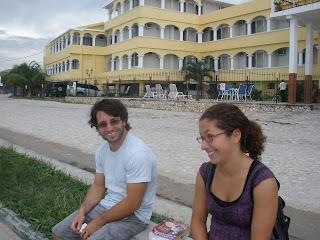
Flores echoed the peeling pastel design, and while slightly more tall buildings filled the town, it was hardly built up. Flores is an island in the Lago di Peten Itza, the most northern major lake in the country, and the smallest of the three big ones as far as my map shows (Atitlan and the largest, Izabal, being the others). It is one of the common bases for trips to Tikal (we, as you may have noted, visited it post-Tikal, using it as our final refueling pit). The island offers no actual beaches, but plenty of places to swim.

Which is nice, because there appears to be little else to do amongst the square kilometer or so that makes up the town. Our time was punctuated by a rain storm to end all rain storms, one of those rain storms where the sky doesn't seem to let up or rain itself out as it might after ten minutes in a normal thunderstorm, but keeps going, catching its breath and then unleashing fresh torrents of cooling, thundering rain, and so all anyone can do is put away their outdoor furniture and wait for things to stop, and though the rain never seems like it will, somehow, eventually, it calms down, spurts for one last flash of power, and then dies away. Considering how sticky we felt the day before, and that we had swum in the morning, this was a fine sequence of events. It even left us with a pristine sunset, as pretty as promised.
 2. Maxims for Volcano Climbing
 - It should be noted that Gina contributed in one big way to our plans. It was she who pushed for us to take the trip to the Volcan de Pacaya, a tour arranged through our Antigua hostel that would run an hour-plus on the road each way, and 3-4 hours hiking up and then down the volcano. The volcano stood as one of the highlights to our trip, figuratively and literally, so it was all in all a good call.
A few weeks before, a friend and I recalled
Dharma Bums, my friend being more into Kerouac than I. Still, we could agree on the eternal wisdom and comic joy found in Ray Smith's revelation, "You can't fall off a mountain!"
As the three of us and a tour group of 13 including us, plus a guide, hiked up
Pacaya, I kept this and other mottoes in mind.
When You Reach The Top of a Mountain, Keep Climbing - This famous Zen saying is presented in
DB as the flipside to the falling off a mountain idea. Never settle for your goals, keep pushing past for better things, etc. Or in the context of our hike, just when you think you've reached the peak after 45 minutes of hiking through a grassy, wooded area, and the views in the distance are pristine and smoky, you should consider that volcanoes emit ash and lava that make plant life quite scarce, and as such you probably have to keep climbing upwards. Unless a downwards jaunt comes next...
 Not so fast, my friends! (Ok, I learned none of these people's names except for the dude to my left, and only because I heard the minibus driver call him it. Oh, and the two girls in the middle, I guess).You Can't Fall off a Mountain!
 - So after rejoicing and group photoing, we looked out to the volcano ahead of us and took in the fact that there was still quite a bit of our climb left. Except much of it was below us first, before kicking back up to our height or higher. To do that math, one has to accept that there's going to be a little down first. Which is where ol' Jack's truth comes in.
 Where might one fall off this path? It's impossible!
Feeding out of that first peak was a long path, well trod upon and covered in ash that went ankle deep, over a meter wide, stretching down a good half a kilometer. The angle of decline was pretty good too. To tackle such conditions, one is presented with three options: 1. Pick your way daintily through the path, protecting yourself and trying to save your shoes/socks/feet from getting disgusting (an impossible task), and enjoying none of the ride; 2. "Ski" down the hill, as it resembles in consistency and slope an intermediate ski path; 3. Recall Japhy Ryder and Ray Smith and leap down the mountain, as you can't fall off.
 Gina helpfully models the ski method, with extra points for arm fashion.
After starting out at #1, not realizing what this path really was, and then morphing to #2 more out of gravitational force than any conscious decision, I brought to mind the opportunity at hand and started taking jumps. They were 5 to 10 foot leaps, and by the time I figured it out, I only had a couple more minutes to take advantage, but for that brief period, I felt like a moon walker, like Carl Lewis, like a giant of a man, able to scale great distances in easy, pleasurable bounds. It was an addicting, thrilling feeling, and if we had the time, I would have gladly gone on that slope consecutively two or three times, risking the complete ruin of my new shoes if necessary. As it was, I became the annoying show-off who kept leaping down the path even when the path changed to the post-volcano one, where people were also going up, and where missteps led to rocks tumbling down the path and into the ankles of people below, and I just took the thing all too far. Ah well.
 What awaited us after the decline.You can fall into Lava! -
 Not that we did. Still, once shaking out our shoes and resuming our single file line through the final stretch, we kept the hot red stuff in mind as our final goal. For a while, we walked past ridged black rock and occasional caves hollowed out and soaked in gray soot, the snake that our tour group formed expanding in length as the front of the pack and the back of the line grew increasingly far from one another. And then, after 15-20 minutes of our renewed climbing, I felt a hot blast of air come at me. The volcano vents were upon us.
When standing near the top of volcano, you have several different environmental factors working on you. You're at a high altitude, so the winds that blow are cold and the air is thinner and brisker, instilling a nice burn in the lungs. Climbing that high causes you to sweat and get sticky. The ground beneath your feet is rarely smooth, and attention has to be paid to find a good spot to rest at or tread further on. And then, every fissure in the ground or the mountain around you might serve as a new vent for hot air to blast at you from, becoming increasingly common as you come closer to the lava.

The lava itself offers a few interesting points. First of all, the stuff flows and oozes in a way reminiscent of all those cheesy sci-fi monster movies about the Blob or whoever it was. Nobody gets too close as to risk touching the stuff, but there's various daring feats to get closer to it, with more hot flashes than in the
Golden Girls dressing room. Also, the steam coming off the lava gives a translucent blurry edge to whatever is behind the lava, so the green scenery gets wavy and lazy.
Also, the heat from the lava can burn or melt things. Shoes, for one, if you get lazy and inconsiderate. Also, marshmallows, which explains why, when we entered the volcano park complex, the driver of our minibus let somebody open the door to sell us packs of marshmallows. Almost as odd as the fact that as soon as we got out of the van, two or three little boys demanded that we buy walking sticks from them. "Stick!" "Stick!?" they greeted us with. No thanks, kid, I'm doing just fine with what I got.
 Any time is a good time to compare trivial cultural Differences
 - While on our trek, we were in a group that included two middle aged Spanish women (pobrecitas), a lone Spanish dude in his 20's, a cute young French couple, a Brit, and 7 Americans. Nothing special, perhaps. Which didn't stop much of the conversation from revolving around the peculiarities of various British accents, what British people thought about Americans and vice versa, why futbol hasn't caught on in the states, and so on and so forth ad nauseum. No matter where you are, you're not far from the same old same old.
[/tourist snobbery]
A Merry Guide Leads to a Merry Trip - We were lucky enough to be led by the mighty Sergio, an intrepid volcano climber who effortlessly pushed us towards our destination, bouncing back and forth between the front of the line and the back. At one point, I led the group on the early part of the around one bend, Sergio four or five people behind me in line. When I reached the top of the bend, there he was in front of me, as if out of a cartoon.
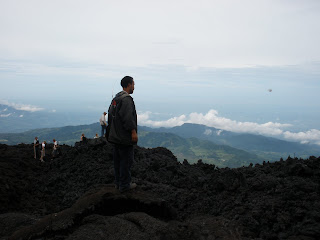
Ol' Sergio had a close to the vest sense of humor about him. Early on, the Brit asked him how much longer we had. "
Siete kilometros," he said with a smile, which occurred to us as strange, since the hike was supposed to be four kilometers in total. Then a little later, one of the pobrecitas asked him if we were coming to an easy part. "No, one of the most difficult," he said. Again with a smile. As it turns out, he was telling the truth both times (7 kms included the return down, it seems).
But Sergio didn't just fool around with us. On the easy walk back from the lava, he and another guide interrupted one another's work leading the walk to sneak up on each other, pranking and hitting and fooling around in all merriment. As we were savoring our success, it was a nice way to cap off the trek. Though not nice enough for some...
 The one side effect of not falling off the mountain was that your shoes got quite sooty. Oh well, it's not like they were new shoes that we argued over or anything, right?
Some times there's More to it than Fun - At the bottom, waiting for the go ahead to walk two minutes to our bus, Diane, the third member of the Shvartsman Guatemala team (an honorary Shvartsman for the trip, perhaps), asked one of the pobrecitas if she had fun.
"Fun? No, fun is not the word for this."
"But were you glad you did it?"
"Yes, I'm glad. It was a good experience. I can say that now, anyway. Doing it, that was not fun."
Ah well.
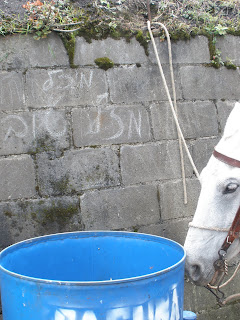 Definitely worth a Mazal Tov, ain't that right horsey? Especially if you didn't step in any of their green leftovers...
3. Buses (of chicken and other varieties) - For local bus service, your best and most common option is to take a "chicken bus". The so-called chicken bus consists of an auctioned-off, old American school bus (the yellow ones with no individual seats and the alarm in the back door), refitted, remodeled, repainted, but certainly not reenvironmentalized (as seen by the huge black clouds they leave in their wake), and returned to the roads a few thousand miles south in Guatemala. Bright colors are common, hard to understand (for a gringo) sayings may be painted on, and there may even be classy artistic
designs. To wit:

The ride on one of these buses is also an experience. For 8 QZ (~$1) we rode from Antigua to Guatemala City. Or as we learned to call it, Guate. How did we learn? By the 50th time the bus driver's assistant had hollered "Guate, Guate, Guate!" out the door to passers by, attempting to fill the bus to capacity and earn his loot, we caught on.
Other highlights of a chicken bus include getting the chance, on crowded trips, to go three to a schoolbus seat, a difficult feat to pull once you're out of 2nd grade. Also, the back door, formerly disabled and hands off for American schoolkids, is now a viable way to fill in the less crowded places of a bus later on in the ride. And in case you ever get hungry, vendors are known to get on for a minute, hawk gum or candies or fruits, and then hop off after moving a couple units. It's quite a spectacle, but then again, 1 QZ to go across Guate to the airport isn't shabby.

Coach buses are their own treat. Not so much because the buses are special or terrible or especially shoddy or anything; they're no worse than a Fung Wah bus, really. It's what Guatemalan bus companies do to their buses. And when I say Guatemalan bus companies, I mean Fuente del Norte, the biggest company, on which we rode twice.
The first time was fine: we had seats on the trip from Guate to Rio Dulce, and while not all the reading lights worked and the ride wasn't smooth enough to sleep upon, it wasn't so bad. The perennial tease when they would turn on the hallway lights for each stop, only to turn them off just as one read a paragraph, was frustrating, but whatever. What we did get a glimpse of, on that ride, was the true meaning of overbooking, as not only was every seat filled. The hallway was filled as well, sundering one side of seats from the other with a line of people, pairs of legs and
nalgas hanging at face level to remind you how lucky you really were to have that creaky non-reclining seat.
Which leads to our less fortunate ride from Rio Dulce to Flores, and another segment of how to.
How to Stand on a 4-hour bus ride - Sideways is better than straight forward - Standing perpendicular to the bus's direction (i.e. facing one side or another of the bus, not the front or back) affords one decent protection against the rapid accelerations and decelerations of aggressive bus drivers. Meanwhile, if you have the hallway spot to yourself, your rear end can easily cushion a curve towards your backside, while your hands will catch the seat in front of you going the other way. Much better than stretching your arms to the higher bars or luggage areas, wearing out your shoulders and reminding you that you're only 5'3'', you weren't made for this. Not that I'd know.
Don't freak out when the police stop the bus (twice) - Chances are, they're just hoping to catch drug smugglers. Assuming you're not smuggling drugs, just keep your wits and means of identification about you. If you are, plant them on somebody who has a seat, in hopes of accelerating the queue so you can sit down.
Make sure you have good ventilation - Standing by a window helps you get fresh air, to refresh the lungs, but also in the case that, oh, say, a child just can't make it past his diaper, and the mother, impatient and uneager to subject her poor boy to stink and poop, decides to make a quick change on the bus. That fresh air might come in handy. Also useful if you're stuck with somebody's armpits in your face for a little too long for comfort.
Get your Rest - If the bus stops, for police or other reasons, make sure you get off your feet. Swallow that pride and relax, take a load off. And if you try to do this in someone's seat on the bus, maybe you can hope anew that they won't make it back on. It's a long shot, but still.
Think clear, but not really deep Thoughts - The advantage of standing up is that you can't go pell-mell with your thought process into anxieties over the past or the future, racing through everything you will ever have to do or everything you've already done and wondering how you messed up or how you will mess up in the future. Your body hurts too much for that. Still, clear focus and inward reflection will take you away from that pain, if just for a little bit. Focusing on the breath, or perhaps the breasts, that might do it.
Rely on the Kindness of Strangers - Maybe a nice Mayan grandmother will make her grown-up son slide over to give you the arm rest to lean on. Maybe another man will see that example and offer it to your friend. Maybe someone will concede that you were ahead of them in line for a seat and give you the seat. Whatever it is, be grateful and take advantage. Even if they only gave you the seat for the last five minutes at the end of the trip.
There's no Prize at the End (except really sore buttocks and feet) - If you are the last one standing, chances are you're either the nicest guy or the biggest fool on the bus. Often, it's one and the same thing.
4. A short scene from a 1:00 am drop off on the south side of the bridge in Rio Dulce town:Late at night, with no idea of where to go. We follow the sign to the hostel, but after a walk in rain and against barking dogs of a couple minutes, we double back, sure we are lost, lost for good, lost for this night, lost forever. We return to the bridge where we were let off, where the bus driver and his assistant looked at us like we were crazy for wanting to get off there, why would anyone get off on the south side, anyway, damn what your tour book said.
A uniformed man sits on a chair outside a shack, across the road from us. He has a shotgun and smooth facial skin. "The hostel? Just keep walking under the bridge, you'll find it." We thank him, our words drowned out by a crack of thunder in the air. We march off, books in hand, back past the increasingly aggressive dog, under the increasingly aggressive rain, with the increasingly spooky thunder and lightning. Eventually, we stumble into a hostel, the hostel, the one we had reserved from Guate, where the person we spoke to asked, stunned, "1 in the morning?" before saying that was fine, no problem.
Our room was ready for us, a clean, spare room, with rickety wood walls. We unloaded and immediately went to sleep, resting our heads to the old-fashioned chatter of the heavy rain around us. We slept.
And then, a few hours later, the roosters woke us.
5. That strange Caribbean anomalyUpon getting off the motorboat after a scenic boat ride down Rio Dulce, through high-walled green canyons of insane beauty, our first greeting in Livingston was from a young man who suggested we go stay in one of the hostels in the town. "The best hostel in Livingston! Come see it!" he said over and over. "We've got the best weed," he said to me in an aside. (And maybe here I can mention that in Lisboa, 3 or 4 different people offered me hashish.) We politely turned him down and pushed on.
Within a few minutes walk on the uphill Calle Principal, we found our hotel, as a tall man of indeterminate age let us into a room and quoted us a price of 100 QZ (i.e. about $4 per person). He didn't give us a key, however, so we had to wait for the true owner of the hotel to confirm our stay. On the other hand, he did pull off the tricky double of offering me ganja and then asking for money for dinner.

Our first activity in Livingston, once all these issues were sorted (no ganja or dinner, I'm afraid), was to walk on the beach in hopes of finding a place to swim. Our book said it was a 5-7km walk, and as we strolled on the beach, two things came to the fore: there were pigs on the beach, and also huge rain clouds rolling in off the bay.

Just as we noticed these clouds and found it wise to put away the books we were holding, we also decided that maybe swimming wasn't in the cards. As such, we turned around, found the first road south off the beach, and climbed up the hill that it led through. We stood at the top of the hill and saw the storm literally rolling towards us, rain nearing by the meter, and after brief hesitation when the torrents reached us, we headed for cover and to wait out the rough parts. And we met a couple new friends.

The sisters taught us to not be afraid of the rain, and to remember that getting wet is part of the natural cycle of things. Also, they played tag and giggled and climbed all over the walls we hid under.
Livingston houses a largely
Garifuna population. The Garifuna were once a group of African slaves on a Caribbean island who eventually found their way to Honduras, Belize, and Guatemala, with Livingston as their main Guate landing ground. They have their own language, and many of them speak both Spanish and English proficiently.
Obviously, on the one hand Livingston is a strange thing in Guatemala, a Caribbean enclave of largely African heritage people, in a place one can only reach by boat (though I don't think it is an island). There's a sense of culture unique to the town, which I'll cover in a minute. On the other hand, much of Livingston's nature is essentially Guatemala. There's the lack of set schedules and the relaxed pace. There's the dilapidated neoclassical architecture, though here more reminiscent of the Caribbean. There's a greater sense of drift to the people in Livingston than in the country in general, but the lack of anywhere to go is a common theme. And the torrential rain that came down on us that first day, waxing and waning so that one had to time their dinner jaunts and exits so as to not get drenched, is common to the whole country, certainly.
At first, in the lazy cottage style and the beach, Livingston reminded me of Cape Cod. Of course, one is limited in their comparisons to what they've seen before, which makes Livingston/Cape Cod a lame comparison. The Bahamas would be more accurate, but even then, Grand Bahama Island (the only one I've been to) was more open and sandy. So maybe let's forget comparisons, na?
***
That night we went to a music show. Loosely advertised (the guy, our drifter friend, who earlier offered ganja gave us a small flier that said "Show tonight at Cafe Gari-Ubafu, with no time or date upon it - also, he caught us on the way to dinner and claimed a finder's fee of some bread from the owner of the restaurant, and then asked us for money for more food), the show took place in a small bar. Each table had a lit candle, with the only other light in the room coming from the bar in the back corner. A dusty shroud hung around the room, islands of light tearing the darkness and allowing faces to emerge. When we arrived, our drifter friend sat at another table, talking to a family he had "brought" in to the club, with some sure commission coming to him.
He wasn't the only person to appear amidst the darkness, to join a table and start a conversation as if we had stepped into a Dickens book. Another apparition joined us, telling us in accented English that he was from LA. After one of his long pauses, he told us he was from Canada. "Ontario," he said.
"Where from in Ontario?"
After a few beats, he said, "Quebec."
Also, somewhere in the conversation he offered us weed. And the bar reeked of it.
The room gradually filled to about 10-15 people (capacity was easily three or four times this), with a constant rotation to fill those 10-15 spots. Beyond the drifters and the two bar owners, everyone was a tourist, here in all likelihood because their guidebook told them Garifuna music was special (our reason as well), and eager to take in the "authentic" spectacle. Not long before, a friend told me that he used to hate strip clubs, that they made him feel depressed, but now he loved them, because, "They're sloppy, they're ridiculous, they're superficial, they're meaningless, and that's what life is." He proceeded to get a 6-song lap dance. While his argument didn't quite sway me, I had a similar sense watching the two-way performance we were a part of.
At last the band showed up and played. There were six (or at times seven) of them, three on hand drums, one playing a percussive shelf or marimba, one playing the shakers. And the others there to sing. Everybody sang. The music was a polyrhythmic bounce where everything fell into a feel of two, drums hammering over each other but well synchronized. The vocals were similarly foreign and yet united, with one member usually leading a call and response that the whole band followed. The song structure was also vague to our western ears, though after a while forms of rising and falling stood out. All in all, there was a cacophonous polyphonic monophony feel to everything. Which is to say, it all came together.
Two little girls seemed like the only locals there, perhaps unaware about how strange their presence was. The older one danced, shaking her hips in a way that our culture has indoctrinated to think as inappropriate for a 6-year old, though really it was inevitable from the music. The other one had more fun running from table to table, cupping her hands as close as she dared to each candle flame, before pulling away and running to the next one with glee.
Eventually the band went off for an intermission of unknown length. We sat back in the quiet glow of the evening, and then our air was joined by a solo effort, a woman who played a mean hand drum and sang well, her music simpler and more affecting (not that she could make it too complex). I even thought I heard a familiar famous Mexican melody somewhere in there.
As for the final word on the night, it ended the way all nights must end at a Garifuna music show. To wit, photo evidence:
 Our man espies the original drifter (OD), Alexander, working it out on the dance floor. Our man is intrigued.
 OD continues to work it on out, crowing that he's Alexander the Great, and calling for challengers. Our man, unimpressed, dares to approach the breach.
 Uh-huh. Aww yeah. Baby. Uh-huh.
 There hasn't been this much shaking going on in Guatemala since the Earthquake in '73.
  Alexander concedes defeat and offers Our Man and his posse a collective photo. Everybody's happy.
 Well, except this guy. Oh well.
6. And now, about the country itself. I certainly have felt more foreign in a country than I did in Guatemala. Morocco freaked me out the first day I was there, whereas with Guatemala the transition was easy. Perhaps it was because people were as nice as the books say, or because they're used to tourists, or because I (and Diane) know a little bit of Spanish so it's not a complete linguistic loss.
The country is almost uniformly beautiful, green hills and jungles (and occasionally lakes). Being as it's cheap and possesses many sites of interest, Guatemala is a great place to visit, and everything we saw confirmed this impression. If anything, we could have used another week or two.
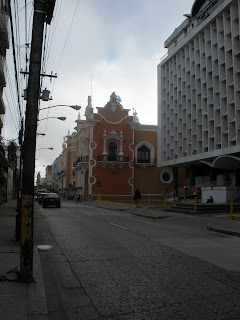
There are grimmer sides to Guatemala. Guatemala City, a.k.a. Guate (see picture and anecdote above), is a grungy, traffic laden, messy place. It also synthesizes the highs and lows of the country, full of poverty and discomfort, black smoke and old-fashioned, dying architecture. While there were no specific remnants of the political turmoil in the country over the last twenty years, except for tinted windshields, it could still be said that everything natural about the country is wonderful, while the human side of things needs much work.
We also encountered a strange set of racial attitudes, when Diane (of Vietnamese heritage, American citizenship), received frequent cat calls of, "Chinita!" At times people were just curious (a couple just asked if she was from China), but often there was a tone of menace, as in the first occasion when we walked the streets of Guate (the word "papucha" was thrown, which may or may not mean something bad, but seemed to add to the menace). It's a strange thing to encounter in a country of several races, and a country where racism is so historically endemic, but either way, it makes for a slightly less pleasant time.
Not that people on the whole were not friendly. They weren't especially friendly either, and often the congeniality came with an eye on sales of some sort. Which is part of the game, no complaints, especially considering we stuck out as big ol' gringo (or Chinese, I guess) tourists.
The lasting impression and yen for me involving Guatemala is that it seems like a great place to come unglued, to get lost in, to separate from the "normal" world. For example, the second half of
Jeff in Venice, Death in Varanasi* sees a formerly self-centered and pleasure-seeking journalist unwind and become a skinny, needless man who blends into his surroundings in the ancient Indian city of pilgrimage. Guatemala, and for some reason, though I wasn't there, Lago di Atitlan), seems like the sort of place where I could do that, just get away and turn off the world and most importantly, myself. That, to me, is a great credit to Guatemala as a country.
*(While I'm on books, Francisco Goldman's
Long Night of White Chickens, about a boy and his family torn between the Boston area and Guatemala, is fantastic, and provides an interesting perspective while going around the country.)
7. Lastly, some photos from Mayan RuinsI don't propose to describe all that we saw in Tikal, nor fill you in on the history of
Tikal . Before I let the photos do the talking, a few words on the other senses. Because a trip to Tikal includes the sounds of the jungle, of bird calls, cicada buzzes, and bee swarms, as well as the hollow thwack of the stone under your feet as you climb some of the structures. And there are the smells of Tikal, of the jungle freshness, of the old buildings and trees, of the inevitable sweat upon your body, though thankfully, not of horse crap everywhere (no horses in Tikal, making it very unlike the volcano).
In again committing the sin of comparison, I found Tikal more interesting than the one place I could compare it to fairly, Petra. Not so much in the work itself; both places had quite impressive buildings, with equally impressive history behind them. And while Petra had its share of donkey droppings, that doesn't really make a difference. The hike is slightly tougher at Tikal when you factor in all the pyramid/temple climbing, but not a huge difference.
It was the setting that really separated the two in my mind. The desert and canyons surrounding Petra are beautiful, but they don't compare to walking through a jungle to get from one building to the next. When no tour groups were nearby, which happened often, we found ourselves alone with the sounds and scents mentioned above, with beautiful lush trees everywhere, and that transports the visitor.
Also, I might add that at Petra, the nicest structure essentially comes at the beginning, while thanks to good planning (ahem) our trip to Tikal saved the Gran Plaza for the end, more or less. But that probably doesn't make a big difference, unless somebody speculates that he would be a great tour leader in his older age. Meh.
 Ceiba, the tree of life in the Mayan culture.
 The famous coatis, something of a cross between a monkey and a raccoon. Here, he shows us his better side.
  One of the first structures we came up to, at Complejo P.
  The thrill of being on top, before one realizes that being on top in Tikal involves climbing up and climbing down many, many times.
 The jungle in the morning.
 No seating, and hardly any monuments.
 The view from atop Templo IV of Templos I, II, and the pyramid de El Mundo Perdido. Also, a pleasant canopy.
 Special exploration/excavation work. Some come to this sort of thing naturally. Que es un "moleo?"
 Climbing these pyramids, you could get the sense of how easy it is to fall to your death, accidentally or otherwise. In fact, no climbing on Templo I because two people fell to their death in recent years. Eek.
 A more down to ground level set of structures. People might have actually lived here.
  And there's Templo I. Impressive, na?