Showing posts with label Foreigners. Show all posts

22.8.12

The People You Meet, Things You See - The Red Bike Rides in Bretagne, Pt. 7

07/08                                     16:32                                     Train to Rennes


Distance biked since last checked: 109 km (45 km Friday, 7 km Saturday, 30 km Sunday, 27 km Tuesday)

Today marks my first directly eastward journey on the trip. The meaning is clear: I’m almost home.

A portside Rozd in Brest
When it comes to traveling, I find the back half of a trip or the last few days more relaxing. With the return home closer, I feel less bad about thinking ahead to arrival and forgetting to enjoy today. Paradoxically, I find it easier to focus on the trip at hand when there’s less of it to think about. My last two days are all but planned, I have only one more bike ride in front of me, and no tight time constraints except to get up on time for my train home Thursday. This sense of comfort with endings contrasts with how I enjoy books. In reading a good book, my favorite moment is the halfway mark, when I know there’s as much joy ahead of me as that I’ve already uncovered. After that, bittersweetness fills a reading that I know too soon will end, even as desire to finish compels me to continue without undue delay. Perhaps the physical effort that goes into traveling and the mental effort required to plan and manage the trip blunts that bittersweetness, or maybe for all my supposed adventurousness I am just a boring homebody who would be happy reading, writing, and eating peanut butter all day without leaving the house. One can rule nothing out.

In any case, I am on my way home, with room for one last big detour. My trip as realized fell reasonably far from the details I imagined, even as of two days ago. The structure of plans and reality matched, mostly.: head west on the southern shore of Bretagne, then loop back east on the Northern side, but instead of going to a festival on a peninsula that would have required a 40 km bike trip each way with no sure thing on tickets or lodging, I went to Lorient and the FIL for a couple hours; instead of working my way through the northern shore of Bretagne over 2-3 days, I took a train to Dol-de-Bretagne, whence I will make my one stop tomorrow; instead of visiting St. Malo I stayed two nights on l’île d’Ouessant (I realized only in the Rennes train station I could have just as easily stayed in St. Malo tonight. Ah well, save something for next time).

Anyway, I’m happy with how this has turned out. And now for a few anecdotes about people I’ve met or seen along the way.

I’ve spent more time in bars on this trip than I might usually. Actually, in Europe there are few cafes as we Americans think of them, ala the local coffee shop or Starbucks. Of course there are Starbucks, but not many. Otherwise, when waiting for a train, a travel partner, or a muse to roll on through, I’m sitting in a bar cum salon de thé cum brasserie.

(The one main exception I can think of: Ghent, Belgium, where they have cupcake shops. It should come as no shock that I like Ghent).

In Auray, a town of little note for me except its position on two train lines, I had a beer and waited for my train to Lorient. Behind the bad a woman with chestnut-brown hair and the wrinkles of the late 40s worked. A man with a large backpack, a large dog, and both a grizzled voice and a grizzled face stood at the bar and had a drink. A couple of old men sat at the right of the bar. A couple of not quite as old women sat at a table to the left. I sat at a table in the middle, against the wall facing the bar. Across perched on a stool a girl with short dark hair and a turquoise shirt, cute, more or less my age.

In to the bar came two men who sidled up next to the girl. The one, older, bigger, with a bandana over his hair, exchanged kisses with her. The other, wiry build and wired energy, talked with the barmaid about what beers were available. His choices were not. His voice rose. He said something choice to either the girl or the barmaid. His companion asked him to go wait outside. This appeared to be a ritual for the duo.

The older of the two men continued to talk with the girl, standing. The other recurred at the door, anger still on his breath and voice. His only pause was to love up on the dog. The dog, at least, did not get upset at him. The rest of us continued our activities as if all was well. The train of life approached.

The man made a last sally to the bar. The diatribe renewed in his tongue, he uttered a choice word at the barmaid (I missed it). A man working at the bar appeared, furious, yelled at the man, it was about time to stop talking and start punching.

Calmer heads prevailed. The older man banished his companion again. The barman cooled off. I caught the eye of the barmaid, drying a glass and shaking her head. “He was looking for it,” she said.

In a bar on Ouessant, a similar tale.  I sat at the bar and drank a Belle Kriek beer (cherry, Belgian), reading my Polish book and watching the TV, the latter more successfully. Around the curve of the bar to my right, a local drunk stood. A green sweatshirt, shorts, thin graying hair, and a half-conscious, eerie smile on his lips. A box of Kinder Bueno bars rested on the bar next to him. A couple of kids came into the bar, about 14 years old, asking for fruit drinks (earlier, walking, I heard the boys bragging about all this alcohol they had on them – vodka, whisky, etc.). The drunk tut-tutted them but with no authority, unheeded. Instead, he tried offering everyone within reach a candy – me, the kids, and so on. Also to no avail.

Another man joined the first at the bar. This had wild gray hair and a stubbled, attractive face. His yes held a spark and his look was, as yet, sober. He ordered a drink and fell into banter with the first man. The two rearranged chairs in the room, possibly with intentions of emulating the 3000 meter steeplechase shown on the screen behind them but most likely out of the first’s impetuous inebriation). The second joined in the Kinder Bueno game, buying one and putting it on his tab – he had a golden credit card with a company name on it. Again, I turned down an offered candy bar.

The energy finally went sour as the bar staff decided the first had to step outside (they may have picked up on the annoyed looks from me and others at the bar). The second, after asking if he too had to leave and hearing he didn’t, turned his liberated attention elsewhere. He was impressed with my Kriek beer and asked, several times, for the name so he could order one. He asked me about my reading before backing off when he either heard my French or decided he might disturb me. After I moved to a table (in part to avoid the first drunk) he again pointed to my book or my beer and offered to buy me another, flashing his credit card. “Vous êtes très gentil,” I told him, “but I’m leaving after the race.”

Outside, a yell and a tumbling piece of furniture clattered among the din. One of the hotel/bar staff ran outside. A few bar patrons joined. I did not go and rubberneck. The second stayed at the bar, craning his neck towards the door and perhaps finding his beer a little sweeter. A man with a notepad entered a few minutes later.

Usain Bolt won the race, of course. I stepped out, thinking of humanity’s highs and lows.

Outside of the bar, the train is a good place to catch sight of our curious habits. On one train, from Lorient to Quimper, I sat in the entry area with my bike. Across the entry way, a white-haired woman sat next to the bathroom. Perhaps an inappropriate place.

A man in the car behind her came to use the bathroom. He was bald and dressed in a Picasso-striped shirt. He tried the bathroom door. It didn’t give. Once or twice more he tried before leaving, perplexed. The woman said nothing.

A minute later a man left the bathroom; I had not been sure someone was in there. A minute later, a young woman staggered into the bathroom, looking not all there. Our striped-shirt man tried the door again another minute after, again with no luck. He tried once more, then looked at the woman. Only then did she tell him the bathroom was occupied.

Passons… the man, without ever changing his strategy by actually waiting for the bathroom, finally got in. A young woman tried the door, found it locked, and waited. The man left. She entered, did her bit, and exited. She left the door half-open. The woman, not one to speak, stared at the girl with annoyance for a few seconds, then rose from her seat and shut the door.

On a different train, from Brest to Rennes, a man struck up a conversation with me about my bike. As with Jeff, it was another of those French-English foreign conversations. This man congratulated me on my journey.

The Picture I took
In between trains in Quimper, before stopping in the African bar, I walked around looking for an internet café (I traveled on this trip like it was 2005). As I crossed over a bridge a couple blocks from the train station, I stopped to take a picture. A black man with dreads approached me and asked if I was Italian. He had a few teeth missing and a beer in his hand (it was a little after noon). My answer that I was American excited him. He told me he was from South Africa, where the last World Cup was, did I go? My negative response did not dissuade him from giving me a big handshake as we parted.

Before capping this ramble, I’d like to mention something about crêperies that I’ve observed after eating crepes an average of once a day since arriving in Bretagne. That is: one cannot order two crepes at once. The waiters worry that either the second crepe or your appetite will cool off too much for it to be worth it. So one crepe at a time does one progress through one’s meal. Also, when one switches from salty, buckwheat crepes (known as galettes) to sweet white flour dessert crepes, the wait staff changes one’s silverware. This does not (usually) happen going from galette to galette. This makes sense but still amuses me.

On Sunday, I rode my bike to Le Conquet from Brest to catch the ferry to Ouessant. Many dark clouds blew over the city, and the sky was clear enough in its cloudy way that one could see the wind at work. Having a fair amount of time to make my boat, and still tense from the night prior (of the Aching Jaw), I decided to wait out the rain when I could (I avoided the two bigger of the three rainclouds that passed over my head).

It was while waiting out the first, still in Brest, perched under a bus stop with my legs folded under to evade the windblown drops, that a woman joined. She had gray-brown hair to match a gray suit, and a faint blond mustache that was all the same quite visible, and in 15 minutes or so, she told me much about her life.

She has a cousin in the Bay Area who she learned about well into adulthood; the cousin’s father left France before the war and, despite aiding the war effort in the U.S., would have been tried as a deserter if he returned. She lived in interior Bretagne before moving to Brest when she was young and the city not yet rebuilt from the war. She finds native Brest folk (Brestians?) standoffish and unhelpful, making it two people I met who moved to another place in Bretagne and disliked the locals. She similarly dislikes people from Luxembourg and that part of Germany, finding them cold, unlike Germans from Munich. She also dislikes Russians and their difficult literature.

I learned that Mongols fought for Napoleon and then stayed in France after the war, helping to build the Nantes-Brest canal. This woman had Scottish and, she thought, Mongol blood in her. Almost every time she made a reference to Mongols, she pulled her eyes thin.

Such are the people I’ve met and the interactions I’ve seen on this trip.


13.8.12

A Series of Ordinarily Extraordinary Events - The Red Bike Rides in Bretagne, Pt. 3

02.08                      23:00              Hostel Room in Quiberon
Weather: The sun overcomes, the wind still blows fierce
Distance biked: 75 km yesterday, 45-50km today

Jeff was the 3rd most extraordinary thing that happened to me today. He approached me as I sat at a table in a bar. The bar was not crowded; five to seven locals joked around the bar, and I sat alone, half a floor away. I sat crouched over this very journal, finishing yesterday’s entry. My bike helmet sat on the table in front of my beer. I wore my “civilian”, non-bike clothes, but no doubt still stank. Beneath me lay my bursting backpack. As always, I must have cut a strange figure.
“Where from?” he asked me. He had been walking back from the bathroom. I told him, in French.
A simulation of our linguistic struggles
“Who you?” he continued in English. I don’t mean to brag in saying it, but I will: my French was better than his English. Certainly more fluid.
“Je m’appelle Daniel,” I said.
“Oh, I’m Jeff.” We shook hands. He had long curly brown hair and bright blue eyes and facial hair all over.
He asked me what I was doing, why I was in Bretagne, and where I was staying. He stuck to the English. Rarely am I out-stubborned over which language to use, but I had to hand it to him. I ended up throwing some English in.
“You’re going to Quiberon tonight? Do you have number?” He meant phone. He proceeded to offer me a place to stay at his house. He wouldn’t be there that night, but his girlfriend would. He then told me to see the Côte Sauvage and take pictures (he mimed taking pictures with his hand). By the time we ended our conversation, he had told me work was good in the tourist season – the summer – but not for the rest of the year, that he was from Nantes, and the Breizh (Breton) word for “see you soon” at our parting (Something like Quenavoohoo). We also exchanged a second, more elaborate handshake.

I don’t know why they always come to me, but they do.
(I was not bold enough to take Jeff up on his offer).

***

The fourth most extraordinary thing today was biking through Elven. The town was nothing special, but its name is Elven! (An Elven in Breizh. Vannes is Gwened in Breizh. Pretty cool).

As I said, Bretagne has Celtic roots. Breizh is related to old Celtic languages, with lots of gw, q, k, and ac sounds – the most familiar Breton name to Americans I Kerouac (also Bretagne – Brittany in English – is related to Grande Bretagne in French – you guessed it, Great Britain).

For me, Celtic roots mean nerdy fantasy worlds I ate up as a kid. First Lloyd Alexander’s Prydain Chronicles, then of course Tolkien’s books. I was not terribly sad about missing Merlin’s tomb, but if you told me where the village Beren and Luthien passed the end of their days, I’d be there yesterday (that’s a Silmarillon reference, uber-nerdy Tolkien stuff). 

If the shoe fits...(though really, I'm more hobbit-like)
Part of the excitement and majesty of this trip for me is to explore a related setting. I trek through forests and wide wheat fields, past mysterious ponds and quiet stone hosues, over hills and to windswept coasts. The interior of Bretagne enchants, and towns named Elven only add to the fun.

Not all of Elven was fun, however…

***

The most dually frustrating and positive thing today was that I bought a map. The map kept me on track – no zigzagging today. The only diversion was when I found a bike path that took me along the canal between Nantes and Brest. This was great, and I only wish it could have been more on my way to Vannes. Biking on flat, quiet bike paths by water is hard to beat.

The frustration is twofold. First, when I have a map, I look at it. A lot. Like every time I come to a significant intersection or a new town. My memory is good but not for pictures, and doubt is strong in me. Most often this is seen in the many photos of me traveling, with a backpack on and my nose in a book. It’s usually a guidebook, and I’m usually checking a map.

More physically frustrating was that my map showed no topography. I had no idea when hills were coming. The ride through Elven felt like one long uphill with brief flat pauses and the rarest of dips in the road. I pride myself on being tough, but 100 km in two days and hill after hill is enough to knock the tough out of me. One of my cycling maxims (I’ve at least two) is that every uphill is rewarded and every downhill paid for. It sure didn’t feel like I was rewarded today. Only on the last 10 kms did I rediscover my gumption and gut it out. A few downhills helped.

***

A few pettily extraordinary things:

-          I’m staying in a hostel. The only thing I don’t like about hostels is sharing my room with strangers. I’ve not done so in a long time, maybe four years. Still, for this trip I thought I could deal with it. What the hell, I want to go cheap. Them’s the breaks.

I showed up at 21:30, a half-hour before reception closed. I got placed in a room with four beds. Alone. Hot damn.

-          I showed up so late due to finally conceding on the train front. I had to take the train one stop before transferring to a train for this peninsula. The earlier train that went was a TGV, the one where you have to pay.
I could have said fuck it, snuck on, and hoped I wouldn’t have to deal with anybody for the ten minutes before I changed. Instead? I took a ticket for a later regional train and went for a drink and dinner in Vannes (meeting Jeff in the process). Maturity, I guess.

-          As mentioned, the sun came out. Ruins my joke that the one thing in my backpack I could do with out is the sunscreen. I did wear my long-sleeved shirt tonight.

-          I kept my Olympics streak alive, watching the women’s gymnastics tonight in the common room. I don’t think I’ve ever watched them so much, at least not since I was a kid – in ’08 I had just moved to Israel (no tv), in ’04 I worked two jobs, etc. Growing up, the Olympics were just about the only really-approved sports programming in our house. My mother liked the gymnastics, swimming, skiing, and figure skating.

-          While writing this, I finished my survival pack for the day – bread already gone, I ate an apple and finished my bar of chocolate. The chocolate only had half a row left. “Who’s been eating my chocolate?” I thought. I always eat it row by row, and the only way I would have left it like that is if I had been interrupted.
I checked in my back pack. There on the bottom was the rest of the chocolate, broken off. Good thing I checked.

***


The second most extraordinary thing I came across today was the beach. I’m staying in a hostel just north of Quiberon, on a narrow peninsula (Jeff described the people here as close-minded, “Quiberon for Quiberon” types, saying that 15 km out in the water, the mentality is bizarre). The beach is right there. So after checking in and claiming my room, I threw on my long sleeves and walked over, hoping to catch a glorious sunset.


There was no sun to be seen, though at 21:35 it was still light out. Plenty of other things demanded attention. I reached the sand and saw little white specks jumping all over. I thought at first that they were specks of trash blown about that looked like bugs. On further inspection, they were bugs. Leaping little whit erratic maggots or something. They popped left and right and up and down like excited gas molecules, with only rare periods of considered crawling. Barefoot and otherwise, I found the buggers all over my feet and ankles. They covered the whole dry sand area, especially congregating around seaweed and such clumps.

The wet sand area was the biggest I’ve seen. Wide as a football filed, the smooth sand was covered with a slim layer of water, not enough to stick up your nose or drown in. It represented a large tidal variation.

I walked barefoot out to the water’s edge. The water chilled me though gulls braved it. I skipped a few stones before my weak shoulder ached. The ocean roar drowned out my singing. Down to my left, on the south of the peninsula, a few lights shone, Quiberon’s agglomeration. Two couples sauntered on the wet sand. 


And then I turned around. Rising above the tree line, not visible closer to the shore, was the full moon. Orange and ripe like the whiffs of stinky cheese I bumped into en route, the moon hung over as if ready to swallow the peninsula. With such a narrow base and 15 kilometers out into the water, with all this as normal, it’s hard to imagine how the locals could have anything but a bizarre mentality.

The most extraordinary thing today? That breath filled my lungs, blessings my life, and that I was able to take part in all of it. And that I have another day to tackle tomorrow.

7.5.11

New Orleans Hipsters to Herzliya Arabs - Breaking onto new Pitches


There was a moment in the game that Monday where a player on the other team stood at little past the mid line with the ball. Though it was a football (i.e. soccer - I'm going to use football the whole article, for consistency's sake) game, not necessarily conducive to man-to-man marking ala basketball, we were only playing 4 on 5 and I was ready to cover him. He stood there, however, with nary an eye towards me, nor towards advancing the ball towards our net. Instead, he looked at his teammate and cussed him out. This opponent of mine, the one with the ball, didn't look all that different than me; he berated his teammate in a language I don't speak, one that isn't too different from a language I do speak, but that to the uninitiated ear has a harshness to its beauty, a harshness that lends itself naturally to ripping into friends.

This yelling, back and forth, went on for about 20 seconds. Were this a true competitive endeavor, I would have had no trouble stealing the ball, sprinting to a breakaway against the distracted keeper, and misfiring on an easy shot. This a friendly outing, at least for me, I sat there and watched the conversation. I, the only non-Arabic speaker in the crowd, may have forgotten to keep my lower jaw from slackening. So when the man with the ball finally stopped his venting and turned his head back to the field of play, the nine of us, aware of the absurdity that featured me in the middle, watching all of this, burst into laughter. The laughter lasted another ten seconds, and then we resumed the game.

All the potential fruits of sports and travel, wherein we cross boundaries, realize anew how differences remain, and play on anyway, those fruits spilled out of those ten seconds.

***

For someone who never played formal football, I've had quite a career with the sport, as it were. There was high school cluster (i.e. intramural) football, where I gained rep as a fearless and athletic if not necessarily good goalie, the type of "intense competitor" who stayed on the field after the finals game senior year, one in which I gave up 5 goals, two of which I still don't hear the end about from a friend on the other team. Then there was fall workouts for wrestling in college, where we'd alternate between ultimate frisbee and football as conditioning games; I was notorious for playing hard and for a zero shooting percentage, my misses worthy of an hour-long blooper reel. For my two full years in Israel, I was improbably the assistant high school football coach, specializing on working with the keepers and the reserves; one of this year's captains still calls my motivational speeches "the best", though I should also point out that the team finished 5th this year in the final tournament without me after 7th and 10th (out of 10) with me.

The football career at the center of this post, however, is even less formal. I refer to the pickup games and local gatherings I've taken part of in various places. The excitement of the World Cup 2006 leading me into a regular game during my one summer in Durham, NC. The games I played that fall in the neighborhood rubber court with the boy from the family I lived with in Moscow, notable for the teenagers, two of them, who would smoke cigarettes during the "halftime" break. The game Ben brought me to in Madrid over Thanksgiving 2008, where the best player on the pitch was a girl who played at Oregon St. The game played in the sunset last fall in Rwanda with genocide orphans.

Here is where I could insert the cliches about the commonality of sports, the shared experience inherent in a game, the way boundaries can be bridged and friendships made over a meeting ground of rules and end lines and balls, all the stuff included in that "potential fruits" sentence that ended the section above, and then remind that there is no larger, more common meeting ground than football. Cliches are nice to lean on every now and then, as Paul Simon said in a recent piece on inspiration and "genius". As such, I allow you the space to lean on that cliche as much as you'd like.


That taken care of, I'd like to avoid the cliche by going into the particularities of these two recent settings, my last two games, one in New Orleans, the other in Raanana, Israel.

***

I lucked into the New Orleans game. One lucks into all of the soccer games they might play. One also creates their own luck. Seek a game and it can be found, as long as one is open to luck.

I lived in a "communal house", as the owner called it, a five minute walk from City Park in the Mid-City area of New Orleans. The house was freezing; the unadvertised downside of living in a warm-weather area is that all the houses are designed to be cool. This makes sense, is a logical approach even, a pleasing example of the convergence of architectural necessity and environmental efficiency. It also means that if the warm-weather area gets cold, due to a natural cycle, a climate change twisted world, or the impending apocalypse, one's abode is miserable to be in. In Israel, this was a problem of tile floors and windows facing North-South to limit sunlight; in New Orleans, big open wood floored rooms with no heating system made nights cold and rainy afternoons more pleasant outside than in. Add in the inevitable disappointment over the false bill of goods that a warm weather area has peddled to the visitor or transplant in winter, and time spent in the house, even for a homebody like me, takes on a significantly lower quality.

Anyway, in this communal house lived four other people. Two were the owner and her husband, she a New Orleans native who had taken on the hijab, presumably upon marriage, and he a Palestinian-American with a heavy Jersey accent, only slightly ground up by his Arabic tongue. Another was a New Zealand gal traveling around the world, paying her way by working as a waitress (on Bourbon Street here; her next stop was Nashville). The last was a Louisiana native of about my age, a nice guy named Bryant who happened to be on a kickball team and, even more pertinently, to organize a weekly football game. Such was my in.

A weekly game on a highly visible if officially private field opposite City Park (we were kicked off this field once or twice in the three games I played there) is bound to attract four different groups to its games:

1. The originals, meaning the founder(s) of the game and then their initial circle of friends who want to play. Keeping it to just this group will ensure a cohesive vision of what the game is meant to be about and what the level of the players will be; the drawback is that unless the founders are really popular, there won't be very big games. In the Israel game to be covered below, for example, I felt that all the players were of this group, with the exception of me of course. Cohesive, but also only enough for 4 v 4 without me.

2. A group of hardcore players, hardcore in the sense that they will show up come rain or shine, Saturday or Sunday, hard week of work or not. In our case, this group did not consist solely of the original members; Bryant invited one or two of them, who then invited the rest of their group, who then decided they needed to take the intensity UP a notch, leading to some friction between the original members who just wanted to play a nice game of footie and those who wanted to play some fucking football, brah!! This friction was resolved before I got there.

3. The semi-regular friends of the hardcore and originals, those who will play once or twice a month, who view it as either an occasional workout to get back to their athletic roots or a social outing (worth noting here I think that, fair or not, about 95% of the athletes at the NO games were male, and 100% for the one game in Israel). Essential to have a regular rotating cast of this group to have a fun, relatively good level game week in and week out. Conveniently enough, until I move to a place for more than a month or two, I fall into this category.

4. Passers-by and other strangers who happen to stumble upon the game via word of mouth or voracious search of a city's fields for a possible game. The biggest wild-card of the four groups, as the strangers can either add a joyous synergy to the game of unexpected quality or drag on the overall group's harmony or level of play. A tough thing to predict, but one can't turn away strangers.


The first time I played was within a week of moving into the house. I hardly knew Bryant, am not the most outgoing person among strangers, and so stuck to my lane. For pickup football, I interpret that to mean three things: volunteering to do the menial tasks that help the game along (playing goalie, fetching the ball when it goes astray in warmups or game time), playing hard but fairly, and keeping my mouth shut except to respond to people talking to me or making jokes in my direction (a smile and a polite laugh is all I need in those situations). Not integrated into the game and not a dominant player (or personality), I carved out the niche of running hard along the outside, occasionally getting the ball on breaks and creating opportunities for my team. I also leveraged my big advantage, besides hustling: physicality. At one point, I bumped into Bryant, who was playing on the opposing team, and threw some muscle into my efforts to take the ball from him. "Oh, hey roomie," he said in mild surprise as we tussled. I made sure to say sorry and put my hands up after I passed the ball away. In my unofficial stat keeping of the number of positive plays I made versus the number of times I messed up, I think I came out in the black, if ever so slightly.

I have long mulled over the words of T.S. Eliot in Four Quartets - "For us there is only the trying/the rest is not our business," though perhaps denuding the statement of its fatalistic/catholic meaning. I consider that to stand as a general prescription for how to lead one's life when existing in the blessed world of the western middle class, where we can expect effort, meaningful effort, to afford us continued opportunities and at least a reasonable subsistence. In pickup football, where no one can really expect anything of a player except effort, this trying becomes all the more singularly essential.

Why I wrapped myself in the protective shell of hard work and amiability, I observed group #2 in action, exhibiting their New Orleans particularity. A group of young fellows more or less my age, apparently NO natives who used to play together in high school or youth leagues, they offered both the upper crust of talent in the game and the majority of the talking, stamping their personality onto the spirit of the game.

Their personality, collectively, was loud and rowdy, reminiscent of, well, young men who like to play sports. Constant slurs and taunts flew between them as they played on opposite sides. I learned, for example, that "Jamook" is a taunt against people of Italian heritage. Also, I saw the plight of the athletic but not exceptionally talented female when playing in this crowd; every time one of the three girls who showed up over the three weeks would make a solid play, the bullhorn of this group would cheer for her: the intention was good, the result a little patronizing.

That said, this group, especially the louder fellows, consisted of mostly nice people. By my third (final) game, they knew who I was and were happy to see me. There was rarely if ever malice in their voices or taunts, just that constant veneer of shit-talking and easy joking that defines behavior and relationships among young males, in America at the very least.

What football, or any group activity, can provide to the traveler, the visitor, the new implant in a city, is a chance to tap into a new network, to find a way to connect to a new population in a new place, through doing something familiar, old. A friend of mine always said that the best way to meet people (I think she and I were talking about potential romantic partners at the time) is by doing the things you like to do in ways that allow you to meet other people. Fortunately, I stumbled on a romantic partner through a job, saving me from the dating scene. But when it comes to the occasional need that I feel, a need most people probably feel more often, to spend time with fellow humans, to interact, to laugh at dumb jokes about one another's physical incompetence, this strategy becomes valuable. Football as a way to make friends, I'm saying.

***

I didn't join the game in Israel because I wanted to make friends. I'm only in Israel for a total of 9 weeks this time around, and have plenty of friends who are still here. I'm a short-timer through and through, and don't need very many friends anyway. No, that didn't interest me very much. I was just seeking a way to workout, a way to run, to expend physical energy in a way not allowed by standing in front of children for 3+ hours a day.

Shortly after my return in late March, I met with my friend Yehuda, and my exercising desire came up. He, no football player, mentioned that he had a group of friends that played at the Sportek in Herzliya every Monday night. The group was a set of Israeli Arabs, at least a few of them students at the university Yehuda and I had just earned our M.A. from. This certainly intrigued me further, and a couple Mondays later, I was on my way to meet with the gang.

Political discourse in Israel finds itself in an interesting, if troubling place in 2011. On the one hand, the distance between politics and life is much narrower here than anywhere else I've been, closer than the occasionally energized U.S.A. in the last decade, closer than the easy benevolence of Western Europe, the unapproachable abyss sundering citizens from their leaders in Rwanda or Guatemala, or the laughable remove at which Putin and co. operate in Russia. The country is small, meaning that people are more likely to know their leaders or meet with their leaders, but more significantly, the issues are more important, matters not of just getting a job or paying an excessive amount of taxes, but of what the country is to become, of peace and war, of, in a reductive phrasing, life and death.

At the same time, Israelis that I encounter appear to be worn out from caring, eager to submerge political discourse underneath the easy calm of everyday life, an everyday life that, when removed from the question of the territories, the fact that most young people serve in the army, and so on, is pretty nice. The weather is great, the economy has done as well as almost any western economy in the post-crisis climate, and cultural life here is unique, a mix of European heights and Middle Eastern zest. Why bother with the difficult issues that affect the country, especially when they're not going to be solved either way?

I don't mean to simplify the situation, nor to judge, at least not as harshly as the above question might appear to do. Humans do not have the capacity to take on constant complexity and moral ambiguity over a period of 10 years, 20 years, 63 years, thousands of years, depending on how you define the situation. Politics are still talked about, still essential, but there's also less reason to talk; most citizens have made up their minds one way or the other, and either the status quo will hold on for the coming years or the logjam will break and the floods of change will reach Israel as well, for better or worse.

That digression takes me away from the story though, and I apologize. I meant to say all this as an introduction to the fact, unfamiliar to many who haven't visited Israel, that there is a large Arab population within the country itself. About 20-25% of the citizens of Israel are Arabs. They vote, they live in mixed communities as well as their own, and they are a part of the daily fabric of life here (for some obvious examples, often Arabs work as gas station attendants, and not coincidentally many gas stations feature good Arab restaurants). Definitely, there is discrimination for the minority, but from what I can tell over my time here, the best historical analogy of the Arab situation in Israel itself would be to African-Americans' place in the U.S. before the Civil Rights movement. Arabs in Israel have more rights, I would say, but there is more intensity to the feelings between majority and minority.

That further digression is to explain that while I had no intention to bring up politics with these Arabs in either an explicit or implicit sense, I thought it would be very interesting to spend some time with the group. I knew Israeli Arabs, either through school or through frequent encounters, but I wouldn't number any as acquaintances even. This was an opportunity to open a window on a different part of Israel. And to run around and kick a ball.


***

I ran to the Sportek just after 9:00pm on that Monday night. The main organizer, Nabil, had mentioned the possibility that the courts would be full in Herzliya (we would play on a basketball court, basically), and that we might have to drive to the next town over, Raanana. For that reason I couldn't bike over either. I ran to make sure I wasn't late.

I got there, didn't see anybody, and called. Nabil and co. had made the decision to drive over to Raanana and somebody would take me in a car. I gave the description of what I was wearing and where I was, and after a while, a cat named Weill (that's how the name sounded, anyway) found me. He called the driver, who brought the car over, full of passengers already. The driver had a long black beard, the type we associate with religious Muslims named Omar (his name). Another car pulled up with Nabil, who shook my hand happily and said we were going to Raanana, so pile in. I squeezed into the first car, a compact, Weill sat next to me, and we drove with 5 passengers over to the next town, I trying to quiet my inner alarm bells.

As cultured and well-traveled and unfazed as I claim to be as a modern liberal citizen of the world, those bells persisted. My concerns numbered as follows:

1. I have just gotten into a car with five young Arab guys I don't know. The one friend who told me about them is a great guy but who knows if his judgment is always the sharpest? Again, for purposes of analogy, think about getting into a car with 5 locals in, say, East St. Louis.

2. Never mind what they might do to me, that's ridiculous - I had already brought very little money with me, I'm unimportant, they came recommended, that's fine. But what if the cops happen to see a heavily bearded Arab driving a car and notice that he is driving a car with five passengers for 4 seats? Wouldn't it figure that there would be trouble? That might not be good for my job security.

3. Did I remember to put on my Tom's of Maine brand woodspice-scented deodorant that night, or just in the morning, and if not, had that morning application worn off?

As usual, these fears were exaggerated and unrealized (well, except for #3, but then, we were men about to run around: bad smells were typical). Weill and I had a pleasant if mildly uncomfortable talk about our university, uncomfortable not only for the clown car conditions but because he wondered why an American would ever bother to study in Israel. I explained that I came to work here and then just studied while I stayed an extra year, but avoided the subject of the Jewish right of return and the identity Jews around the world feel with Israel, sensing that could get us into a drawn-out political conversation that while likely to be perfectly reasonable, would have perhaps been a little premature in our relationship.

We arrived at the court safely and found a couple guys shooting at a hoop on an otherwise vacant court; the adjacent court had a full football game with Israeli kids going, and so we would have to find a way to convince these guys to let us play. These two players, like many of the kids on the other court, wore kippas, denoting their religious beliefs as Jews: if Herzliya is one of the most liberal and secular places in the country, Raanana is a little bit more conservative and certainly more religious: I remember driving through their once and seeing an ad campaign for women's underwear, a series of ads on the median of the main road, crossed out with big white stripes.

This was the other big inner tension I felt during the game; the possibility of friction between our group and any other groups at the park. Again, any fear was unfounded, but as a dovish, grovelling, peace-loving American from a land where everything works (more or less), as a middle brother in all senses, I was eager to see no further tensions emerge. I imagined how Jewish Israelis might perceive the harsh foreign sounds of Arabic or the accent my fellow football players had when they spoke Hebrew (which they did better than me, of course), I imagined them (the Raanana Jews) finding them (the Herzliya Arabs) aggressive, pushy, rude, and them (the HAs) feeling the same way about them (the RJs), and me stuck in the middle, powerless and in between.

Again, nothing really happened. When balls were kicked from one court to the other, each group helped the other get the ball back, as marks typical football behavior. There was no anger spilled over from one group to the other, no signs of serious tension. Well, except for the anger and tension between the two guys on the other team of my game. And that is all well and good on the court in some measure.

The game then, was like many other football games, for me most reminiscent of the ones I played in Russia on a similar rubber court. 4 on 5 made it hard to play truly evenly, and there wasn't quite as much running as I'd like, but the energy was expended ne'ertheless. I was again about a mid-level player, good at running and hustling, not so great with my touch or shot, better than average when playing in net. The other players were in general better with the ball but not as quick or aggressive. It was just a football game, not much different from the one in New Orleans, and mostly different because of the numbers and the ground we played on.

The difference was all in the details. Like how every call or word the others spoke was in Arabic except when they spoke to me (in either Hebrew or English) and then maybe for a phrase or two afterward as they repeated what they said to me or stayed in the foreign tongue unconsciously. Like how Arabic became slowly more comprehensible to me, or at least the sounds became more distinguishable, rising from an initial bouillabaisse of, "ha-ra-wa-la-err-yuu-fa-ras" to words I could grasp, words I could ask about, like himsa ("five", if I remember right) and erjaa ("get back," yelled all too often for the team of four). Like the yelling I started this piece with.

There is little other profundity or humor that came out of that night. We had a good time, the guys dropped me off at my apartment after the game (only four in the car that time), I said I'd come and play after Passover break, I talked with Yehuda about the guys last night. We didn't achieve peace, we didn't become great friends, we didn't get into any fights. We just had a good game, and plan to do it again.

When moving from place to place, a traveler, me or any other, has to devise a balance between experiencing the new place and keeping a sense of self intact. That sense, that balance, is thrown off at times, which is one of the jarring effects of travel, opportunities to change for better or worse. But one cannot always be jarred, and so there emerges a need to straddle the divide between the world, new and foreign, between being with other people and being alone.

Just as doing things you like to do is a good way to meet people, so is it a way to find that balance abroad. The activity remains familiar, the people different, and the time spent more meaningful and amenable at the same time. And when it comes to finding common activities to do with strangers, there's little better than kicking a ball around and running after it.

27.10.10

Rwandan Ruminations

A smattering of notes, poems, and pictures from the Rwandan trip. When I use a picture that was not actually taken by me, I will credit the group. Many of the photos from the last post, including all of the dancing photos natch, are from the group. Also, the poems would ideally have indentations on various lines, but I don't feel like dealing with the formatting to figure that out.


Group photo.

First day of the trip entry:

A white cocoon envelops our group somewhat. Kigali is nicer than expected, more developed, more expensive. One drive through it was not enough to get a grasp for the city; it sprawls out along hills as if in a countryside. The city is green and red and gorgeous. I sat facing the east through twilight and felt a surge of awe rise through my guitar playing. After dusk with cicadas, lights dotting the hills, and the scent of mosquito repellent, Kigali returns to a natural state.

People have behaved on a spectrum from overly friendly to suspicious and sullen. Our customs officer asked me how I was and our young Rwandan aide is irrepressible to the poitn of obsequiousness. The man who opens the gate to our hostel waves excitedly at us when we enter or leave. People do seem to look at us whenever we pass with curiosity and either eagerness or distrust. Our waitress was polite but coldly so. Many were eager to accommodate us whenever an opportunity came up.


Chanted vocal music bubbles over to us on our hostel porch. Choral music rolls strong and spiritual, whether religious or traditional, harmonic monophony with flashes of call and response.

We must suspend our expectations for this trip. Processes are often slow, many things don't work, we will get sick or lost or sore or cranky. In flavor and degree, this will be a trip unlike any I have experienced for a long time, if ever.

24/09

Obviously, someone else took this, but on my camera. If that makes a difference.

The Visitor


Birds chirp all around me
a cock crow is what woke me
It is a multifabric blanket of sound rising from the hill
Coming to cover me until the sun reaches my part of the hill
A human voice, human labor,
Sometimes this thread emerges on the blanket
I await the blanket, Africa is colder than I thought
And I am a visitor in this land,
A group surrounds me, a white cocoon in the black land
Some know more, some less, some care not to know
Some are connected, some are plugged in
Some are digging, some are sleeping in
I know no more than anyone
And knowing is not a character trait that makes me better
The bird chirp blanket and the white cocoon and the air less than hot
But all I am is a visitor in this thought

Second day of the trip entry

Rwandan restaurant - the wait, the good goat meat, the Ugandan waragi (rubbing alcohol and gin), chapati in a back room of a side street with a smiling hostess Sara called sister (dada) in Swahili, the armed men on the streets. Habyarima's house with secret passageways and torture rooms and churches for Christianity and animist faiths, wreck of the plan, the desire to change the house into a museum. A tightening of the group. The glow of our trip in its absurdity and naive expectation in the face of trauma.

Group photo.

Nyabarongo River entries

He is six or seven years old, dark skinned in a dull brown t-shirt and darker brown pants. I say "mwarimutse" and "amakuru". He says "nimeza". He has a plastic water bottle one-fifth full with coins. He asks me something, uses the word "falanga". I smile and shrug, then say, "nitwa Daniel," using poor Kinyarwanda. I ask, "witwande?" He says "Tunezi Bevinda" or something similar. I ask him to repeat the second name, he does, I say "ndakwashimaye" tow or three times until I get it right. We stand. No words are shared. A minute later he moves, I wish him a "nimosi meza".

As I write this under a bridge, a man in a hat walks by. We talk about where I came from, about where we are, basic pleasantries, and then I see I have to go. I wish him well and begin to leave. He reminds me to take my camera. Very kind. He laughs at my sloppiness as I smile and walk away.


***

Imagining the river full of bodies, the strong current bogged down by the bloated flesh, well, it makes a lot of the heavier rock songs (I'm thinking "Bodies" by the Drowning Pool) sound ridiculous. Also makes most of life's problems seem absurdly insignificant. So it goes.


Weakness

I can be weak. I am weak. I will be weak.
This does not mean I should seek weakness.
Nor should I eschew my attempts to be strong.
It means that I will be weak even amidst my strengths.
Sometimes in familiar ways, sometimes in new ways.
Remember:
I am weak even as I am strong.
Even as I am right I will be wrong.
I shall seek even more strength, but not for power.
I shall seek rightness, not righteousness.
I shall accept myself and others
I will fail to accept both, but will try again.
Even as I am good, I am bad.
I will learn to understand that.

29/09


The Worst Moment


The worst moment of my life
I walk down the green walled hallway
I am late, too late, I came from too far away
And I see you coming out of the room, coming towards me
On your face the most twisted look
Your face is stuck
Your eyes perched on the edge of a waterfall
Your mouth fallen, your brow scrunched, your nose raised
You walk past me, unable to look in others' eyes
And I see Babushka hugging someone outside the door
I know she is gone, she is no more
I am too late
I am too late to say goodbye.
Too late to change anything.
Too late to feel.
All I can do is help put things together.
And really, I am too late for that.

And you are out driving, alone, where no one knows.

27/09

23.10.10

Mzingus Making Moves

This may come as no surprise, but I'll say it anyway: I've never felt like the "white man" like I did in Rwanda.

Come on, I bet you can barely tell which one is me.

Again, no shocker. Besides anything else, much of my traveling experience has been in the western world, namely the U.S. and Europe. There was a foray to Morocco, wherein I freaked out at the attention I drew in the Marrakesh souk but otherwise shrugged off the strangeness, blending in with plenty of other tourists in my own la-la land besides the Atlantic Ocean. There was last year's trip to Guatemala, but that country's proximity to the U.S. and its own racial makeup that includes plenty of European heritage makes white skin either something to ignore or something to resent.

The closest I've come to the reaction we received on this trip came from a trip I took after 8th grade to Japan with a group of kids from school. A cherished trip for me, our 8 days in Hokkaido saw our group take the lead in many of the "art camp" activities that we took part of. Vibrant, brash, and a little flamboyant, we got a little bit of a taste for the life of a rock star, as many of the Japanese kids followed us eagerly while we sang "New York, New York" and "Puttin' on the Ritz." (Did I mention we were flamboyant?)

This kid is the best.

In many ways, that trip was the travel experience I most recalled in seeking a comparison for the Rwanda trip: the school-related group trip, the assortment of activities that was loosely related to academics, and the way the group bonded to create a shared energy that one could not anticipate or predict. But I'm writing about being the white man, so let me return to that.

I've already written about the "mzingu", so let me further detail what it was like to be a mzingu. Kigali is a growing city, and may be ahead of many African cities in development and standard of living. At the same time, Rwanda remains remote, and the presence of a foreigner is still significant to many people. As such, seeing the "white man" is a new experience.

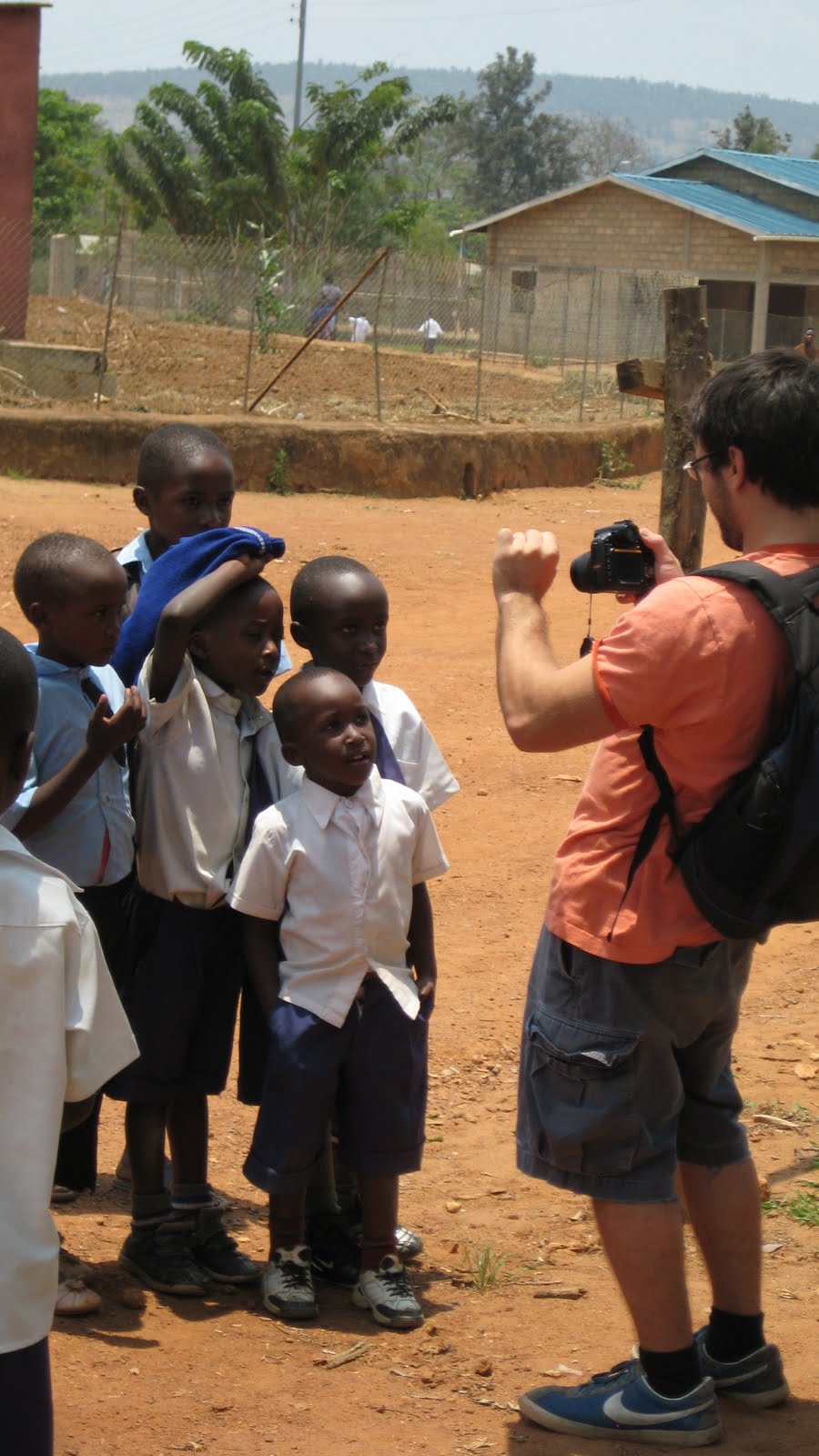
Children are most obvious in the way they acted around mzingus. Four of us went for a walk in the valley near our hostel early on in our trip. As we walked by people and waved, we could see parents indicating to their children that, "look, those are mzingus!" Subsequently, packs of children started chasing after us, shouting, "Mzingu, mzingu!" Once they reached us they were less sure of what to do, most of them standing there shyly and putting their hands out when we offered ours. We never shook hands, instead lightly touching palms. The bolder among our group would hug children.

Hot on the trail of the mzingus.


I mentioned also that there are different types of mzingus; in our group of 4 was a girl of half-Asian descent, her mother being from Malaysia. To her the children came running and shouting an extra word amidst their "Mzingu" calls. It took FGL Sara to interpret for us; they were shouting, "Mzingu nihao! Mzingu nihao!" The same girl later drew greetings of "konichiwa," as older Rwandans showed more cultural dexterity if not sensitivity.

That valley experience was not unique. After a morning of visiting genocide sites, we walked around a village that held several different schools with children getting out for lunch break and recess, which led to several iterations of hugging, throwing children around, taking pictures, and embracing mzinguness. In my trip to the market, I walked by a family in a corner. The adults were pointing at me and telling their 3-year old boy that, hey, look, that's a mzingu, a real live one. I turned the corner so that my back was to them, and a few seconds later I heard a little patter of feet; the little boy had run up to me. He put his hand on my pocket, as if to confirm I existed, and then quickly ran back.


"Look at how well the mzingu dresses!"


This curiosity tinged with reverence was not limited to children. We went to paint a house one morning, and on the way, we stopped to buy the paint, rollers, and masks needed. As our van stood in the street, and I sat in the van, behind one of the girls in our group, a man came up to the window. The man, in a ratty long-sleeved shirt and plain pants, was probably a little older than me. He shook my hand through the window and then proceeded to ask how he could make friends with white people.

"It would be very good to have white friends," he said in decent English. I stammered a few answers. "I would very much like to have a white girlfriend," he said. "That would be very good." He then indicated the girl in front of me. "Is she your sister?"
"No, she's too pretty to be my sister," I said, awkwardly. He did not respond directly. "Is she your girlfriend?" No, I said.
"She is very beautiful." She giggled nervously at the attention.
The man repeated how much he'd like to have a white girlfriend. The other members of our van started to pile in as we at last had the necessary paint and rollers. "I would very much like to meet your sister," the man said as we prepared to leave, "I am sure she would be beautiful like you." It was my turn to giggle nervously. And off we drove, I wishing him well in his quest.

These positive feelings for visitors was a surprise to me, though it shouldn't have been. We were briefed that Rwandans were liable to be closed and suspicious of others, an understandable mode to adopt for citizens of a country 15 years away from civil war and genocide. Furthermore, we might have expected raw feelings over the way that the international community ignored the genocide. At first, I thought that there was a spectrum that spanned two main forms of response to our presence - there were Rwandans who waved eagerly at us, such as the gardener at our hostel who gave us a two handed wave just about every time he saw us for two weeks, and there were Rwandans who eyed us with a bit of distrust. But I later found that whenever we waved at a Rwandan, they waved back eagerly; whenever we spoke to or greeted a Rwandan, they responded with a happy tone; whenever we engaged in a conversation, we found an appreciative conversationalist to join us. They may not have been spilling out their whole life story, but everyone was happy to see us.

My guess is that people make simple associations. The foreigners they run into in Kigali are generally there to help out; whether they help successfully or not is a different issue. Nobody ties foreigners specifically to the international community - if anything, we make up for the past failure. And yes, the "mzingus" tend to have more money, which is viewed not as a threat or even an opportunity - some kids and people begged for money, but on a much lower scale than you would expect. I think more people asked me for money in New York this weekend than they did in my time in Kigali (to be fair, I didn't understand that "falanga" meant cash the first couple times I heard it in Kigali. Also, to be fair, New York City has about as many people as Rwanda).

Keepaway from the mzingus. A typical scene.


Whatever the reason for the reverence white people were accorded in Rwanda, or at least the reverence we were accorded with in Rwanda, it left us feeling like we were in a movie. Any movie set in Africa where the visiting do-gooding (or possibly secretly evil) white man is surrounded by eager African children who marvel at his western clothes and modern technologies: that was the sort of scene we replicated on several occasions. Western clothing is an assimilated part of the globalized Rwanda, but many children were eager to have photos taken by us or to take photos of us or to pose or whatever they could do, if just to see pictures of themselves in the viewfinder. One of our group members had been to parts of rural Ethiopia where children had never seen their own image, with no ready water supply or mirror to go all narcissistic in front of; Rwanda was not that removed from the modern day, but there was great eagerness to meet us. This can get wearying, as everybody who sees you wants a piece of you, almost literally - they want to touch you, talk to you, occasionally receive money from you, and in general bask in you (I hope this doesn't sound arrogant - there's nothing special about us or any white person that visits that merits such attention, or at least nothing special that had anything to do with our control, personal characteristics, or deeds. Rwandans, kids mostly, just appreciate what the mzingu represents). But the eagerness is generally welcoming and positive.

Especially for free plane rides are they enthusiastic.


And that eagerness for the west and modern culture was where the dancing came in. Well, that and my sweet moves.

Workin' it. Uhh. Yeah.


The first time I danced was just among our group at a bar in Kigali. Our main man Patrick took us out to a local establishment after we ate an overly mzingu meal with Israelis in the country at a Chinese restaurant (of all the combos in the world). Fueled by a devilish mixed drink I came up with - Fanta Fiesta (a new, black currant flavored Fanta that tasted like grape cough medicine if grape cough medicine tasted good; also, all soda in Rwanda used actual sugar instead of high fructose corn syrup, which didn't really mean soda was any healthier there, but meant it was a lot tastier) and Ugandan waragi (a clear alcoholic drink that I was warned about but that tasted like nothing more than, well, 80 proof alcohol, for better or worse), we started to bust out moves, but only for the amusement of ourselves and a few bystanders. A couple of the guys and a couple of the girls danced, but it was mostly a warm up night, a preview of things to come.

Those in the know are aware that this move is a Dave Frisch special.

The next night we went out to Papyrus. It was a Thursday night and we had a long Friday ahead of us, so we thought we'd have a nice meal and then go dancing. So we did it. We went dancing. And to Papyrus's credit, they were bumping killer jams for a long stretch, which made it easier to dance.

As anybody who has seen me dance at either a recent wedding or in general (chances are there aren't many of you) knows, when I dance, I bring energy, quasi-rhythm, and a bunch of enthusiastic but not exactly classy moves to the floor. Lots of side to side, lots of shoulder shimmying, lots of changing levels and hitting the floor. In other words, I dance like I wrestle, except with slightly less direction and a lot more spasticism.

"Bend down, then row it. Row it. Work that back. In the rhythm! And one! And two!"

There was no telling how this would play out on the Kigali dance floors. But within a few moves to Haddaway's classic, "What is Love?", I had helped form a circle and had a few young men from the area dancing along with me, mirroring my moves. I would dip to the left and pull my arms back in a fly lift sort of pattern, they would match. I would shake my right arm down in front of me and twist my body to the right, and two guys wearing baseball caps would be right with me. I would run around on my head to "It's Raining Men" on the floor and...well, I did that move alone. And the "chasing my head with my legs as I lied prone on the ground," that move was alone. But it was popular.

"Look at that crazy mzingu! I think he's having a seizure!"


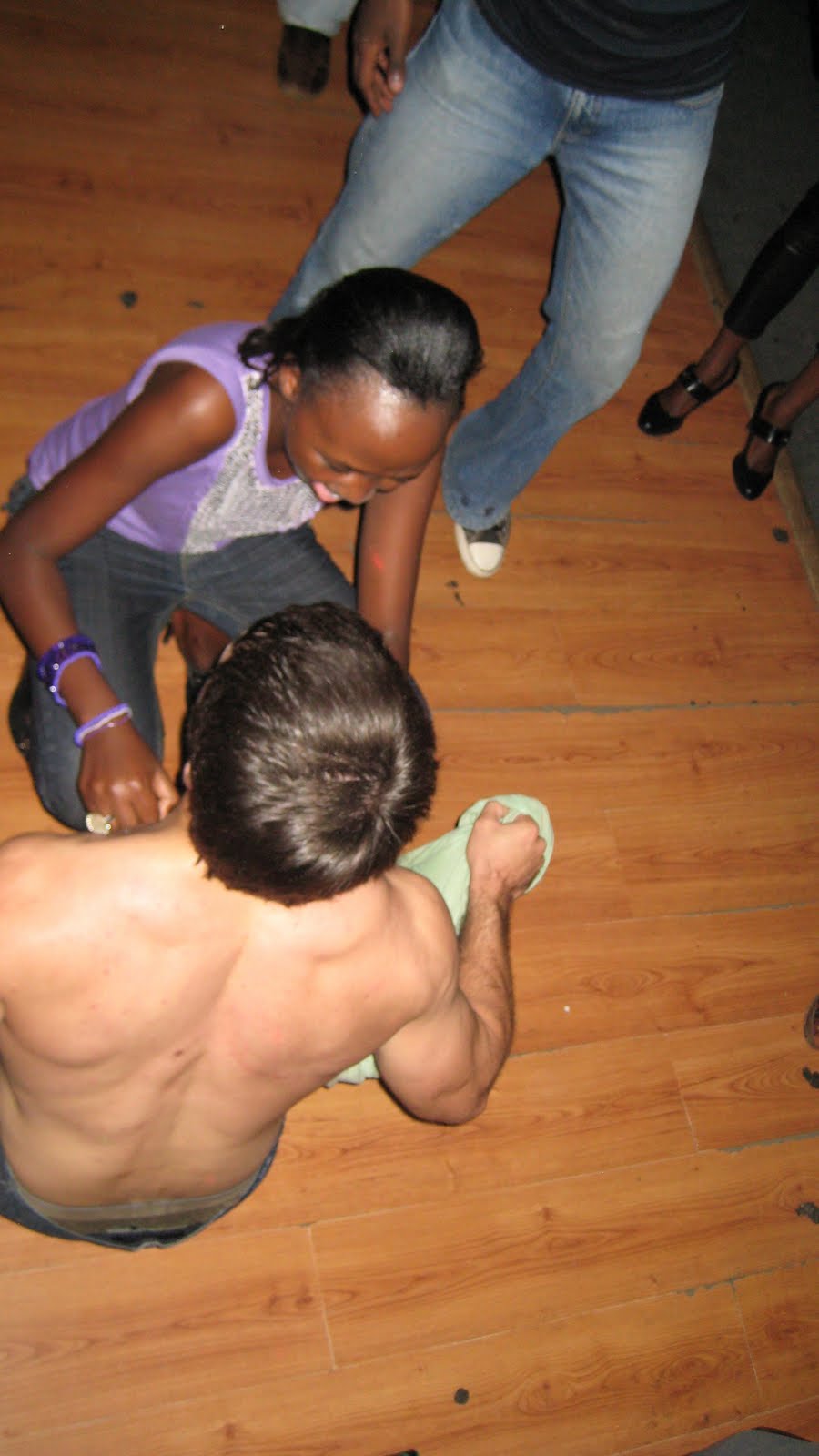
This dancing dynamic was replicated at the Kigali Business Center night club (the KBC, as it's known) on our penultimate night, where I hit the floor out of duty when the DJ fulfilled my MJ or Prince request (though "Thriller" qualifies as the bare minimum fulfillment of that request, where "Little Red Corvette" or "Wanna Be Startin' Something" qualify as maximum fulfillment), and then later somehow ended up without a shirt dancing on the floor to another song that was familiar but that I can't quite name. These dancing dalliances also met with a strong crowd response from locals, including moments where a throng of girls jumped around me, and moments where a local lady of ill-repute danced behind me and rubbed my neck. She was not ready for the proverbial jelly, as it were.

Apparently, I was really easy to pose with when on the floor.


There's one other digression merited regarding dancing in Africa that makes it a little different. I will assume that Rwanda is not a very good place to be a homosexual: that is based solely on assumption and a little bit of asking around in Rwanda and of experts, but also on the idea that neighboring Uganda recently attempted to outlaw homosexuality, with death a potential penalty for some offenders. I'm presuming that Kigali, at the very least, is not trying to win Let's Go recognition as a gay capital, if you catch my drift.

Not that there's anything wrong with digging these moves or those pits.


That said, there is a frankness to showing affection that you would not see in the U.S. for sure, and in most places in the west. As one might find men holding hands in the Arabic world, you find it in Rwanda, more than you find men holding hands with women even. Women have a very strong position in Rwandan (or at least Kigalien) society, but there are still old-fashioned charms like triple kissing when you say hello or goodbye.

"Hey, how YOU doin?" (Also, sweaty much?)

This frankness extends to the dance floor, where guys dance with other guys just like they would with women. Which is weird, at first. At Papyrus, I thought I had stumbled upon a gay enclave as men bumrushed me to dance a little too close for comfort. By the time I danced at KBC, I was an old hand, and I didn't blink whether it was man, woman, group of women, group of men, or lady of ill repute who wanted to dance close with me. All of those constituencies were represented, by the by, which is another way of saying my dancing was a big hit.


I made sure the number of photos of me dancing close with a girl double the number of me dancing close with a guy. In case you had doubts.


A final illustration of the open arms with which the mzingu and his strange habits were greeted in Rwanda could be found at a small church congregation of only 500 people or so on a Sunday morning. At this pentecostal gathering, inside a building whose inner walls and ceiling were fashioned, perhaps consciously, to look like a revival tent, we witnessed an impressive service. The service started with gospel rock offerings from a talented 5-piece band and a choir, giving the feel of a concert for 20+ minutes. Then a few quiet messages were passed and we were introduced as guests. We went on stage, gave a speech and taught a song and dance ("David Melech HaOlam") for kids to join us in, and then retreated to our seats.

"And make sure to donate to the collection basket, kids!"


A few more announcements were shared, and then the band kicked into another song. This time, the tech staff cranked up a computer and a projector and showed the words on a screen. So we could sing along, more or less. More and more, as the song went on, as it was pretty repetitive. This song in fact stretched into the epic territory, far outstripping "Freebird" or any Led Zeppelin classic in terms of length and righteousness, and at last coming to a halt somewhere in Grateful Dead noodling territory, but with less noodling.

Instead, there was a chorus line, and they were dancing. Men and women pulled out a few steps that they kept switching on and off like a new hat to try on in a store before taking it home. I, deciding to wear my kinesthetic learning hat, followed along with the steps, allowing myself to get into the groove of the service and the worship, even if my heart wasn't exactly into the worship and my thoughts, ala King Hamlet's, were not exactly rising heavenwards.

The chorus line proceeded to don a three step and kick maneuver in each direction. 1-2-3 kick, turn 1-2-3 kick, etc. I executed this maneuver dutifully from my seat, perhaps bumping into the interpreter the church seated next to me so I could understand the sermon. After a few minutes of auditioning, unwittingly, I found myself compelled to go up on the stage. Which is to say Eddy, our Rwandan friend who introduced us to this church, led me on stage. And left me there. One mzingu on the end of a Rwandan chorus line.

I couldn't find the video of me dancing, so here's the song we sang to. This song went on for over 20 minutes. I guess it made as much sense as "Hey Jude," at least.


So I continued to follow the step on stage, with great elan and exuberance, if a slight hesitation over my incongruous presence in front of everyone. And, well, it was an experience: I didn't ruin the show, but I didn't elevate it as much as fit into it. Which was fun.

Such is life being a mzingu in Rwanda: exhilarating, exhausting, exciting, and exorbitantly rewarding. At least, for a little while.


Let's slide in an epic performance of our inside joke song of the trip, "Hey, Mzingu."