Showing posts with label Luxembourg. Show all posts

25.7.12

The Red Bike Rides: Vive La Voie de La Liberté!

This is the second in a series of at least three posts about bike rides I've taken this summer. The first was here, with a bit more explanation.

07/July/2012

As mentioned previously, Luxembourg is small. The city boasts about 90-100K residents, which almost puts it on par with Alphabet City in New York. On weekends, when all the commuters from France, Belgium, and Germany stay home, it can feel even lonelier.

Fortunately, there are other places to visit a short train ride away. 20 minutes to the West, just past the IKEA on the Belgium side of the border, is Arlon, an old Roman outpost that recently hosted a high-quality music series. 45 minutes in the opposite direction, one crosses the Moselle River and reaches Trier, the oldest city in Germany and home of Karl Marx. There's no real city closer than two hours away in the north (see the first article in this series). But in the south, it takes 45 minutes to reach Metz, the closest French city to us.

Naturally, if it takes 45 minutes to bike to Metz it can't take much longer to bike there. A couple of Saturdays ago, I tested out that axiom. The 60 Kms took me just over 4 hours and yielded the following photos and feelings:


View Larger Map


The Border Flag. Fairly Straightforward.

 It took me about an hour to get out of the city and then the country. I took a highway that was also named Route de Thionville. Thionville is the town that marks the halfway point between Luxembourg and Metz.

Look just to the left of the leaping deer sign for the smokestacks.
When biking in the south of Luxembourg, I've noticed a nuclear plant on the far end of the horizon. Four smokestacks rise to the sky in hollowed out, hourglass fashion, defying the onlooker to ignore it. It turns out this is the Cattenom plant, which is either the 7th or 8th largest nuclear plant in the world by power produced. The last time Amy and I visited Metz together in the spring, we stumbled upon a protest against nuclear power that most directly targeted the plant in question. In any case, the smokestacks' presence are largely inescapable when traveling through the surrounding, largely flat countryside.

An idyllic dip in said countryside.


History, recent and ancient, is everywhere in Europe. Posts like the one pictured above lined the whole route from Luxembourg to Thionville, and probably continued along the road to Metz. The blue plaques back the words "Voie de La Liberté." This was the road the American army took in the fall of 1944 to liberate Northeast France and subsequently Luxembourg.
It's a small thing, the commemoration of this feat, but I still enjoyed taking the road in the opposite direction.


Thionville is situated on the Moselle. The Moselle is a helluva river for our area: starting in the Vosges mountain range in France, it winds through Metz, Thionville, and up to form the border between Luxembourg and Germany, before breaking off towards Trier and eventually feeding into the Rhine at Koblenz. Its namesake valleys in Luxembourg and Germany are famous for cremant (sparkling wine ala champagne, and just as good) and white wine, respectively. We took a river cruise along the German border with friends one day this spring, and I wondered about the history of the river, and if anybody fled across the river by cover of night to escape Germany in, say 1938. Above, in Thionville, I'm wondering if there's anywhere along the river bank where I can pee without getting arrested.


My route took a fortuitous turn at this point. Not only did I find a reasonably tree-filled area where I could relieve myself: the road also became a bike-only path along the Moselle for the next 20 kilometers. Riding along the quiet river with only a few people passing me and the verdant waterfront to guide me, I felt a fleeting, powerful on rush of joy. For about an hour along the river, I sang, I cried, "Vive le vélo rouge! Vive la voie de la liberté!" I thought about things to write, I thought about life, I thought about nothing.

The thought process was especially liberating and meditative. When doing something meant to be meditative, like yoga or, well, meditation, I find my challenge is to harness my mind, to focus it on nothing or else on the task at hand. To reign in the "monkey mind". Usually, I fail at this on any objective scale, which is partly why I do yoga less than I should and meditate not at all. But when riding, when I have nobody to answer to and nothing to achieve, when I am exercising my physical energy and giving my testosterone and all the rest of it an outlet, I find my mind soaring, unshackled and unconcerned. On this day, with the weather a perfect sunny 70 degrees, riding along the river in a foreign country, thinking to myself in the language of the country (on about a 3rd grade level, but still), alone and free to strike out on my own path, I remembered my blessings, one mumbled French phrase at a time.

(And anybody knows how liberating it is to relieve an overstretched bladder on top of anything else).

That pillar on the left with the circle and cross was some sort of strange windmill. One cannot capture its motion on a still-motion camera. Helas.
Europe, or at least the corner I'm in, may be more progressive about bike paths, but that doesn't always mean they maintain them well. A crisis, indeed.
Not sure how clear it is, but two of my favorite things about biking in Europe are represented here. To the left: cows. To the center/right: slow-moving traffic, on a Saturday no less.

A day late, half a meter short.
As you might be able to read from that picture, the Tour de France beat me into town by a day. I actually had planned to bike to Metz the day before, but the rainy start to the day and my own laziness led me to postpone the trip for the day. While it would have been cool and of the moment to get to Metz for the Tour, it was probably for the best that I waited a day. Wouldn't want to show up those bikers in their tight clothing by making it clear that one can bike well with a loose t-shirt and shorts on. Not that I bike well.


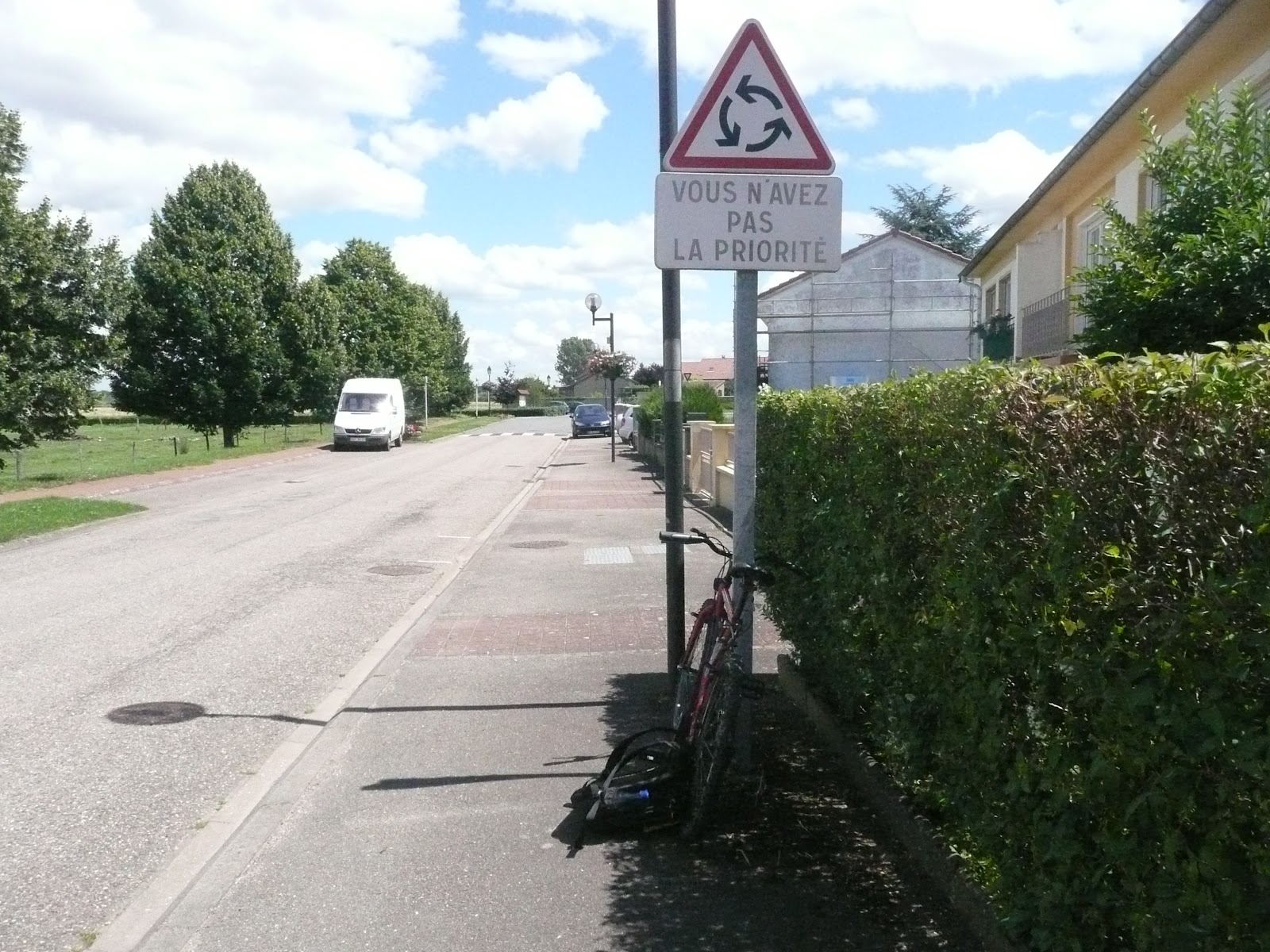
I'm not sure the installer of this sign realized its profundity: "You do not have the priority."


Metz is known for a few things. First, its name sounds German, and it was part of the Alsace-Lorraine region occupied by the Germans after the war in 1871, a wound that stuck in France's national consciousness the way, say, we shout "Remember the Alamo!" (Never mind that we won that war and never concede territory, for a second). The city also is home to the poet Paul Verlaine, a giant of 19th century French poetry. It hosts the first extension of the Centre Pompidou in a building that looks like a cross between an obese circus tent and a misshapen spaceship. Lastly, there is a huge cathedral there, replete with Chagall stained glass windows and Gothic grandeur. You can vaguely see the cathedral in the background here. Not my best photo.


Lastly, the Metz train station. By this point, weary from weaving through the suburbs and the northern part of the city, and anxious about the 40 or so euros I spent on DVDs and a French book about being fat and loving it, I felt drained of the earlier euphoria. In its place came the more lasting but more tenuous feeling of achievement.

What had I achieved? Nothing, really. Just a  4+ hour bike ride across a border and into France, a few transactions successfully managed in French, and a mild pain below my neck from wearing my backpack all day, including my computer to test out the weight.

Achievement is a funny thing. Take a big enough perspective, and all achievement is kind of silly. Take a small enough perspective, and the simplest task becomes a triumph over the gods. But the body, freed from thought and consciousness, knows when it has worked, and knows the feeling of satisfaction that accompanies fatigue. Whether or not that work and effort went to any end is up for the mind to waffle on.

Thinking back then, on the train, and now, a couple weeks later, I think of that hour along the river. Achieving that feeling is enough to keep going. On the bike or otherwise.

Vive le vélo rouge! Vive la voie de la liberté!

(Ok, I'll stop now.)

9.7.12

The Red Bike Rides: The Length of Luxembourg

Perhaps inspired by these people, and maybe also by living in a country where the only famous athletes are cyclists, or possibly just because there are an abundance of well-signed paths that show off the natural beauty of the country, making this one of the best areas in the world to trail cycle (I imagine), I've done a lot of bike riding in the year since coming to Luxembourg. While riding on one of my day trips this week, I decided it might be fun to run some photo essays of the trips, possibly inspired by some of the sources above but also this essay . In any case, I hope whoever reads this enjoys it.

04/July/2012

Luxembourg is small.

I used that lead once in an article about Israel, but Luxembourg makes Israel look gigantic. Israel's got a big old desert for a gut, and Luxembourg's slim, hourglass figure leaves Israel regretting every extra trip it took to the sand bar. Israel is 8x larger than Luxembourg, a veritable Goliath to the puny European David (and no, that does not include the occupied territories).

Then again, Luxembourg leaves Rhode Island wondering if it should renew its gym membership (you're looking a little boxy, RI).

Anybody who can positively identify Luxembourg's status - not just a city-state, not a random town in Germany, but an independent country - knows it's small. The implications of its size are what's interesting. In this case, the implication that a reasonably fit person can cross the country the long way in less than a day.


The Rough Outline of my trip (click to enlarge)


Last Wednesday, I took the train up to Belgium. There are two ways to take the train to Belgium from Luxembourg-Ville. The fast way is to go to Arlon on the way to Brussels, a 35 km ride that takes 20 minutes. The longer way is to go up to Gouvy, just across the northern border of Luxembourg. That train continues to Liege, and from there one can presumably head off to either Northwest Germany or Amsterdam. I took my red hybrid bike on the train, bought a ticket good up until the Luxembourg border, stayed on for one more stop, and got out an hour later in Belgium.


The humble Gouvy train station.

Gouvy is, as best as I could tell, a small town. Once, trains from several different routes ran through the town. Now, there's only the one between Luxembourg and Liege. Liege, for that matter, had the first international train station in the world, and now boasts a modern marvel or monstrosity, depending on your point of view.

That is the Cafe du Luxembourg over the bike's front wheel. Gouvy boasting its cosmopolitan flair.
I bought a few candy bars at the grocery store kitty corner to the train station and took off for the border. It's only a 6km ride or so to Luxembourg. There is little to mark the border: a gas station, mentioning its border status, a few road signs to let visitors know the changing rules, and a slight change in language, as the Luxembourg stores flash a bit of German or Luxembourgish in their signage. The humblest border I've seen was on a ride from Luxembourg to Arlon; I went on a rural road, and all that changed besides the signs were the color of the pavement, which grew lighter, and the quality of the housing, which grew poorer as I entered Belgium.

Friteries are uncommon in Luxembourg, so this is a border hangover to welcome those funky Belgians.


To get by Customs, one only needs to offer the officers some grass.

The northern half of Luxembourg is less populated and less cultivated. Luxembourg has a reputation, being lumped in with Belgium and Netherlands as BeneLux or the low countries, of being flat, but it's not really. The Ardennes mountain range run through this part of the country, and though it's really more like a series of hills, it still offers challenges. A few weeks ago I blundered through some especially difficult riding on the west side of the country. Fortunately, hidden all the way on the eastern spine, I didn't have major trouble biking down the country.

A detour through a wheat field left me with flies in my eyes and mouth, and on my arm.

I've noticed while biking around Luxembourg the preponderance of bugs. In general, it's not so buggy here: in our apartment on these summer nights with the balcony door open, a few moths will come in, the occasional mosquito, and, if one leaves the door unattended in the morning, a bird. But bugs aren't a huge problem. Except when biking, where midges and little gnats seem to drop from the air like, well, flies. I've swallowed at least two flies who unwittingly headed straight for my throat, and two or three other ones at least bounced off my craggy teeth. Considering my main form of entertainment while riding, besides looking at farm animals, is singing songs to myself - songs I've written, songs I'm writing, or songs I just made up involving rude drivers or what not - it becomes quite an occupational hazard.


One cool thing about riding in these parts is the recent history you come across. I imagine if anybody's eyes perked up when they read "the Ardennes" above, it had to do with history calling. The northern half of Luxembourg, as well as a contiguous section of Belgium, saw the last German thrust in World War II in what became known as the "Battle of the Bulge". The German attack caught the Allies off guard, creating a bulge in their lines. Regrouped, the Allies beat back the Germans, and the rest of the Western war was fought on German territory. At least as far as monuments go, Luxembourg (and the bordering regions of France and Belgium, at least), remain grateful for the American-led efforts to liberate the country. This small monument is one of many that dot the country.


The American most loved by the memorializing Luxembourgers is General Patton. The leader of the 3rd army died, ironically (or controversially), in the aftermath of a car accident suffered in Germany six months after the war in Europe ended. Per his request to be buried with his men, Patton's body lies about 10 km from where I type this, in the Luxembourg-American cemetery in Hamm. The photo above comes from a memorial to Patton outside the Patton museum in Ettelbruck, the biggest city in the center of Luxembourg (all of 7,600 residents). I somehow lost the photo of my bike beneath a statue of Patton, the General in his army uniform with binoculars in his hands, poised to look across the dangerous Luxembourg countryside.

 It was mild coincidence that I happened across these memorials on the 4th of July. I had intended to go for a bike ride and knew it was the 4th, but didn't plan on seeing any memorials. It made for a nice connection though: on Thanksgiving last year, Ben and I visited the cemetery in Hamm on bikes. So I believe I've been as patriotic as one can be for not being in the country on the holidays in question and not spending much time with other Americans.


This bike ride, almost the entire length of the country, was about 85km (roughly 50 miles). The big mental challenge for me was to make it to Ettelbruck, whence I had ridden from/to several times. Ettelbruck is a good center of the country location, and there's a very nice trail along the Alzette river that runs as meekly as the water below. So, satisfied with myself, I took my last photo for the day.

Me at the border at the beginning of the day. Already sweating. Maybe for the fries.


27.12.11

All Lost in the Christmas Markets

 Strasbourg Christmas Market
What’s the difference between life in Europe and in the U.S.A.? It’s a common question, especially when talking to one’s grandparents on Skype. It comes up in expat-American conversations from a number of angles.

The difference is, in general, not large. Our life in Europe does not differ greatly from our life in America, no more than life in New York City differs from life in Ludington, Michigan, or life in Paris differs from life in Esch-sur-Sûre, Luxembourg.

Differences exist, but mostly mundane, everyday ones: e.g. European pencils are skinnier (I speak from personal experience). There are countless petty differences on this order. On a deeper level, there’s always the generic freedom of living abroad, the ability to lose oneself in the local language (languages in Luxembourg), and the daily challenge of making oneself understood. All of these things are great, but they have to do more with being abroad than where one is, or than Europe.

For all that, one thing that stands out in Europe is the rhythm to which the Old World sways. Europe, or at least the Northwestern continental corner (i.e. the upper half of France, Germany, and Benelux) appears to have an established approach to traversing the year, one based on weather, tradition, religion, ancient harvest rituals, and a dash of modern industry.

The year begins with New Year’s celebrations and the leftover Christmas season holidays (Epiphany). That last burst of holiday joy and as many cords of wood as a household can manage sustain homes through the next six or so weeks, a grim period where “sunlight” lasts about 7-8 hours a day, mostly appearing in grim, gray-white cloudy form. Winters are dreary, cold, and rainy, with a surfeit of snow to lighten the spirit. Everybody likely tucks their heads into their coats, stays inside as much as possible, and bears witness to the relation between the word “hibernate” and the French word for winter, “hiver”.

Carnival, that last bastion of sinning on the Catholic calendar before Lent, offers the first upbeat of excitement. Whîle much of this region has Catholic roots, if reformed religious views, the impetus to celebrate probably comes as much from cabin fever as anything else. The celebration takes place in mid-to-late February, spring lurking around the corner. As such, a week of festivities leads to a shorter, more excited waiting period for the return of warmth and the sun.

Spring sets its own rhythm, with Easter, nature’s own resurrection, and the joy of returning to outdoors activities and longer days overtaking the continent. Spring will be lovely and summer no less so, though in August, everybody goes away on vacation. September marks the return to work and school, but also the beer and harvest festival season; one can find a festival every weekend until mid-November. It makes it difficult to schedule other activities with beer connoisseurs.

And in mid-November, the rhythm beats with Christmas Markets, to be described here forth.

Les Marchés de Noël

Strasbourg street
Annual market festivals of modern times emerge from basic traditions of people coming together to sell their goods. In Luxembourg there is the annual end of summer Schueberfouer, a fair that has its roots in the late Middle Ages, with this year having been the 671st celebration.

The idea of having a market around Christmas time appears to date back to a similarly late medieval date, at least as far back 13th or 14th century. While I didn’t find unequivocal evidence for where and when they began, most sources and intuition suggest this to be an originally German institution. The small wooden cabins that house each vendor and his/her wares, the ruddy nature of the fare and the people, and the adaptation to cold weather all suggest Germany: the markets feel like prefab portals into a Grimm Brothers tale.

I knew naught of these markets before coming to Luxembourg. As an American Jew whose main prior abroad experience was in Israel, I might not be expected to know much about Christmas. Christmas as a child meant three things: 1. Watching movies; 2. going to my best friend David’s house to see what he got for the holiday that I could share in – mostly, I hoped for video games; 3. a day off from wrestling practice. In college, I would be home for only about 5-7 days centered on Christmas, and in addition to that sense of homecoming, I had to maintain my weight for a tournament that awaited me on my return to the South. After college, I spent two Christmases in Israel, which became a time where Amy would go home and I could relax in our apartment. All in all, Christmas hasn’t been on my radar.

The Christmas Markets, however, arrested my attention. Les Marchés de Noël (the French name, which is easier to type than Christkindelmärik), do more than just propagate the big 3 C’s – Christianity, Commercialism, and Capitalism. They also provide a vibe, a sense of community, and a chance to drink hot beverages and interact with people in other languages. This mixture sucked in my interest as a secular, American Jew, and draws thousands of other people as well.

First, a Christmas Village in Belgium
 
On what we in the U.S. call Black Friday, where stores put on grand deals and people frantically fight over those deals, Les Marchés de Noël open here. It was on the Saturday after, following a Thanksgiving celebration in Luxembourg the night prior, that Ben and I stumbled on our first Christmas market, in Belgium.

We were visiting Liège, a proud, independent city in east Belgium, just barely a part of the French-speaking half of the country, Wallonia. The brick-laden city stood as an industrial powerhouse, and remains twice the size of Luxembourg, with just under 200K residents. There’s a grand view to be had after climbing300 some-odd steps to the Citadel, and the author George Simenon, creator of the Inspector Maigret series,was a native of the city. We decided on Liège as our weekend destination for all these things, and because it was the best we could do for one day and a less than 3 hour train ride.

"I don't see a 'She-Wolf', do you?"
It was to our surprise that, after we dumped off our bags and began our cruise through the center of the city, we stumbled upon a bunch of the wooden houses and a skating rink. There at Place St. Paul we found booths and waffles and chocolates galore, as well as modern dance music that can be found anywhere (read: Shakira). Europeans enjoy taking things outdoors as much as possible, and Les marchés provide another example. With mobile heaters set up and an array of hot chocolate and hot wine stands surrounding the rink, people congregated to exchange holiday cheer and body warmth.  

Having tasted a bit of the holiday spirit, we continued through the pedestrian streets of the city center and round a corner, whereupon we discovered another market. This market was officially a “Village de Noël,” though despite their website’s explanation, I can’t really say there’s a difference between the two.

The village held the real action, in any case. Held on Place St. Lambert (the site of a recent violent attack), the village offers a Ferris wheel, large slide to ride down, food booths, trinket and ornament vendors, a large brass band playing marches, and all the glühwein, hot chocolate, and beer one could ask for – truly the heart of the Liège Christmas festivities.

The Chocolate and Marzipan in action. Photo by Benjamin Chang.
Being in Belgium, we decided to do as the Belgium tourists do. I bought a cornet of fries, drenched in Andalusian sauce, but our chocolate choices were more noteworthy. Ben couldn’t resist a large slab of white marzipan at the Charlemagne chocolatiers’ booth (Charlemagne’s purported birthplace is close to Liège). We stopped there to pick up the slab and buy some gift chocolates. As we deliberated and worked through language barriers, a local cut us in line, picking a bag of chocolates unhesitatingly and demanding the right to pay. The woman behind the booth muttered her apologies to us, eyes wide with helplessness. The man, a swarthy fellow, remained unabashed, however: “I tell everyone when they come to Liège, they must come for the chocolate. That’s why you come to Liège!” He faded back into the crowd, but his words, or at least his breath, left the impression that he had come for the glühwein as well.

We returned at night, the best time to visit the markets. The glow of lights; the ongoing excitement found in the way people walk and talk in waves and spikes and streams and rambles; the defiance of the weather and the earlier and earlier onset of night, all this brings out the best of Europe and of Les marchés. Well, that and the hot chocolate and waffles we munched on from Galler, who have a factory in the town.

The Humble Home Front

Luxembourg’s Christmas market is a more humble affair. Everything in Luxembourg is a more humble affair, except maybe the approach to global finance. The city of Luxembourg sets up two marchés, one on the Place de Paris near the train station, and one in the center on the Place d’Armes. The central marché is the main one. Four rows of 5-10 booths snake across the square. Various local bands and artists play carols at the gazebo on the west end, though in their absence a DJ is liable to spin some modern takes on the season’s songbook – I’m pretty sure I heard an Mariah Carey Christmas song in there.

Luxembourg’s market, like most of its social life, is sort of rinky-dink, but with a few special items. First, they sell grompelkichelchen, which are crepe-sized potato cakes, and quite tasty. Also, the Luxembourg marché, like most other marchés, sells Glühwein, the mulled wine specialty of les marchés. Glühwein translates into French as vin chaud, which translates into English as hot wine, which gives you the essence of the stuff. It’s wine, usually red, that is heated, spiced, and sweetened. (The second meaning of “to mull” is “to heat, sweeten, and flavor with spices for drinking, as ale or wine,” which also captures the essence of the stuff. I did not know that definition).

I had my only full cup of glühwein in Luxembourg. To drink glühwein in Luxembourg, one pays 3 euros for the wine and another 2 euro deposit for the mug; I drank mine out of a Christmas shoe shaped mug. Despite the charm, the sticky sweetness was a little bit too much for me. Some on the internet call glühwein the German winter version of sangria, but somehow what I had didn’t work for me the same way.

The last nice thing about Luxembourg is a shared quality with other markets, but significant. Placed in the center, the market serves as a universal meeting point. Anybody can come in, check out the booths, drink a glühwein, and soak in the atmosphere. The center of that center square features a set of tables, so that the main food booths look on each other and people gather under the glow of those heaters and act merry and cold and like themselves, but the best part of themselves. I’m not sure Black Friday allows for the same behavior.

Le Capitale de Noël
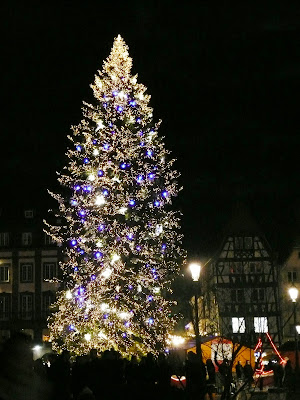
The largest decorated Christmas Tree in the world (or so they say).
Last for this tale is the market in Strasbourg. Strasbourg, a French city of 280K residents on the border of Germany, is significant for many things, but those things belong in a different article

The important thing to know here is that Strasbourg is the self-dubbed “Capital of Christmas.” Here I thought I visited the capital of Christmas when I went to Bethlehem for Christmas 2008, but no. What right does Strasbourg have to the title of Christmas Capital, trumping Bethlehem’s renown as Jesus’ birthplace? Well, as best as I can tell it rests on three claims, all of dubious veracity.

11.  Strasbourg, according to one of my French teachers but not most other people, held the first Christmas market. Strasbourg’s market dates to 1570, meaning it’s pretty damn old, but as noted earlier, probably not the oldest.
22.     Strasbourg is the birthplace of the Sapin de Noël, i.e. the Christmas tree. The Internet renders this debate more unclear. Some sources say yea, verily, and others claim that the Christmas tree was first added to the end of the year festivities near either Riga or Tallinn. Both claims pin the innovation in the 16th century, so at least half-credit to this claim so far for Strasbourg.
33.       Strasbourg has a really cool set of Christmas markets and celebrations.

This last claim could only be verified in person. Amy, A. (a friend of ours), and I took a weekend trip to scope out the situation. We arrived by train on a rainy Friday evening, rented a car, ate dinner, and then headed out of the city to our village B&Bs; we got lost, confused in the rain, angry at each other, and then eventually inside late enough to wake the proprietors of the inns. Les marchés would be a Saturday thing.

Also part of the promise - Christmas-themed pastries.
On Saturday, we arrived in the city to visit the markets just after noon. Strasbourg’s center is called “Grande île”, or the big island. It’s an apt name, as the center is an island surrounded by the Ill River, which feeds into the Rhine River a few kilometers farther east. The whole island is a UNESCO World Heritage site, with a grand Cathedrale de Notre Dame its heart. That World Heritage site held at least 9 separate markets (two others are off the island). This is Strasbourg’s Christmas promise – a series of markets in different places and with different themes strewed across the dense city center, so that in one day one can experience a full array of Christmas in the heart of Europe.

We started by getting off the tram in the center and walking to Place Kleber. The market there was unspectacular, but we got a hot chocolate, the initial rush of the crowds and street musicians to be found everywhere in the city, and Le Grand Sapin de Noël. Strasbourg claims that their Christmas tree is the tallest decorated tree in the world. Whether or not that’s the case, it’s pretty grand, standing there in the middle of Place Kleber, an open square capable of hosting such a big Christmas tree.

Romance has its downsides.
After the tree, we stopped in an ornate chocolate shop, where the ladies bought gifts. I watched as a two-story, two-horse cart clomped along a curving street, leaving a string of photographing tourists and, well, horse shit behind them. This throwback transportation guided us to the Place du Temple Neuf, a smaller square that is normally a parking lot, but did well in providing a couple places for vendors to vend. I did most of gift shopping here, but we also tried some chestnut and blueberry jams.
Rue des Hallebards
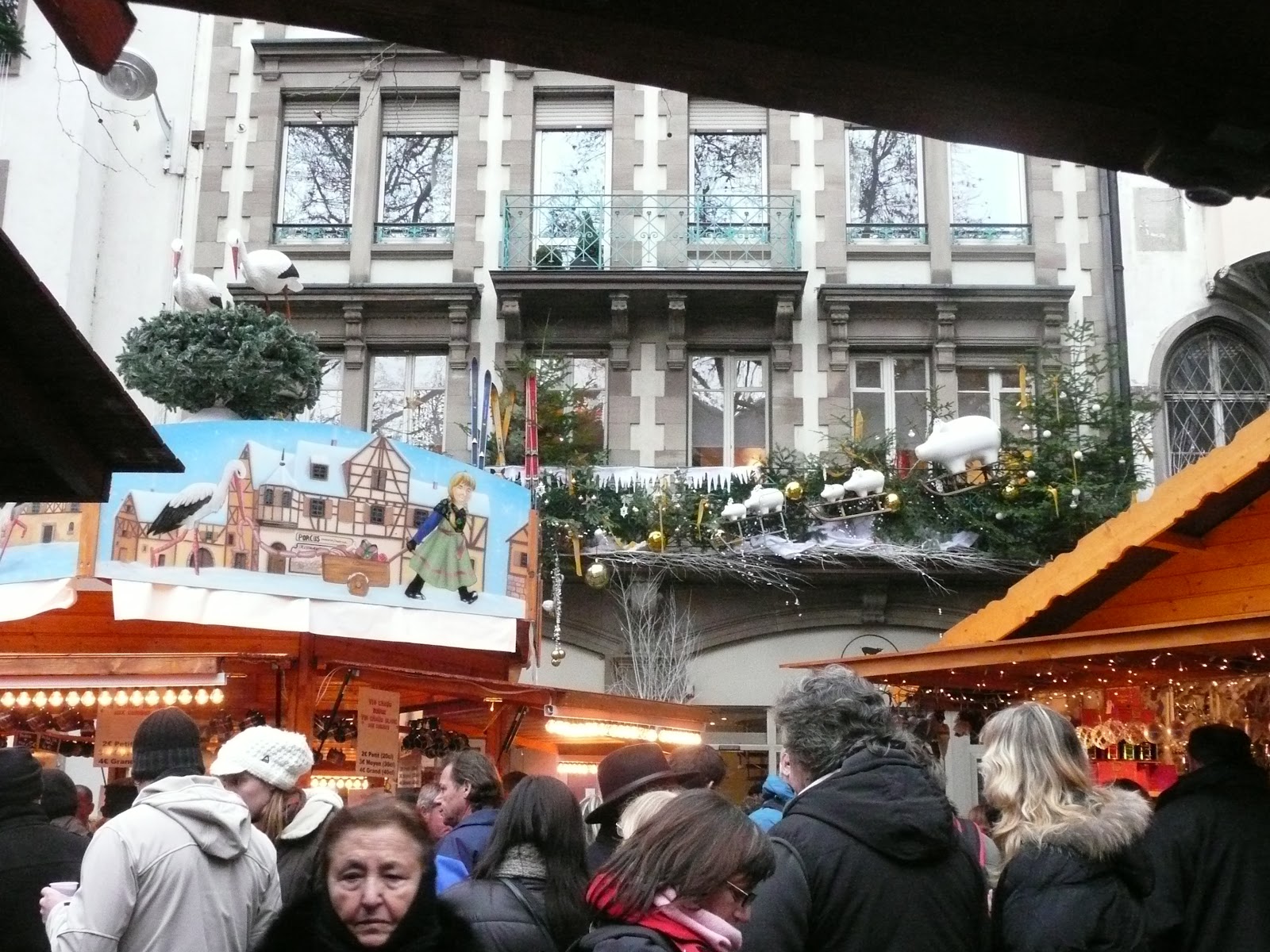
This prologue led us to the Rue de Hallebards, over which hung a series of chandeliers enclosed in glass cases. This striking decoration forewarned us of the main attraction of the city one block to the south, the Cathedrale. The crowds thronged in 10 person-wide waves spanning the street, cresting in the market at the foot of the crazy Cathedrale, the center of the Capital of Christmas.

Impressively, the crowds and the markets almost obscured the huge building behind, as the eye naturally fell on the red and brown of the booths, on the accordion players sitting street level, on the people, the people.  We wended our way through the crowds, lost one another, reunited, and then decided to split up, the ladies one way and I another.

My wandering took me to the south side of the Cathedrale, where Strasbourg had set up their skating rink, less central than the one in Liège but still popular. I then drifted down to the river, left the markets for a little bit, strolling through the east side of the Grande Île, but I didn’t wander long: the girls sent out the bat signal, too cold to continue shopping in the marchés and eager to get indoors to some old-fashioned modern stores. I rejoined them, helped them install themselves in a café, one with no room for me, and went back on the walk.

I turned to the western section of the city, knowing a well-touted literary café awaited me in that direction. I walked past the village for children, a tent that housed games and activities at the foot of another pink sandstone church (pink sandstone the most available building material for the city). The waves of crowds thinned and grew less frequent as I found the river again and walked along it to the Petite France district. There I found the former industrial heart of Strasbourg, set on a few fingers of land in the middle of the river. Restaurants serving endless variety of sauerkraut dishes, as well as a good share of pig knuckle, surrounded a market touting local crafts. I finished my gift shopping here and at another market of local Alsatian flavors around the corner: cognac-flavored egg liquor was my big find.

That ended the daytime Christmas market touring. Though tired, burdened by the fruits of our successful day of shopping, and wary of our half-hour commute to the inn, we still had the night ahead of us. We still had the best of the markets to look forward to.

Petite France at night (Market on the right)
I met the girls at the Place Kleber, where we took the necessary photos of the tree at night. From there, we returned to the Petite France area. Though we didn’t find a prompt, authentic eatery that could satisfy each of our culinary concerns, we did get to wander about in the cold, through the continuing crowds, amidst the glow of the market, and with sips from Amy’s cup of Glühwein. While we were stressed and cold and not overly warmed by the wine and the Christmas cheer, it was cute all the same.

After at last finding a grand Thai meal, we drifted back to the river on our walk to the tram that would take us to our car. Christmas decorations lit up both banks of the river. The red and yellow and green stoplight glare of Christmas bathed in the pink sandstone tint of the city harmoniously. The river lapped at the bank as we trundled along with our booty, past amorous couples, families, and groups of students. The relief of a full day’s end washed over us.

***


Hot wine 'neath the Cathedral. Just as the pope would like, I'm sure.
Our ride home was probably not all that different from one we would have taken if the three of us had gone shopping in, say, the Mall of America in A.’s home state of Minnesota. We would have felt the same relief from finishing our gift-buying. In either situation we would have had stories to tell about the people we saw and the encounters we had. Inevitably, in our core we would have faced the paradox of feeling good about buying gifts for others and feeling bad about feeding the consumerist colossus and the endless need for more and more stuff (or maybe that was just me).

Maybe Les marchés de Noël is just a grand gimmick, capitalism disguised as quaint nostalgia and doused in hot wine. Tradition or not, the idea of the markets is that they are markets; venues to sell products. Many of those products are unnecessary. The Christmas market is just hype.

But then, gimmick or not, the feeling is different. Bringing people together, placing them outside, putting them on a map in a location together, removed from the stronger waves of modern advertising, modern technology, modern post-modern detachment from the world, this still stands as a difference from the malls and the Walmarts and the consumer is king mentality of the U.S.

Europe still doesn’t really bring Christmas any closer to the original idea of celebrating Jesus. I’m not close to becoming a convert to the Christmas season (nor to Christianity, natch). But if one has to choose to take part in the Christmas season, one can do worse than to go to the markets, and to get outside on the streets, together.


15.8.11

Luxembourg after eight days, in ten words or in 2,000

A few possible mottos for Luxembourg, the capital of the country of Luxembourg:

“Luxembourg: Always Take an Umbrella”

“Luxembourg: Everything’s Smaller Here”

“I don’t need to look like a Luxembourger to know how to say, ‘I’m a bad mofo’ in Luxembourgish”

“Luxembourg: Notre grisaille est notre beauté“  (Our grayness is our beauty) 

“Luxembourg: Come for the Eurail Connections, stay for the view”

“Luxembourg: Non, we are not a city in Germany.”

***

The first impression one has on Luxembourg, before one arrives, is a collective “Really?” The relatively non-EU exposed will say, “Luxembourg is its own country? Really?” The geographically curious will say, “Luxembourg is smaller than Rhode Island and a sovereign country? Really?” The young man moving to the city and looking for a job will say, “I might have to learn Luxembourgish? Luxembourgish is a language? Really?” Luxembourg is something of the fairy tale on which the hopes and dreams of modern Western Europe are built, and much of it challenges credulity.

Luxembourg is the world’s only Grand Duchy, meaning the only place ceremonially ruled by a Grand Duke. They have pictures of the current Grand Duke, a tall and handsome man named Henri right out of “Choose your Royal Figure!” casting books, everywhere in the city, a degree of admiration and worship I’ve only seen surpassed in less politically balanced countries; I saw about as many pictures of Paul Kagame in Rwanda as I have of Henri here.

Luxembourg is a tiny country, one that not surprisingly suffered from invaders and changing rulers for much of its history. It gained its independence in the mid 19th century, discovered a deep iron ore shortly thereafter, and managed to maintain some wealth for the rest of the century. In the 20th century, twice the country suffered under German invasion and occupation. It makes sense from that perspective, then, that the country would be one of the founding members and driving forces of the EU, which in its first form was the European Economic Community, if my memory of undergraduate history serves me correctly, and that community may have well been based around the trading of iron and steel, at the time a cornerstone of Luxembourg’s economy. In the 21st century the country serves as one of Europe’s financial capitals, holds the European Court of Justice to boost its claim to being Europe’s 3rd capital (behind Brussels and The Hague, I believe? Or Paris?), and due to a relatively low tax rate also hosts a number of multinational companies (Amazon and Skype (pre-Microsoft at least) are two examples that come to mind).

Luxembourg is a tiny country and host to a tiny population. The capital, where we live, boasts of 100,000 or so residents. The country as a whole has a population of 500,000. Meaning Boston’s official population is about 100K people more. Like Boston, however, Luxembourg has a huge commuting population during the regular working day. According to our relocation agent, that 500K swells to two million people on a given weekday as workers stream in from Belgium, Germany, and France (the three surrounding countries) to take advantage of Luxembourg’s strong economy and generous worker benefits. Even in the height of the August vacances, every other car I’ve seen seems to have a D or F license plate for Deutschland and France, respectively.

Which leads to one of the major benefits of this tiny ‘burg (any city that makes Tel Aviv look big, well…): the multitude of languages and peoples that make up that 500,000 population (never mind the two million). I’ve seen and heard various quotes for the immigrant percentage of the population, anywhere from 37% to 49.9%. Many of the people who live here are not from here: that much is apparent. Among the largest groups represented here are Portuguese and, more historically, the Italians. The Portuguese are the largest group, weighing in at about 20% of that 37-49% of the immigrant population, which makes them just under a tenth of the total population. Of course, that means there are about 50,000 Portuguese natives living in Luxembourg, hardly a grand wave of migration, but everything is smaller here. Amy and I have also been impressed, walking around, by the evident diversity of the city, both in its restaurants (in 8 days we’ve eaten at Luxembourgish, German, Italian, French, Indian, and mediocre Middle Eastern) and the people walking the streets, with Africans, Russians (Eastern Europe, what what!), and Indians, among others, offering a pleasant blend in the city.

That human diversity leads to linguistic. The official languages of the country are French, German, and, yes, Luxembourgish, a Dutch/German patois with a bit of French sprinkled in. The order in that previous sentence marks the order in which we’d like to learn the languages if we stay here long enough, though Amy reports that Luxembourgish has a charming sound to it: their word for ok, it appears, is “Tiptop.” Beyond those official languages, one hears of course the omnipresent English, in its British, American, and International varietals, one hears the Portuguese of that community, one hears a fair deal of Italian and then Spanish from tourists, one hears Dutch that is vaguely distinguishable from German, one hears when he strains his ear some Russian, some Arabic, and even the barest snatch of Hebrew. For language whores like us, it’s hard to imagine a better place than Luxembourg for the size.

(One interesting footnote to this linguistic diversity, for me, is as follows: I asked J, our main relocation agent, how the hell he knows what language to use with a given person. He, a handsome man of about my age, with a skin complexion that suggests Mediterranean, South American, or even African heritage somewhere down the line, who claims Belgian as his nationality but has lived in Luxembourg all his life, and who of course speaks all the languages needed, recalled, “It’s interesting. If someone looks foreign, I would probably speak French to them first, unless I hear them speak German or English or something else. If it is a setting where I know they’ll speak Luxembourgish, I speak Luxembourgish. Sometimes, people, like just now at the bank, will begin speaking to me in French because I don’t look Luxembourgish, and I’ll say, ‘it’s ok, we can speak Luxembourgish if you want,’ and they’ll say, ‘sorry,’ and we’ll speak Luxembourgish. So it’s hard to say. Sometimes you just know, sometimes you don’t.”)

***

It’s August here in Luxembourg, and in some ways you’d know it, while in others you wouldn’t. You’d know it because there is a lack of bustle during the week, because many of the restaurants are on their congé, because it’s doubtful that any recruiter or company is going to respond to my desperate pleas for another month. You wouldn’t know it because, well, it’s not that warm. On a warm day like yesterday, the temperature bleeds into the mid 20’s Celsius, or low to mid 70s Fahrenheit. Mostly though, I’ve been wearing long sleeves and jeans (though by golly, I’ve actually seen Europeans wearing shorts: the glorious benefits of globalization!).

Beyond that, the fate of the day’s sky never reaches surety or permanence. Any day might start of cloudy, break into a bit of blue and sun, and then fall back into showers or drab overcast, before cycling through again. Even today, looking out on a mostly clear blue sky out our living room window, I expect that there will be rain at some point, and that our umbrellas will again serve us well. (N.b.: posting this a few hours after writing it, I find myself proven wrong – it has been sunny and gorgeous, hitting 30 degrees Celsius, or about 85 Fahrenheit.)

August sentiments do reign over the city’s mood though, in all senses. While much of the rest of the continent and indeed the world may be rife in protest, worry, and fear of debt (despite being in Israel for the better part of three years, including during a war and some seemingly monumental political moments, I feel like I missed out on the action there, for example), here our second Sunday was marked by a concert in one of the town centre fairs, along with a large collection of mimes dressed In different costumes – clock heads, instruments, butterflies, Enlightenment-era bewigged royals – walking around to mug for photos with children and families, some on stilts, other at ground level. Today is a Catholic holiday and, Luxembourg being ostensibly a Catholic country, the city is mostly shut down and quiet. On the whole, Luxembourg holds a nice mix of French flair for life and German industriousness, I say on first glance, but in August the French side is winning.

***

Lastly, on the physical nature of the city.

The Centre on the Left, the Rest on the Right.
Luxembourg owes its existence in large part to its physical nature. The main city was once a fortress; that fortress rested on a rocky formation surrounded by river valleys; as such, the city is something of a land island, surrounded by natural moats. This did little to slow the 20th Century Germans, or many of the foreign rulers from earlier history, but nevertheless, Luxembourg stood out, in a literal sense.

Grund from above.
What that means for our cozy town is that the centre locks onto the olden fortress area; a largely pedestrian shopping area occupies the heart of the city, streaming shoppers past the landmark squares in front of the Grand Ducal Palace (one of five in the country, I hear). Then, surrounding the city are the valleys of the Petrusse and Alzette rivers, as well as les Villes basses. The rivers are hardly impressive, the Petrusse hardly a stream, less than a meter wide, the Alzette a staid stew of a river bearing that grungy green that many city rivers boast of, though without the size or import of those other rivers. The low cities, Grund, Clausen, and Pfaffenthal, offer the classic Old Europe feel, narrow cobblestone paved roads next to a river, replete with Michelin-starred restaurants and a famous church (the Abbaye of Neumunster). We have so far only made it to Grund, home to many of the Portuguese in town, as well as a pair of Scottish or Irish pubs. It was indeed scenic strolling down to the low town on a Saturday night, twilight upon us and the black roofed buildings of the old city towering above.

A Grund street. Ok, a slight incline.
The city is not hilly in the way I often think of European cities as being hilly. In the main part of the city there are mild undulations, but nothing significant. What of the high versus low cities, you might ask. It is of course true that there are different altitudes in the city, but it is better to think of the city height as a discrete rather than continuous functions – to get to the bottom, one descends on a steep decline, whether towards Grund et al. or one of the outer neighborhoods, Cents for example. To get back, one takes a cab or a bus. The high city is mostly flat, the low cities are mostly flat. No, hills are not part of the scenery.
For all that, we do live on something of an incline, and from our 3rd floor apartment (4th floor by American counting), we have a slightly elevated view of the center and of the old town, and a peering glance to the train tracks and villes basses below. The contrast between that high and low, along with the contrast between the more traditional center and the modern surrounding neighborhoods (to our northeast, we can spot the beginning of Kirchberg, where the EU institutions are housed), and the ever-present contrast between sun and clouds, blue and gray, lends Luxembourg its beauty, a beauty it can boast of.

At that, I leave you with a picture of the view I have from my desk, as well as a standing invitation, presuming I actually know you, to come visit. And if I don’t know you, just visit this site for more writing on Luxembourg, travel in and near the country, and any other adventures that merit the time. Tiptop? Tiptop. Et Merci.