Showing posts with label Kids. Show all posts

2.11.10

Three Last Thoughts on Rwanda

I don't pretend to be able to summarize in a few pithy words what my/our trip to Rwanda was like. Actually, I can easily pretend to be able to do it, I just don't feel like it. Enough internet ink has been spilled on this site about the trip to Rwanda, I think: this post will bring me over 14,000 words. So anybody who is reading this and cares about what my overall impressions on the trip were should be able to pull something together based on the seven (including this one) posts and all that is contained therein.

At the same time, I want to write one more post about Rwanda. Not only because I promised it in the first post on Rwanda (more to myself than to anyone else), but because there is more I can say. And more I want to tell. So in lieu of any grand conclusions about the trip or huge statements, I give to you three little snapshots, events from the trip that encapsulated much of what happened as a whole, while also providing some entertainment. These events are not in chronological order.

Live at Gisenyi

Lake Kivu the morning after the storm.

The trip was harrowing; twice I have mentioned the thundering rains that could have ended our trip prematurely. We rode 10 passengers in a van designed to carry 14 passengers max in theory, but a van with bulky but thin cushions that did little to hide the feel of the steel bars beneath, a van with seats too close together so that there was no leg room even for the midgets like me, a van that had a multi-colored lamp inside that could do the disco rotation as needed, and a van that came from Dubai, where it was apparently the van for a hair salon. Riding in the van for four hours already that day (with stops), we were worn out as it was, and in no condition to weather the storm peacefully. We were saved by the steady driving of our main man Pascal, a driver who switched on to our group with the new van and who, on his first day, wore a bowling shirt with the name "Baker Hughes" stitched on the back. Maybe a code name? Or his bowling nickname, ala The Jesus?

In any case, the trip was harrowing. It led to our only night out of Kigali, a small hotel on a hill overlooking Lake Kivu, a Great Lake (Africa style, obviously) on the border with the Democratic Republic of Congo. We arrived shortly after dusk and, after divvying up rooms and unpacking, a few of us went out on the porch and talked and watched the lightning storm. I brought my guitar out and provided quiet and (I hoped) non-intrusive background music to the more serious conversations around me.There was an uneasy beauty of the moment.

We went to a relatively lame hotel restaurant by the water, mosquitoes infiltrating the overpriced dining hall, but our bonds were tight and the chocolate mousse cake I ordered (for dinner) good. Indeed, though I was weary from the car ride and the trip in general, hitting its 11th and 12th days, and though this trip marked the final high water mark before travel and group fatigue wore on my experience, we were at a high water mark at that restaurant, and the glow of our mzingu bubble on Kivu preserved that positive feeling.

We returned to the hotel just shy of midnight. I was most interested in going to sleep, but there was a general clamor for some music. And so I pulled out my guitar and played some tunes, pulling from the back catalog of hits ("Barcelona," "Ain't No Minivan Mama"), the fruitful summer of 2010 writing I had done ("Cellulite", "Stuck at the Start"), and the two Rwandan-inspired tunes I had written ("Any Given Day," "Hey, Mzingu", and yes, I did just cite a bunch of my own songs that most people have never heard. It's my blog, roll with it). My lovely audience that I would have liked to take home supported and enjoyed cigars, waragi, tequila, and the company, as well as the scenic backdrop, one of the nicest I will ever play in front of in my amateur musician career. The beauty here was easier, more exhausted, but joyous, a true cap on the high water experience.

An hour and a half later, I woke up in my bed in the hotel room to the evil sound of a nearby buzzing mosquito. My roommate was not on anti-malaria pills and had avoided vaccinations and in general was doing things all naturally to protect his body (we enjoyed watching him put together his herbal cocktail each morning at breakfast). No problem; I had all the respect in the world. And when we roomed together in Gisenyi, with two beds but only one mosquito net, I said, "No problem, you take it. Mosquitoes don't like me much anyway." My macho stubbornness striking again, as you see.

So when the mosquito woke me, I lay still for a few minutes, thinking I could wait it out. I slapped at the air aimlessly as well, or not aimlessly since I could hear him, but with very poor accuracy. The quiet desperation of hearing a mosquito buzzing around you and knowing there is nothing you can do to stop her, and knowing that the noise (definitely the noise and not so much the fact that she will bite you) would not let you sleep, and that sleep is the thing you most need to preserve your calm, your patience, and your sanity, this quiet desperation set in for me.

My roommate, fortunately, is a good sleeper. Fortunate, because my solution was to turn on the lights, sit as still as possible in a poor lotus position, and kill as many mosquitoes as necessary to allow me to sleep. There is always the illusion, after all, that it's only one mosquito that is buzzing around your head; their buzzes sound the same. I killed one mosquito. A buzz returned. I was not fooled. I killed another mosquito. I swung and missed at a few more. Somehow, my roommate stirred but did not wake. I imagined myself to be a modern day Mr. Miyagi with a lower hit-rate. Much lower.

In the end, I killed about 10 mosquitoes over 20-30 minutes, turned out the lights, and pulled the sheet over my head. I slept soundly if incompletely until the morning.

The World's (or at least Rwanda's) finest football pitch (Or backdrop)

A group photo of the memorable pitch.

East Rwanda, on one of the rare spaces in the country flat enough and big enough for a football (i.e. soccer) pitch, with 25 some-odd (we played about 13 v 13) boys aged from 16-24 or so who were ostensibly sophomores in high school, all orphaned or made vulnerable by the genocide, in the sunny but fading late afternoon light, with a beautiful vista to the east that suffered not at all for the fact that we wouldn't be able to see the sunset over it.

That was the scene. We were visiting the Agahozo Shalom Youth Village, and as part of our visit, we got to play football with the kids (or basketball, or volleyball, but I chose the footie). The village is an oasis, of sorts, for the aforementioned vulnerable and/or orphaned population of Rwanda, operating as a high school for these kids. So far they have 250 students, admitting a new freshman class of 125 students each year to hit a maximum of 500 students in two more years.

But enough about the technicalities. On the pitch, the kids are about what you would expect them to be: talented, able, but lacking savvy, teamwork, or foresight that comes with coaching and paying attention to sports. Understandable, of course, considering they have a lot more important things to deal with than being good at football; this isn't a factory or even a competitive high school. It's just a place for kids to play the game.

So a couple of us joined in the game, running up and down, making a couple plays here and there and getting frustrated from time to time. I learned the appropriate words to call for the ball, "Karibu" (meaning "welcome") and "he-he" (short e's; the word means "here"), and called for the ball plenty, but didn't really get many touches - there were a couple sweet crosses I made that didn't lead to goals, but ah well, I screwed up plenty times too. Meanwhile, the light grew hazier and the beauty rose to match it.

And then we had to leave. The game was still going, and we had to leave. My unfortunate response was to fall into "Cheese Fries or nothing" mode*. I ignored the first several calls. Then I turned in and gave up, gathering my t-shirt, walking sulkily off the field and probably spitting to the side a few times more than necessary. I entered the car and, making sure to voice my frustration, said, "Tha's some bullshit."

After a pause, somebody asked what this so-called "bullshit" was.

I hemmed and hawed as I got the words out, then said, "When will we ever get a chance to play on a field like that in a setting like that? We can eat in Mzingu restaurants for the rest of our life," in reference to our rush back to Kigali.

Well then.

Another lost temper. Another blown fuse. And though I won the battle this time - I got the cheese fries, so to speak - I lost the war, failing to make it two weeks without losing my cool. Haval, as we would say. Haval.

But it was a good line. And a pretty place.

Our Redemption From the Children


The scene as I first saw it.

I sat in Nyamata church, the second of two churches on the day. We had been to the Nyabarongo River earlier, where genocidal killers dumped their victims' bodies to "send them back to Ethiopia", via Lake Victoria. We had been to Ntarama church, of the bloodied Sunday school wall of the previous post. Whatever one might say about the reasons for our trip, the futile nature of it, the inability we faced in plumbing the depths of our or others' trauma, it can at least be conceded that we had not had the most pleasant day.

After writing a poem in my journal and sitting inside the church on my own for a few minutes, I heard a harmonica play. Evan was blowing out a tune; "Love Me Do" it sounded like. In an otherwise solitary and silent moment, it made for a pleasant break. I went outside to see where he was.

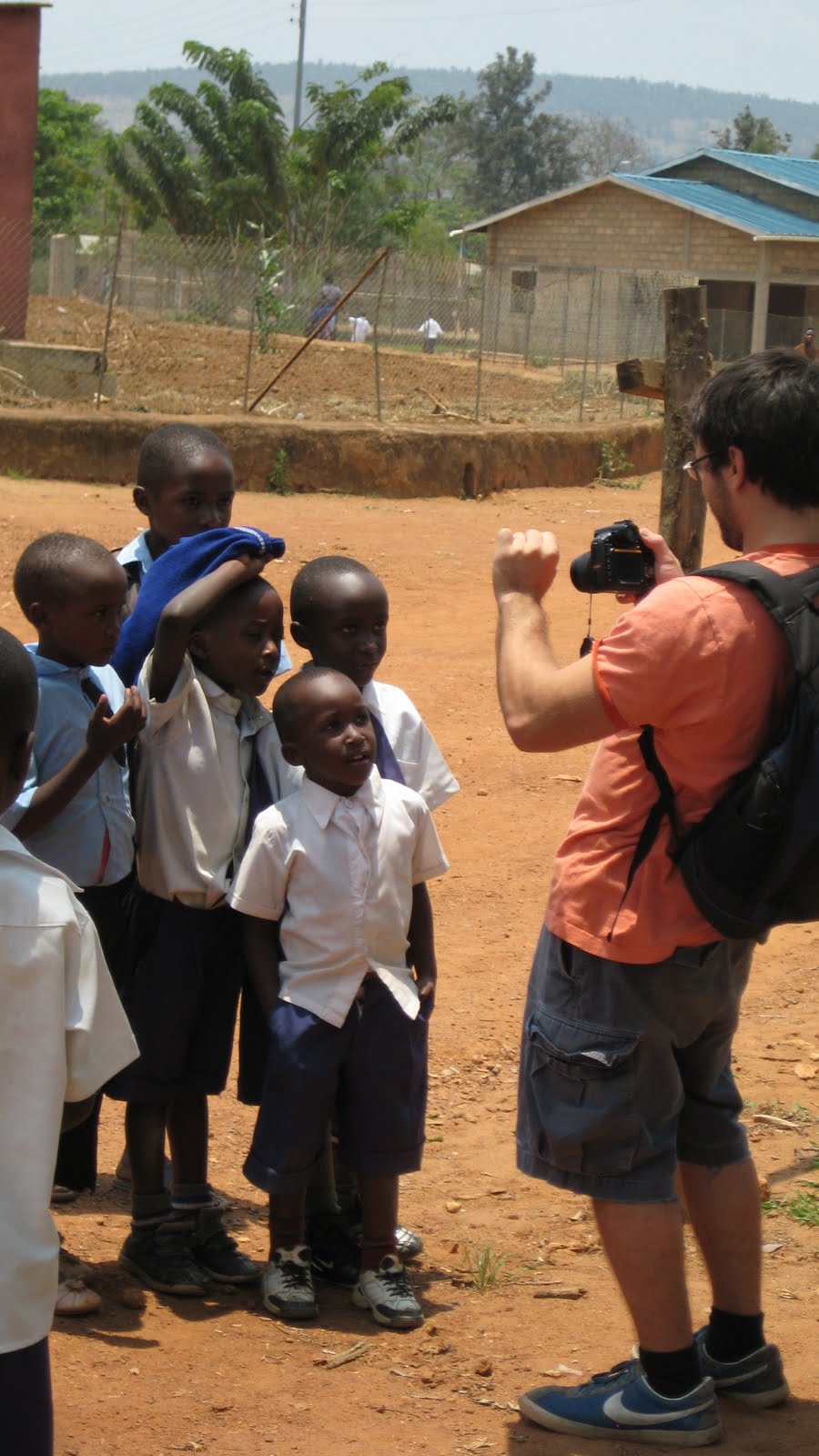
When I got outside, I found that Evan was not just playing on his harmonica, but playing on his harmonica for twenty or more schoolchildren. Others from our group were out there dancing and smiling and talking to the kids, taking pictures and then showing the kids their image on the camera. No better balm in this world did God invent than the smile and laughter of a curious child.

We spent the next hour walking around the village, chasing after different groups of schoolchildren and picking them out, spinning them around, hugging them, and laughing with them. We drank over-sugared Coke and broke into sprints after the over-cute kids. We alternately terrorized and brightened everyone's day. On my trip in Europe,

Ben made the point, in Hamburg, that no matter how unsuccessful we were in achieving our objectives, or how annoying our requests might have been, we certainly made everyone's day a little bit more unusual and, dare I say it while trying to avoid sounding arrogant, more special. Well, that was at least ten times as true in Rwanda, and even more true in Nyamata village.

But we, of course, were the bigger beneficiaries. I talked about the dissonance between visiting terrible sites and experiencing beautiful people and scenery: this was the greatest dissonance we felt, and the loveliest. It was the most special moment we had on the trip, I feel, and I doubt my companions would protest too much.


Ah hell, one more bonus note from Rwanda - the last night


Our going away party featured a long round of speeches from everybody we managed to rope into our goodbye circle from our friends in Rwanda - potential sugar daddies, sons of reggae stars, good friends we had met in Israel, our friendly hostel security guard, our guides, friends from our blog we weren't as close to - and from us. Then I played on my creaky guitar, loud enough over the roar of the fire to bother the other guests in the hostel and lead us to leave the hostel and go to a nearby traffic circle. Where, after waking up the guard on duty sleeping in the fountain itself (no running water), we proceeded to run through a few more songs. Then a few more goodbyes. Then a giddy, solemn march back to the hostel, I on an improvise-ready little riff with Evan accompanying on his harmonica to a little ditty while the others reveled in the beautiful possibility and sadness of Kigali's night sky, together for the last time. The trip was everything it was supposed to be, even when it wasn't. It was every happiness we could hope for even when we were sad, every calm realization we sought even when we (I) lost our cool. It was certainly a success, a victory, an experience, and something to remember. And, almost a month later, I can still say with certainty that I don't think it'll be a last time, either in Africa or Rwanda. No, one way or another, this was just a beginning.


The Chorus of the other Rwanda related song I wrote, by the bonfire.

23.10.10

Mzingus Making Moves

This may come as no surprise, but I'll say it anyway: I've never felt like the "white man" like I did in Rwanda.

Come on, I bet you can barely tell which one is me.

Again, no shocker. Besides anything else, much of my traveling experience has been in the western world, namely the U.S. and Europe. There was a foray to Morocco, wherein I freaked out at the attention I drew in the Marrakesh souk but otherwise shrugged off the strangeness, blending in with plenty of other tourists in my own la-la land besides the Atlantic Ocean. There was last year's trip to Guatemala, but that country's proximity to the U.S. and its own racial makeup that includes plenty of European heritage makes white skin either something to ignore or something to resent.

The closest I've come to the reaction we received on this trip came from a trip I took after 8th grade to Japan with a group of kids from school. A cherished trip for me, our 8 days in Hokkaido saw our group take the lead in many of the "art camp" activities that we took part of. Vibrant, brash, and a little flamboyant, we got a little bit of a taste for the life of a rock star, as many of the Japanese kids followed us eagerly while we sang "New York, New York" and "Puttin' on the Ritz." (Did I mention we were flamboyant?)

This kid is the best.

In many ways, that trip was the travel experience I most recalled in seeking a comparison for the Rwanda trip: the school-related group trip, the assortment of activities that was loosely related to academics, and the way the group bonded to create a shared energy that one could not anticipate or predict. But I'm writing about being the white man, so let me return to that.

I've already written about the "mzingu", so let me further detail what it was like to be a mzingu. Kigali is a growing city, and may be ahead of many African cities in development and standard of living. At the same time, Rwanda remains remote, and the presence of a foreigner is still significant to many people. As such, seeing the "white man" is a new experience.

Children are most obvious in the way they acted around mzingus. Four of us went for a walk in the valley near our hostel early on in our trip. As we walked by people and waved, we could see parents indicating to their children that, "look, those are mzingus!" Subsequently, packs of children started chasing after us, shouting, "Mzingu, mzingu!" Once they reached us they were less sure of what to do, most of them standing there shyly and putting their hands out when we offered ours. We never shook hands, instead lightly touching palms. The bolder among our group would hug children.

Hot on the trail of the mzingus.


I mentioned also that there are different types of mzingus; in our group of 4 was a girl of half-Asian descent, her mother being from Malaysia. To her the children came running and shouting an extra word amidst their "Mzingu" calls. It took FGL Sara to interpret for us; they were shouting, "Mzingu nihao! Mzingu nihao!" The same girl later drew greetings of "konichiwa," as older Rwandans showed more cultural dexterity if not sensitivity.

That valley experience was not unique. After a morning of visiting genocide sites, we walked around a village that held several different schools with children getting out for lunch break and recess, which led to several iterations of hugging, throwing children around, taking pictures, and embracing mzinguness. In my trip to the market, I walked by a family in a corner. The adults were pointing at me and telling their 3-year old boy that, hey, look, that's a mzingu, a real live one. I turned the corner so that my back was to them, and a few seconds later I heard a little patter of feet; the little boy had run up to me. He put his hand on my pocket, as if to confirm I existed, and then quickly ran back.


"Look at how well the mzingu dresses!"


This curiosity tinged with reverence was not limited to children. We went to paint a house one morning, and on the way, we stopped to buy the paint, rollers, and masks needed. As our van stood in the street, and I sat in the van, behind one of the girls in our group, a man came up to the window. The man, in a ratty long-sleeved shirt and plain pants, was probably a little older than me. He shook my hand through the window and then proceeded to ask how he could make friends with white people.

"It would be very good to have white friends," he said in decent English. I stammered a few answers. "I would very much like to have a white girlfriend," he said. "That would be very good." He then indicated the girl in front of me. "Is she your sister?"
"No, she's too pretty to be my sister," I said, awkwardly. He did not respond directly. "Is she your girlfriend?" No, I said.
"She is very beautiful." She giggled nervously at the attention.
The man repeated how much he'd like to have a white girlfriend. The other members of our van started to pile in as we at last had the necessary paint and rollers. "I would very much like to meet your sister," the man said as we prepared to leave, "I am sure she would be beautiful like you." It was my turn to giggle nervously. And off we drove, I wishing him well in his quest.

These positive feelings for visitors was a surprise to me, though it shouldn't have been. We were briefed that Rwandans were liable to be closed and suspicious of others, an understandable mode to adopt for citizens of a country 15 years away from civil war and genocide. Furthermore, we might have expected raw feelings over the way that the international community ignored the genocide. At first, I thought that there was a spectrum that spanned two main forms of response to our presence - there were Rwandans who waved eagerly at us, such as the gardener at our hostel who gave us a two handed wave just about every time he saw us for two weeks, and there were Rwandans who eyed us with a bit of distrust. But I later found that whenever we waved at a Rwandan, they waved back eagerly; whenever we spoke to or greeted a Rwandan, they responded with a happy tone; whenever we engaged in a conversation, we found an appreciative conversationalist to join us. They may not have been spilling out their whole life story, but everyone was happy to see us.

My guess is that people make simple associations. The foreigners they run into in Kigali are generally there to help out; whether they help successfully or not is a different issue. Nobody ties foreigners specifically to the international community - if anything, we make up for the past failure. And yes, the "mzingus" tend to have more money, which is viewed not as a threat or even an opportunity - some kids and people begged for money, but on a much lower scale than you would expect. I think more people asked me for money in New York this weekend than they did in my time in Kigali (to be fair, I didn't understand that "falanga" meant cash the first couple times I heard it in Kigali. Also, to be fair, New York City has about as many people as Rwanda).

Keepaway from the mzingus. A typical scene.


Whatever the reason for the reverence white people were accorded in Rwanda, or at least the reverence we were accorded with in Rwanda, it left us feeling like we were in a movie. Any movie set in Africa where the visiting do-gooding (or possibly secretly evil) white man is surrounded by eager African children who marvel at his western clothes and modern technologies: that was the sort of scene we replicated on several occasions. Western clothing is an assimilated part of the globalized Rwanda, but many children were eager to have photos taken by us or to take photos of us or to pose or whatever they could do, if just to see pictures of themselves in the viewfinder. One of our group members had been to parts of rural Ethiopia where children had never seen their own image, with no ready water supply or mirror to go all narcissistic in front of; Rwanda was not that removed from the modern day, but there was great eagerness to meet us. This can get wearying, as everybody who sees you wants a piece of you, almost literally - they want to touch you, talk to you, occasionally receive money from you, and in general bask in you (I hope this doesn't sound arrogant - there's nothing special about us or any white person that visits that merits such attention, or at least nothing special that had anything to do with our control, personal characteristics, or deeds. Rwandans, kids mostly, just appreciate what the mzingu represents). But the eagerness is generally welcoming and positive.

Especially for free plane rides are they enthusiastic.


And that eagerness for the west and modern culture was where the dancing came in. Well, that and my sweet moves.

Workin' it. Uhh. Yeah.


The first time I danced was just among our group at a bar in Kigali. Our main man Patrick took us out to a local establishment after we ate an overly mzingu meal with Israelis in the country at a Chinese restaurant (of all the combos in the world). Fueled by a devilish mixed drink I came up with - Fanta Fiesta (a new, black currant flavored Fanta that tasted like grape cough medicine if grape cough medicine tasted good; also, all soda in Rwanda used actual sugar instead of high fructose corn syrup, which didn't really mean soda was any healthier there, but meant it was a lot tastier) and Ugandan waragi (a clear alcoholic drink that I was warned about but that tasted like nothing more than, well, 80 proof alcohol, for better or worse), we started to bust out moves, but only for the amusement of ourselves and a few bystanders. A couple of the guys and a couple of the girls danced, but it was mostly a warm up night, a preview of things to come.

Those in the know are aware that this move is a Dave Frisch special.

The next night we went out to Papyrus. It was a Thursday night and we had a long Friday ahead of us, so we thought we'd have a nice meal and then go dancing. So we did it. We went dancing. And to Papyrus's credit, they were bumping killer jams for a long stretch, which made it easier to dance.

As anybody who has seen me dance at either a recent wedding or in general (chances are there aren't many of you) knows, when I dance, I bring energy, quasi-rhythm, and a bunch of enthusiastic but not exactly classy moves to the floor. Lots of side to side, lots of shoulder shimmying, lots of changing levels and hitting the floor. In other words, I dance like I wrestle, except with slightly less direction and a lot more spasticism.

"Bend down, then row it. Row it. Work that back. In the rhythm! And one! And two!"

There was no telling how this would play out on the Kigali dance floors. But within a few moves to Haddaway's classic, "What is Love?", I had helped form a circle and had a few young men from the area dancing along with me, mirroring my moves. I would dip to the left and pull my arms back in a fly lift sort of pattern, they would match. I would shake my right arm down in front of me and twist my body to the right, and two guys wearing baseball caps would be right with me. I would run around on my head to "It's Raining Men" on the floor and...well, I did that move alone. And the "chasing my head with my legs as I lied prone on the ground," that move was alone. But it was popular.

"Look at that crazy mzingu! I think he's having a seizure!"


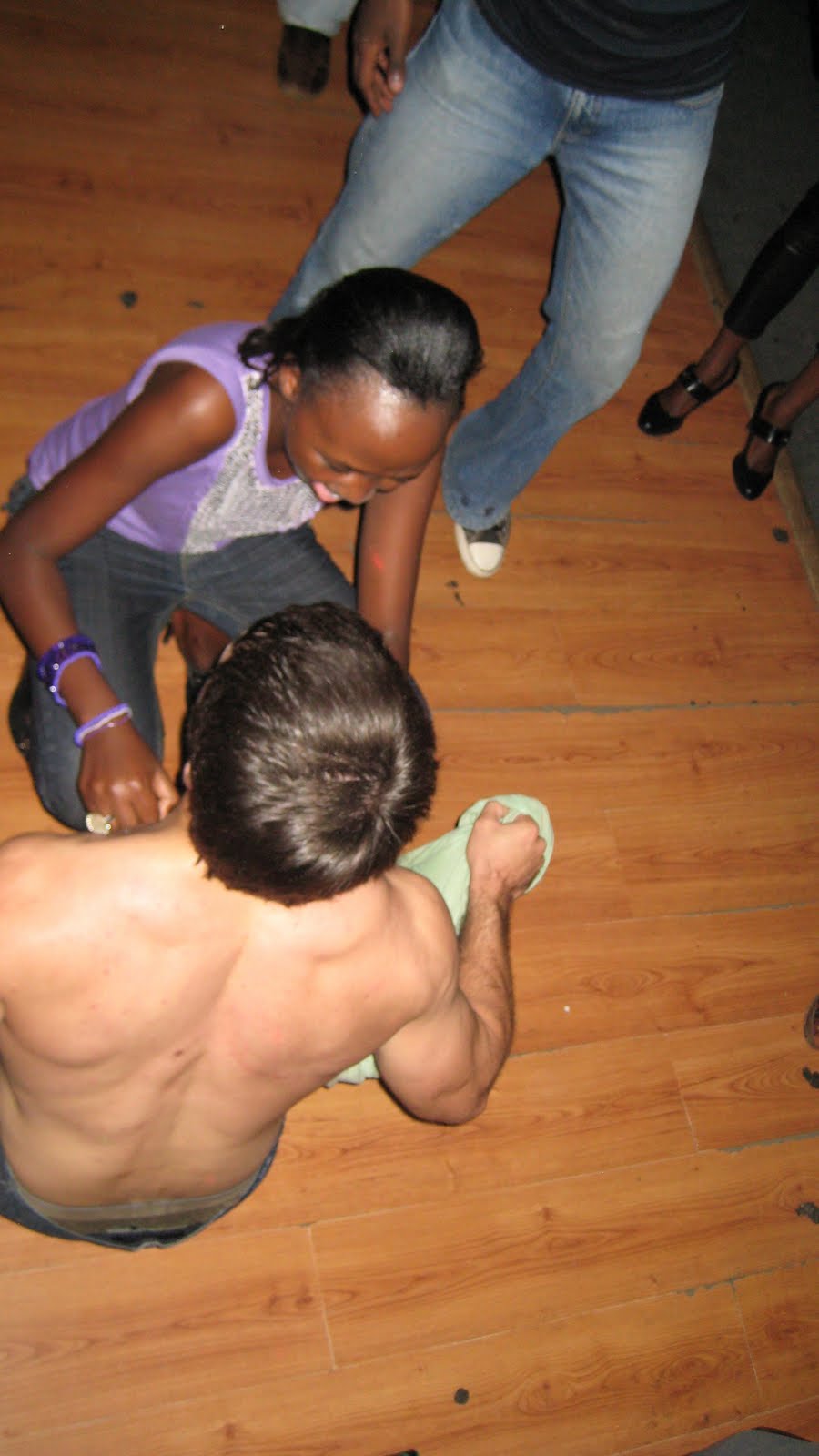
This dancing dynamic was replicated at the Kigali Business Center night club (the KBC, as it's known) on our penultimate night, where I hit the floor out of duty when the DJ fulfilled my MJ or Prince request (though "Thriller" qualifies as the bare minimum fulfillment of that request, where "Little Red Corvette" or "Wanna Be Startin' Something" qualify as maximum fulfillment), and then later somehow ended up without a shirt dancing on the floor to another song that was familiar but that I can't quite name. These dancing dalliances also met with a strong crowd response from locals, including moments where a throng of girls jumped around me, and moments where a local lady of ill-repute danced behind me and rubbed my neck. She was not ready for the proverbial jelly, as it were.

Apparently, I was really easy to pose with when on the floor.


There's one other digression merited regarding dancing in Africa that makes it a little different. I will assume that Rwanda is not a very good place to be a homosexual: that is based solely on assumption and a little bit of asking around in Rwanda and of experts, but also on the idea that neighboring Uganda recently attempted to outlaw homosexuality, with death a potential penalty for some offenders. I'm presuming that Kigali, at the very least, is not trying to win Let's Go recognition as a gay capital, if you catch my drift.

Not that there's anything wrong with digging these moves or those pits.


That said, there is a frankness to showing affection that you would not see in the U.S. for sure, and in most places in the west. As one might find men holding hands in the Arabic world, you find it in Rwanda, more than you find men holding hands with women even. Women have a very strong position in Rwandan (or at least Kigalien) society, but there are still old-fashioned charms like triple kissing when you say hello or goodbye.

"Hey, how YOU doin?" (Also, sweaty much?)

This frankness extends to the dance floor, where guys dance with other guys just like they would with women. Which is weird, at first. At Papyrus, I thought I had stumbled upon a gay enclave as men bumrushed me to dance a little too close for comfort. By the time I danced at KBC, I was an old hand, and I didn't blink whether it was man, woman, group of women, group of men, or lady of ill repute who wanted to dance close with me. All of those constituencies were represented, by the by, which is another way of saying my dancing was a big hit.


I made sure the number of photos of me dancing close with a girl double the number of me dancing close with a guy. In case you had doubts.


A final illustration of the open arms with which the mzingu and his strange habits were greeted in Rwanda could be found at a small church congregation of only 500 people or so on a Sunday morning. At this pentecostal gathering, inside a building whose inner walls and ceiling were fashioned, perhaps consciously, to look like a revival tent, we witnessed an impressive service. The service started with gospel rock offerings from a talented 5-piece band and a choir, giving the feel of a concert for 20+ minutes. Then a few quiet messages were passed and we were introduced as guests. We went on stage, gave a speech and taught a song and dance ("David Melech HaOlam") for kids to join us in, and then retreated to our seats.

"And make sure to donate to the collection basket, kids!"


A few more announcements were shared, and then the band kicked into another song. This time, the tech staff cranked up a computer and a projector and showed the words on a screen. So we could sing along, more or less. More and more, as the song went on, as it was pretty repetitive. This song in fact stretched into the epic territory, far outstripping "Freebird" or any Led Zeppelin classic in terms of length and righteousness, and at last coming to a halt somewhere in Grateful Dead noodling territory, but with less noodling.

Instead, there was a chorus line, and they were dancing. Men and women pulled out a few steps that they kept switching on and off like a new hat to try on in a store before taking it home. I, deciding to wear my kinesthetic learning hat, followed along with the steps, allowing myself to get into the groove of the service and the worship, even if my heart wasn't exactly into the worship and my thoughts, ala King Hamlet's, were not exactly rising heavenwards.

The chorus line proceeded to don a three step and kick maneuver in each direction. 1-2-3 kick, turn 1-2-3 kick, etc. I executed this maneuver dutifully from my seat, perhaps bumping into the interpreter the church seated next to me so I could understand the sermon. After a few minutes of auditioning, unwittingly, I found myself compelled to go up on the stage. Which is to say Eddy, our Rwandan friend who introduced us to this church, led me on stage. And left me there. One mzingu on the end of a Rwandan chorus line.

I couldn't find the video of me dancing, so here's the song we sang to. This song went on for over 20 minutes. I guess it made as much sense as "Hey Jude," at least.


So I continued to follow the step on stage, with great elan and exuberance, if a slight hesitation over my incongruous presence in front of everyone. And, well, it was an experience: I didn't ruin the show, but I didn't elevate it as much as fit into it. Which was fun.

Such is life being a mzingu in Rwanda: exhilarating, exhausting, exciting, and exorbitantly rewarding. At least, for a little while.


Let's slide in an epic performance of our inside joke song of the trip, "Hey, Mzingu."