Showing posts with label Africa. Show all posts

2.11.10

Three Last Thoughts on Rwanda

I don't pretend to be able to summarize in a few pithy words what my/our trip to Rwanda was like. Actually, I can easily pretend to be able to do it, I just don't feel like it. Enough internet ink has been spilled on this site about the trip to Rwanda, I think: this post will bring me over 14,000 words. So anybody who is reading this and cares about what my overall impressions on the trip were should be able to pull something together based on the seven (including this one) posts and all that is contained therein.

At the same time, I want to write one more post about Rwanda. Not only because I promised it in the first post on Rwanda (more to myself than to anyone else), but because there is more I can say. And more I want to tell. So in lieu of any grand conclusions about the trip or huge statements, I give to you three little snapshots, events from the trip that encapsulated much of what happened as a whole, while also providing some entertainment. These events are not in chronological order.

Live at Gisenyi

Lake Kivu the morning after the storm.

The trip was harrowing; twice I have mentioned the thundering rains that could have ended our trip prematurely. We rode 10 passengers in a van designed to carry 14 passengers max in theory, but a van with bulky but thin cushions that did little to hide the feel of the steel bars beneath, a van with seats too close together so that there was no leg room even for the midgets like me, a van that had a multi-colored lamp inside that could do the disco rotation as needed, and a van that came from Dubai, where it was apparently the van for a hair salon. Riding in the van for four hours already that day (with stops), we were worn out as it was, and in no condition to weather the storm peacefully. We were saved by the steady driving of our main man Pascal, a driver who switched on to our group with the new van and who, on his first day, wore a bowling shirt with the name "Baker Hughes" stitched on the back. Maybe a code name? Or his bowling nickname, ala The Jesus?

In any case, the trip was harrowing. It led to our only night out of Kigali, a small hotel on a hill overlooking Lake Kivu, a Great Lake (Africa style, obviously) on the border with the Democratic Republic of Congo. We arrived shortly after dusk and, after divvying up rooms and unpacking, a few of us went out on the porch and talked and watched the lightning storm. I brought my guitar out and provided quiet and (I hoped) non-intrusive background music to the more serious conversations around me.There was an uneasy beauty of the moment.

We went to a relatively lame hotel restaurant by the water, mosquitoes infiltrating the overpriced dining hall, but our bonds were tight and the chocolate mousse cake I ordered (for dinner) good. Indeed, though I was weary from the car ride and the trip in general, hitting its 11th and 12th days, and though this trip marked the final high water mark before travel and group fatigue wore on my experience, we were at a high water mark at that restaurant, and the glow of our mzingu bubble on Kivu preserved that positive feeling.

We returned to the hotel just shy of midnight. I was most interested in going to sleep, but there was a general clamor for some music. And so I pulled out my guitar and played some tunes, pulling from the back catalog of hits ("Barcelona," "Ain't No Minivan Mama"), the fruitful summer of 2010 writing I had done ("Cellulite", "Stuck at the Start"), and the two Rwandan-inspired tunes I had written ("Any Given Day," "Hey, Mzingu", and yes, I did just cite a bunch of my own songs that most people have never heard. It's my blog, roll with it). My lovely audience that I would have liked to take home supported and enjoyed cigars, waragi, tequila, and the company, as well as the scenic backdrop, one of the nicest I will ever play in front of in my amateur musician career. The beauty here was easier, more exhausted, but joyous, a true cap on the high water experience.

An hour and a half later, I woke up in my bed in the hotel room to the evil sound of a nearby buzzing mosquito. My roommate was not on anti-malaria pills and had avoided vaccinations and in general was doing things all naturally to protect his body (we enjoyed watching him put together his herbal cocktail each morning at breakfast). No problem; I had all the respect in the world. And when we roomed together in Gisenyi, with two beds but only one mosquito net, I said, "No problem, you take it. Mosquitoes don't like me much anyway." My macho stubbornness striking again, as you see.

So when the mosquito woke me, I lay still for a few minutes, thinking I could wait it out. I slapped at the air aimlessly as well, or not aimlessly since I could hear him, but with very poor accuracy. The quiet desperation of hearing a mosquito buzzing around you and knowing there is nothing you can do to stop her, and knowing that the noise (definitely the noise and not so much the fact that she will bite you) would not let you sleep, and that sleep is the thing you most need to preserve your calm, your patience, and your sanity, this quiet desperation set in for me.

My roommate, fortunately, is a good sleeper. Fortunate, because my solution was to turn on the lights, sit as still as possible in a poor lotus position, and kill as many mosquitoes as necessary to allow me to sleep. There is always the illusion, after all, that it's only one mosquito that is buzzing around your head; their buzzes sound the same. I killed one mosquito. A buzz returned. I was not fooled. I killed another mosquito. I swung and missed at a few more. Somehow, my roommate stirred but did not wake. I imagined myself to be a modern day Mr. Miyagi with a lower hit-rate. Much lower.

In the end, I killed about 10 mosquitoes over 20-30 minutes, turned out the lights, and pulled the sheet over my head. I slept soundly if incompletely until the morning.

The World's (or at least Rwanda's) finest football pitch (Or backdrop)

A group photo of the memorable pitch.

East Rwanda, on one of the rare spaces in the country flat enough and big enough for a football (i.e. soccer) pitch, with 25 some-odd (we played about 13 v 13) boys aged from 16-24 or so who were ostensibly sophomores in high school, all orphaned or made vulnerable by the genocide, in the sunny but fading late afternoon light, with a beautiful vista to the east that suffered not at all for the fact that we wouldn't be able to see the sunset over it.

That was the scene. We were visiting the Agahozo Shalom Youth Village, and as part of our visit, we got to play football with the kids (or basketball, or volleyball, but I chose the footie). The village is an oasis, of sorts, for the aforementioned vulnerable and/or orphaned population of Rwanda, operating as a high school for these kids. So far they have 250 students, admitting a new freshman class of 125 students each year to hit a maximum of 500 students in two more years.

But enough about the technicalities. On the pitch, the kids are about what you would expect them to be: talented, able, but lacking savvy, teamwork, or foresight that comes with coaching and paying attention to sports. Understandable, of course, considering they have a lot more important things to deal with than being good at football; this isn't a factory or even a competitive high school. It's just a place for kids to play the game.

So a couple of us joined in the game, running up and down, making a couple plays here and there and getting frustrated from time to time. I learned the appropriate words to call for the ball, "Karibu" (meaning "welcome") and "he-he" (short e's; the word means "here"), and called for the ball plenty, but didn't really get many touches - there were a couple sweet crosses I made that didn't lead to goals, but ah well, I screwed up plenty times too. Meanwhile, the light grew hazier and the beauty rose to match it.

And then we had to leave. The game was still going, and we had to leave. My unfortunate response was to fall into "Cheese Fries or nothing" mode*. I ignored the first several calls. Then I turned in and gave up, gathering my t-shirt, walking sulkily off the field and probably spitting to the side a few times more than necessary. I entered the car and, making sure to voice my frustration, said, "Tha's some bullshit."

After a pause, somebody asked what this so-called "bullshit" was.

I hemmed and hawed as I got the words out, then said, "When will we ever get a chance to play on a field like that in a setting like that? We can eat in Mzingu restaurants for the rest of our life," in reference to our rush back to Kigali.

Well then.

Another lost temper. Another blown fuse. And though I won the battle this time - I got the cheese fries, so to speak - I lost the war, failing to make it two weeks without losing my cool. Haval, as we would say. Haval.

But it was a good line. And a pretty place.

Our Redemption From the Children


The scene as I first saw it.

I sat in Nyamata church, the second of two churches on the day. We had been to the Nyabarongo River earlier, where genocidal killers dumped their victims' bodies to "send them back to Ethiopia", via Lake Victoria. We had been to Ntarama church, of the bloodied Sunday school wall of the previous post. Whatever one might say about the reasons for our trip, the futile nature of it, the inability we faced in plumbing the depths of our or others' trauma, it can at least be conceded that we had not had the most pleasant day.

After writing a poem in my journal and sitting inside the church on my own for a few minutes, I heard a harmonica play. Evan was blowing out a tune; "Love Me Do" it sounded like. In an otherwise solitary and silent moment, it made for a pleasant break. I went outside to see where he was.

When I got outside, I found that Evan was not just playing on his harmonica, but playing on his harmonica for twenty or more schoolchildren. Others from our group were out there dancing and smiling and talking to the kids, taking pictures and then showing the kids their image on the camera. No better balm in this world did God invent than the smile and laughter of a curious child.

We spent the next hour walking around the village, chasing after different groups of schoolchildren and picking them out, spinning them around, hugging them, and laughing with them. We drank over-sugared Coke and broke into sprints after the over-cute kids. We alternately terrorized and brightened everyone's day. On my trip in Europe,

Ben made the point, in Hamburg, that no matter how unsuccessful we were in achieving our objectives, or how annoying our requests might have been, we certainly made everyone's day a little bit more unusual and, dare I say it while trying to avoid sounding arrogant, more special. Well, that was at least ten times as true in Rwanda, and even more true in Nyamata village.

But we, of course, were the bigger beneficiaries. I talked about the dissonance between visiting terrible sites and experiencing beautiful people and scenery: this was the greatest dissonance we felt, and the loveliest. It was the most special moment we had on the trip, I feel, and I doubt my companions would protest too much.


Ah hell, one more bonus note from Rwanda - the last night


Our going away party featured a long round of speeches from everybody we managed to rope into our goodbye circle from our friends in Rwanda - potential sugar daddies, sons of reggae stars, good friends we had met in Israel, our friendly hostel security guard, our guides, friends from our blog we weren't as close to - and from us. Then I played on my creaky guitar, loud enough over the roar of the fire to bother the other guests in the hostel and lead us to leave the hostel and go to a nearby traffic circle. Where, after waking up the guard on duty sleeping in the fountain itself (no running water), we proceeded to run through a few more songs. Then a few more goodbyes. Then a giddy, solemn march back to the hostel, I on an improvise-ready little riff with Evan accompanying on his harmonica to a little ditty while the others reveled in the beautiful possibility and sadness of Kigali's night sky, together for the last time. The trip was everything it was supposed to be, even when it wasn't. It was every happiness we could hope for even when we were sad, every calm realization we sought even when we (I) lost our cool. It was certainly a success, a victory, an experience, and something to remember. And, almost a month later, I can still say with certainty that I don't think it'll be a last time, either in Africa or Rwanda. No, one way or another, this was just a beginning.


The Chorus of the other Rwanda related song I wrote, by the bonfire.

1.11.10

Looking Where The Blood Once Flowed


Trauma is a weird thing. Experienced, it leads to all sorts of repression, covering up, avoiding, or compensating, as well as growth, change, dealing with the experience, sharing, and recovering. Witnessed or observed, trauma can be both easier to understand and sympathize with and harder to grasp fully and empathize with; one can tell how awful an event is, but at the same time there is a distance, a barrier that prevents one from appreciating how deep that awful event goes.

I'm not sure what the difference is, exactly, between experiencing and observing trauma, having done both. I would suspect that when you experience it, you feel the depth of a trauma and then seek to paper it over and avoid it, hoping to get on with your life at whatever cost. When you observe it, you seek to get to that depth of the trauma as much as you can so as to appreciate the pain others felt and to help them whatever way you can. In both instances, the depth is lost, either under an inability to sink down and explore others' watery trenches or a struggle to steer away from one's own undertow.

There's no way for me to tell you that I now understand the Rwandan genocide or that I can relate to you what Rwandan survivors and normal people actually feel 16 years later. No more than there is a way for me to tell you that I understand my mother's death 6 years ago or how I actually feel about it 6 years later. In both cases there is a sad depth, and occasionally the tremors that those inner plates set off reach the surface - in grinding teeth at night or respectful silence as a survivor sheds tears when telling her story again - but a lack of the necessary knowledge, understanding, and even courage to get plumb that depth.


I can point out some of the interesting tremors I observed in Rwanda's memorial process and in the way people live with the legacy of genocide. So let's go to that.

As I hinted at in the previous post, the way the country preserves the memory of genocide is hitting a period of transition. The main effect of this change, it appears, will be to bury all or most of the bones and change the experience from one of evidence and thrusting the visitor's face in the horror to one of teaching the visitor of the genocide. We still got the evidentiary, horrific version, so let me tell you about it.


Nyamata church with 16 year old clothing deposits.


Having the horror of genocide thrust in our faces was both jarring and numbing. Jarring in the sense that we saw the skulls, saw the clothes, saw sites of genocide as they were 16 years ago. The clothes in the photo above, that is, were the clothes those who died in the genocide were wearing. The big dark stain you see in the corner of the building below is one of blood. The building is a Sunday school at Ntarama. Children were hiding in the Sunday school and children were the victims therein. I leave it to your minds to tie these sentences together as you wish. This was, for many of us, the most affecting memorial site.


But, as with so much of life's experiences, the subtle display was more effective than the over the top. We later went to Murambi, a memorial site closer to Butare, a major university city in the south of Rwanda. There the display was somehow more graphic than skulls or clothes. The history, in short, was that Murambi had a church that was the site of genocide - many Tutsis fled to church, which had been safe havens in previous times of violence, only often, too often, to be betrayed by either church officials or just the predictable nature of their actions, as militias and the army found their victims more easily - and then a base for French soldiers who came as part of Operation Turquoise, the UN sponsored "peacekeeping" mission I mentioned in the previous post that kept peace mostly for those who inflicted genocide and war. The French soldiers buried the victims and then set up volleyball courts and other activities of leisure over the graves, per the current Murambi memorial's info. After the war and RPF assumption of control throughout the country, the graves were exhumed and many of the skeletons were preserved in lime and placed on display in 20+ barracks-like rooms on the grounds.

This is really gross, both in numbers and in effect. And it could be viewed in two ways. I subjected myself to every room, to the lime smell, and to the relentless pace of genocide site-seeing, to at least witness what they wanted to show: child skeletons, baby skeletons, bodies on top of each other, children in parents' arms, tufts of hair on some skeletons, clothes still on the skeleton, a baby in the arms of an adult, and most of all the look of horror frozen on all the faces, and the defensive, helpless poses they ended their lives in. I thought I had no right as a foreigner, as a visitor who claimed to be interested in Rwanda and its past, and as a representative, unwitting or otherwise, of an international community and western world (and the U.S.) that failed to do anything productive to prevent this genocide, to look away.

Others in our group, coming from a Judeo-Western perspective, found the display disgraceful to the memories of those people and all sufferers, and felt that the preservation of the bodies was self-defeating: the bodies did not look authentic enough to serve as evidence against genocide deniers they thought, so what's the point? (No photos were allowed inside any of these sites largely to prevent more foreigners from sneaking photos of the sites and then claiming the photos served as proof of a fabricated genocide). I understood their point.

Ntarama Church.

Something else spurred me on at this site and others; the strange willfulness of the guides. In this case, I mean the guides representing each site, though it could include our young Rwandan guide - he claimed that anyone who didn't look at these things was showing weakness, though that stance was part of his own repression and recovery from his trauma, an incredible story that saw him and his polio-stricken mother tramp across Rwanda to Congo, a 3-week journey undertaken when he was only 4 years old. So his stance, considering his experience, is understandable.

And that stance and similar experiences may be what was behind the way our guide at Murambi kept pushing me and a couple others along the site. She, a cute woman in her 30's with a bright, toothy smile, walked a room ahead of us, waiting for us to advance, and barely concealing her disappointment when somebody else peeled off and stopped looking at the rooms. I sensed that she almost deliberately pushed us into this experience, as if to say, "Here, you silly Mzingu. You want to visit Rwanda? You want to understand the genocide? Keep looking then. Here it is. Welcome to the bed that everybody in the world helped us make. Sleep well." But she did all this, as everybody does, with a smile.

A chalkboard in the former outpost for Belgian soldiers killed at the beginning of the genocide in a ploy to get the UN to pull out their mission (which they did). The writings are angry notes left by the affected Belgian families for commanding general Romeo Dallaire, who is generally viewed as a noble man in his conduct regarding the genocide, hamstrung by the bureaucracy behind him.

This same sort of dissonance emerged in our meetings with survivors. We met with a couple kinds of survivors, in terms of mentality. When volunteering, we painted houses for young (20s and 30s), relatively cheerful and recovered men and women who were unlikely heads of households, orphaned 16 years ago and forced to lead their families. They were eager for our help and almost rehearsed in their thanks and happiness at our being there. Especially considering the narrow amount of time we had to help them, I felt that something was off; it could have been just me, but I wasn't sure that we were helping as much as receiving an opportunity to help, and while the side benefits of hanging out with these survivors were there for both us and them and us, there was a strangely unsatisfying, self-absorbed taste left in my mouth.

When we visited survivors who were not as well off, there was a stranger dynamic. One young woman in a survivors' village on the outskirts of Kigali broke into tears while recounting her story. We sat and listened sympathetically, eager to be as supportive as we could and to show our gratitude for her sharing our story. Our interpreters, young men who worked in an organization dedicated to helping survivors, were strangely nonchalant and even jovial as they listened to the survivor's testimony for the proverbial nth time. I suppose they didn't need to be shedding tears or donning dour looks, and the survivor didn't seem to care, and maybe they even cheered her up, but there was something slightly off about this scene.

 The woman second from left is the one described below.
But in our visits to survivors we also saw incredible things about Rwanda as a land and as a country. We visited a widows' village (also on the outskirts of Kigali, a major flaw in Rwanda's survivor aid program), where we met one poor woman who couldn't leave her room from depression. The guide who brought us there, a woman in her 40s, was better about bringing us together in the appropriate tone, and perhaps we brightened the widow's 10:00 hour for a few minutes, but there was not much we could do.

We did marvel, however, at the cheery garb of the other widows in the village, and even more so at the workers in their village. You see, amongst a village of mostly women between the ages of 35-55, all survivors of the genocide, the people repairing a house that recently lost a roof in a storm were genocide perpetrators. Criminals, prisoners, in other words, who were from other areas but who nevertheless inflicted crimes on other people that these widows suffered from themselves. "The prisoners depend on the women," our guide told us. "They get their water from the widows, and so they have to work together." We all thought this would be a grave security risk and a frightening thing for the women, but apparently it works out.

Our man was also adorned in cheery garb, I might add.

There is one last major, stunning inconsistency in visiting genocide sites and survivors in Rwanda. Perhaps it is not an inconsistency, but the universe's way of leveling us out and reminding us of who we are and how life is never just one way or another. Each site we visited was set in natural beauty, in gorgeous vistas and amazing scenes. And beyond the natural beauty offering a stark background to the human horrors, there was also the human beauty: each place we visited had people around who either worked at the site, or lived near the site, or went to school near the site, and their kindness lifted us up out of whatever funk we fell into. Whether or not we had a right to feel that funk, whether or not we could appreciate the trauma of the country on any significant level, and whether or not any of this mattered, the beauty that came after each sad experience added a clear gloss over everything we did. We didn't forget what we saw, and the horror did not diminish, but we did at least feel a little bit better. Each little bit counts in dealing with trauma, one way or the other.

The view from Murambi.
 

31.10.10

After the Great Fall

 This is a somewhat rambling post on the political situation in Rwanda. Outside of the usual scope, I guess, but this is my main (only?) writing outlet these days. And it's still about Rwanda.

Driving around Kigali, it is possible to forget the genocide, to forget the civil war of 16 years ago. The city is relatively prosperous and growing. People smile and volunteer friendly conversations more than a shell-shocked or closed populace would. While there are many organizations, governmental or otherwise, who are headquartered in the center of the city and whose focus is on preventing genocide, aiding survivors, or other related issues, there is not a noticeable survivor presence in the city.

In some ways, the government and the people would like the genocide to be put past them. The country is seeking to gain a reputation as a tourist destination, and they are seeking to grow a modern service economy, and they are seeking to do both these things in part by shedding the main word association publics in the west have with Rwanda, genocide. It is not that the country seeks to forget, of course; many argue that the continuing legitimacy for the Kagame regime is tied as much to the fact that he led the forces that ended the genocide as to the fact that he has rebuilt the country thoroughly since that time. Many in Rwanda would like to remind others that there's more to the country than genocide history, is all.

The memorialization of the genocide is in an interesting transitional period. Many of the sites we visited were preserved monuments to brutality as much as anything else; skulls, bones, clothes, and even in one place full skeletons remained intact and on display as a testament to what happened. This on the one hand is an effort to display the very real effect of the 1994 genocide and to ensure its memory endures; on the other hand, there is not a great amount of respect for the bodies of those who died.

So the memorialization is changing, in part. Our guides hinted to us that sites such as Murambi, Ntarama, and Nyamata (I'll go more into them in the next post) may be radically different in 4-5 years, with the bones finally buried and the focus of the exhibit shifted in some way. The Kigali Memorial Center, whose exhibit was furnished by a company that also organized our tour of the country, is a model for what's to come in many ways: a very informative museum-exhibit combined with mass graves, a wall of names, several symbolic gardens or statues, and a heavy dose of witness testimony. It's a very fine exhibit, as far as that goes, and if the genocide sites can be shifted from bare bones evidence of the genocide, literally, to informative and testimonial based sites that still capture some of the experience of the history, that would be a good thing for the memorialization process. Then again, if they do indeed follow through on their plans to do things like transform the former President Juvenal Habyarimana's (his plane was shot down on 6 April, 1994, triggering the genocide which would start the next day; he had long been aligned with genocidal forces, though his signing of a peace accord may have been the final straw in leading him to sacrifical lamb status) house into a national museum and party site - our visit came during preparations for a wedding later that day - perhaps the memory will not be as well preserved.

But let's go back to the history itself, and the impact it has on the country to this day. Without giving a footnoted, academically cited, and overly detailed summary of Rwanda's history, I hope to not reduce it too much. I also hope not to mess up too much.

In essence, Rwanda was part of a kingdom with Burundi before the arrival of German and, after World War I, Belgian colonizers. The colonizers solidified the vague racial categories of Tutsi and Hutu by formalizing people's identity via identity cards, backing up the categories with pseudo scientific (eugenic) theories on the differences between the two groups, and placing the smaller Tutsi group in power, leading to newly emphasized tensions between the two groups. Towards the end of their colonial reign, the Belgian leaders decided to give up on the Tutsis and backed Hutus for power. Hutu leaders, sensing the opportunity to take advantage of their people's anger over being subservient to Tutsi interests, built their power on racial grounds, and when the Belgians left, they initiated several cycles of violence against Tutsis.

These cycles continued until 1990, when the Rwandan Patriotic Front, a largely Tutsi-exile army, and the Rwandan national army fought a civil war. The RPF, co-led by current Rwandan President Paul Kagame, was a better organized army and gained ground and leverage. The Rwandan government was also constrained by economic struggles (there was a great drop in coffee prices, an export crop Rwanda relied on) and donor nations eager to see Rwanda make peace, leading to a peace accords. The Arusha Peace Accords didn't include all necessary powers and provided for a shaky power-sharing government, but at least was sensed to be a path forward.

Instead, the President Habyarimana was killed when his plane was shot down on April 6th, 1994. It is still a hot topic of dispute as to who killed the president; Rwanda and its allies, as well as more experts, believe that the Hutu Power movement surrounding the president (who was a Hutu and a hard-liner, at least before conceding to the peace process) killed him as a way to launch a genocidal campaign and consolidate power - they felt that using a scapegoat of the minority Tutsi group (15% of the country's population) would rally the majority behind the government and keep them in control. Many in France (a strong supporter of the genocidal regime) and a few others believe the RPF was behind the assassination. Most circumstantial evidence points to the Hutu Power group being responsible, and I have a hard time seeing why the RPF would have done it, for what it's worth.

Either way, the genocide began the next day, April 7th, 1994. For 100 days, Hutu militias and government military forces killed between 500,000 and 1.2. million (the most common estimate is 800,000) Rwandans, mostly Tutsis, though also moderate Hutu political figures and Hutus who stood in the way. The genocidaires had studied their history well, and used tricks from the Holocaust to Somalia to carry out their genocide and disengage the international community. This was a classic case of the world standing by and watching, at times even doing less than helping - when the UN finally "sent" in a mission, it was a French led army in the Southwest that did nothing more than provide an escape route for the genocidaires fleeing from the RPF forces who had relaunched their fighting in response to the genocide. The genocide only stopped when the RPF won the war and assumed control and power of the country.

The Rwandan genocide was renowned for its brutality. Rwanda is a small country (population between 8 and 11 million over the last fifteen years), and to carry out such a genocide required participation from many people in the country, including ordinary people, neighbors hunting or snitching on their Tutsi neighbors. Families with mixed marriages were torn apart. Major tools for carrying out the genocide included machetes and a local weapon that was basically a wooden stick with a nail on it.

The only other thing I'll say about the genocide before moving to firsthand observations is that it is still unclear how true and how constructed the racial identities are. One popular belief was that Tutsis came from Ethiopia, and so many Hutus "sent them back" to Ethiopia via rivers. Common stereotypes say that Tutsis are taller and more beautiful, while Hutus shorter, stockier, and thinner. Others say that there is, or was, no real distinction between the two groups, and that the term Tutsi was affixed to anybody who had ten or more cattle; as such, Tutsi/Hutu was a class distinction. At this point, or at least at the genocide's point, the distinctions became hardnosed facts, but it should be remembered that there was no primordial, inherent reason for the population in Rwanda to bifurcate into two major groups (there is a third, the Twa, which makes up 1% of the population and is usually considered incidental to the racial politics of the country).

This history also has to be remembered when considering the current political condition of Rwanda. President Kagame has strong control of Rwanda, having recently won re-election with a 93% vote, a number most people consider not to be doctored. But there were a few numerous high-profile disqualifications of opposition politicians from the race, and so 93% isn't a wholly safe number to throw out either; in general, whenever somebody is elected with 93%, there is cause for suspicion.

It is hard to find people who will dispute the notion that Kagame and his team have a strong grasp on the political space in Rwanda. The dispute begins in assessing the implications of that control. On the one hand, Kagame is undoubtedly popular, especially in Kigali - you can't go far without seeing Kagame t-shirts sold or worn, and signs of his campaign hung ubiquitously even a month after the election. Rwanda has grown, Kigali is booming for an African city, and the country appears to be much safer and stabler than most societies would be 16 years after a wrenching social trauma on any scale, never mind one that wipes out an eighth of the population.

At the same time, as my German friend on the trip pointed out, one should get uneasy whenever one man has so much power. Even if the government's intentions are good, it is not healthy in the long term to have such focused control. For example, the government has led a very positive idea of reeducating the people to believe in "banyarwanda", or the people of Rwanda. As in, "we are all Rwandans, not Tutsis or Hutus." A great idea that hopefully will set in to eradicate any racial reasons for Rwandans to discriminate against each other (or for outsiders to encourage dissension and divide and conquer, as was the source of all these problems). But if most people still know who's a member of which group, as we were often told, or if most people perceive the political beneficiaries of the current system, i.e. the people in power currently, to be Tutsis, this system and concept of a new Rwanda hits a blurry border with older systems of privileged people and groups.

For all this, I would like to return to the history and to the bias of Americans and the West. It's easy for us, feeling ourselves to be in an open, democratic society where the political space is far wider (whatever our problems), to criticize a country like Rwanda (similar issues affect westerners' views on Israel, but this is not the space for that). We did not have a tortuous genocide rip asunder our nation within the past two decades; World War II tore apart Europe and led to change, but the main perpetrators were convicted and the general population (i.e. Germans) atoned for their grievous faults, while many of the victims left (Jews, most obviously). America's genocide happened hundreds of years before and was swept under the rug; the country has survived just fine despite the treatment of Native Americans, thanks.

We should consider, then, what would happen had there not been a strong control of the political space. Everything I heard suggested that there are still people in Rwanda who are eager to stir up racial divisiveness. Without getting on the slippery slope too quickly, we can see that racial divisiveness is the foundation for genocidal ideology. This is the government's justification for the disqualifications from the previous election and other political crackdowns that strike us as overmuch. We could be right in thinking this, but can only reach a fair conclusion if we consider the full context.

Two more points about that context, and here I will draw parallels to the situation in Israel. Interestingly enough, there are many parallels between the two countries, if not quite as much as Rwandans especially would like there to be. But the history, the international position, the internal development, the emphasis on security and independence, the controversial issues hovering around, the kindness and defensiveness of the people, and the beauty of the land are just a few of the similarities that these two countries share. What follows could be said about either.

Rwanda has achieved a lot since the genocide of 1994. Undoubtedly aid has helped, and similarly undoubtedly I haven't actually been to any other African countries to compare Rwanda to. But from all I heard and saw, Kigali especially and Rwanda as a whole has grown substantially in the past 15 years and has surpassed its neighbors in many ways. I never really felt in danger in Rwanda (well, not counting the drive through the mountains of west Rwanda in thundering rain at dusk; I felt fairly in danger then), though the presence of armed personnel around the city and the country was a little alarming. All to say that while it is not unambiguously so, Rwanda is a growing country that has done well, and that has ambitions to do better - Kagame has gone on the record in many places about his desire to outgrow the need for aid. This is commendable, and should at least be weighed against the costs of certain political limits, for the time being. In Israel, this growth is at a far more advanced level, but also should be considered when looking at the country as part of the Middle East and as part of its political issues.

The other point is that when external pressures encourage Kagame and Rwanda to open up, or Israel to achieve peace and make sacrifices towards achieving that peace, for example, they are not just doing it to waste their breath or punish the nation in question. In Rwanda's case, true political freedom and a sense of real unity forged under the label of "banyarwanda", where neither former racial group is benefiting more than the other, would be the true sign of recovery from the genocide and emergence as a modern and rising African nation-state. That is not as easy as it sounds in the sentence above, of course, and outsiders need to be cognizant of the challenges facing Rwanda. That doesn't mean they can't help and prod Rwanda to keep moving forward.

We were in Rwanda for the release of the UN Congo report, a report detailing the many abuses that occurred in the Democratic Republic of Congo over a decade of fighting. Rwanda was implicated in this report, and the wording suggested that Rwanda could be accused of genocide against Hutu forces in the east Congo.

This naturally infuriated just about everybody we met in Rwanda. The report has been accused, justifiably, of poor sourcing and lack of context, and generally appears to be a shoddy effort, for the UN or otherwise. Rwanda's Ministry of Foreign Affairs released a sharp 30-page document refuting the UN report (which ran 566 pages), and they had every right and justification to refute it (we actually befriended one of the authors of the report during our time there). It should also be noted that just about every other African nation implicated in this report also refuted the findings, and that only Rwanda's role in the report and their reaction has been covered to a significant degree in the international media.

But even in this clearly flawed report and justified response, there are gray shades to consider. Rwanda's ire emerges most from the term "genocide" - the report accuses them of killing tens of thousands of people, whereas the Rwandan genocide saw, as I said, 500,000-1.2 million die. Any equivalency of this even on the report's terms would be foolish, and Rwandans fear that were the term genocide to be slapped on the Congo, the international community's opinion would slide back to a "cycle of violence, they are all bad" mode, which would tarnish the Rwandan government's legitimacy and more significantly the nature of the trauma Rwanda suffered. Then when you consider the limited validity of the report, or the many missing contextual factors - for example, the Rwandan report (which I would link, but their site is struggling right now) points out how many Hutus the Rwandans repatriated to their country, and their goal of bringing all Rwandans back to Rwanda, which doesn't easily fit in with genocide. Accusing Rwanda of supporting genocide on any grounds is a wholly dangerous and arguably existential threat to the country and its safety, as Rwandans see it. They are wholly right on this.

At the same time, I have a hard time doubting that atrocities were committed in the Congo, and that Rwanda's troops just like so many others had a hand in committing them. Some transparency is needed in dealing with this problem. As with many situations in Israel (the Goldstone report being the most obvious recent one), just because the report itself was wholly flawed and shoddy doesn't mean it didn't reveal serious issues that need to be dealt with. Israel has dealt with it to some degree; Rwanda needs to figure out if they are ready to as well.

Rwanda has done tremendously in recovering from their genocide, growing their country, and dealing with their internal issues over the past 16 years. Our thrilling and successful visit showed me nothing less. That said, the government still needs to open up and solidify its emerging democracy as a truly free and open place. That doesn't happen in a day; it will be very interesting to see how far along the country gets in the next 7 years before Kagame's term ends and, under constitutional law, he has to step down from the presidency. It will be an important test for the country, to say the least. And progress will go a long way towards breaking any last remnants of the cycle of violence that did lead to the genocide.

27.10.10

Rwandan Ruminations

A smattering of notes, poems, and pictures from the Rwandan trip. When I use a picture that was not actually taken by me, I will credit the group. Many of the photos from the last post, including all of the dancing photos natch, are from the group. Also, the poems would ideally have indentations on various lines, but I don't feel like dealing with the formatting to figure that out.


Group photo.

First day of the trip entry:

A white cocoon envelops our group somewhat. Kigali is nicer than expected, more developed, more expensive. One drive through it was not enough to get a grasp for the city; it sprawls out along hills as if in a countryside. The city is green and red and gorgeous. I sat facing the east through twilight and felt a surge of awe rise through my guitar playing. After dusk with cicadas, lights dotting the hills, and the scent of mosquito repellent, Kigali returns to a natural state.

People have behaved on a spectrum from overly friendly to suspicious and sullen. Our customs officer asked me how I was and our young Rwandan aide is irrepressible to the poitn of obsequiousness. The man who opens the gate to our hostel waves excitedly at us when we enter or leave. People do seem to look at us whenever we pass with curiosity and either eagerness or distrust. Our waitress was polite but coldly so. Many were eager to accommodate us whenever an opportunity came up.


Chanted vocal music bubbles over to us on our hostel porch. Choral music rolls strong and spiritual, whether religious or traditional, harmonic monophony with flashes of call and response.

We must suspend our expectations for this trip. Processes are often slow, many things don't work, we will get sick or lost or sore or cranky. In flavor and degree, this will be a trip unlike any I have experienced for a long time, if ever.

24/09

Obviously, someone else took this, but on my camera. If that makes a difference.

The Visitor


Birds chirp all around me
a cock crow is what woke me
It is a multifabric blanket of sound rising from the hill
Coming to cover me until the sun reaches my part of the hill
A human voice, human labor,
Sometimes this thread emerges on the blanket
I await the blanket, Africa is colder than I thought
And I am a visitor in this land,
A group surrounds me, a white cocoon in the black land
Some know more, some less, some care not to know
Some are connected, some are plugged in
Some are digging, some are sleeping in
I know no more than anyone
And knowing is not a character trait that makes me better
The bird chirp blanket and the white cocoon and the air less than hot
But all I am is a visitor in this thought

Second day of the trip entry

Rwandan restaurant - the wait, the good goat meat, the Ugandan waragi (rubbing alcohol and gin), chapati in a back room of a side street with a smiling hostess Sara called sister (dada) in Swahili, the armed men on the streets. Habyarima's house with secret passageways and torture rooms and churches for Christianity and animist faiths, wreck of the plan, the desire to change the house into a museum. A tightening of the group. The glow of our trip in its absurdity and naive expectation in the face of trauma.

Group photo.

Nyabarongo River entries

He is six or seven years old, dark skinned in a dull brown t-shirt and darker brown pants. I say "mwarimutse" and "amakuru". He says "nimeza". He has a plastic water bottle one-fifth full with coins. He asks me something, uses the word "falanga". I smile and shrug, then say, "nitwa Daniel," using poor Kinyarwanda. I ask, "witwande?" He says "Tunezi Bevinda" or something similar. I ask him to repeat the second name, he does, I say "ndakwashimaye" tow or three times until I get it right. We stand. No words are shared. A minute later he moves, I wish him a "nimosi meza".

As I write this under a bridge, a man in a hat walks by. We talk about where I came from, about where we are, basic pleasantries, and then I see I have to go. I wish him well and begin to leave. He reminds me to take my camera. Very kind. He laughs at my sloppiness as I smile and walk away.


***

Imagining the river full of bodies, the strong current bogged down by the bloated flesh, well, it makes a lot of the heavier rock songs (I'm thinking "Bodies" by the Drowning Pool) sound ridiculous. Also makes most of life's problems seem absurdly insignificant. So it goes.


Weakness

I can be weak. I am weak. I will be weak.
This does not mean I should seek weakness.
Nor should I eschew my attempts to be strong.
It means that I will be weak even amidst my strengths.
Sometimes in familiar ways, sometimes in new ways.
Remember:
I am weak even as I am strong.
Even as I am right I will be wrong.
I shall seek even more strength, but not for power.
I shall seek rightness, not righteousness.
I shall accept myself and others
I will fail to accept both, but will try again.
Even as I am good, I am bad.
I will learn to understand that.

29/09


The Worst Moment


The worst moment of my life
I walk down the green walled hallway
I am late, too late, I came from too far away
And I see you coming out of the room, coming towards me
On your face the most twisted look
Your face is stuck
Your eyes perched on the edge of a waterfall
Your mouth fallen, your brow scrunched, your nose raised
You walk past me, unable to look in others' eyes
And I see Babushka hugging someone outside the door
I know she is gone, she is no more
I am too late
I am too late to say goodbye.
Too late to change anything.
Too late to feel.
All I can do is help put things together.
And really, I am too late for that.

And you are out driving, alone, where no one knows.

27/09

23.10.10

Mzingus Making Moves

This may come as no surprise, but I'll say it anyway: I've never felt like the "white man" like I did in Rwanda.

Come on, I bet you can barely tell which one is me.

Again, no shocker. Besides anything else, much of my traveling experience has been in the western world, namely the U.S. and Europe. There was a foray to Morocco, wherein I freaked out at the attention I drew in the Marrakesh souk but otherwise shrugged off the strangeness, blending in with plenty of other tourists in my own la-la land besides the Atlantic Ocean. There was last year's trip to Guatemala, but that country's proximity to the U.S. and its own racial makeup that includes plenty of European heritage makes white skin either something to ignore or something to resent.

The closest I've come to the reaction we received on this trip came from a trip I took after 8th grade to Japan with a group of kids from school. A cherished trip for me, our 8 days in Hokkaido saw our group take the lead in many of the "art camp" activities that we took part of. Vibrant, brash, and a little flamboyant, we got a little bit of a taste for the life of a rock star, as many of the Japanese kids followed us eagerly while we sang "New York, New York" and "Puttin' on the Ritz." (Did I mention we were flamboyant?)

This kid is the best.

In many ways, that trip was the travel experience I most recalled in seeking a comparison for the Rwanda trip: the school-related group trip, the assortment of activities that was loosely related to academics, and the way the group bonded to create a shared energy that one could not anticipate or predict. But I'm writing about being the white man, so let me return to that.

I've already written about the "mzingu", so let me further detail what it was like to be a mzingu. Kigali is a growing city, and may be ahead of many African cities in development and standard of living. At the same time, Rwanda remains remote, and the presence of a foreigner is still significant to many people. As such, seeing the "white man" is a new experience.

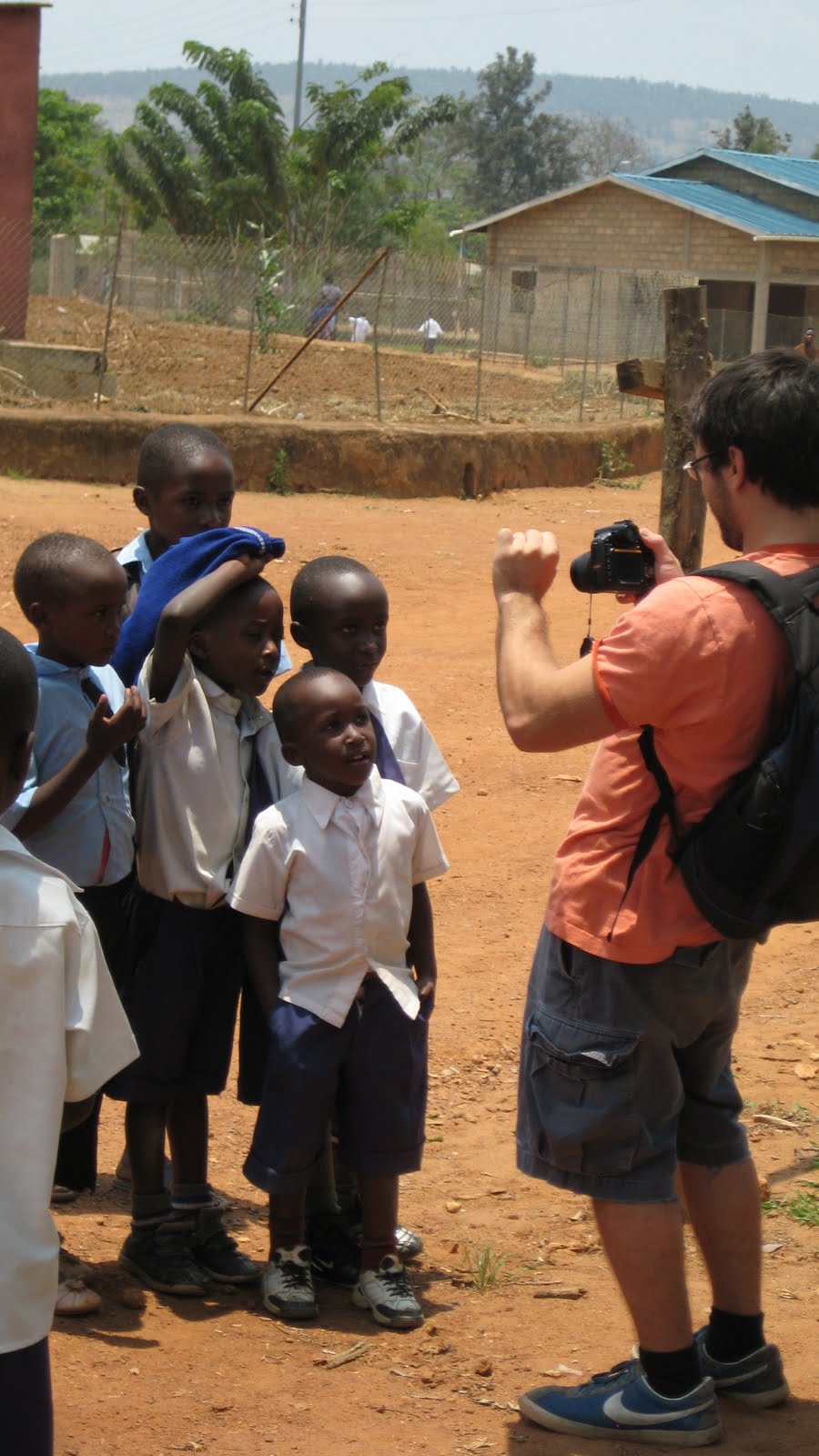
Children are most obvious in the way they acted around mzingus. Four of us went for a walk in the valley near our hostel early on in our trip. As we walked by people and waved, we could see parents indicating to their children that, "look, those are mzingus!" Subsequently, packs of children started chasing after us, shouting, "Mzingu, mzingu!" Once they reached us they were less sure of what to do, most of them standing there shyly and putting their hands out when we offered ours. We never shook hands, instead lightly touching palms. The bolder among our group would hug children.

Hot on the trail of the mzingus.


I mentioned also that there are different types of mzingus; in our group of 4 was a girl of half-Asian descent, her mother being from Malaysia. To her the children came running and shouting an extra word amidst their "Mzingu" calls. It took FGL Sara to interpret for us; they were shouting, "Mzingu nihao! Mzingu nihao!" The same girl later drew greetings of "konichiwa," as older Rwandans showed more cultural dexterity if not sensitivity.

That valley experience was not unique. After a morning of visiting genocide sites, we walked around a village that held several different schools with children getting out for lunch break and recess, which led to several iterations of hugging, throwing children around, taking pictures, and embracing mzinguness. In my trip to the market, I walked by a family in a corner. The adults were pointing at me and telling their 3-year old boy that, hey, look, that's a mzingu, a real live one. I turned the corner so that my back was to them, and a few seconds later I heard a little patter of feet; the little boy had run up to me. He put his hand on my pocket, as if to confirm I existed, and then quickly ran back.


"Look at how well the mzingu dresses!"


This curiosity tinged with reverence was not limited to children. We went to paint a house one morning, and on the way, we stopped to buy the paint, rollers, and masks needed. As our van stood in the street, and I sat in the van, behind one of the girls in our group, a man came up to the window. The man, in a ratty long-sleeved shirt and plain pants, was probably a little older than me. He shook my hand through the window and then proceeded to ask how he could make friends with white people.

"It would be very good to have white friends," he said in decent English. I stammered a few answers. "I would very much like to have a white girlfriend," he said. "That would be very good." He then indicated the girl in front of me. "Is she your sister?"
"No, she's too pretty to be my sister," I said, awkwardly. He did not respond directly. "Is she your girlfriend?" No, I said.
"She is very beautiful." She giggled nervously at the attention.
The man repeated how much he'd like to have a white girlfriend. The other members of our van started to pile in as we at last had the necessary paint and rollers. "I would very much like to meet your sister," the man said as we prepared to leave, "I am sure she would be beautiful like you." It was my turn to giggle nervously. And off we drove, I wishing him well in his quest.

These positive feelings for visitors was a surprise to me, though it shouldn't have been. We were briefed that Rwandans were liable to be closed and suspicious of others, an understandable mode to adopt for citizens of a country 15 years away from civil war and genocide. Furthermore, we might have expected raw feelings over the way that the international community ignored the genocide. At first, I thought that there was a spectrum that spanned two main forms of response to our presence - there were Rwandans who waved eagerly at us, such as the gardener at our hostel who gave us a two handed wave just about every time he saw us for two weeks, and there were Rwandans who eyed us with a bit of distrust. But I later found that whenever we waved at a Rwandan, they waved back eagerly; whenever we spoke to or greeted a Rwandan, they responded with a happy tone; whenever we engaged in a conversation, we found an appreciative conversationalist to join us. They may not have been spilling out their whole life story, but everyone was happy to see us.

My guess is that people make simple associations. The foreigners they run into in Kigali are generally there to help out; whether they help successfully or not is a different issue. Nobody ties foreigners specifically to the international community - if anything, we make up for the past failure. And yes, the "mzingus" tend to have more money, which is viewed not as a threat or even an opportunity - some kids and people begged for money, but on a much lower scale than you would expect. I think more people asked me for money in New York this weekend than they did in my time in Kigali (to be fair, I didn't understand that "falanga" meant cash the first couple times I heard it in Kigali. Also, to be fair, New York City has about as many people as Rwanda).

Keepaway from the mzingus. A typical scene.


Whatever the reason for the reverence white people were accorded in Rwanda, or at least the reverence we were accorded with in Rwanda, it left us feeling like we were in a movie. Any movie set in Africa where the visiting do-gooding (or possibly secretly evil) white man is surrounded by eager African children who marvel at his western clothes and modern technologies: that was the sort of scene we replicated on several occasions. Western clothing is an assimilated part of the globalized Rwanda, but many children were eager to have photos taken by us or to take photos of us or to pose or whatever they could do, if just to see pictures of themselves in the viewfinder. One of our group members had been to parts of rural Ethiopia where children had never seen their own image, with no ready water supply or mirror to go all narcissistic in front of; Rwanda was not that removed from the modern day, but there was great eagerness to meet us. This can get wearying, as everybody who sees you wants a piece of you, almost literally - they want to touch you, talk to you, occasionally receive money from you, and in general bask in you (I hope this doesn't sound arrogant - there's nothing special about us or any white person that visits that merits such attention, or at least nothing special that had anything to do with our control, personal characteristics, or deeds. Rwandans, kids mostly, just appreciate what the mzingu represents). But the eagerness is generally welcoming and positive.

Especially for free plane rides are they enthusiastic.


And that eagerness for the west and modern culture was where the dancing came in. Well, that and my sweet moves.

Workin' it. Uhh. Yeah.


The first time I danced was just among our group at a bar in Kigali. Our main man Patrick took us out to a local establishment after we ate an overly mzingu meal with Israelis in the country at a Chinese restaurant (of all the combos in the world). Fueled by a devilish mixed drink I came up with - Fanta Fiesta (a new, black currant flavored Fanta that tasted like grape cough medicine if grape cough medicine tasted good; also, all soda in Rwanda used actual sugar instead of high fructose corn syrup, which didn't really mean soda was any healthier there, but meant it was a lot tastier) and Ugandan waragi (a clear alcoholic drink that I was warned about but that tasted like nothing more than, well, 80 proof alcohol, for better or worse), we started to bust out moves, but only for the amusement of ourselves and a few bystanders. A couple of the guys and a couple of the girls danced, but it was mostly a warm up night, a preview of things to come.

Those in the know are aware that this move is a Dave Frisch special.

The next night we went out to Papyrus. It was a Thursday night and we had a long Friday ahead of us, so we thought we'd have a nice meal and then go dancing. So we did it. We went dancing. And to Papyrus's credit, they were bumping killer jams for a long stretch, which made it easier to dance.

As anybody who has seen me dance at either a recent wedding or in general (chances are there aren't many of you) knows, when I dance, I bring energy, quasi-rhythm, and a bunch of enthusiastic but not exactly classy moves to the floor. Lots of side to side, lots of shoulder shimmying, lots of changing levels and hitting the floor. In other words, I dance like I wrestle, except with slightly less direction and a lot more spasticism.

"Bend down, then row it. Row it. Work that back. In the rhythm! And one! And two!"

There was no telling how this would play out on the Kigali dance floors. But within a few moves to Haddaway's classic, "What is Love?", I had helped form a circle and had a few young men from the area dancing along with me, mirroring my moves. I would dip to the left and pull my arms back in a fly lift sort of pattern, they would match. I would shake my right arm down in front of me and twist my body to the right, and two guys wearing baseball caps would be right with me. I would run around on my head to "It's Raining Men" on the floor and...well, I did that move alone. And the "chasing my head with my legs as I lied prone on the ground," that move was alone. But it was popular.

"Look at that crazy mzingu! I think he's having a seizure!"


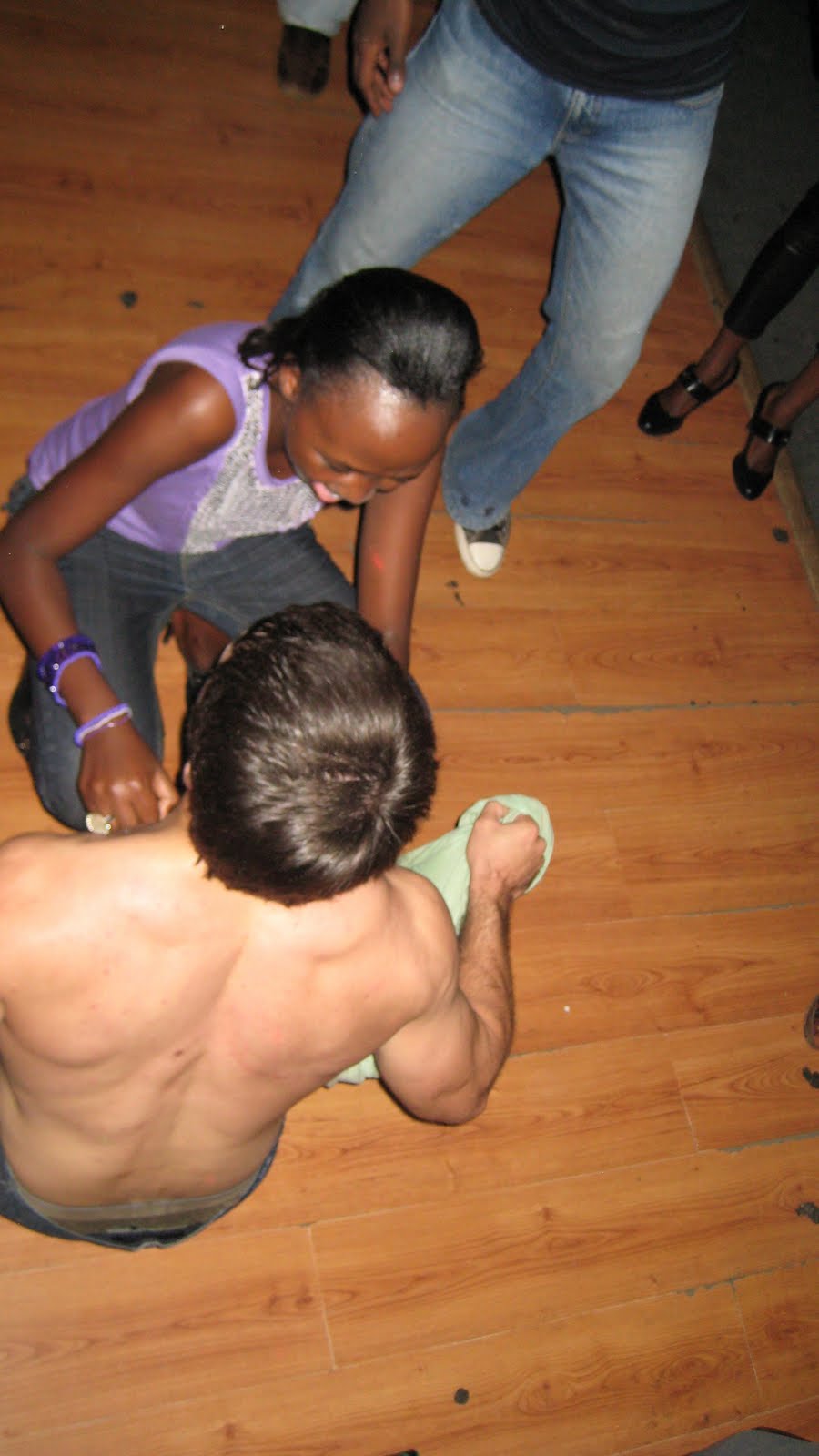
This dancing dynamic was replicated at the Kigali Business Center night club (the KBC, as it's known) on our penultimate night, where I hit the floor out of duty when the DJ fulfilled my MJ or Prince request (though "Thriller" qualifies as the bare minimum fulfillment of that request, where "Little Red Corvette" or "Wanna Be Startin' Something" qualify as maximum fulfillment), and then later somehow ended up without a shirt dancing on the floor to another song that was familiar but that I can't quite name. These dancing dalliances also met with a strong crowd response from locals, including moments where a throng of girls jumped around me, and moments where a local lady of ill-repute danced behind me and rubbed my neck. She was not ready for the proverbial jelly, as it were.

Apparently, I was really easy to pose with when on the floor.


There's one other digression merited regarding dancing in Africa that makes it a little different. I will assume that Rwanda is not a very good place to be a homosexual: that is based solely on assumption and a little bit of asking around in Rwanda and of experts, but also on the idea that neighboring Uganda recently attempted to outlaw homosexuality, with death a potential penalty for some offenders. I'm presuming that Kigali, at the very least, is not trying to win Let's Go recognition as a gay capital, if you catch my drift.

Not that there's anything wrong with digging these moves or those pits.


That said, there is a frankness to showing affection that you would not see in the U.S. for sure, and in most places in the west. As one might find men holding hands in the Arabic world, you find it in Rwanda, more than you find men holding hands with women even. Women have a very strong position in Rwandan (or at least Kigalien) society, but there are still old-fashioned charms like triple kissing when you say hello or goodbye.

"Hey, how YOU doin?" (Also, sweaty much?)

This frankness extends to the dance floor, where guys dance with other guys just like they would with women. Which is weird, at first. At Papyrus, I thought I had stumbled upon a gay enclave as men bumrushed me to dance a little too close for comfort. By the time I danced at KBC, I was an old hand, and I didn't blink whether it was man, woman, group of women, group of men, or lady of ill repute who wanted to dance close with me. All of those constituencies were represented, by the by, which is another way of saying my dancing was a big hit.


I made sure the number of photos of me dancing close with a girl double the number of me dancing close with a guy. In case you had doubts.


A final illustration of the open arms with which the mzingu and his strange habits were greeted in Rwanda could be found at a small church congregation of only 500 people or so on a Sunday morning. At this pentecostal gathering, inside a building whose inner walls and ceiling were fashioned, perhaps consciously, to look like a revival tent, we witnessed an impressive service. The service started with gospel rock offerings from a talented 5-piece band and a choir, giving the feel of a concert for 20+ minutes. Then a few quiet messages were passed and we were introduced as guests. We went on stage, gave a speech and taught a song and dance ("David Melech HaOlam") for kids to join us in, and then retreated to our seats.

"And make sure to donate to the collection basket, kids!"


A few more announcements were shared, and then the band kicked into another song. This time, the tech staff cranked up a computer and a projector and showed the words on a screen. So we could sing along, more or less. More and more, as the song went on, as it was pretty repetitive. This song in fact stretched into the epic territory, far outstripping "Freebird" or any Led Zeppelin classic in terms of length and righteousness, and at last coming to a halt somewhere in Grateful Dead noodling territory, but with less noodling.

Instead, there was a chorus line, and they were dancing. Men and women pulled out a few steps that they kept switching on and off like a new hat to try on in a store before taking it home. I, deciding to wear my kinesthetic learning hat, followed along with the steps, allowing myself to get into the groove of the service and the worship, even if my heart wasn't exactly into the worship and my thoughts, ala King Hamlet's, were not exactly rising heavenwards.

The chorus line proceeded to don a three step and kick maneuver in each direction. 1-2-3 kick, turn 1-2-3 kick, etc. I executed this maneuver dutifully from my seat, perhaps bumping into the interpreter the church seated next to me so I could understand the sermon. After a few minutes of auditioning, unwittingly, I found myself compelled to go up on the stage. Which is to say Eddy, our Rwandan friend who introduced us to this church, led me on stage. And left me there. One mzingu on the end of a Rwandan chorus line.

I couldn't find the video of me dancing, so here's the song we sang to. This song went on for over 20 minutes. I guess it made as much sense as "Hey Jude," at least.


So I continued to follow the step on stage, with great elan and exuberance, if a slight hesitation over my incongruous presence in front of everyone. And, well, it was an experience: I didn't ruin the show, but I didn't elevate it as much as fit into it. Which was fun.

Such is life being a mzingu in Rwanda: exhilarating, exhausting, exciting, and exorbitantly rewarding. At least, for a little while.


Let's slide in an epic performance of our inside joke song of the trip, "Hey, Mzingu."

11.10.10

On the Mzingu

I will talk about the experience of being a mzingu in a separate post. This focuses on the Kigali mzingu community itself. Enjoy.

Rwanda is in Africa. in Africa, or at least sub-Saharan Africa, most people are black. I trust these are simple enough statements.

The language of Rwanda is Kinyarwanda. The East African language is beautiful and full of sounds unfamiliar to our ears: "mwiliwe" and "ndakwashimeya," for example ("good afternoon," and "nice to meet you," respectively). Kinyarwanda has a beautiful word in it, a word all the more beautiful for its meaning and implications. The word is "mzingu" (pronounced "mi-zun-goo").

"Mzingu" best translates as "gringo." For English, the more direct translation is "foreigner," but it misses the curiosity, colloquial quality, and mild bemusement mixed with the slightest tint of disdain that I perceive in the term. There is also lost the sense of the universal, the usage of "mzingu" a label affixed to anybody who passes by and is clearly not from around these parts. To get the comparison right, I should imagine an American walking down a street in, say, Monterrey, and receiving loving cries and curious calls from children and adults alike of "gringo!" Maybe this happens just as or similar to how I imagine it.

Mzingu is not strictly a racial term, though white skin is the most obvious manifestation of mzingu-ness. I've been told that black Americans, for example, also draw mzingu cries. Asians of any sort get the mzingu chinai cry, in recognition of a notable Chinese presence here. But "mzingu" can be further found as a distinguishing factor in terms of way of life here in Kigali.

Man fourth from left? Mzingu total.

Take the typical "mzingu" male in Kigali (n.b. credit to fellow group member Ariana for first pointing out the following characteristics in the mzingu male. I have only developed and solidified her theory). He is white. He is of average or above-average height. Aged somewhere between 25 and 35. He dresses well, whether from a less formal foundation t-shirt, polo shirt, or argyle sweater with birkenstock wardrobe or a business outfit. His hair is often daintily ruffled, giving the impression of a low maintenance, never care attitude that undoubtedly takes a high degree of mainteance. The mzingu is handsome, whether in a stunning deep blue eyes with blessed reserve way or an awkward and lacksadaisical way.

There is also an aura that surrounds the mzingu. His deadpan smile and slack hands in his pockets say, "I don't care, I'm in Africa." I am in Africa, he says, and nothing can faze me. The cool pools of blue are filled with irony, the water of detachment, the sense that I am here to do well and live life to the fullest, so don't bother me with your limitations and your overly friendly nature and your foreign languages.

It should be said that the typical mzingu male represents a social class. He is generally American or British, from an upper middle class background or higher, and preppy. He appears to have eschewed his easy lifestyle of law school or corporate work to do good, good that involves travel and exoticisim. His investment in good comes with a mild, detached condescension, as if his upbringing cannot be forgotten; his high status and his good deeds elevate him higher, so that even those he helps can hardly be on a par with him, though the mzingu will never say this. Likely, the mzingu will continue his good work (and this description should not lead to the impression that the mzingu is not doing good deeds, or that he is even a bad guy: many mzingus are quite likable) for a few more years before wearing himself out and growing disillusioned, at which point he will retreat to his easy life, maintaining warm memories of his African days and a steady donation pattern (n.b. fellow group member Roei made this point).

Moving past the mzingu male ot the mzingu cultural life. Mzingu cultural life revolves around a narrow scene of nicer restaurants, white nightclubs, and creature cultural comforts. There is a hotly anticipated mzingu trivia night at an Italian restaurant on Monday nights. There is instant familiarity as the 200-300 members that make up the adult mzingu community (n.b. FGL Sara's estimate) know each other well, see each other almost nightly, and easily adjust to the permanent transience of the community.

The Mzingu Male observes nature.

A few Rwandans dot the community, and we would commit a grave error in calling the mzingu community exclusive. Certainly not de jure, and not de intention (n.b. I know). If it is de facto, it is mostly due to language, financial, and cultural considerations. When mzingus venture out to a Rwandan restaurant, for example, they are unable to beat the long wait for service, ruining any satisfaction that might come from the authenticity, quality, and price of the meal. Those Rwandans who are in the community often adopt mzingu manners of dress and cultural taste, though I imagine uneasily.

Mzingu communities are to be found globally. Kigali's may not be unique in ways beyond the language and obvious local peculiarities. One should not marvel at the size, considering the opposing forces of Rwanda's remoteness on one side and the need for development and post-genocide related support on the other.

We should not judge the mzingu community, but consider it and walk in its shoes for a mile or two. This will be the next post.


A short clip of the Mzingu male's strange mating ritual.