|
| Strasbourg Christmas Market |
What’s the difference between life in Europe and in the
U.S.A.? It’s a common question, especially when talking to one’s grandparents
on Skype. It comes up in expat-American conversations from a number of angles.
The difference is, in general, not large. Our life in Europe
does not differ greatly from our life in America, no more than life in New York
City differs from life in Ludington, Michigan, or life in Paris differs from
life in Esch-sur-Sûre, Luxembourg.
Differences exist, but mostly mundane, everyday ones: e.g. European
pencils are skinnier (I speak from personal experience). There are countless petty
differences on this order. On a deeper level, there’s always the generic freedom
of living abroad, the ability to lose oneself in the local language (languages
in Luxembourg), and the daily challenge of making oneself understood. All of
these things are great, but they have to do more with being abroad than where
one is, or than Europe.
For all that, one thing that stands out in Europe is the
rhythm to which the Old World sways. Europe, or at least the Northwestern
continental corner (i.e. the upper half of France, Germany, and Benelux) appears
to have an established approach to traversing the year, one based on weather,
tradition, religion, ancient harvest rituals, and a dash of modern industry.
The year begins with New Year’s celebrations and the
leftover Christmas season holidays (Epiphany). That last burst of holiday joy
and as many cords of wood as a household can manage sustain homes through the
next six or so weeks, a grim period where “sunlight” lasts about 7-8 hours a
day, mostly appearing in grim, gray-white cloudy form. Winters are dreary,
cold, and rainy, with a surfeit of snow to lighten the spirit. Everybody likely
tucks their heads into their coats, stays inside as much as possible, and bears
witness to the relation between the word “hibernate” and the French word for
winter, “hiver”.
Carnival, that last bastion of sinning on the Catholic calendar before Lent,
offers the first upbeat of excitement. Whîle much of this region has Catholic
roots, if reformed religious views, the impetus to celebrate probably comes as
much from cabin fever as anything else. The celebration takes place in mid-to-late
February, spring lurking around the corner. As such, a week of festivities leads
to a shorter, more excited waiting period for the return of warmth and the sun.
Spring sets its own rhythm, with Easter, nature’s own
resurrection, and the joy of returning to outdoors activities and longer days
overtaking the continent. Spring will be lovely and summer no less so, though in
August, everybody goes away on vacation. September marks the return to work and
school, but also the beer and harvest festival season; one can find a festival every
weekend until mid-November. It makes it difficult to schedule other activities
with beer connoisseurs.
And in mid-November, the rhythm beats with Christmas Markets,
to be described here forth.
Les Marchés de Noël
 |
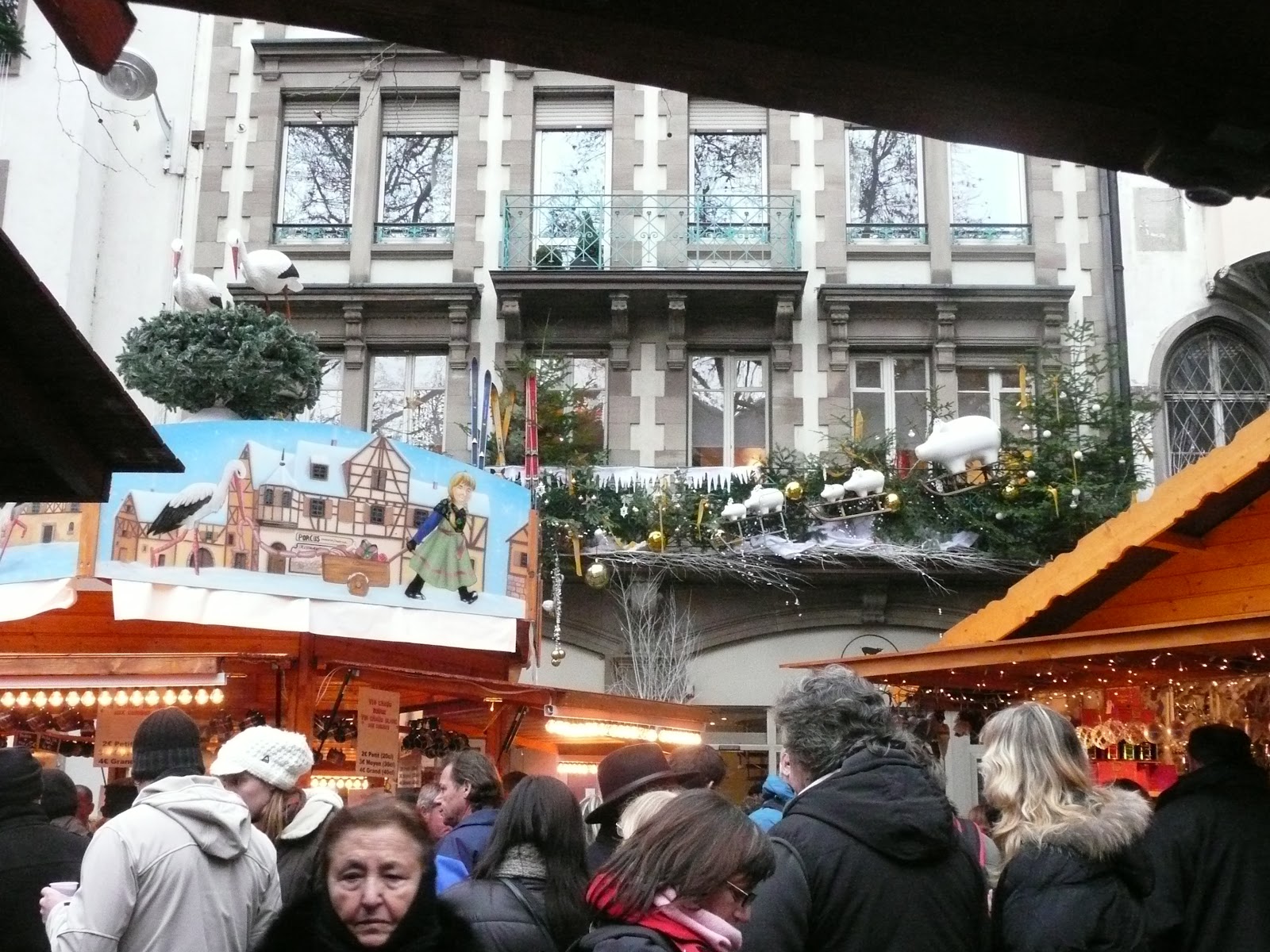
| Strasbourg street |
Annual market festivals of modern times emerge from basic
traditions of people coming together to sell their goods. In Luxembourg there
is the annual end of summer
Schueberfouer, a fair that has
its roots in the late Middle Ages, with this year having been the 671
st
celebration.
The idea of having a market around Christmas time appears to
date back to a similarly late medieval date, at least as far back 13th
or 14th century. While I didn’t find unequivocal evidence for where
and when they began, most sources and intuition suggest this to be an
originally German institution. The small wooden cabins that house each vendor
and his/her wares, the ruddy nature of the fare and the people, and the
adaptation to cold weather all suggest Germany: the markets feel like prefab
portals into a Grimm Brothers tale.
I knew naught of these markets before coming to Luxembourg. As
an American Jew whose main prior abroad experience was in Israel, I might not
be expected to know much about Christmas. Christmas as a child meant three
things: 1. Watching movies; 2. going to my best friend David’s house to see
what he got for the holiday that I could share in – mostly, I hoped for video
games; 3. a day off from wrestling practice. In college, I would be home for only
about 5-7 days centered on Christmas, and in addition to that sense of
homecoming, I had to maintain my weight for a tournament that awaited me on my
return to the South. After college, I spent two Christmases in Israel, which
became a time where Amy would go home and I could relax in our apartment. All
in all, Christmas hasn’t been on my radar.
The Christmas Markets, however, arrested my attention. Les
Marchés de Noël (the French name, which is easier to type than Christkindelmärik), do more than just propagate the big 3 C’s –
Christianity, Commercialism, and Capitalism. They also provide a vibe, a sense
of community, and a chance to drink hot beverages and interact with people in
other languages. This mixture sucked in my interest as a secular, American Jew,
and draws thousands of other people as well.
First, a Christmas
Village in Belgium
On what we in the U.S.
call Black Friday, where stores put on grand deals and people frantically fight
over those deals, Les Marchés de Noël open
here. It was on the Saturday after, following a Thanksgiving celebration in
Luxembourg the night prior, that Ben and I stumbled on our first Christmas
market, in Belgium.
We were visiting Liège, a proud, independent city in east Belgium, just barely
a part of the French-speaking half of the country, Wallonia. The brick-laden
city stood as an industrial powerhouse, and remains twice the size of
Luxembourg, with just under 200K residents. There’s a grand view to be had
after climbing300 some-odd steps to the Citadel, and the author George Simenon,
creator of the Inspector Maigret series,was a native of the city. We decided on Liège as our weekend destination for
all these things, and because it was the best we could do for one day and a
less than 3 hour train ride.
 |
| "I don't see a 'She-Wolf', do you?" |
It was to our surprise
that, after we dumped off our bags and began our cruise through the center of
the city, we stumbled upon a bunch of the wooden houses and a skating rink.
There at Place St. Paul we found booths and waffles and chocolates galore, as
well as modern dance music that can be found anywhere (read: Shakira).
Europeans enjoy taking things outdoors as much as possible, and Les marchés provide another example. With mobile heaters set
up and an array of hot chocolate and hot wine stands surrounding the rink,
people congregated to exchange holiday cheer and body warmth.
Having tasted a bit of
the holiday spirit, we continued through the pedestrian streets of the city
center and round a corner, whereupon we discovered another market. This market
was officially a “Village de Noël,” though despite their website’s
explanation, I can’t really say there’s a difference between the two.
The village held the real
action, in any case. Held on Place St. Lambert (the site of a recent violent attack),
the village offers a Ferris wheel, large slide to ride down, food booths,
trinket and ornament vendors, a large brass band playing marches, and all the glühwein,
hot chocolate, and beer one could ask for – truly the heart of the Liège Christmas
festivities.
 |
| The Chocolate and Marzipan in action. Photo by Benjamin Chang. |
Being in Belgium, we decided
to do as the Belgium tourists do. I bought a cornet of fries, drenched in
Andalusian sauce, but our chocolate choices were more noteworthy. Ben couldn’t
resist a large slab of white marzipan at the Charlemagne chocolatiers’ booth
(Charlemagne’s purported birthplace is close to Liège). We stopped there to
pick up the slab and buy some gift chocolates. As we deliberated and worked
through language barriers, a local cut us in line, picking a bag of chocolates unhesitatingly
and demanding the right to pay. The woman behind the booth muttered her
apologies to us, eyes wide with helplessness. The man, a swarthy fellow,
remained unabashed, however: “I tell everyone when they come to Liège, they
must come for the chocolate. That’s why you come to Liège!” He faded back into
the crowd, but his words, or at least his breath, left the impression that he
had come for the glühwein as well.
We returned at night, the
best time to visit the markets. The glow of lights; the ongoing excitement found
in the way people walk and talk in waves and spikes and streams and rambles;
the defiance of the weather and the earlier and earlier onset of night, all
this brings out the best of Europe and of Les marchés. Well, that and
the hot chocolate and waffles we munched on from Galler, who have a factory in
the town.
The Humble Home Front
Luxembourg’s Christmas
market is a more humble affair. Everything in Luxembourg is a more
humble affair, except maybe the approach to global finance. The city of
Luxembourg sets up two marchés, one on the Place de Paris near the train
station, and one in the center on the Place d’Armes. The central marché is
the main one. Four rows of 5-10 booths snake across the square. Various local
bands and artists play carols at the gazebo on the west end, though in their
absence a DJ is liable to spin some modern takes on the season’s songbook – I’m
pretty sure I heard an Mariah Carey Christmas song in there.
Luxembourg’s market, like
most of its social life, is sort of rinky-dink, but with a few special items.
First, they sell grompelkichelchen, which are crepe-sized potato cakes,
and quite tasty. Also, the Luxembourg marché, like most other marchés,
sells Glühwein, the mulled wine specialty of les marchés. Glühwein
translates into French as vin chaud, which translates into English
as hot wine, which gives you the essence of the stuff. It’s wine, usually red,
that is heated, spiced, and sweetened. (The second meaning of “to mull” is “to
heat, sweeten, and flavor with spices for drinking, as ale or wine,” which also
captures the essence of the stuff. I did not know that definition).
I had my only full cup of
glühwein in Luxembourg. To drink glühwein in Luxembourg, one pays
3 euros for the wine and another 2 euro deposit for the mug; I drank mine out
of a Christmas shoe shaped mug. Despite the charm, the sticky sweetness was a
little bit too much for me. Some on the internet call glühwein the
German winter version of sangria, but somehow what I had didn’t work for me the
same way.
The last nice thing about Luxembourg is a shared quality
with other markets, but significant. Placed in the center, the market serves as
a universal meeting point. Anybody can come in, check out the booths, drink a glühwein,
and soak in the atmosphere. The center of that center square features a set of
tables, so that the main food booths look on each other and people gather under
the glow of those heaters and act merry and cold and like themselves, but the
best part of themselves. I’m not sure Black Friday allows for the same
behavior.
Le Capitale
de Noël
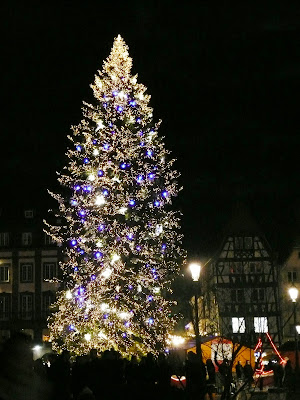 |
| The largest decorated Christmas Tree in the world (or so they say). |
Last for this tale is the market in Strasbourg. Strasbourg,
a French city of 280K residents on the border of Germany, is significant for
many things, but those things belong in a different article
The important thing to know here is that Strasbourg is the
self-dubbed “Capital of Christmas.” Here I thought I visited the capital of Christmas
when I went to Bethlehem for
Christmas 2008,
but no. What right does Strasbourg have to the title of Christmas Capital,
trumping Bethlehem’s renown as Jesus’ birthplace? Well, as best as I can tell
it rests on three claims, all of dubious veracity.
11.
Strasbourg, according to
one of my French teachers but not most other people, held the first Christmas
market. Strasbourg’s market dates to 1570, meaning it’s pretty damn old, but as
noted earlier, probably not the oldest.
22.
Strasbourg is the
birthplace of the Sapin
de Noël, i.e. the Christmas tree. The Internet renders this debate more
unclear. Some sources say yea, verily, and others claim that the Christmas tree
was first added to the end of the year festivities near either Riga or Tallinn.
Both claims pin the innovation in the 16th century, so at least
half-credit to this claim so far for Strasbourg.
33.
Strasbourg has a really
cool set of Christmas markets and celebrations.
This last claim could only be verified in person. Amy, A. (a
friend of ours), and I took a weekend trip to scope out the situation. We
arrived by train on a rainy Friday evening, rented a car, ate dinner, and then
headed out of the city to our village B&Bs; we got lost, confused in the
rain, angry at each other, and then eventually inside late enough to wake the
proprietors of the inns. Les marchés would be a Saturday thing.
 |
| Also part of the promise - Christmas-themed pastries. |
On Saturday, we arrived in the city to visit the markets
just after noon. Strasbourg’s center is called “Grande île”, or the big island.
It’s an apt name, as the center is an island surrounded by the Ill River, which
feeds into the Rhine River a few kilometers farther east. The whole island is a
UNESCO World Heritage site, with a grand Cathedrale de Notre Dame its heart.
That World Heritage site held at least 9 separate markets (two others are off
the island). This is Strasbourg’s Christmas promise – a series of markets in
different places and with different themes strewed across the dense city
center, so that in one day one can experience a full array of Christmas in the
heart of Europe.
We started by getting off the tram in the center and walking
to Place Kleber. The market there was unspectacular, but we got a hot
chocolate, the initial rush of the crowds and street musicians to be found
everywhere in the city, and Le Grand Sapin de Noël. Strasbourg claims
that their Christmas tree is the tallest decorated tree in the world. Whether or not that’s the case, it’s pretty
grand, standing there in the middle of Place Kleber, an open square capable of
hosting such a big Christmas tree.
 |
| Romance has its downsides. |
After the tree, we stopped in an ornate chocolate shop,
where the ladies bought gifts. I watched as a two-story, two-horse cart clomped
along a curving street, leaving a string of photographing tourists and, well,
horse shit behind them. This throwback transportation guided us to the Place du
Temple Neuf, a smaller square that is normally a parking lot, but did well in
providing a couple places for vendors to vend. I did most of gift shopping
here, but we also tried some chestnut and blueberry jams.
 |
| Rue des Hallebards |
This prologue led us to the Rue de Hallebards, over which
hung a series of chandeliers enclosed in glass cases. This striking decoration
forewarned us of the main attraction of the city one block to the south, the
Cathedrale. The crowds thronged in 10 person-wide waves spanning the street,
cresting in the market at the foot of the crazy Cathedrale, the center of the
Capital of Christmas.
Impressively, the crowds and the markets almost obscured the
huge building behind, as the eye naturally fell on the red and brown of the
booths, on the accordion players sitting street level, on the people, the
people. We wended our way through the
crowds, lost one another, reunited, and then decided to split up, the ladies
one way and I another.
My wandering took me to the south side of the Cathedrale,
where Strasbourg had set up their skating rink, less central than the one in Liège
but still popular. I then drifted down to the river, left the markets for a
little bit, strolling through the east side of the Grande Île, but I didn’t
wander long: the girls sent out the bat signal, too cold to continue shopping
in the marchés and eager to get indoors to some old-fashioned modern stores. I
rejoined them, helped them install themselves in a café, one with no room for
me, and went back on the walk.
I turned to the western section of the city, knowing a
well-touted literary café awaited me in that direction. I walked past the
village for children, a tent that housed games and activities at the foot of
another pink sandstone church (pink sandstone the most available building
material for the city). The waves of crowds thinned and grew less frequent as I
found the river again and walked along it to the Petite France district. There
I found the former industrial heart of Strasbourg, set on a few fingers of land
in the middle of the river. Restaurants serving endless variety of sauerkraut
dishes, as well as a good share of pig knuckle, surrounded a market touting
local crafts. I finished my gift shopping here and at another market of local
Alsatian flavors around the corner: cognac-flavored egg liquor was my big find.
That ended the daytime Christmas market touring. Though
tired, burdened by the fruits of our successful day of shopping, and wary of
our half-hour commute to the inn, we still had the night ahead of us. We still
had the best of the markets to look forward to.
 |
| Petite France at night (Market on the right) |
I met the girls at the Place Kleber, where we took the
necessary photos of the tree at night. From there, we returned to the Petite
France area. Though we didn’t find a prompt, authentic eatery that could satisfy
each of our culinary concerns, we did get to wander about in the cold, through
the continuing crowds, amidst the glow of the market, and with sips from Amy’s
cup of Glühwein. While we were stressed and cold and not overly warmed
by the wine and the Christmas cheer, it was cute all the same.
After at last finding a grand Thai meal, we drifted back to
the river on our walk to the tram that would take us to our car. Christmas
decorations lit up both banks of the river. The red and yellow and green stoplight
glare of Christmas bathed in the pink sandstone tint of the city harmoniously.
The river lapped at the bank as we trundled along with our booty, past amorous
couples, families, and groups of students. The relief of a full day’s end
washed over us.
***
 |
| Hot wine 'neath the Cathedral. Just as the pope would like, I'm sure. |
Our ride home was probably not all that different from one
we would have taken if the three of us had gone shopping in, say, the Mall of
America in A.’s home state of Minnesota. We would have felt the same relief from
finishing our gift-buying. In either situation we would have had stories to
tell about the people we saw and the encounters we had. Inevitably, in our core
we would have faced the paradox of feeling good about buying gifts for others
and feeling bad about feeding the consumerist colossus and the endless need for
more and more stuff (or maybe that was just me).
Maybe Les marchés de Noël is just a grand gimmick,
capitalism disguised as quaint nostalgia and doused in hot wine. Tradition or
not, the idea of the markets is that they are markets; venues to sell products.
Many of those products are unnecessary. The Christmas market is just hype.
But then, gimmick or not, the feeling is different. Bringing
people together, placing them outside, putting them on a map in a location
together, removed from the stronger waves of modern advertising, modern
technology, modern post-modern detachment from the world, this still stands as
a difference from the malls and the Walmarts and the consumer is king mentality
of the U.S.
Europe still doesn’t really bring Christmas any closer to
the original idea of celebrating Jesus. I’m not close to becoming a convert to
the Christmas season (nor to Christianity, natch). But if one has to choose to
take part in the Christmas season, one can do worse than to go to the markets,
and to get outside on the streets, together.