I usually try to keep my writing focii separate, so that the music writing stays on 30music, the political on global or arab comment, and the self-indulgent travel-tinted sprawling pieces on this here blog. But, as in the past, sometimes the separate worlds overlap, like the sweetest of venn diagrams.
As such, here is the full transcript of an interview I took with Dr. Bruce Maddy-Weitzman on the events going on here in the recent past and near future. If you're curious about what's going on here beyond the newspapers, this is a pretty good behind the scenes sort of read. If long.
And I have a couple actual, normal blog posts coming soon. So there's that.
The edited, shorter version of this interview can be found here.
Me: What are the general big issues you take out of the conflict, and also the first week of the aftermath – the ceasefire has held so far – and what are the big themes or big issues to draw from?
Dr. Bruce Maddy-Weitzman: Look, to put it in some perspective, this was the 4th major confrontation, violent confrontation we’ll call it, between Israel and Palestinian groups or forces over the last quarter-century, beginning with the 1st Lebanon War, really a war against the PLO, then to the 1st Intifada, the 2nd Intifada, and now this. In between that, of course, you had considerable spasms or incidents of violence as well. The suicide bombings of the 1990s come to mind in particular.
Which means this confrontation, the dynamics change, the personalities change, even the political orientations of the groups change, but we are still in this seemingly intractable conflict. Which is obviously quite discouraging.
This latest round is over. I think that the chances are pretty good that the ceasefire will hold indefinitely, that it will be translated into certain kinds of arrangements which will stabilize the situation, for now. I can’t say how long that will last. I think, just the way the (2nd) Lebanon War ended in summer of 2006, and since then basically the ceasefire has held almost perfectly, so too in this case I think that it’s fairly likely that we won’t see another round like we just saw any time soon.
What did each side achieve from this? Israel went into this determined not only to end the rocket fire, but to also change the “rules of the game”. That, “Hamas shoots rockets, we shoot back,” and this kind of tit-for-tat doesn’t really change Hamas’s behavior.
Beyond that, I think there was also a general desire for Israel to strengthen its deterrent posture. This was clearly on everyone’s mind, and has been for some time. There was a feeling here that Israel’s deterrent posture over the last years has weakened.
Now, “deterrence,” it’s a very watery concept. What does it mean to deter? How do we know it’s working, and how do we know that it’s declining? In this regard, I think the Lebanon War was seen as…the goal of the Lebanon operation as well was to strengthen Israel’s deterrent posture, because there was a feeling that Israel was weaker. This was the metaphor of Nasrallah with a spider web. He described Israel as a spider web that was very intricate, but one big sweep of the hand and it would collapse, very vulnerable in that regard.
Me: And the tipping point for that was the kidnapping of two soldiers?
Dr. Maddy-Weitzman: The cross border attack which actually was probably the killing, probably the soldiers died in that attack.
The response at that time was also with very much in mind the deterrent, “we can’t allow these kinds of things to continue on.” And the message wasn’t just being directed at the non-state actors on our borders, but at their patrons. Even more so at their patrons, particularly Iran.
And Iran’s penetrated into the Arab-Israeli arena in ways that have never been seen before. And frankly, I for one didn’t see it coming, not to that extent. So a key element of the Lebanon war was the immediate attack on the Iranian medium-range missile emplacements, which were mostly taken out at the very first day of the war. That was a message.
Ironically, Hezbollah got the message. I think its behavior has been moderated since then, and we can see that even in its behavior now, that it refused to open a second front.
Now, Hamas didn’t get the message, the previous message. Hamas interpreted the whole Hezbollah experience as something to be emulated: that Israel could be pushed, that Israel was weak. They looked at the shortcomings of the Lebanon war too: Israel’s conduct of the war, the military conduct, the confusion, the lack of preparedness, which was all laid out in the Winograd Commission report, the self-criticism, the hand-wringing, the head-holding. Hezbollah claimed this was a defeat for Israel, and so did a lot of other people.
Hamas, I think, looked at matters that way, and so did Iran, to an extent. One of the goals, I think a central goal of this operation, was not just to teach Hamas a lesson and to press home the point that Israel has the capacity and willingness to strike back “disproportionately”, what they would consider to be disproportionate, against Hamas, but also to send a clear message to the rest of the region and the world that it wasn’t going to allow an Iranian client-state to develop on its borders.
In that regard, I think it’s clear, we can say Hamas was not Hezbollah. They certainly hadn’t achieved the level of weaponry, of military sophistication, of capacity to do to Israel what Hezbollah was able to do. And a lot of the Hamas slogans – we’re going to make the Gaza a hellhole, a graveyard for the Israeli soldiers – obviously turned out not to be the case. Hamas turned out to be far weaker than we had anticipated, and in that regard, I think Israel has significantly improved its deterrent posture.
It’s not just the fact that they hit them hard, and showed everybody that if you mess with us, we’re going to hit you back, but it’s also the incorporation of the diplomatic elements into the picture. At least on paper, the support for a change in the strategic alignment, the strategic parameters governing the Gaza area, the support for Israel’s desires is considerable. The French are patrolling off the shores of Gaza, the Americans signed a memorandum of understanding, they’re training Egyptian troops dealing with smuggling, they’re talking about interdicting Iranian ships in the Gulf of Aden.
Hamas’s alignment with Iran did not play well in Western capitals. It gave Israel room for time, and room for action, in a way similar to the way Hezbollah’s alignment with Iran did as well.
What you see also is the Arab world dividing on this matter. Especially Egypt, which was very unhappy Hamas’s behavior, very unhappy with Hamas’s provocation of Israel, very unhappy with its cozying up to Iran at the expense of the relationship with Egypt. Egypt is losing influence with Hamas vis-à-vis Iran. Hamas being the daughter organization of the Egyptian Muslim Brotherhood.
All of these things led the Egyptian leadership to feel that enough is enough, that Hamas is going too far, and they need to be taught a lesson. They need to be cut down to size. Especially since this is taking place on Egypt’s borders, and Egypt is looking like it can’t control its own borders, and is being blamed by Hamas for Palestinian plight and all that. And that didn’t sit well with the Egyptians at all.
The Egyptian participation in this sort of Western framework is a gain for Israel as well. It remains to be seen whether this framework will have real teeth and do what it’s supposed to do. People point to a similar type of framework that was established after the Lebanon War under resolution 1701, which was supposed to interdict smuggling. And it hasn’t; Hezbollah has more weapons now than it had then. Obviously, one needs to monitor the real commitment to implementing these kinds of things.
But, unlike Hezbollah, Hamas doesn’t have the kind of strategic depth that Hezbollah had. Hezbollah had Syria for strategic depth, with Iran further back. Whereas Hamas has the sea and Egypt. It’s not the same kind of setup.
So from that regard, one can say that Israel’s achievements in this operation were considerable. Now, they came at costs, obviously. Israel’s image has been damaged to a considerable extent among public opinion. In the West, pictures of wholesale destruction of civilian areas are disturbing. All the more so in the Arab world, and among Palestinians as well. There’s no question that more hate towards Israel will have been generated by this operation, which doesn’t bode well if you talk about the need for a long-term reconciliation or a modus vivendi.
You can even suggest the possibility that radical forces might become even stronger, particularly among Palestinians. If Palestinians can’t achieve a newly-reconstituted national unity government, if opinion continues to fragment, there’s a possibility of splintering off from Hamas to represent even more Islamist, jihadi, Bin Laden-type radical views, which would make Hamas look like a positively moderate force in comparison.
You’re going to have to watch that very closely. It’s very likely that you will find at least small groups of Palestinians going in that direction.
Me: How does Hamas come out of this? Obviously they’re claiming victory, which is not surprising. A lot of people talked about how now they’re going to be the representative (for the Palestinian people). Israel doesn’t want to speak with them and dignify them. Has Hamas achieved that? Is there a chance that they become moderate in the sense of Hezbollah, where they have responsibility now, or is that unlikely? Is it a bigger fear that we’ll go extreme?
Dr. Maddy-Weitzman: Hamas has always had a number of different viewpoints within it. Not in ideological terms. On that they’re united: the creation of an Islamic state in Palestine to replace the state of Israel, in all of Palestine. In terms of how one achieves that, there have been different trends. One can point to pragmatic kinds of thinking, and I don’t say moderate, I say pragmatic, adapting to particular circumstances.
It’s clear that there were sharp differences of opinion within Hamas over the decision to tear up the ceasefire and goad Israel into an attack, which Hamas believed was going to be beneficial for it, that an improved set of arrangements would be established. Clearly, that wasn’t the case; they paid a horrific price for that thinking.
Hamas is likely to demonstrate a greater degree of pragmatism, to seek accommodations, both within the Palestinian camp – again, not giving up their hegemony over Gaza, but seeking to present some kind of common front, so that the Palestinians, with Mahmoud Abbas, so that they can then move on and say, “this is how we’re going to deal with the opening of the crossing points, the passages to ease the siege.” This is an immediate issue for them, so they can engage in reconstruction, and get legitimized as an interlocutor by the international community.
It is possible that they will achieve that over time, that more and more we’ll hear voices in the West: “You need to engage in dialogue. They’re an important force. You can’t just ignore them. You have to find ways.” And that’s a double-edged sword. By Hamas engaging, they may have to modify their behavior in ways which eventually threaten to clash with their principles. On the other hand, it means that they may be getting legitimized in a way that’s to their benefit, without them giving things up.
I think that one’s likely to see more and more efforts by various parties to get that kind of indirect dialogue with Hamas, trying to nudge Hamas. Israel has difficult choices to make on this, because there’s more pressure now to negotiate a deal to return Gilad Shalit, so the question is, what price do we pay? Same thing to do with the opening of the crossings, well who’s in charge of the crossings? Who’s in charge of the reconstruction aid? Can Israel and the international community achieve a kind of arrangement where Hamas isn’t the main beneficiary for getting the credit for the reconstruction, or not?
Hamas clearly will want to maintain its hegemony over this matter, and all the parties are going to be maneuvering in the weeks ahead to see how much benefit they can gain in this next round of picking up the pieces.
Me: In the whole region, I feel like a lot of interesting things came up; like you said, the split of the two axes. To me the three most interesting things were Egypt on the one side becoming very strong for Israel, but then Syria, with whom we were negotiating, and it almost seemed like there would be a thaw, or an opportunity. I’m curious what the significance is to Syria’s statements.
Dr. Maddy-Weitzman: Yes, I’m thinking about that too. On the face of it, a Syrian-Israeli agreement is much easier to achieve than a Palestinian-Israeli agreement. It’s straightforward, it’s between states, you deal with territory, you deal with sovereign countries, with authorities, you make arrangements; it’s not an existential matter, per se. It’s not an inter-communal conflict on core ideological matters.
But Bashar Assad, I think, is going to be reluctant to pay the price that he has to pay for a peace treaty, which is shifting his alliance orientation. Moving out of the Iranian radical camp – supporting the radical groups and getting support from Iran – and moving into the Western camp. I don’t think he wants to do that, I think he wants to have both. I think he wants to maintain his connections with Palestinian and Lebanese forces, he wants to maintain his connections with Iran, [i]and[/i] he wants to have better ties with the West, and he was trying to work through Turkey to get that.
But his militancy on these matters is very off-putting. I think it’s probably less likely also that the new Israeli government will want to pick up where the Olmert government left off. So I think we’ll probably again see a hiatus in the Israeli-Syrian track. Especially since the Turkish President has gone and alienated the Israeli political class with his behavior.
Me: And that’s the other country that was interesting was Turkey all of a sudden. Do you view that as a serious blow to the relationship?
Dr. Maddy-Weitzman: It’s problematic. The Israeli-Turkish relationship is based on common strategic interests. The forces in Turkey that are the guardians of those strategic interests are still there, and still appreciate those values, the value of that relationship.
Politically, of course, the elected leadership is an Islamist party and an Islamist government, which has a different set of considerations. And certainly a significant segment of public opinion in Turkey identified strongly with the Palestinians and is very hostile towards Israel, and we saw that during the war. This is a cause for concern, and for worry. Turkey’s stance is going to be watched very, very closely.
But in any case, it’s not at all clear that the new Israeli government will give the Syrian-Israeli track a priority. Especially since everybody knows that that means accepting the idea of withdrawing from the Golan. Assuming that it’s a Netanyahu-led government, he would be unlikely to want to send that message early on in his term of office.
I’m not so sure the Americans are going to be so keen on renewing that track either, even though there’s been a lot of advice in Washington that’s said, “go for the Syrian-Israeli track right away, because it’s more doable.” Well, I’m not sure it is.
Me: Are you not sure it is now mostly because of the Gaza conflict and the issues that were raised during the conflict? Or do you think it was the same before?
Dr. Maddy-Weitzman: I was skeptical before. I’m more skeptical now. And I think because the Israeli government is about to change, that also is going to play a role here.
Now, if the Americans do get clear signals from the Syrians that they want to play, that they want this to go forward, which is very possible…everybody’s waiting for Obama. Bashar Assad’s going to want to find out where does Obama stand on this. And if he does send the appropriate signals, that will get America’s attention. And that in turn will get Israel’s attention.
But again, getting attention and talking doesn’t automatically lead you to an agreement. A bunch of water has to flow first, under the drain, under the bridges, in the Jordan River. And there’s not much water there. Maybe that tells us what the prospects are.
Me: I think most people don’t expect much in terms of these tracks from the Netanyahu government, which is all but sure to happen. What’s the significance on a broader scale that Israel, even before the war, was leaning towards Netanyahu, and just that the population is in a more right wing, security-based view – or maybe it’s the economics – but what does it say about the broader future prospects of Israel and peace if they’re swinging to the right?
Dr. Maddy-Weitzman: I don’t think the economics are playing any role in any of this. Israelis usually vote on security issues, and not on economics. And they also vote on tribal orientation. People don’t change their orientations. They may shift between parties, but they don’t shift between blocs.
You’re right about Israeli public opinion becoming more right wing, and it’s something that’s been true over the last eight years. It’s a result of the ongoing violence and the failure of politics to produce a lasting peace; it’s a failure of the diplomacy.
And yet, when you ask people how they outline a settlement, you’ll find a solid majority of public opinion is in favor of a two-state solution, in favor of a centrist kind of solution, not a right wing solution. There is a consensus on that.
There’s probably less consensus in Israel about the kind of hard steps that Israel would have to take to help the dynamics of a diplomatic effort, particularly on settlement matters. It’s a divisive issue, and the lack of leadership on it has just made it that much more difficult to move forward on the idea of dismantling even illegal outposts, let alone settlements. It’s clear that in any final peace agreement, that some settlements will have to be dismantled. But that day is not even around the corner, so it may not seem very relevant to most people at this point.
Israelis underestimate the symbolic effect that settlement expansion on public opinion in the other side, and also on the opinion of leadership on the other side. Continuous settlement building is seen as an example of massive Israeli bad faith. And Israelis don’t appreciate that to a sufficient degree.
With regard to the Netanyahu government, the likely Netanyahu government; I mean, maybe, you never know, but one could suspect that most likely he will be the next prime minister, well that also depends on the nature of his coalition. It seems very likely to me that Ehud Barak will be his Defense Minister, which means the Labor party is in the coalition.
Which means you’re talking about a center-right government, but not a right wing government. And that’s a big difference. It means you have a government that can engage and will engage with Washington, that will try to avoid confrontation with Washington. You can see already in Livni’s campaign, that she’s trying to campaign on the basis that Netanyahu will result in a confrontation with Washington, and we don’t want that. Netanyahu clearly will not want to be in open confrontation with Washington. He will try to balance off the competing domestic political forces and the need to be a statesman. And that’s why Barak will be very important for him to have.
If he went even farther, let’s say, and had a broad three-party (Labor, Likud, Kadima) coalition, that would be welcome by a lot of people, because it would mean a government less beholden to smaller religious or right wing parties. But it remains to be seen whether that’s going to happen or not. That’s more of a long shot, I think.
But it’s very possible. Don’t forget, who is Kadima? Most of it is ex-Likud members…
Me: It’s not such a leap for them to join…
Dr. Maddy-Weitzman: No, no, it’s more to do with the personalities. It will be interesting to see how it plays out.
The Middle East is a dangerous place. The question of Iran’s nuclear program is something that’s going to be high on everyone’s agenda in the next year or two, and we’re going to need wise heads.
Me: What do you view as the likely shifts on that case? Iran almost seems unrelated to what just happened, but obviously it’s the elephant in the room.
Dr. Maddy-Weitzman: It’s very related. I don’t know. Clearly, the U.S. administration is going to see if it can critically, and constructively, and robustly engage Iran on this matter. I think the fact that Dennis Ross has been appointed to be the point man on that, I think that’s an interesting choice, actually.
I know that Ross is a proponent of this sort of approach, robust engagement. Which means, find out what the Iranians are thinking, see what you can do, but also make sure that you have sticks as well as carrots. I think the fact that he knows the Israelis well, and the Israeli thinking well, will be an asset perhaps, to make sure the Americans understand where the Israelis are, and the Israelis understand where the Americans are.
But I don’t know where it’s going to go, and a lot of it depends on internal Iranian things, which I don’t have a good enough sense of.
Me: Their election is soon.
Dr. Maddy-Weitzman: Yes, their election is soon. There’s always been a broad consensus in Iran that Iran should be a nuclear power. But that doesn’t mean that everybody’s in agreement on the path to get there, the timing, and how to respond to particular international pressures or incentives. It remains to be seen.
Me: Would you say the same thing about the new U.S. administration? We’ve talked about it, obviously, but a new Obama administration’s effect on the region, is that still sort of an unclear thing? Do we need to just see what his line is on Israel-Syria, Israel-Palestine?
Dr. Maddy-Weitzman: I think everybody expects the Americans to take a higher profile on the Israeli-Palestinian, or Arab-Israeli tracks. Nobody doubted that they would be intimately involved with the Iranian matter, and how much continuity and how much change there will be remains to be seen. After all, the American positions have already changed to some degree. And the continuity is there with (Secretary of Defense Robert) Gates, for example. Even though Obama will be the one to set the tone.
There’s a lot of expectation out there for Obama. And undoubtedly it’s exaggerated, which can lead to disappointment. But it seems to me that a lot of people in this region understand that, and want America to play a positive role here.
Me: On both sides.
Dr. Maddy-Weitzman: Yes, absolutely. The trick for the Administration will be translating that desire and good will into something that makes sense for the regional actors, and makes sense for America’s interests. Big concepts, but then you have to have incremental steps. This is how things are done.
Then maybe you can look around in 2-3 years and say, “Wow, things have really moved.” As opposed to this tremendous breakthrough, a sudden breakthrough on these issues, which are close to being intractable, but they need attention. And one hopes that they’ll receive the right kind of attention.
Me: What do you think the trends are, because there are a few different things – between Obama, between the war, between Netanyahu – what do you see as the trend? Is it a positive one, will we be making incremental steps? Or will it be mostly disappointment?
Dr. Maddy-Weitzman: I think there’s room for some progress on the Israeli-Palestinian front, for some incremental improvements after the war. Which ideally should be accompanied by proactive measures in the West Bank. Showing some improvement in the daily lives of people.
I think that there are some opportunities there for incremental improvement. As I said, I think that Hamas has been humbled by what happened, and that’s to the good. They’ve been taken off their high horse, even if they haven’t been crushed. If anybody thought that was going to happen, they weren’t being realistic.
Obviously, peace isn’t around the corner. I’m not overly optimistic on that regard. The Palestinian state-building project of the 1990s was a failure, and that’s one of the reasons why the peace process failed. What we have now are two de facto Palestinian entities, and they’re going to have to work mightily to bring a semblance of unity to their own camp. It’s essential if there’s going to be any progress on the big political issues.
I can’t say that I’m overly optimistic about that, but maybe Hamas’s weakening does provide the possibility for a return of an increasing strength of the Palestinian Authority, of Fatah, with Arab help, with Egyptian help, with international help. But they’re not going to be just replaced. There’s a lot of work to be done on their side. And on our side, we’re going to have to make some hard decisions too.
Peace isn’t breaking out, that’s for sure. Let’s hope that we can start taking some positive steps, some incremental steps, and start repairing the damage that’s been caused over the last eight years.


31.12.08
Two weeks in the life, or the Lost Highway
I've mentioned in this space and probably others that I've had guests in Israel before, had guests coming for Christmas break, and would be eager to have more guests as my time here continues. You, a skeptical friend or relative or stranger, might ask, "Why would I want to visit Israel? What would such a trip entail?" Well, rest assured, because I present to you a "sample" itinerary of what you might get in a two-week visit to the Holy Land. Only the best, of course.
For our purposes, we will imagine a visiting party of three people, one who happens to arrive a few days later and stay a few days later. Be warned that somewhere in the second week, we hit a searing digressionary narrative.
Also, while it's unpleasant and certainly raises the anxiety level, I'm pretty sure the nastiness in Gaza won't affect the day-to-day of this itinerary. And hopefully, whenever you, dear guest, come, that problem will be contained. Unlikely eliminated, but hopefully contained.
Day 1 - Arrival: Two guests arrive at Ben Gurion Airport, weary but excited after an overnight trip that included a brief layover in Rome. I (heretofore referred to as "The Host", or similar titles) meet them at the airport, hug them, and escort them to a small, low-quality car, a Fiat Bravo. Once their scant baggage is loaded into said car, the host takes them away from the airport, remembering only at the exit to pay for the short-term parking, causing a small backup leaving the airport.
The group avoids the main highways that would lead through Tel Aviv, for fear of traffic. Instead, they make their way with reasonable haste up the 4, over the 5, and back up the 2, into the cozy little Israeli burb of Herzliya. They wind their way down the seaside road and to the apartment building that the group will be staying in. The group somewhat inconveniently lug the little luggage they have up the 3 floors, then soak in the atmosphere of an Israeli dusk.
Plans are made quickly, and the group goes out to the local 24-hour supermarket to load up for dinner. The host prepares a chicken stir fry served upon quinoa, and a certain dear friend comes over to join the group, bottle of wine in hand. Though the evening feels a little like a job interview, all enjoy themselves, and when the host's roommate arrives, the company becomes only merrier. All are pleased and tired, off to sleep at a reasonable hour so as to revive themselves for the trip.
Days 2-3 - Hang in TA: While the host finishes up with his job responsibilities, the two guests sleep in, relax, and learn how to catch the 90 bus to Tel Aviv. They gallivant around Old Jaffa, the shopping laden streets of Dizengoff, Allenby, and Rothschild, and attract the attention of strange men along the beach, the weather temperate even in the middle of December. They also meet this woman of Russian roots, who gives them practical advice about Tel Aviv and a few Hebrew tidbits, as well as some fashion inspiration:

The one planned meeting on Day 2 between guests and host in Tel Aviv is held, though the host, assuming his guests would be late and approaching from the southern side of Levinsky Rd., wanders over to the bus station, and hence misses his guests walking on the northern side of Levinsky Rd. to the Ha-Hagana train station where they had agreed to meet.
Regardless, the group just barely catches the 8:00 train home, and then proceed to eat falafel and hummus before returning to the host's residence. The host makes sure his guests are all taken care of and ready for the next day, and then leaves them for the night. One of the guests later goes crazy over news that an old friend is planning to join the group in a week. She works through anxiety by cleaning the host's kitchen, always in need of a touching up.
 Strange man and his autoharp on the beach: Ahh, Tel Aviv.
On Day 3, the planned meeting gets delayed till the evening, a convenient move that allows for the host to celebrate the onset of a vacation with his colleagues and then usher a couple of them out of town. After that, host meets guests on Dizengoff and Ester Ha-Malka in almost perfect timing. Rather than celebrate such timing, host takes guests back to Herzliya, where the group relaxes and dreams about the grand future of the next few days, planning meticulously and throwing every possible idea at the wall, settling on a few of them that leave no clear direction for the next day, never mind the rest of the trip. The same guest who went crazy the night before gets excited again over a request from a major metropolitan magazine for a photo.
Day 4 - Jerusalem: After a third consecutive late start for the group (though the first late start that the host himself participated in), the trio make the snap decision to drive to Jerusalem. Says one of the trio later in the day, "I didn't even know where we were going when we left the house."
Being Shabbat, the roads are largely empty, the traffic spots near the center largely available and definitely free, and the center part of Jerusalem dead. Fortunately, the Old City still buzzes with tourist-sparked life. The trio enter the old city through Jaffa Gate, taking reams of photos, with American tourists, school girls, small Arabic children, the Church of the Holy Sepulchre's under renovation wing, the Western Wall, the fading sun towards the Medittereanean, the view of the Dome of the Rock and the Al Asqa Mosque from the Southern wall of the Old City, the big dreidels hanging in celebration of Hanukkah, and each other as subjects. Many souvenir items are considered, though few are purchased. At times in the Arabic quarter, the host genuinely fears that the photo taking could lead to unpleasantness. The group buy two chocolate cylinders with marshmallow on the inside, a national desert. The day is a success.
 Doesn't this picture scream, "This day is a success?"
Day 5 - Pick up and hang in TA: The guest who previously went crazy over emails departs to the north, to visit relatives. Plans are made to reunite with her in a day or two. Meanwhile, another guest is due later that day. In preparation, the host goes to the doctor to see about this rash on his arm. Then he collects the second guest, and the two of them go to Tel Aviv, where the host has an urgent meeting over legal status. Once that is left unresolved, the two finally resume interesting activities, walking over to Neve Tzedek, the hip, boutique-laden neighborhood of Tel Aviv. While the duo look at all the interesting shops, the guest laments that, "it's a little weird shopping with you, Dan." The host has no good response, and eventually they split a business lunch at an Iraqi restaurant and return to their car and head to Ben Gurion Airport.
The third guest is improbably held up at customs, to the point where the duo wonder if he somehow missed the flight. Just after the host goes to ask if there's any way of confirming the third guest's presence on the flight from Milan to Israel, thinking that perhaps the snow storm in New York delayed him tremendously, the host discovering that he'd have to wait a second hour before the passenger list would become accessible to him, the third guest appears, looking a little greasy in a wool square sweater and khakis. He was held up by El Al questioning in Milan, barely making it to his flight. His bag did not make it on, nor his calculator. This will be a recurring issue.
Regardless, the group treks back to Tel Aviv, where the host attends a wrestling practice, while the two guests wander around and buy doughnuts, not really getting lost in a shakier neighborhood of Tel Aviv. They then convene at the host's home for dinner and a phone update with the good folks back at home.
 Glamorous. But really, all services are provided at Chez Shvartsman.
Day 6 - Art in TA: General lethargy, possibly on the part of the host, leads the group to stay in Tel Aviv. Also, the weather is bad. So amidst the rain and dull, the group take the train and then walk to Tel Aviv Museum of Art. It's widely agreed upon among the group, hosts and guests alike, that if Jonathan Richman was here, he'd go to the room with all the Chagalls, since there were no Cezannes.
The Museum of Art is solid if not masterful, but also whets one's appetite. As three, the group walks over to Rabin Square, a major central part of Tel Aviv, where they buy a falafel for lunch. They then catch the train home. A stop at the supermarket leads to the host's first flare-up at a guest, but the rough patch is quickly smoothed over, and the trio makes it home safe and sound, eager for more adventures the next day.
Day 7 - Haifa: Despite missing the train they intended to catch, the group manages to successfully embark on a trip to Haifa. The host has not yet been to Haifa, so the trip is a little bit of a mystery for all involved.
 It's what the family does, I suppose.
Upon arriving at the central station in Haifa, near the northern port of the city, they make tracks to meet with the third guest, the fourth member of their group, returning from her sojourn to relatives. Beforehand, the two entities (that is, the group of three and the fourth member) agree to meet at the entrance to the BaHai Gardens. Bahai is a faith centered in Haifa, and their gorgeous domes and buildings, as well as the luscious gardens that surround them, are considered the main tourist attraction in Haifa. It appears to be an appropriate place to meet.
Having not yet been to Haifa, and also deprived of his guide book (in the 4th member's possession), the host has to rely on intuition and cleverness. The Haifa train station is at the port, as mentioned. It is also at the bottom of a hill: the whole city of Haifa rests upon that hill, Mt. Carmel. Even more essentially, the pretty domes and structures of the Bahai Gardens are visible from below. "Walk towards the dome," he says, and the group sets off.
The climb is disorderly, a weaving path through stairways and roads, almost always upwards, punctuated by one of the guests's teasing of the host, asking if this is the sort of thing he'll put on his blog, a heroic climb and a "victory", nearly earning a punch, but at last the group arrives just above the dome. The trio has arrived right about on time for the planned rendezvous, after a half hour of walking uphill.
There are three problems with their situation (there are always problems). First, the Bahai Gardens are closed due to the rain that has fallen off and on the past two days; the caretakers are concerned for the health of their visitors, in that they might slip on those slick garden paths (it doesn't rain much in Israel). Second, to visit the Bahai Gardens, one needs to be on a guided tour, and spots for a guided tour must be reserved three days in advance. So visiting the gardens is out for the group. Most essentially, the host realizes after 15 minutes of waiting that this probably isn't the planned meeting point, and that the group must climb higher.
 A sign of urban (or fruit) decay somewhere on the climb in Haifa. Those are slugs.
After asking for directions and following them, the group finds themselves on a road looking down upon Haifa with the sun poking out of the clouds and a stiff, autumnlike breeze whipping through the road. The group realizes they have no way of knowing if they've missed their fourth member or if this is exactly where they're supposed to meet. As they ponder their dilemma, the fourth member pulls up in a cab and waves frantically. All has been resolved.
 Relief sets in on high in Haifa.
The group continues their stay at the top of the mountain, stopping in Jacko, a restaurant that the host's guide book suggests is the key spot in Haifa, though in fact it is a chain that even has a restaurant in the host's hometown. The group is relieved and sated ne'ertheless, and after eating they proceed to return to the train station, where the host needs to be to get to practice. Much relief is also shared over the return trip downhill. The evening ends with the fourth member, the third guest, joining the host for practice so as to take photos, while the other two guests get off at the wrong station and bicker amongst each other, though in the end reuniting with the rest of the group in merry fashion.
Day 8 - Dead Sea: Reunited and refocused, the group takes off on a grand adventure, driving through the West Bank to arrive at the Dead Sea. Turning onto a Mineral Beach, the group takes in all the requisite pleasures of the world's lowest point. They include:
- Swimming (or more accurately floating) in the Dead Sea
- Getting the sulfurous water in one's eye, despite host's admonitions to be careful about getting water in one's eyes
- Covering up in mud
- Warming up in the 39° Celsius sulfur pool on the Beach grounds
- Drawing the attention of a Russian speaker from Northern Israel and his Latvian friend. Viktor and Nikolai. Viktor gives the host his phone number and email address with an invitation to visit in Tzfat, while Nikolai talks about how Ukraine still has all the good camaderie of the Soviet Union, and also lavishes a little bit too much attention on one of the female guests in our group. No harm, no foul, however.
 Nikolai (and a woman in his group: his daughter?) look on as the three members of our group he wasn't interested in have fun with mud.
Day 9 - Bethlehem: Being as Day 9 coincides with Christmas, the group decides to go to Bethlehem. To go to Bethlehem, one needs to go to Jerusalem first, and then catch a cab or a bus to the border crossing into the Palestinian-controlled West Bank, and then catch a cab further into Bethlehem.
The group sets out and parks somewhere in south Jerusalem, relatively close to the crossing. They decide to take a cab to the border rather than dealing with Jerusalem traffic. On the way, the group gets sidetracked by a bakery. One member of the group, a male guest, is particularly intrigued with the doughnut selection.

Once filled on doughnuts and other delectable pastries, the group catches a cab. The cab driver takes them the short distance to the checkpoint, meanwhile explaining that he can't cross over because, "they don't like me there; they'll kill me," and warning the group to watch for their wallets. He's mostly joking.
In fact, the scariest part of this adventure is due to the cab driver, who instead of recommending the group to go through the checkpoint and do things as appropriate, begins to negotiate with an Arabic cab driver for the fare to take this group to Bethlehem. At first negotiations occur in Hebrew, but when the Arabic driver notices the host listening with interest, they switch into Arabic. Eventually, a deal is set: 100 shekels for a sketchy cab ride that takes the group through a back way into Palestinian territory. Still, no damage done again, and the group ends up in the Manger Square.
The weather is wet and droopy, and the group wanders down Manger St., a market of sorts, before going to the Church of the Nativity, where the big guy was born as a little guy 2009 years ago, or so the story goes. The Church is hollow and old and impressive in its simplicity, though the grotto where Jesus was supposed to be born is fairly ritzy and packed, full of Franciscan priests who usher everybody along and speak Italian, English, or French at times.
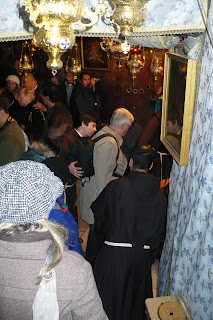
The trip is not a very long one, as there's not much to do in bad weather in Bethlehem. Also, Christmas Eve is apparently the time to be in Bethlehem. The group make a few gift purchases, the host flares up at one of the guests again, and the group catches a cab back to the border crossing. In the host's limited Hebrew, inquiries are made to the cab driver about why the ride back to the border is so much cheaper than the ride here. Nothing is delivered.
The group passes through the security checkpoint this time, and then catches one more cab back to the car. After some confusion from the young cabbie on where to go, they end up on the correct street. With a little walking they reach their car, weary and ready to return home and rest before a planned weekend trip to Petra. A little traffic greets them, but this doesn't appear to be a big issue.
*Searing Digression! Searing Digression!*
So the traffic from Jerusalem at rush hour on a Thursday night (remember, that's like Friday here) might be expected to be bad. Ok, I had this in mind. Even though on paper we had enough time to get back to Tel Aviv by practice time, I had reconciled myself to not going to practice, and the traffic as we crawled out of the city confirmed my reconciliation.
Tel Aviv has bad traffic at rush hour too, as do many cities in the world. The difference, which would prove to be fatal, between Jerusalem and Tel Aviv, is that Tel Aviv is in a flat area, whereas Jerusalem rests on a hill, among other hills. While this makes for lovely scenic driving and adds to the Holy City's aura, it also is not fun to drive in during traffic. Especially when you have a manual transmission car. And when you're driving uphill. Do I need to go on? Ok, I'll go on.
As we slogged up the hill, my nerves were already a little frayed. The pressures of hosting, the pain of traffic, the general anxiety of being a self-tormenting dink, it was all getting to me. I tried to stay calm as I listened to a mix I had made for said dear friend, an intro to Emo, but for some reason I found my emotions rising to a self-dramatic pitch.
And then I started having trouble putting the car into first gear. And then when I did, the RPMs on the car started going up as I climbed. "We should pull over at the next exit so we can chill out and let the traffic go," my cousin suggested. Wise advice, but the next exit was a half kilometer away. Uphill.
Smoke started coming out of the hood. The tachometer started going up to 5 or 6 as we inched up, a meter or two at a time. And then it just stopped catching at all. The clutch, that is.
So, in the middle lane of the highway, amongst a huge stream of traffic, on an uphill on the country's main highway, connecting the two major cities in the country, my car was stuck. We were stuck. Not good news.
We got out of the car, and a couple neighbors in the traffic helped us push the car to the side of the road, out of kindness and also self-interest. There, we found two other cars pulled over, and an older man, religious, with a black hat and a long gray beard, came over and commisserated with me, he a little bit in English, I a little bit in Hebrew. I called the tow company, where the Russian operator told me she would try to get a tow truck there in sooner than two hours, but no promises.
We had already spent about 90 minutes in traffic. We were tired. We still had the chicken, pita, and salad we had packed in our bag for lunch, as of yet uneaten, and we had the Harel mall looming just above us, our unreachable rest area. We left the car and walked ten minutes to that mall, along the highway or the shoulder, and dined there. The tow company called me and said a guy would come soon. I cut short my rest to return to my car, where I found no one. My family came after me, and they huddled together under an umbrella (light rain began to fall) as I sang "Lost Highway" and "Two Headed Boy, Pt. 2" to myself. It was that kind of night.
It then turned into absurd. Cops drove up to us. "Drive the car out of here!" one said to me in Hebrew, I think. "Lo yahol, I can't, the car is broken!" I responded, as if the point wasn't clear. My religious compatriot partially translated for me, but then the cop's actions spoke for themselves. For awhile, I was concenred that I'd receive a fine or even somehow be arrested, because I didn't have the mandatory safety triangle one is supposed to set up in Israel when he's broken down.
Instead, the cop held up his hands to oncoming traffic and told them to stop. Then he pulled his car perpendicular to traffic. While traffic wasn't quite as bad as it had been while we were driving, there were still plenty of cars on the road. Those cars were no longer moving. Thanks to us. We shut the highway down.
 Umm yeah, about not moving? Sorry, guys, our bad.
We sat there and marveled at the situation as the cops sent for a special cop truck to tow our cars to a safer location. My cousin flitted about the traffic, reporting that people started coming out of their cars, asking angry questions but also flirting and similarly laughing at the problem, while she took pictures and said she had no idea what was going on. It was partly true.

Eventually, the cop tow truck, driven by a nice, English-speaking retired cop, took us up to the exit ramp near the mall. This was apparently far enough out of danger. From there we had another half hour wait for a tow truck. At last the tow truck driver came. And, not speaking English, he told me that he couldn't take my car home to Herzliya that night, and what's more, he couldn't take us back to Herzliya.
I've been in Israel for 5 months now, and naturally the culture has seeped into me. Part of that culture is that ornery brashness, that strident screamer that demands what he wants, whether or not he gets it. Well, anyway, that part of me came out, as I lit into this driver, practicing my Hebrew at much higher volume levels than I was accustomed too (and if you ever want a good way to practice your foreign language, having your car break down is foolproof). He told me it was asoor, which I recently learned means forbidden, but I told him that we tsarachim linsoa l'Herzliya, that we had to go to Herzliya, and then his boss yelled at me in English.
Finally, this kind lady came over and helped us out. Besides speaking Hebrew, she spoke great English and was Russian. Olga was inclined to help us out, then, and she translated for me that it was the law that they couldn't take us back, or some such issue. And that my car would be taken to Herzliya tomorrow. And that the girls could stay with her if they wanted to in Jerusalem, and just go back home tomorrow. And she said she had "no fucking idea" about something, using profanity in that adorable way foreigners do.
In any case, both because I wanted to get to my bed and the guests wanted to take off for Petra and Eilat the next day, we turned down her kind offer, saw off our car in the tow truck, and then walked back up to the mall. After ten nervous minutes of looking, we caught a cab willing to take us the 50 minutes home. The price wasn't extravagant, and at last we wiped off our minds of another car disaster. At least for a few hours. Someday I'll look back and laugh on it.
Back to our itinerary...
Days 10-12 - Eilat and Petra, host free: Wiped out, our defeated yet somehow charming host relinquishes his right to lead the trip to the South. He stays home as the guests rent a car and drive to Eilat, leave their car there, take a cab to Petra, stay in Petra for two nights and one day, and then take a bus back to Eilat, where one of the three dips into the somewhat chilly Red Sea, while the rest look eagerly to a return to Herzliya. They stop by a crater on both of the drives in Israel, they get into a small accident, and they take funny photos.
 There's something incongruous about this Petra picture, and also something quite nice.
 Who knows what's going on here? Marcel Marceau, maybe?
When at last the trio of guests return to Herzliya, they find a lukewarm, decent tortilla español awaiting them, as well as a purchased chocolate cake. It is, after all, one of the guests's birthday.
Day 13 - Tel Aviv hardcore: The group splits up almost as quickly as it reunites. The fourth member drops the group off at the Diaspora Museum while she heads to shop and then meet with her old friend.
The group ventures into the Diaspora Museum on Tel Aviv University campus, in northern Tel Aviv. While the host finds the exhibits interesting and educational on the actual historical and geographical spread of the Jewish people, he concedes that it is a text-heavy museum (the type of museum, that is, that he prefers). His guests find it either ok but a little slow, or just poor. You can't please 'em all.
While the host is ready to pack it in for the day, the group revives the day by pushing him to lead the way to the Carmel Market. Walking through half (if not more) of Tel Aviv, the trio enjoy a nice day, stopping at a pizza place for a quiche and a rolada, and then at last hitting the Carmel Market a little after sundown. They shopped for gifts and chocolate. Then, to seal the night, they stopped by a Israeli-chain bookstore, where they bought nothing; a little Spanish-language bookstore, where they bought a cookbook; and a Russian-language bookstore, where they bought Cheburashka-related paraphenelia. A successful night, dampened a little bit by the long wait for the bus home.
Day 14 - Jerusalem again: The group, joined by the fourth member and her old friend, embarked on another, perhaps final trip to Jerusalem. Despite having the car back, the host decides against wading into Jerusalem's traffic issues again (also perhaps stung by the mechanic's assessment of blame for the clutch that he had just replaced two months before, charging the full repair to the host, with only a 20% discount on labor and a driving lesson thrown in). The group missed a train on the way to the central bus station, and fourth member and her old friend had wallet trouble, but in the end they caught the bus to Jerusalem that runs every 20 minutes.
From there, they embarked on a nearly hour-long walk to the Old City, down Jaffa Road. The walk took longer due to ambling pace and occasional purchases. In any case, once in the Old City, the group hit the two highlights, Church of the Holy Sepulchre and the Western Wall. At the former, the two girls in the group used their feminine wiles to get well advanced into the line to view Jesus's tomb, ignoring the vile verbal barbs of the Russian tour group people aroudn them who rightly questioned them on their line cutting. At the latter, one of the members of the group remarked, when asked what he thought about the Western Wall, the most holy site in Judaism: "It's a wall. It's old. Meh."
That was about it for the host, who headed back to the bus station to yet again go to practice. The guests lingered around Jerusalem a little bit longer, and then split up at the bus station and returned to Tel Aviv. A mixed success, perhaps, but every one made it home ok.
Day 15 - Last night of the year, trip for two: As it's New Year's Eve (known as Sylvester in Israel, not a major holiday though Tel Aviv knows how to party, apparently), the group takes various tacks. The host goes to the center to continue waffling over citizenship, while two guests visit the beach near the host's home and even swim in the cold Mediterranean. Later, one of those guests heads into the city to meet with the fourth member and her old friend. The host and the other guest linger in Herzliya, and the host yells very loudly at El Al for not delivering the guest's luggage to the apartment. Eventually they head into the city to ring in the New Year with pomp and happenstance, as well as family and maybe even dinner. Or perhaps the rain drives the whole group to stay in at Herzliya. Then, either way, the host drives two of the guests to the airport, and the other guest and the old friend stay with the host a little bit longer.
Days 16-21 - Just one guest: We'll probably hang out. Maybe we'll do something. Masada, the Kinneret (a.k.a. Sea of Gailee), Jaffa, Caeserea? Maybe Mark will get his bag? Who knows.
Anyway, all that could be yours if you come visit Israel! Hopefully minus the car trouble, but with this host, you never know.
For our purposes, we will imagine a visiting party of three people, one who happens to arrive a few days later and stay a few days later. Be warned that somewhere in the second week, we hit a searing digressionary narrative.
Also, while it's unpleasant and certainly raises the anxiety level, I'm pretty sure the nastiness in Gaza won't affect the day-to-day of this itinerary. And hopefully, whenever you, dear guest, come, that problem will be contained. Unlikely eliminated, but hopefully contained.
Day 1 - Arrival: Two guests arrive at Ben Gurion Airport, weary but excited after an overnight trip that included a brief layover in Rome. I (heretofore referred to as "The Host", or similar titles) meet them at the airport, hug them, and escort them to a small, low-quality car, a Fiat Bravo. Once their scant baggage is loaded into said car, the host takes them away from the airport, remembering only at the exit to pay for the short-term parking, causing a small backup leaving the airport.
The group avoids the main highways that would lead through Tel Aviv, for fear of traffic. Instead, they make their way with reasonable haste up the 4, over the 5, and back up the 2, into the cozy little Israeli burb of Herzliya. They wind their way down the seaside road and to the apartment building that the group will be staying in. The group somewhat inconveniently lug the little luggage they have up the 3 floors, then soak in the atmosphere of an Israeli dusk.
Plans are made quickly, and the group goes out to the local 24-hour supermarket to load up for dinner. The host prepares a chicken stir fry served upon quinoa, and a certain dear friend comes over to join the group, bottle of wine in hand. Though the evening feels a little like a job interview, all enjoy themselves, and when the host's roommate arrives, the company becomes only merrier. All are pleased and tired, off to sleep at a reasonable hour so as to revive themselves for the trip.
Days 2-3 - Hang in TA: While the host finishes up with his job responsibilities, the two guests sleep in, relax, and learn how to catch the 90 bus to Tel Aviv. They gallivant around Old Jaffa, the shopping laden streets of Dizengoff, Allenby, and Rothschild, and attract the attention of strange men along the beach, the weather temperate even in the middle of December. They also meet this woman of Russian roots, who gives them practical advice about Tel Aviv and a few Hebrew tidbits, as well as some fashion inspiration:

The one planned meeting on Day 2 between guests and host in Tel Aviv is held, though the host, assuming his guests would be late and approaching from the southern side of Levinsky Rd., wanders over to the bus station, and hence misses his guests walking on the northern side of Levinsky Rd. to the Ha-Hagana train station where they had agreed to meet.
Regardless, the group just barely catches the 8:00 train home, and then proceed to eat falafel and hummus before returning to the host's residence. The host makes sure his guests are all taken care of and ready for the next day, and then leaves them for the night. One of the guests later goes crazy over news that an old friend is planning to join the group in a week. She works through anxiety by cleaning the host's kitchen, always in need of a touching up.
 Strange man and his autoharp on the beach: Ahh, Tel Aviv.
On Day 3, the planned meeting gets delayed till the evening, a convenient move that allows for the host to celebrate the onset of a vacation with his colleagues and then usher a couple of them out of town. After that, host meets guests on Dizengoff and Ester Ha-Malka in almost perfect timing. Rather than celebrate such timing, host takes guests back to Herzliya, where the group relaxes and dreams about the grand future of the next few days, planning meticulously and throwing every possible idea at the wall, settling on a few of them that leave no clear direction for the next day, never mind the rest of the trip. The same guest who went crazy the night before gets excited again over a request from a major metropolitan magazine for a photo.
Day 4 - Jerusalem: After a third consecutive late start for the group (though the first late start that the host himself participated in), the trio make the snap decision to drive to Jerusalem. Says one of the trio later in the day, "I didn't even know where we were going when we left the house."
Being Shabbat, the roads are largely empty, the traffic spots near the center largely available and definitely free, and the center part of Jerusalem dead. Fortunately, the Old City still buzzes with tourist-sparked life. The trio enter the old city through Jaffa Gate, taking reams of photos, with American tourists, school girls, small Arabic children, the Church of the Holy Sepulchre's under renovation wing, the Western Wall, the fading sun towards the Medittereanean, the view of the Dome of the Rock and the Al Asqa Mosque from the Southern wall of the Old City, the big dreidels hanging in celebration of Hanukkah, and each other as subjects. Many souvenir items are considered, though few are purchased. At times in the Arabic quarter, the host genuinely fears that the photo taking could lead to unpleasantness. The group buy two chocolate cylinders with marshmallow on the inside, a national desert. The day is a success.
 Doesn't this picture scream, "This day is a success?"
 Day 5 - Pick up and hang in TA: The guest who previously went crazy over emails departs to the north, to visit relatives. Plans are made to reunite with her in a day or two. Meanwhile, another guest is due later that day. In preparation, the host goes to the doctor to see about this rash on his arm. Then he collects the second guest, and the two of them go to Tel Aviv, where the host has an urgent meeting over legal status. Once that is left unresolved, the two finally resume interesting activities, walking over to Neve Tzedek, the hip, boutique-laden neighborhood of Tel Aviv. While the duo look at all the interesting shops, the guest laments that, "it's a little weird shopping with you, Dan." The host has no good response, and eventually they split a business lunch at an Iraqi restaurant and return to their car and head to Ben Gurion Airport.
The third guest is improbably held up at customs, to the point where the duo wonder if he somehow missed the flight. Just after the host goes to ask if there's any way of confirming the third guest's presence on the flight from Milan to Israel, thinking that perhaps the snow storm in New York delayed him tremendously, the host discovering that he'd have to wait a second hour before the passenger list would become accessible to him, the third guest appears, looking a little greasy in a wool square sweater and khakis. He was held up by El Al questioning in Milan, barely making it to his flight. His bag did not make it on, nor his calculator. This will be a recurring issue.
Regardless, the group treks back to Tel Aviv, where the host attends a wrestling practice, while the two guests wander around and buy doughnuts, not really getting lost in a shakier neighborhood of Tel Aviv. They then convene at the host's home for dinner and a phone update with the good folks back at home.
 Glamorous. But really, all services are provided at Chez Shvartsman.
Day 6 - Art in TA: General lethargy, possibly on the part of the host, leads the group to stay in Tel Aviv. Also, the weather is bad. So amidst the rain and dull, the group take the train and then walk to Tel Aviv Museum of Art. It's widely agreed upon among the group, hosts and guests alike, that if Jonathan Richman was here, he'd go to the room with all the Chagalls, since there were no Cezannes.
The Museum of Art is solid if not masterful, but also whets one's appetite. As three, the group walks over to Rabin Square, a major central part of Tel Aviv, where they buy a falafel for lunch. They then catch the train home. A stop at the supermarket leads to the host's first flare-up at a guest, but the rough patch is quickly smoothed over, and the trio makes it home safe and sound, eager for more adventures the next day.
Day 7 - Haifa: Despite missing the train they intended to catch, the group manages to successfully embark on a trip to Haifa. The host has not yet been to Haifa, so the trip is a little bit of a mystery for all involved.
 It's what the family does, I suppose.
Upon arriving at the central station in Haifa, near the northern port of the city, they make tracks to meet with the third guest, the fourth member of their group, returning from her sojourn to relatives. Beforehand, the two entities (that is, the group of three and the fourth member) agree to meet at the entrance to the BaHai Gardens. Bahai is a faith centered in Haifa, and their gorgeous domes and buildings, as well as the luscious gardens that surround them, are considered the main tourist attraction in Haifa. It appears to be an appropriate place to meet.
Having not yet been to Haifa, and also deprived of his guide book (in the 4th member's possession), the host has to rely on intuition and cleverness. The Haifa train station is at the port, as mentioned. It is also at the bottom of a hill: the whole city of Haifa rests upon that hill, Mt. Carmel. Even more essentially, the pretty domes and structures of the Bahai Gardens are visible from below. "Walk towards the dome," he says, and the group sets off.
The climb is disorderly, a weaving path through stairways and roads, almost always upwards, punctuated by one of the guests's teasing of the host, asking if this is the sort of thing he'll put on his blog, a heroic climb and a "victory", nearly earning a punch, but at last the group arrives just above the dome. The trio has arrived right about on time for the planned rendezvous, after a half hour of walking uphill.
There are three problems with their situation (there are always problems). First, the Bahai Gardens are closed due to the rain that has fallen off and on the past two days; the caretakers are concerned for the health of their visitors, in that they might slip on those slick garden paths (it doesn't rain much in Israel). Second, to visit the Bahai Gardens, one needs to be on a guided tour, and spots for a guided tour must be reserved three days in advance. So visiting the gardens is out for the group. Most essentially, the host realizes after 15 minutes of waiting that this probably isn't the planned meeting point, and that the group must climb higher.
 A sign of urban (or fruit) decay somewhere on the climb in Haifa. Those are slugs.
After asking for directions and following them, the group finds themselves on a road looking down upon Haifa with the sun poking out of the clouds and a stiff, autumnlike breeze whipping through the road. The group realizes they have no way of knowing if they've missed their fourth member or if this is exactly where they're supposed to meet. As they ponder their dilemma, the fourth member pulls up in a cab and waves frantically. All has been resolved.
 Relief sets in on high in Haifa.
The group continues their stay at the top of the mountain, stopping in Jacko, a restaurant that the host's guide book suggests is the key spot in Haifa, though in fact it is a chain that even has a restaurant in the host's hometown. The group is relieved and sated ne'ertheless, and after eating they proceed to return to the train station, where the host needs to be to get to practice. Much relief is also shared over the return trip downhill. The evening ends with the fourth member, the third guest, joining the host for practice so as to take photos, while the other two guests get off at the wrong station and bicker amongst each other, though in the end reuniting with the rest of the group in merry fashion.
Day 8 - Dead Sea: Reunited and refocused, the group takes off on a grand adventure, driving through the West Bank to arrive at the Dead Sea. Turning onto a Mineral Beach, the group takes in all the requisite pleasures of the world's lowest point. They include:
- Swimming (or more accurately floating) in the Dead Sea
- Getting the sulfurous water in one's eye, despite host's admonitions to be careful about getting water in one's eyes
- Covering up in mud
- Warming up in the 39° Celsius sulfur pool on the Beach grounds
- Drawing the attention of a Russian speaker from Northern Israel and his Latvian friend. Viktor and Nikolai. Viktor gives the host his phone number and email address with an invitation to visit in Tzfat, while Nikolai talks about how Ukraine still has all the good camaderie of the Soviet Union, and also lavishes a little bit too much attention on one of the female guests in our group. No harm, no foul, however.
 Nikolai (and a woman in his group: his daughter?) look on as the three members of our group he wasn't interested in have fun with mud.
Day 9 - Bethlehem: Being as Day 9 coincides with Christmas, the group decides to go to Bethlehem. To go to Bethlehem, one needs to go to Jerusalem first, and then catch a cab or a bus to the border crossing into the Palestinian-controlled West Bank, and then catch a cab further into Bethlehem.
The group sets out and parks somewhere in south Jerusalem, relatively close to the crossing. They decide to take a cab to the border rather than dealing with Jerusalem traffic. On the way, the group gets sidetracked by a bakery. One member of the group, a male guest, is particularly intrigued with the doughnut selection.

Once filled on doughnuts and other delectable pastries, the group catches a cab. The cab driver takes them the short distance to the checkpoint, meanwhile explaining that he can't cross over because, "they don't like me there; they'll kill me," and warning the group to watch for their wallets. He's mostly joking.
In fact, the scariest part of this adventure is due to the cab driver, who instead of recommending the group to go through the checkpoint and do things as appropriate, begins to negotiate with an Arabic cab driver for the fare to take this group to Bethlehem. At first negotiations occur in Hebrew, but when the Arabic driver notices the host listening with interest, they switch into Arabic. Eventually, a deal is set: 100 shekels for a sketchy cab ride that takes the group through a back way into Palestinian territory. Still, no damage done again, and the group ends up in the Manger Square.
The weather is wet and droopy, and the group wanders down Manger St., a market of sorts, before going to the Church of the Nativity, where the big guy was born as a little guy 2009 years ago, or so the story goes. The Church is hollow and old and impressive in its simplicity, though the grotto where Jesus was supposed to be born is fairly ritzy and packed, full of Franciscan priests who usher everybody along and speak Italian, English, or French at times.

The trip is not a very long one, as there's not much to do in bad weather in Bethlehem. Also, Christmas Eve is apparently the time to be in Bethlehem. The group make a few gift purchases, the host flares up at one of the guests again, and the group catches a cab back to the border crossing. In the host's limited Hebrew, inquiries are made to the cab driver about why the ride back to the border is so much cheaper than the ride here. Nothing is delivered.
The group passes through the security checkpoint this time, and then catches one more cab back to the car. After some confusion from the young cabbie on where to go, they end up on the correct street. With a little walking they reach their car, weary and ready to return home and rest before a planned weekend trip to Petra. A little traffic greets them, but this doesn't appear to be a big issue.
*Searing Digression! Searing Digression!*
So the traffic from Jerusalem at rush hour on a Thursday night (remember, that's like Friday here) might be expected to be bad. Ok, I had this in mind. Even though on paper we had enough time to get back to Tel Aviv by practice time, I had reconciled myself to not going to practice, and the traffic as we crawled out of the city confirmed my reconciliation.
Tel Aviv has bad traffic at rush hour too, as do many cities in the world. The difference, which would prove to be fatal, between Jerusalem and Tel Aviv, is that Tel Aviv is in a flat area, whereas Jerusalem rests on a hill, among other hills. While this makes for lovely scenic driving and adds to the Holy City's aura, it also is not fun to drive in during traffic. Especially when you have a manual transmission car. And when you're driving uphill. Do I need to go on? Ok, I'll go on.
As we slogged up the hill, my nerves were already a little frayed. The pressures of hosting, the pain of traffic, the general anxiety of being a self-tormenting dink, it was all getting to me. I tried to stay calm as I listened to a mix I had made for said dear friend, an intro to Emo, but for some reason I found my emotions rising to a self-dramatic pitch.
And then I started having trouble putting the car into first gear. And then when I did, the RPMs on the car started going up as I climbed. "We should pull over at the next exit so we can chill out and let the traffic go," my cousin suggested. Wise advice, but the next exit was a half kilometer away. Uphill.
Smoke started coming out of the hood. The tachometer started going up to 5 or 6 as we inched up, a meter or two at a time. And then it just stopped catching at all. The clutch, that is.
So, in the middle lane of the highway, amongst a huge stream of traffic, on an uphill on the country's main highway, connecting the two major cities in the country, my car was stuck. We were stuck. Not good news.
We got out of the car, and a couple neighbors in the traffic helped us push the car to the side of the road, out of kindness and also self-interest. There, we found two other cars pulled over, and an older man, religious, with a black hat and a long gray beard, came over and commisserated with me, he a little bit in English, I a little bit in Hebrew. I called the tow company, where the Russian operator told me she would try to get a tow truck there in sooner than two hours, but no promises.
We had already spent about 90 minutes in traffic. We were tired. We still had the chicken, pita, and salad we had packed in our bag for lunch, as of yet uneaten, and we had the Harel mall looming just above us, our unreachable rest area. We left the car and walked ten minutes to that mall, along the highway or the shoulder, and dined there. The tow company called me and said a guy would come soon. I cut short my rest to return to my car, where I found no one. My family came after me, and they huddled together under an umbrella (light rain began to fall) as I sang "Lost Highway" and "Two Headed Boy, Pt. 2" to myself. It was that kind of night.
It then turned into absurd. Cops drove up to us. "Drive the car out of here!" one said to me in Hebrew, I think. "Lo yahol, I can't, the car is broken!" I responded, as if the point wasn't clear. My religious compatriot partially translated for me, but then the cop's actions spoke for themselves. For awhile, I was concenred that I'd receive a fine or even somehow be arrested, because I didn't have the mandatory safety triangle one is supposed to set up in Israel when he's broken down.
Instead, the cop held up his hands to oncoming traffic and told them to stop. Then he pulled his car perpendicular to traffic. While traffic wasn't quite as bad as it had been while we were driving, there were still plenty of cars on the road. Those cars were no longer moving. Thanks to us. We shut the highway down.
 Umm yeah, about not moving? Sorry, guys, our bad.
We sat there and marveled at the situation as the cops sent for a special cop truck to tow our cars to a safer location. My cousin flitted about the traffic, reporting that people started coming out of their cars, asking angry questions but also flirting and similarly laughing at the problem, while she took pictures and said she had no idea what was going on. It was partly true.

Eventually, the cop tow truck, driven by a nice, English-speaking retired cop, took us up to the exit ramp near the mall. This was apparently far enough out of danger. From there we had another half hour wait for a tow truck. At last the tow truck driver came. And, not speaking English, he told me that he couldn't take my car home to Herzliya that night, and what's more, he couldn't take us back to Herzliya.
I've been in Israel for 5 months now, and naturally the culture has seeped into me. Part of that culture is that ornery brashness, that strident screamer that demands what he wants, whether or not he gets it. Well, anyway, that part of me came out, as I lit into this driver, practicing my Hebrew at much higher volume levels than I was accustomed too (and if you ever want a good way to practice your foreign language, having your car break down is foolproof). He told me it was asoor, which I recently learned means forbidden, but I told him that we tsarachim linsoa l'Herzliya, that we had to go to Herzliya, and then his boss yelled at me in English.
Finally, this kind lady came over and helped us out. Besides speaking Hebrew, she spoke great English and was Russian. Olga was inclined to help us out, then, and she translated for me that it was the law that they couldn't take us back, or some such issue. And that my car would be taken to Herzliya tomorrow. And that the girls could stay with her if they wanted to in Jerusalem, and just go back home tomorrow. And she said she had "no fucking idea" about something, using profanity in that adorable way foreigners do.
In any case, both because I wanted to get to my bed and the guests wanted to take off for Petra and Eilat the next day, we turned down her kind offer, saw off our car in the tow truck, and then walked back up to the mall. After ten nervous minutes of looking, we caught a cab willing to take us the 50 minutes home. The price wasn't extravagant, and at last we wiped off our minds of another car disaster. At least for a few hours. Someday I'll look back and laugh on it.
Back to our itinerary...
Days 10-12 - Eilat and Petra, host free: Wiped out, our defeated yet somehow charming host relinquishes his right to lead the trip to the South. He stays home as the guests rent a car and drive to Eilat, leave their car there, take a cab to Petra, stay in Petra for two nights and one day, and then take a bus back to Eilat, where one of the three dips into the somewhat chilly Red Sea, while the rest look eagerly to a return to Herzliya. They stop by a crater on both of the drives in Israel, they get into a small accident, and they take funny photos.
 There's something incongruous about this Petra picture, and also something quite nice.
 Who knows what's going on here? Marcel Marceau, maybe?
When at last the trio of guests return to Herzliya, they find a lukewarm, decent tortilla español awaiting them, as well as a purchased chocolate cake. It is, after all, one of the guests's birthday.
Day 13 - Tel Aviv hardcore: The group splits up almost as quickly as it reunites. The fourth member drops the group off at the Diaspora Museum while she heads to shop and then meet with her old friend.
The group ventures into the Diaspora Museum on Tel Aviv University campus, in northern Tel Aviv. While the host finds the exhibits interesting and educational on the actual historical and geographical spread of the Jewish people, he concedes that it is a text-heavy museum (the type of museum, that is, that he prefers). His guests find it either ok but a little slow, or just poor. You can't please 'em all.
While the host is ready to pack it in for the day, the group revives the day by pushing him to lead the way to the Carmel Market. Walking through half (if not more) of Tel Aviv, the trio enjoy a nice day, stopping at a pizza place for a quiche and a rolada, and then at last hitting the Carmel Market a little after sundown. They shopped for gifts and chocolate. Then, to seal the night, they stopped by a Israeli-chain bookstore, where they bought nothing; a little Spanish-language bookstore, where they bought a cookbook; and a Russian-language bookstore, where they bought Cheburashka-related paraphenelia. A successful night, dampened a little bit by the long wait for the bus home.
Day 14 - Jerusalem again: The group, joined by the fourth member and her old friend, embarked on another, perhaps final trip to Jerusalem. Despite having the car back, the host decides against wading into Jerusalem's traffic issues again (also perhaps stung by the mechanic's assessment of blame for the clutch that he had just replaced two months before, charging the full repair to the host, with only a 20% discount on labor and a driving lesson thrown in). The group missed a train on the way to the central bus station, and fourth member and her old friend had wallet trouble, but in the end they caught the bus to Jerusalem that runs every 20 minutes.
From there, they embarked on a nearly hour-long walk to the Old City, down Jaffa Road. The walk took longer due to ambling pace and occasional purchases. In any case, once in the Old City, the group hit the two highlights, Church of the Holy Sepulchre and the Western Wall. At the former, the two girls in the group used their feminine wiles to get well advanced into the line to view Jesus's tomb, ignoring the vile verbal barbs of the Russian tour group people aroudn them who rightly questioned them on their line cutting. At the latter, one of the members of the group remarked, when asked what he thought about the Western Wall, the most holy site in Judaism: "It's a wall. It's old. Meh."
That was about it for the host, who headed back to the bus station to yet again go to practice. The guests lingered around Jerusalem a little bit longer, and then split up at the bus station and returned to Tel Aviv. A mixed success, perhaps, but every one made it home ok.
Day 15 - Last night of the year, trip for two: As it's New Year's Eve (known as Sylvester in Israel, not a major holiday though Tel Aviv knows how to party, apparently), the group takes various tacks. The host goes to the center to continue waffling over citizenship, while two guests visit the beach near the host's home and even swim in the cold Mediterranean. Later, one of those guests heads into the city to meet with the fourth member and her old friend. The host and the other guest linger in Herzliya, and the host yells very loudly at El Al for not delivering the guest's luggage to the apartment. Eventually they head into the city to ring in the New Year with pomp and happenstance, as well as family and maybe even dinner. Or perhaps the rain drives the whole group to stay in at Herzliya. Then, either way, the host drives two of the guests to the airport, and the other guest and the old friend stay with the host a little bit longer.
Days 16-21 - Just one guest: We'll probably hang out. Maybe we'll do something. Masada, the Kinneret (a.k.a. Sea of Gailee), Jaffa, Caeserea? Maybe Mark will get his bag? Who knows.
Anyway, all that could be yours if you come visit Israel! Hopefully minus the car trouble, but with this host, you never know.
17.12.08
A little bit of cultural difference
I wasn't exactly backed into coaching the Beit Dany Greco Roman team at the Cup of Israel last weekend. After all, I was planning to go watch anyway, and I knew I'd have to do a little bit of coaching to help out. Still, it was only Thursday night that Boris told me I'd be coaching the team, as he'd be busy reffing. Also, I learned that the tournament would be a team event, a dual meet tournament, rather than an individual contest. "It'll be done by two or three," he told me, sounding a reassuring note. A hollow one, but ne'ertheless reassuring. I received instructions to show up in my team-issued black warmup suit at 10, when the tournament was slated to start.
This blog is about a big difference between Israeli and American wrestling mentalities, but it should first be noted what we share in common. It seems no matter where a wrestling tournament takes place, certain rules will hold in place: 1. The tournament will start late. The greco roman mat did not kick in until 11 am, and considering there were only two mats and twice as many greco teams as freestyle teams, this was a nuisance. On a related note, 2. The bracketing and scheduling will be awkward. Beit Dany was in a pool of five teams, while the other pool had four teams. As such we'd have two extra rounds. Logic dictates that our pool should have been the first to wrestle. Logic was ignored. 3. Wrestlers will be jogging around the mat and half-heartedly warming up with headphones in their cauliflower-inflated ears and a mildly tough look on their face. This was a little toned down here but still refreshing to see. 4. There will be only a few women at the tournament, and they will look disproportionally attractive due to the ratio of males to females. Here they looked more Russian than in America (though obviously not than in Russia), but all the same held true to the rule.
The tournament was officially run in Hebrew, but whenever the announcer really wanted to get a coach's attention, she knew to speak in Russian. Most of the yelling from the stands, the cheering, the berating of referees, and the coaching was done in Russian. Veritably, the wrestling community in Israel is founded on Russian (and some Georgian) immigrants, and as such is bound to certain linguistic and stylistic issues.
Ahh, but the wrestling itself? Just fine. Beit Dany showed off with Assa Beersheeva first. Our lineup was a fortified one - Boris's two sons, former national champs, gave us a guaranteed two wins at 74 and 84 KGs, our 55 KG wrestler Ithiel had his biggest battle with the scale, as he received forfeits in all of our pool matches. That meant we had to win one of the other four weight classes (there are only seven in total). Against Assa, a forfeit at 60 KG was enough, but we had another card to play: our American heavyweight.
Dusty first showed up to our club in the middle of October. On the phone he kind of sounded like a pud, and I wasn't expecting much from him; likely, he was just a kid who made aliyah that had wrestled in high school or something. As I waited for him during that practice, the same day that we had received physicals, I wondered if he would be worth my missing out on warmups.
The first thing that impressed me about Dusty was his size; nearly six feet and quite wide. It's not all sculpted at this point, but at the very least, Dusty wasn't a pipsqueak. Considering that at most practices to date I was the biggest guy in the room, at the least he'd provide a new, big partner for me. At just over 100 KG, he had about 60-70 pounds on me.
He filled out some paperwork and we made small talk. "Did you go to Duke?" he asked, noticing the ubiquitous logo on my shorts (or my t-shirt, and it could have been one of five different pairs or t-shirts - ahh, the perks of college athletics). I answered that I did, and he said he went to UNC, and confirmed that he wrestled there, and all of a sudden I put it together: in the 2002-2003 season, he had a back and forth with a teammate of mine, Tom Cass. Cass, a 5th year senior who I as a true freshman palled around with and to some degree looked up to at the time, scored a memorable 7-3 decision over Dusty at the dual meet. The match was notable for Tom scoring back points off a move we had just worked on in practice that week (a sit-out counter involving a crossface pancake - basically, Tom threw his bicep into Dusty's face and flattened him).
I mentioned this match to Dusty. For some strange reason, his recollection of the match was fuzzy; instead, he first recalled beating Tom 7-1 at the ACC tournament later that year. Funny. Dusty also didn't recall that we beat UNC the next time, our only dual meet win over UNC since 1973 - Dusty left the team earlier that year. (Also, I later remembered that Dusty avenged another loss at the tournament and went on to be the OW of the tournament. So I guess that explains it...)
Anyway, Dusty started coming to practice regularly. It had been five years since he wrestled, but with some Duke-UNC camaraderie (can I mention here that I was 7-2 career against UNC, and both losses were to one kid my 4th year? Or 9-0 against my rivals in high school? And that I'm awesome? Ok, thanks), he learned how to handle greco and worked himself back into shape. Boris realized his opportunity and signed Dusty, an Israeli citizen, up for the oncoming cup. There was a slight problem involving Dusty's plans to go home for the winter, but after some ticket juggling and $175, everything was all set, and the Beit Dany lineup had a trump card.
Now, that digression was a vital one to explain and defend my actions to follow. We sent Dusty out against Assa to make sure he got a match in, and he did well, winning something like 4-0, 2-1. I've gone into detail about the rules in freestyle vs. folkstyle, and greco is even more confusing, but I got a feel for it here. Basically, each period is divided into two: one minute in neutral (i.e. standing) and one minute in par terre (on the mat). The second minute is also divided in two, so that each guy gets a turn on top. There's a set of tiebreakers and rules to ensure that no more time is needed. I had it figured out by the end of the day.
Seeing as I was still learning the specifics of the rules, however, it may not be surprising that my "coaching" duties consisted mostly toweling our wrestler off in between periods. I would yell in Russian or English, pending the wrestler and his command of each language. Probably, I was yelling out foolish or simple terms when I coached in Russian, things like, "Behind, behind!"
Still, we kept winning. Assa Beersheeva was an easy 6-1 triumph in matches won. Hapoel Beersheeva tested us a little bit more, but we clinched a 4-2 win before deciding not to send Dusty out. We were resting him for later, I presumed. Next we romped through a thin Akko team, and when Nazareth decided they'd rather go home than wrestle us, we were all set for an easy berth in the finals against the favored squad from Rehovot.
Nazareth's forfeit and the scheduling quirks meant we had to wait about an hour or two before the finals. It was 3:30, which wasn't so late, but signified a large chunk of our day in anticipating this final. Rehovot was the team to beat, but surely Hapoel Beit Dany (our full name), the little team that could, would offer up a strong fight. Right?
Ithiel wrestled his first match of the day. He had to run all night before to make the weight class, 57 KG (with a +2 KG allowance from 55), and was quite fat, happy, and relaxed by the time this match rolled around. His was a vital match to win, a toss-up that we needed to poach to have a good shot at the dual meet.
So naturally, it didn't go so well. In the first period he went scoreless on his feet but lost in the par terre position handily. The second period didn't even go that well: he gave up points on his feet that limited his chances of making the comeback. And so, we started off the match down 1-0. Surely a base from which to launch that strong fight, right?
Well, except Boris had other ideas. Convinced we had no shot at the dual meet - our 66 and 96 were either not very good or somewhat hurt, 60 was a toss up, and their HVY was considered a monster - Boris decided to forfeit the rest of the way. "Our task was completed," he said before the match, and I only now realized to what degree he meant it.
Now, I've never been confused for a super-intense, win-at-all-costs, winning is all there is type. At least not among wrestling people. I'm competitive, but a lifetime of competing, winning, and losing has shown me that there is more to winning, that winning doesn't solve everything, and that you can't always win. Basically, life has taught me platitudes.
Still, given a chance to wrestle, and a berth in the finals, and the noble duty of fair competition that we were meant to rise to, throwing in the towel would be an atrocious move. Or so I thought. And this time, instead of keeping my thoughts to myself, I started to share my thoughts. With increasing volume.
"Why isn't Jacob wrestling?" I demanded to know of Boris.
"He's injured, his leg hurts," Boris said with a smile, unaware of the fury he was about to unleash.
"Injury? Are you kidding, what injury? He should wrestle!"
Needless to say, my line of persuasion was not very effective. We forfeited at Jacob's weight, and then at the next four weights. Faced with an unresponsive audience, I took the only path I saw left to ensure that at least Dusty, after a great hassle to enter the tournament and rejigger his winter schedule and everything, would get to wrestle a second match. I raised my voice.
"This is cowardly! This is pathetic, this is terrible!" I started yelling.
"Why should he wrestle?" Boris responded. "He'll get hurt, he'll embarrass himself in front of his girlfriend."
"But he's leaving tomorrow, let him wrestle! I'm ashamed to do this!"
"He won't win, why should he wrestle? What shame?"
This dialog went on in the center of the gym, in loud tones. No more wrestling was to be done that day, so around us people started to pick up the mats and wrap up the tournament. And there I was, in black warm up pants and a red shirt the senior director of Israel wrestling had given me, with a fu manchu gracing my face and long hair atop my head, screaming in accented Russian at my coach, calling him a coward. I would have called him worse things too, but I had presence of mind to avoid swearing. Also, I wasn't quite sure how to say, "You're a pussy" in Russian. My curse word knowledge isn't that exact, and I feared I'd hit too high or too low in level.
The argument drew in more than just Boris. His sons explained to me in English that I didn't understand how things worked here. I countered in Russian that Israel was tiny and America huge, and as such our wrestlers are better, and that their mentality was screwy. I started making outlandish claims about how Dusty would win the match. I pulled very few punches.
Our prospective opponent heard our arguing and, being a sportsmen and on the appearance a nice guy, he was more than willing to wrestle Dusty. Their team had no problem with it. A ref had no problem with it. And all of a sudden, over the protests of Boris and that senior director, we started the match.
I've worn egg on my face, proverbially and literally, many times before. It's not a new feeling for me, although that doesn't keep it from being unpleasant. And while I'm sure that my stand was the right one, I wore just a little bit of egg on my face in the corner for that match.
Dusty's opponent appeared legit: a head taller and a good deal wider and stronger, the big man from Rehovot could move, and was a greco guy by specialty, not one month of training. Dusty, meanwhile, brought his American can-do attitude, the frame of a 184 pounder (to translate, 84 KG, and while Dusty weighed around 100 KG, the weight class went up to 120 KG, meaning he was giving up around 40 pounds), and some mildly poofy hair to the proceedings. So while he fought ok on his feet, he conceded points in both periods, meaning he had to go on the bottom in par terre first both times. And both times, par terre involved the following sequence: 1. Dusty goes on hands and knees in a table position. 2. Opponent stands besides Dusty, leans over, and locks his hands around Dusty's waist in a reverse gut wrench lock (such that the two were facing opposite directions). 3. Referee blows whistle as soon as opponent locks. 4. As soon as referee blows whistle, opponent lifts Dusty and throws him over his own head, resulting in five points. 5. Period ends by dual criteria of five point move and six point lead.
So yes, Dusty lost. Quite handily. And on one of those big throws, I worried about him getting hurt, and how maybe he didn't really want to wrestle in this match and I backed him into it, and his girlfriend didn't see why he should wrestle, and I'd just stained my reputation in the Israel wrestling community, and oy-voy-voy, what a balagan! But then he landed, and things were ok.
In fact, while it was a weird and tense situation, no harm ultimately was done (well, maybe to my reputation, but we'll see). We stood on the podium for second proudly, took a bunch of pictures at the next few practices, and made up. Ok, Boris did call me out at the beginning of Sunday's practice, saying, "Ze lo tov, ze balagan," or in translation, "That was no good, that was a mess." When the coach reprimands you in a language you don't really speak, it's not great. But, I argued with him again and we moved on. And Ithiel and another guy agreed that the lesson taught was a bad one. So maybe not all of Israel is lost under this pragmatic mentality, and I've just effected a change that will turn the country around. Or maybe I just looked silly again.
p.s. I should also add that Saturday night, after thinking I had let off all my steam, I attended our school's holiday party. I had a great time, but then we went to an Irish bar* in Herzliya (which I again refer to as possessing the feel of a New England 'burb with San Diego weather), and I got all antsy and pouty** and proceeded to go into the mall where the bar was at and buy two CDs*** from Tower Records****. So some steam still there, until we went to a dance club in Tel Aviv and danced off the anxiety, to video performances of "Hung Up On You," and "Sexy Back", the latter of which prompted my favorite male colleague to remark that, "Say what you want about him; Justin Timberlake gets a lot of good pussy." Fun times.
*Want to know what Israel, America, Moscow, China, Madrid, and just about every other place in the world have in common? They have Irish bars. Wonder why I didn't want to go to one?
** I didn't share any stories from Madrid, mainly because there weren't any great ones: it was mostly a time of resting and catching up with Ben. But for Thanksgiving, Ben and Liz hosted a party Friday night. The party was fine (I worked on my bad Spanish), but notable because I was designated wine bottle opener early on, until I broke the third bottle. How? As I successfully opened it, I tugged with such force that the wine bottle flew out of my hand. It fell on the floor. It broke. Sigh.
But also, this footnote is to mention that some of the time at the party, I went into Ben's room and read essays by Borges from Labyrinths. I got a little tired of the Wii-centered party, especially when it was conducted in Spanish and devolved to creating Wii characters for each person at the party.
Liz was concerned about my behavior and implored Ben to talk to me or entertain me. "Don't worry," he said, recalling perhaps my Great Gatsby reading during grad parties on Long Island, or perhaps my D. H. Lawrence browsing at a New Year's party last year in an uber-ritzy Columbus Circle penthouse apartment. "That's what Dan does at parties."
*** Bjork's Debut, which I know, and Lou Reed's Berlin, which I've only heard about. 90 shekels, which is about $23 these days.
**** Bankrupt in the U.S., still around in pricey suburban Israeli malls and Istanbul's airport.
This blog is about a big difference between Israeli and American wrestling mentalities, but it should first be noted what we share in common. It seems no matter where a wrestling tournament takes place, certain rules will hold in place: 1. The tournament will start late. The greco roman mat did not kick in until 11 am, and considering there were only two mats and twice as many greco teams as freestyle teams, this was a nuisance. On a related note, 2. The bracketing and scheduling will be awkward. Beit Dany was in a pool of five teams, while the other pool had four teams. As such we'd have two extra rounds. Logic dictates that our pool should have been the first to wrestle. Logic was ignored. 3. Wrestlers will be jogging around the mat and half-heartedly warming up with headphones in their cauliflower-inflated ears and a mildly tough look on their face. This was a little toned down here but still refreshing to see. 4. There will be only a few women at the tournament, and they will look disproportionally attractive due to the ratio of males to females. Here they looked more Russian than in America (though obviously not than in Russia), but all the same held true to the rule.
The tournament was officially run in Hebrew, but whenever the announcer really wanted to get a coach's attention, she knew to speak in Russian. Most of the yelling from the stands, the cheering, the berating of referees, and the coaching was done in Russian. Veritably, the wrestling community in Israel is founded on Russian (and some Georgian) immigrants, and as such is bound to certain linguistic and stylistic issues.
Ahh, but the wrestling itself? Just fine. Beit Dany showed off with Assa Beersheeva first. Our lineup was a fortified one - Boris's two sons, former national champs, gave us a guaranteed two wins at 74 and 84 KGs, our 55 KG wrestler Ithiel had his biggest battle with the scale, as he received forfeits in all of our pool matches. That meant we had to win one of the other four weight classes (there are only seven in total). Against Assa, a forfeit at 60 KG was enough, but we had another card to play: our American heavyweight.
Dusty first showed up to our club in the middle of October. On the phone he kind of sounded like a pud, and I wasn't expecting much from him; likely, he was just a kid who made aliyah that had wrestled in high school or something. As I waited for him during that practice, the same day that we had received physicals, I wondered if he would be worth my missing out on warmups.
The first thing that impressed me about Dusty was his size; nearly six feet and quite wide. It's not all sculpted at this point, but at the very least, Dusty wasn't a pipsqueak. Considering that at most practices to date I was the biggest guy in the room, at the least he'd provide a new, big partner for me. At just over 100 KG, he had about 60-70 pounds on me.
He filled out some paperwork and we made small talk. "Did you go to Duke?" he asked, noticing the ubiquitous logo on my shorts (or my t-shirt, and it could have been one of five different pairs or t-shirts - ahh, the perks of college athletics). I answered that I did, and he said he went to UNC, and confirmed that he wrestled there, and all of a sudden I put it together: in the 2002-2003 season, he had a back and forth with a teammate of mine, Tom Cass. Cass, a 5th year senior who I as a true freshman palled around with and to some degree looked up to at the time, scored a memorable 7-3 decision over Dusty at the dual meet. The match was notable for Tom scoring back points off a move we had just worked on in practice that week (a sit-out counter involving a crossface pancake - basically, Tom threw his bicep into Dusty's face and flattened him).
I mentioned this match to Dusty. For some strange reason, his recollection of the match was fuzzy; instead, he first recalled beating Tom 7-1 at the ACC tournament later that year. Funny. Dusty also didn't recall that we beat UNC the next time, our only dual meet win over UNC since 1973 - Dusty left the team earlier that year. (Also, I later remembered that Dusty avenged another loss at the tournament and went on to be the OW of the tournament. So I guess that explains it...)
Anyway, Dusty started coming to practice regularly. It had been five years since he wrestled, but with some Duke-UNC camaraderie (can I mention here that I was 7-2 career against UNC, and both losses were to one kid my 4th year? Or 9-0 against my rivals in high school? And that I'm awesome? Ok, thanks), he learned how to handle greco and worked himself back into shape. Boris realized his opportunity and signed Dusty, an Israeli citizen, up for the oncoming cup. There was a slight problem involving Dusty's plans to go home for the winter, but after some ticket juggling and $175, everything was all set, and the Beit Dany lineup had a trump card.
Now, that digression was a vital one to explain and defend my actions to follow. We sent Dusty out against Assa to make sure he got a match in, and he did well, winning something like 4-0, 2-1. I've gone into detail about the rules in freestyle vs. folkstyle, and greco is even more confusing, but I got a feel for it here. Basically, each period is divided into two: one minute in neutral (i.e. standing) and one minute in par terre (on the mat). The second minute is also divided in two, so that each guy gets a turn on top. There's a set of tiebreakers and rules to ensure that no more time is needed. I had it figured out by the end of the day.
Seeing as I was still learning the specifics of the rules, however, it may not be surprising that my "coaching" duties consisted mostly toweling our wrestler off in between periods. I would yell in Russian or English, pending the wrestler and his command of each language. Probably, I was yelling out foolish or simple terms when I coached in Russian, things like, "Behind, behind!"
Still, we kept winning. Assa Beersheeva was an easy 6-1 triumph in matches won. Hapoel Beersheeva tested us a little bit more, but we clinched a 4-2 win before deciding not to send Dusty out. We were resting him for later, I presumed. Next we romped through a thin Akko team, and when Nazareth decided they'd rather go home than wrestle us, we were all set for an easy berth in the finals against the favored squad from Rehovot.
Nazareth's forfeit and the scheduling quirks meant we had to wait about an hour or two before the finals. It was 3:30, which wasn't so late, but signified a large chunk of our day in anticipating this final. Rehovot was the team to beat, but surely Hapoel Beit Dany (our full name), the little team that could, would offer up a strong fight. Right?
Ithiel wrestled his first match of the day. He had to run all night before to make the weight class, 57 KG (with a +2 KG allowance from 55), and was quite fat, happy, and relaxed by the time this match rolled around. His was a vital match to win, a toss-up that we needed to poach to have a good shot at the dual meet.
So naturally, it didn't go so well. In the first period he went scoreless on his feet but lost in the par terre position handily. The second period didn't even go that well: he gave up points on his feet that limited his chances of making the comeback. And so, we started off the match down 1-0. Surely a base from which to launch that strong fight, right?
Well, except Boris had other ideas. Convinced we had no shot at the dual meet - our 66 and 96 were either not very good or somewhat hurt, 60 was a toss up, and their HVY was considered a monster - Boris decided to forfeit the rest of the way. "Our task was completed," he said before the match, and I only now realized to what degree he meant it.
Now, I've never been confused for a super-intense, win-at-all-costs, winning is all there is type. At least not among wrestling people. I'm competitive, but a lifetime of competing, winning, and losing has shown me that there is more to winning, that winning doesn't solve everything, and that you can't always win. Basically, life has taught me platitudes.
Still, given a chance to wrestle, and a berth in the finals, and the noble duty of fair competition that we were meant to rise to, throwing in the towel would be an atrocious move. Or so I thought. And this time, instead of keeping my thoughts to myself, I started to share my thoughts. With increasing volume.
"Why isn't Jacob wrestling?" I demanded to know of Boris.
"He's injured, his leg hurts," Boris said with a smile, unaware of the fury he was about to unleash.
"Injury? Are you kidding, what injury? He should wrestle!"
Needless to say, my line of persuasion was not very effective. We forfeited at Jacob's weight, and then at the next four weights. Faced with an unresponsive audience, I took the only path I saw left to ensure that at least Dusty, after a great hassle to enter the tournament and rejigger his winter schedule and everything, would get to wrestle a second match. I raised my voice.
"This is cowardly! This is pathetic, this is terrible!" I started yelling.
"Why should he wrestle?" Boris responded. "He'll get hurt, he'll embarrass himself in front of his girlfriend."
"But he's leaving tomorrow, let him wrestle! I'm ashamed to do this!"
"He won't win, why should he wrestle? What shame?"
This dialog went on in the center of the gym, in loud tones. No more wrestling was to be done that day, so around us people started to pick up the mats and wrap up the tournament. And there I was, in black warm up pants and a red shirt the senior director of Israel wrestling had given me, with a fu manchu gracing my face and long hair atop my head, screaming in accented Russian at my coach, calling him a coward. I would have called him worse things too, but I had presence of mind to avoid swearing. Also, I wasn't quite sure how to say, "You're a pussy" in Russian. My curse word knowledge isn't that exact, and I feared I'd hit too high or too low in level.
The argument drew in more than just Boris. His sons explained to me in English that I didn't understand how things worked here. I countered in Russian that Israel was tiny and America huge, and as such our wrestlers are better, and that their mentality was screwy. I started making outlandish claims about how Dusty would win the match. I pulled very few punches.
Our prospective opponent heard our arguing and, being a sportsmen and on the appearance a nice guy, he was more than willing to wrestle Dusty. Their team had no problem with it. A ref had no problem with it. And all of a sudden, over the protests of Boris and that senior director, we started the match.
I've worn egg on my face, proverbially and literally, many times before. It's not a new feeling for me, although that doesn't keep it from being unpleasant. And while I'm sure that my stand was the right one, I wore just a little bit of egg on my face in the corner for that match.
Dusty's opponent appeared legit: a head taller and a good deal wider and stronger, the big man from Rehovot could move, and was a greco guy by specialty, not one month of training. Dusty, meanwhile, brought his American can-do attitude, the frame of a 184 pounder (to translate, 84 KG, and while Dusty weighed around 100 KG, the weight class went up to 120 KG, meaning he was giving up around 40 pounds), and some mildly poofy hair to the proceedings. So while he fought ok on his feet, he conceded points in both periods, meaning he had to go on the bottom in par terre first both times. And both times, par terre involved the following sequence: 1. Dusty goes on hands and knees in a table position. 2. Opponent stands besides Dusty, leans over, and locks his hands around Dusty's waist in a reverse gut wrench lock (such that the two were facing opposite directions). 3. Referee blows whistle as soon as opponent locks. 4. As soon as referee blows whistle, opponent lifts Dusty and throws him over his own head, resulting in five points. 5. Period ends by dual criteria of five point move and six point lead.
So yes, Dusty lost. Quite handily. And on one of those big throws, I worried about him getting hurt, and how maybe he didn't really want to wrestle in this match and I backed him into it, and his girlfriend didn't see why he should wrestle, and I'd just stained my reputation in the Israel wrestling community, and oy-voy-voy, what a balagan! But then he landed, and things were ok.
In fact, while it was a weird and tense situation, no harm ultimately was done (well, maybe to my reputation, but we'll see). We stood on the podium for second proudly, took a bunch of pictures at the next few practices, and made up. Ok, Boris did call me out at the beginning of Sunday's practice, saying, "Ze lo tov, ze balagan," or in translation, "That was no good, that was a mess." When the coach reprimands you in a language you don't really speak, it's not great. But, I argued with him again and we moved on. And Ithiel and another guy agreed that the lesson taught was a bad one. So maybe not all of Israel is lost under this pragmatic mentality, and I've just effected a change that will turn the country around. Or maybe I just looked silly again.
p.s. I should also add that Saturday night, after thinking I had let off all my steam, I attended our school's holiday party. I had a great time, but then we went to an Irish bar* in Herzliya (which I again refer to as possessing the feel of a New England 'burb with San Diego weather), and I got all antsy and pouty** and proceeded to go into the mall where the bar was at and buy two CDs*** from Tower Records****. So some steam still there, until we went to a dance club in Tel Aviv and danced off the anxiety, to video performances of "Hung Up On You," and "Sexy Back", the latter of which prompted my favorite male colleague to remark that, "Say what you want about him; Justin Timberlake gets a lot of good pussy." Fun times.
*Want to know what Israel, America, Moscow, China, Madrid, and just about every other place in the world have in common? They have Irish bars. Wonder why I didn't want to go to one?
** I didn't share any stories from Madrid, mainly because there weren't any great ones: it was mostly a time of resting and catching up with Ben. But for Thanksgiving, Ben and Liz hosted a party Friday night. The party was fine (I worked on my bad Spanish), but notable because I was designated wine bottle opener early on, until I broke the third bottle. How? As I successfully opened it, I tugged with such force that the wine bottle flew out of my hand. It fell on the floor. It broke. Sigh.
But also, this footnote is to mention that some of the time at the party, I went into Ben's room and read essays by Borges from Labyrinths. I got a little tired of the Wii-centered party, especially when it was conducted in Spanish and devolved to creating Wii characters for each person at the party.
Liz was concerned about my behavior and implored Ben to talk to me or entertain me. "Don't worry," he said, recalling perhaps my Great Gatsby reading during grad parties on Long Island, or perhaps my D. H. Lawrence browsing at a New Year's party last year in an uber-ritzy Columbus Circle penthouse apartment. "That's what Dan does at parties."
*** Bjork's Debut, which I know, and Lou Reed's Berlin, which I've only heard about. 90 shekels, which is about $23 these days.
**** Bankrupt in the U.S., still around in pricey suburban Israeli malls and Istanbul's airport.
23.11.08
Another Round at the Dead Sea, or Mixed With Mud
Here are a few photos from a weekend's excursion to the Dead Sea, with a few helpful captions:
 This is a spa near the Dead Sea. They had huts.
 This is the Dead Sea, with Jordan across the way. The Dead Sea has shrank noticeably in recent years. As you walk down to the coast, you find markers for where the sea level was in 2004, 2000, 1991, and 1985. Certainly in 1985, all this dry ground you see was covered in sulfurous, mineral-rich water. Somebody call Al Gore.
 Ahh yes, the four languages that make Israel the place it is. And of course, all of it just to say the dirt is muddy, and when the dirt hasn't been muddy in years.
 Hey, nice shoes! Comfortable for taking the long stroll down to the Dead Sea, but not quite durable enough to go in the water with. Fortunately, my nimble steps kept me from cutting up my feet on the rock hard salty ground on the Dead Sea beach and below the water, so as to not have gashes on my feet that the salty water could rip into like salt on so many wounds.
 Despite my failure in gym class to drownproof or float or whatever we had to do for 10th grade gym, I managed to lean back and float on the Dead Sea. I guess I'm not that strong.
 I look like either my older brother in the early 90s or Andrei Arshavin. The common ground? Russianness and mullets. The latter feeds into the former, by the way.
Of course, that was when I emerged from the sea the first time. Then, after sleeping in the depths for two thousand years, I ended up getting a little crusty, and a little dirty, and, well...
 Somehow I still had spandex on. There's more mud beneath the spandex than on it, by the by. Or is that too much info?
 Let's just say that this towel got really dirty after I was through with it. Ok, I only washed my hands off with it, but it was still really dirty. And the sulfur showers did a pretty good job washing off all the mud, except it was a little difficult for the mud in my spandex. No, really, it was real mud, not "mud".
Ok, a few of you have done some sleuthing and are wondering who took all these lovely photos. That is, who accompanied me on this trip to the Dead Sea? Well, fortunately, I got a picture of my companion right over here...
 Oh, wait. That's not it. I stopped seeing that camel in August. Hmm. Let me see...ahh...wait...right here...this might be the one...
 Or to paraphrase Dazed and Confused, I bet we're pretty cute once you wash all that mud off of us.
And next week is my return to Spain, so stay tuned!
 This is a spa near the Dead Sea. They had huts.
 This is the Dead Sea, with Jordan across the way. The Dead Sea has shrank noticeably in recent years. As you walk down to the coast, you find markers for where the sea level was in 2004, 2000, 1991, and 1985. Certainly in 1985, all this dry ground you see was covered in sulfurous, mineral-rich water. Somebody call Al Gore.
 Ahh yes, the four languages that make Israel the place it is. And of course, all of it just to say the dirt is muddy, and when the dirt hasn't been muddy in years.
 Hey, nice shoes! Comfortable for taking the long stroll down to the Dead Sea, but not quite durable enough to go in the water with. Fortunately, my nimble steps kept me from cutting up my feet on the rock hard salty ground on the Dead Sea beach and below the water, so as to not have gashes on my feet that the salty water could rip into like salt on so many wounds.
 Despite my failure in gym class to drownproof or float or whatever we had to do for 10th grade gym, I managed to lean back and float on the Dead Sea. I guess I'm not that strong.
 I look like either my older brother in the early 90s or Andrei Arshavin. The common ground? Russianness and mullets. The latter feeds into the former, by the way.
Of course, that was when I emerged from the sea the first time. Then, after sleeping in the depths for two thousand years, I ended up getting a little crusty, and a little dirty, and, well...
 Somehow I still had spandex on. There's more mud beneath the spandex than on it, by the by. Or is that too much info?
 Let's just say that this towel got really dirty after I was through with it. Ok, I only washed my hands off with it, but it was still really dirty. And the sulfur showers did a pretty good job washing off all the mud, except it was a little difficult for the mud in my spandex. No, really, it was real mud, not "mud".
Ok, a few of you have done some sleuthing and are wondering who took all these lovely photos. That is, who accompanied me on this trip to the Dead Sea? Well, fortunately, I got a picture of my companion right over here...
 Oh, wait. That's not it. I stopped seeing that camel in August. Hmm. Let me see...ahh...wait...right here...this might be the one...
 Or to paraphrase Dazed and Confused, I bet we're pretty cute once you wash all that mud off of us.
And next week is my return to Spain, so stay tuned!
Subscribe to:
Posts (Atom)


