The following conversation would be typical for me if I actually talked to people:
"Where have you been?"
"I was in Spain for two months."
"Oh, awesome! What were you doing there?"
"Not much. Bumming around, teaching English, traveling."
"Where were you in Spain?"
"Madrid, mostly."
"So, what's it like to live in Spain?"
And...STOP dialogue!
Ok, so maybe that dialogue never happens. But it's not hard to imagine. I lived in Madrid for a span of 56 days, nearly two months, and while I only spent about 40 of those days in the city, that should be enough time to get to know Madrid. To get a feel for a city. An understanding.
So I have an understanding. I can say what it's like to live in Madrid. But with qualifications; I know what it's like to live in Madrid when you speak almost no Spanish, don't have to worry about money because of what you've earned or been given previously, teach English for kicks, live in the central strip of the city (from my metro stop, Arguelles, as the NW point until Lavapies in the SW, Retiro and the Paseos in the SE, and the northern part of the paseos in the NE, with excursions to Vincente Calderon further south and the University further North), and associate mostly with expats of one type or another.
What's it like? It's nice. I enjoyed it, and got what I wanted out of the experience - a little spare cash, a little "work" experience, plenty of artistic inspiration, time spent with Ben, a few new acquaintances, a base of Spanish, stories to tell. But what I got out of it is different from what others get out of it.
For example, when you catalog the visitors to Madrid, especially the American ones, there are four main types.
Tourist - Self-explanatory. Usually older, because it takes us time to age out of the desire to be hip, as well as the self-awareness to avoid doing touristy things. Also, fanny packs make more sense on the other side of 35. Seeks out bullfights if they have time.
Student Abroad - College juniors, hungry to live abroad and take easy classes. They mostly go to bars with one another and relish in the late nights that are common to Madrid, enjoy their time terribly much, especially when they speak on the phone to their parents and on facebook posts to their friends. Falls in love with bullfights. When they return to the states, they are forever changed, doomed to a life of reminiscing over their fantastic semester in Madrid.
Expat - Artistic inclinations, most likely in his/her 20's and post-graduate stage, eager to shed their nationality and embrace either Spain itself or an identity of internationalism, which is to say, no identity at all. The type of people who set up literature clubs or fastidiously avoid American fast food places. A desire to perfect Spanish, so as to blend in all the better. No bullfights.
People who don't give a... - They're in Madrid for an indefinite amount of time. They speak good enough Spanish, but aren't practicing at home or anything. They might have a Spanish lover/significant other. If they want to get a good beer, they go to an Irish pub. They watch football, American football, whenever they get a chance. At this point, they're too lazy to travel. They don't care about bullfights, but will go if they get a free ticket.
So those are the four categories. They're not hard and fast; you'll see people drift from 3 to 4, 2 to 3, and so forth. 2 has condescension for 1 though they're quite close in nature, while 3 condescends to 2 except when they have social interaction that might lead to pleasing rewards. 3 used to be the Hemingway-type, which of course means yes to bullfights. And there are drifters - I'd characterize myself as an advanced 2, with hints of both 4 and 1. In Moscow I was more a 3 type (which may have been why I didn't observe the dichotomy of Americans in the city. I met something like 2 of them).
All these people come away with their own experience of Madrid. Some find it exotic, others peaceful, others a great party city. A way to specify this phenomenon: when I came to Madrid for 3-4 days in 2006, I came away with two big things about the city: the night life was crazy, and the siesta was very interesting. This based on living in a hostel where everybody went out a lot and where we ate dinner late. The short story I wrote out of that experience is a fairly cynical piece on alienation.
Now I see Madrid as follows: a busy, modern city that still has a good grasp on an easygoing life. The siesta is mostly a non-factor; the night life is utterly inessential if that's not what you're into (as I am not). The day does unfold at a slower, later pace; dinner will not come before 8 unless you force it, and if you plan to go out, there's no need to leave the apartment before 9:30. Going out without any intentions of staying up late leaves you at home at 2:30. Everybody smokes in bars. The food is very good, especially the gazpachos and the croquetas. Flamenco is really cool, though it's not quite a part of every day culture. And no, I didn't go to a bull fight, mostly out of disinterest, but also lack of time.
Madrid is a cool place. It's big enough that chances are, you'll find the opportunity to do the things you like to do, or run into people who can help you out in that search. The pace and the size allow for the quiet and the freedom that make it feel small. As Jordan Baker said, large parties are so intimate.
So that's my time in Madrid. On the one hand, I'd be comfortable returning to Madrid, because it is a cool city. On the other hand, I can check it off on my list of places to live in. I don't need to go back there, but I wouldn't mind it if the situation set up right.
And this blog is out, until I get to Israel in August. To my 6 readers, thanks for your time. Enjoy the summer. And L'Chaim, I guess.


21.5.08
Galloping around Galicia, by car, train, plane, and rock show
Any journey that begins with just barely catching your train is surely destined to be a good one. So it was for Ben and I, as we dilly-dallied in his apartment until 1:35, in advance of our 2:20 train to Santiago. Now, 40 minutes would probably be sufficient for a trip from Arguelles, our metro stop, to Chamartin, where our train prepared to depart. But then we had to walk to the metro station, just in time to miss the 4 train heading east.
A series of decisions made in trying circumstances - such characterizes the vital moments of our lives. In such a moment, Ben made the call to ride the 3 south two stops and from there catch the speedy 10 heading north, rather than take the tedious 6 five stops to catch the 10 at a higher point. We hopped on the 3, switched efficiently at Plaza de España to catch the 10, and our prospects looked good. We arrived at the metro station at about 2:10.
This meant a five minute walk had to be made with all due haste to ensure our spot on the train. We hustled, hesitated at one crucial juncture before selecting the proper route, and indeed made the train. We were the last ones admitted, scanning our bags through the metal detectors quickly before getting on the first coach of the train. By the time we reached our seats on the other side of the train, the engine had started and the journey had begun. Not quite getting on the train to Lausanne two years ago as it was moving, but still.
And so our five day journey to Galicia began. The train ride was a peaceful, wearying 7 hour trek across green plains and hills. Ben taught me 6 to 12, a card game resembling rummy, which I subsequently taught him. A little girl in a pink sweatshirt danced up and down our coach, and Bourne Ultimatum and Stardust played on the tv. It was most tranquil.
Our arrival in Santiago de Compostela was largely without incident, beyond the fact that at 9:30, it was quite bright out. Galicia is the Northwest province of Spain, which leads to later nights and earlier mornings, sun wise. Also, the weather is similar to England; the sky perpetually wavers between picturesque blue and white, and more ominous gray. In the morning it is always foggy, and while we were there it was usually gorgeous in the afternoon.
We only spent about 15 hours in Santiago, but they were good hours. Santiago is somewhat of a touristy city, a northern relative to Granada in many ways. The center is old, gothic, and can twist a visitor around just as much as Granada. The major difference is that here the attraction is the Cathedral, a beautiful behemoth that is visible from just about anywhere, always offering a reference point for you to find your way from. Outside the center, just like Granada, is a modern city with a famed university. The surrounding landscape is also quite impressive, full of lush green hills. Don't believe me? Well...
 Mutton Chop caressing beneath the grand cathedral
 There's a Ferris Wheel somewhere out there? Can you see it? If not, drink more tea.
 A view of Galicia from the Cathedral Square. Artsy, no?
Now the story resumes on Friday, around noon, but with a key detail from the day before. As we got out of the train at Santiago, we knew we had only a short time there before we would embark for Villagarcia de Arousa, a small beach town that was holding the Festival Do Norte, where we would interview Broken Social Scene and then watch them play. Looking ahead, we asked about the cost of a train ticket to VdA. Two to three euros. Sounds pretty good.
However, we were also concerned by a different issue: we had nowhere to stay at VdA. Naturally, the town of 35,619 inhabitants had limited place to stay, and the festivalgoers had already inquired into the low-cost places. So while sleeping outside or on the beach were options, and we were reasonably certain that we'd find a place if we looked hard enough, the situation was not ideal.
In such a state we were open to suggestions. Fate smiled on us in the form of Avis and Europa Car signs; why not rent a car and just sleep in it?
So Friday, we got to the train station early enough to check with car rental companies before making a decision. As it turns out, the company we didn't see at first, National, offered the best deal. It was within our cost threshold, and so, sold! (err, rented) We had our very own Citroen C2 for two days and 780 Km. The roads would be our playground, now!
As Ben doesn't know how to drive manual, and wouldn't let me attempt to teach him (an event with a 50% likelihood of leading to good times and disaster), I assumed the driver's seat for the next two days. Ben took shotgun and navigated, and we were out of the city and back on the open roads. Well, first we had to pay a 13 euro parking ticket, but oh well. And then there was a toll or two. But we were driving through the toll, at least!
We arrived in Villagarcia, which smelt only a little like the ocean. Our primary mission in the afternoon was to arrange and hold an interview with BSS, as I mentioned. This all went swimmingly, as you can read about on 30music (pt. 1 here, pt. 2 here). In fact, I'm going to leave out all mention of the concert and the band and the manliness of Evan Cranley (in the flesh; the legend will play a part later in this adventure) and leave that for the 'zine. It's called cross-promotion.
With a staggering 8 hours between the end of our interview with the band and their scheduled show time (a fact they were unaware of, in all likelihood), we took off for a few more coastal cities. We drove about an hour to get to O Grove, a town known for its seafood, the region's general specialty. We walked along the beach and then played some tunes by the waterfront, to the delight or dismay of fishermen working late hours.
 The rocks at O Grove. O Grove rocks.
We began our return towards VdA at 9:00, stopping in Cambados, home of famous vineyards for Albariño wine, a white. Naturally, I ordered Ribeiro instead, another famous Galician white. Sometimes I can be a jerk. In other news, Ben had octopus, which was fun.
Again, I exclude the following section of our trip, which was at the concert. It was great; read about it elsewhere. Needless to say, we grew as friends and had a great time, and when 4:30 in the morning rolled around, we were quite eager to pass out in our car.
The Citroen C2 is a rather small car. It's a two door with a back seat, but the recline action on the front two chairs isn't great. Additionally, it's a narrow, if boxy car. So we rejiggered everything as best as we could, Ben settled into the back seat, and I reclined in the shotgun seat. Sleep was far from there, but we tried.
My intermittent rest, sans dreaming, was at last halted by two tour buses who decided to pull in front of us in the parking lot of the Fexdega, where the concert had taken place. Loud speaking in an unknown language - it could have been Spanish, it could have been the local language (Gallego), it could have been something else - was enough to get me out of bed, so I walked around the car and mused on what to do. It was also enough to cause Ben to stir, so I told him I wanted to go to the mall to use the facilities and stock up on my survival kit.
Of course, Saturday wasn't just Saturday: it was the day of Galician literature, a holiday. That's a great holiday, and I want to learn about 2008's honoree, Xose Maria Alvarez Blazquez, but it sure is frustrating to not be able to take care of business and buy food until noon. In fact, we couldn't wait that long - I read Borges and took down some notes on the trip to date, but I needed to get out of there. So at 11 we took off for the North coast
That was another one of our crucial decisions, to do the village hopping we had planned on doing Monday on Saturday instead, and in a mere two hours, we were driving on the AC 862 along the northern coast of Galicia. We decided to go to Ribadeo, because, well, it was the last city in Galicia.
On the way, Ben remembered a student's suggestion: we should go check out San Andreas de Teixido, a small town known to house Celtic ruins. We saw a sign for it, and knowing nothing more than that sentence, we decided to take the turn.
In case I haven't made it clear, we knew very little about San Andreas de Teixido. We knew even less about the road we were driving on. This latter fact held true even as we drove on it. Because, well, we couldn't see anything:
 So it appears that to get to the Celtic ruins, you have to drive through the abyss. Wild horses and cattle guard the road. To get a clearer picture of our condition, Ben and I got out of the car and ascended to the peak of the abyss. From there we couldn't see anything, but we could at least make our presence felt:
 We drove a little farther, descending a tiny bit on the mountain. We could then see a little bit to either side of us. On one side of the road were giants who would not allow us to pass without us consenting to a glorious battle to the death. Needless to say, I heeded to the call and proved myself victorious, while Ben documented the moment:

As our reward, we found a beautiful hike on the other side of the road. Passing through mud and, uhh, "mud", we found the edge of a forest and a stunning vista of the ocean below. It was all a cruel hoax though, because without magic, death-defying efforts, or a rope, there was no reaching the ocean. Tantalized, we stopped short and returned back to our car
 All the same, it's a pretty view, isn't it?
It was only after another ten minutes of driving, one more stop for a nice viewpoint, and a cow toll that we reached the town itself. The town was small and quiet, with roads only made for walking upon. We descended into a small square next to the chapel, and while Ben paused to plan, I laid down on a wall. 20 minutes later I woke up to see him returning from the ruins. So that was that.
Our next choice was easier: there was no way I was driving back through the abyss, if such a thing were metaphysically possible, so we continued on another road that spit us back out on the AC 862 (or its sister, the AC 566) a little bit farther West. So we had to drive on ground already covered, but we made it into Ortigueira with no problems in the late afternoon, around 5 pm. The perfect time for a Cruzcampo Light or some sun-aided napping. We parked near the port, where Spanish families and wedding parties walked along or sat in the cafes. I did some scouting and acquired a survival pack (ham and cheese empanadas, a pack of Ham-flavored chips (they're pretty good, though having a mid-sized bag of them in one pop is a bit much) and a chocolate-filled pastry). Then I found a grassy knoll and a bench. I ate and read Borges and watched a little boy get yelled at his mother for kicking a soda can, and then break into tears when his older brother stole the can and threw it away. Culture is usually universal.
That eternal bug to keep going impelled us to drive East during sunset, and we ended up in Viveiro, another 30 minutes down the road. This is another small city, though it got in our guide book. We arrived, drove around for a suitable spot to pack up for the night, and then hunted out for dinner. Ben aptly described our eatery as the Spanish equivalent to "Fuddruckers", from high-school clientele to cheap and large burgers. We supped sufficiently and returned to our parking lot/sleeping quarters del dia. There was a couple in the car next to us using their car for a different sort of sleeping, so we backed up to the other side of the lot and shacked up. I got the back seat this time, which was probably an improvement, though not a sizable one.

Sunday morning market woke us up this time. The clinking of pipes beneath white tarp roofs to our right, specifically. It was just before 9, which means our span of sleep extended nearly ten hours, though we both knew better than to say we slept that long. We were about an hour away from A Coruña, and the foggy, rainy road awaited us. I did the driving while Ben discovered that one of the advantages to sleeping in the car is that your bed moves with you.
Everything went well - I found the way to the city easily, we dropped off the car, found a hostel, and settled in to get real sleep. More importantly, we encountered Don Rent. Naturally, Don Rent is a place you can rent cars from. One might call him the Don of rental cars. In fact, he went so far as to call himself that, except in a foreign language (English, duh). Not only did this lead to a string of general Don jokes - including our ultimate disappointment with Don Croissant, a pastry shop in A Coruña closed on Tuesdays - but a second life to our string of Evan Cranley jokes (from Broken Social Scene). As you can imagine, by A Coruña we were travel drunk.
 A statue that looked like the legend himself. It was also on Albert Camus street, which is alienatingly cool.
Beyond the Don Manly jokes, the only two big things to discuss about A Coruña (a very nice city, by the way, a good synthesis of old and new, big city and laidback comfort) are the beach and the tower of Hercules. Of the latter: the story goes that Hercules built the tower with his own bare hands, as a testament to his defeat over Geryon. In the very least, the tower dates back to the second century B.C.E., though it got refurbished a little bit in th 17th or 18th century, C.E.
In any case, the tower is a premium tourist attraction in A Coruña. It is not, however, a World Heritage Site. No UNESCO super-protection, no prestige and all that. In the Praza do Maria Pita, the center square, there is a big sign in four languages (Gallego, Spanish, English, French) that implores visitors to "embrace the tower of Hercules. By your embraces we will achieve our goal," of WHS status. So, always amenable to helping out, I did my best:

And then, for my tongue in cheek, as well as dashing good looks, I received punishment befitting Hercules. Invisible peoples lashed me with invisible ropes to the nearby sundial, Rosa de los Vientos, and well, it wasn't good:

There's only one solution to all that straining: the beach.
The beach, Playa del Orzan, was fairly dirty and fairly vacant when we settled onto it. It was only about 20-22° out and a Monday afternoon, so understandable. The sand was fairly rocky and uncomfortable, yet for most of the beach, there were very few good skipping stones. The sun was not as strong as in Morocco, for example, but still capable of doing damage. And the water on the beach was clear, with decent waves and almost no seaweed (it looked worth on other beaches in the city). Also, the water was fairly cold, but not so cold as to deny the irrepressible joy that one gets from submerging himself in the water and feeling its purity, of allowing that purity, that triumph to wash over oneself in salty, liquid form.
How would I know? Well:

A good one to end on for Galicia. And though the time stamp might say this is May 21st, I finished this post from the States. Which means all that's left is a wrap-up post. It'll be up sometime. Maybe.
A series of decisions made in trying circumstances - such characterizes the vital moments of our lives. In such a moment, Ben made the call to ride the 3 south two stops and from there catch the speedy 10 heading north, rather than take the tedious 6 five stops to catch the 10 at a higher point. We hopped on the 3, switched efficiently at Plaza de España to catch the 10, and our prospects looked good. We arrived at the metro station at about 2:10.
This meant a five minute walk had to be made with all due haste to ensure our spot on the train. We hustled, hesitated at one crucial juncture before selecting the proper route, and indeed made the train. We were the last ones admitted, scanning our bags through the metal detectors quickly before getting on the first coach of the train. By the time we reached our seats on the other side of the train, the engine had started and the journey had begun. Not quite getting on the train to Lausanne two years ago as it was moving, but still.
And so our five day journey to Galicia began. The train ride was a peaceful, wearying 7 hour trek across green plains and hills. Ben taught me 6 to 12, a card game resembling rummy, which I subsequently taught him. A little girl in a pink sweatshirt danced up and down our coach, and Bourne Ultimatum and Stardust played on the tv. It was most tranquil.
Our arrival in Santiago de Compostela was largely without incident, beyond the fact that at 9:30, it was quite bright out. Galicia is the Northwest province of Spain, which leads to later nights and earlier mornings, sun wise. Also, the weather is similar to England; the sky perpetually wavers between picturesque blue and white, and more ominous gray. In the morning it is always foggy, and while we were there it was usually gorgeous in the afternoon.
We only spent about 15 hours in Santiago, but they were good hours. Santiago is somewhat of a touristy city, a northern relative to Granada in many ways. The center is old, gothic, and can twist a visitor around just as much as Granada. The major difference is that here the attraction is the Cathedral, a beautiful behemoth that is visible from just about anywhere, always offering a reference point for you to find your way from. Outside the center, just like Granada, is a modern city with a famed university. The surrounding landscape is also quite impressive, full of lush green hills. Don't believe me? Well...
 Mutton Chop caressing beneath the grand cathedral
 There's a Ferris Wheel somewhere out there? Can you see it? If not, drink more tea.
 A view of Galicia from the Cathedral Square. Artsy, no?
 Now the story resumes on Friday, around noon, but with a key detail from the day before. As we got out of the train at Santiago, we knew we had only a short time there before we would embark for Villagarcia de Arousa, a small beach town that was holding the Festival Do Norte, where we would interview Broken Social Scene and then watch them play. Looking ahead, we asked about the cost of a train ticket to VdA. Two to three euros. Sounds pretty good.
However, we were also concerned by a different issue: we had nowhere to stay at VdA. Naturally, the town of 35,619 inhabitants had limited place to stay, and the festivalgoers had already inquired into the low-cost places. So while sleeping outside or on the beach were options, and we were reasonably certain that we'd find a place if we looked hard enough, the situation was not ideal.
In such a state we were open to suggestions. Fate smiled on us in the form of Avis and Europa Car signs; why not rent a car and just sleep in it?
So Friday, we got to the train station early enough to check with car rental companies before making a decision. As it turns out, the company we didn't see at first, National, offered the best deal. It was within our cost threshold, and so, sold! (err, rented) We had our very own Citroen C2 for two days and 780 Km. The roads would be our playground, now!
As Ben doesn't know how to drive manual, and wouldn't let me attempt to teach him (an event with a 50% likelihood of leading to good times and disaster), I assumed the driver's seat for the next two days. Ben took shotgun and navigated, and we were out of the city and back on the open roads. Well, first we had to pay a 13 euro parking ticket, but oh well. And then there was a toll or two. But we were driving through the toll, at least!
We arrived in Villagarcia, which smelt only a little like the ocean. Our primary mission in the afternoon was to arrange and hold an interview with BSS, as I mentioned. This all went swimmingly, as you can read about on 30music (pt. 1 here, pt. 2 here). In fact, I'm going to leave out all mention of the concert and the band and the manliness of Evan Cranley (in the flesh; the legend will play a part later in this adventure) and leave that for the 'zine. It's called cross-promotion.
With a staggering 8 hours between the end of our interview with the band and their scheduled show time (a fact they were unaware of, in all likelihood), we took off for a few more coastal cities. We drove about an hour to get to O Grove, a town known for its seafood, the region's general specialty. We walked along the beach and then played some tunes by the waterfront, to the delight or dismay of fishermen working late hours.
 The rocks at O Grove. O Grove rocks.
We began our return towards VdA at 9:00, stopping in Cambados, home of famous vineyards for Albariño wine, a white. Naturally, I ordered Ribeiro instead, another famous Galician white. Sometimes I can be a jerk. In other news, Ben had octopus, which was fun.
Again, I exclude the following section of our trip, which was at the concert. It was great; read about it elsewhere. Needless to say, we grew as friends and had a great time, and when 4:30 in the morning rolled around, we were quite eager to pass out in our car.
The Citroen C2 is a rather small car. It's a two door with a back seat, but the recline action on the front two chairs isn't great. Additionally, it's a narrow, if boxy car. So we rejiggered everything as best as we could, Ben settled into the back seat, and I reclined in the shotgun seat. Sleep was far from there, but we tried.
My intermittent rest, sans dreaming, was at last halted by two tour buses who decided to pull in front of us in the parking lot of the Fexdega, where the concert had taken place. Loud speaking in an unknown language - it could have been Spanish, it could have been the local language (Gallego), it could have been something else - was enough to get me out of bed, so I walked around the car and mused on what to do. It was also enough to cause Ben to stir, so I told him I wanted to go to the mall to use the facilities and stock up on my survival kit.
Of course, Saturday wasn't just Saturday: it was the day of Galician literature, a holiday. That's a great holiday, and I want to learn about 2008's honoree, Xose Maria Alvarez Blazquez, but it sure is frustrating to not be able to take care of business and buy food until noon. In fact, we couldn't wait that long - I read Borges and took down some notes on the trip to date, but I needed to get out of there. So at 11 we took off for the North coast
That was another one of our crucial decisions, to do the village hopping we had planned on doing Monday on Saturday instead, and in a mere two hours, we were driving on the AC 862 along the northern coast of Galicia. We decided to go to Ribadeo, because, well, it was the last city in Galicia.
On the way, Ben remembered a student's suggestion: we should go check out San Andreas de Teixido, a small town known to house Celtic ruins. We saw a sign for it, and knowing nothing more than that sentence, we decided to take the turn.
In case I haven't made it clear, we knew very little about San Andreas de Teixido. We knew even less about the road we were driving on. This latter fact held true even as we drove on it. Because, well, we couldn't see anything:
 So it appears that to get to the Celtic ruins, you have to drive through the abyss. Wild horses and cattle guard the road. To get a clearer picture of our condition, Ben and I got out of the car and ascended to the peak of the abyss. From there we couldn't see anything, but we could at least make our presence felt:
 We drove a little farther, descending a tiny bit on the mountain. We could then see a little bit to either side of us. On one side of the road were giants who would not allow us to pass without us consenting to a glorious battle to the death. Needless to say, I heeded to the call and proved myself victorious, while Ben documented the moment:
As our reward, we found a beautiful hike on the other side of the road. Passing through mud and, uhh, "mud", we found the edge of a forest and a stunning vista of the ocean below. It was all a cruel hoax though, because without magic, death-defying efforts, or a rope, there was no reaching the ocean. Tantalized, we stopped short and returned back to our car
 All the same, it's a pretty view, isn't it?
It was only after another ten minutes of driving, one more stop for a nice viewpoint, and a cow toll that we reached the town itself. The town was small and quiet, with roads only made for walking upon. We descended into a small square next to the chapel, and while Ben paused to plan, I laid down on a wall. 20 minutes later I woke up to see him returning from the ruins. So that was that.
Our next choice was easier: there was no way I was driving back through the abyss, if such a thing were metaphysically possible, so we continued on another road that spit us back out on the AC 862 (or its sister, the AC 566) a little bit farther West. So we had to drive on ground already covered, but we made it into Ortigueira with no problems in the late afternoon, around 5 pm. The perfect time for a Cruzcampo Light or some sun-aided napping. We parked near the port, where Spanish families and wedding parties walked along or sat in the cafes. I did some scouting and acquired a survival pack (ham and cheese empanadas, a pack of Ham-flavored chips (they're pretty good, though having a mid-sized bag of them in one pop is a bit much) and a chocolate-filled pastry). Then I found a grassy knoll and a bench. I ate and read Borges and watched a little boy get yelled at his mother for kicking a soda can, and then break into tears when his older brother stole the can and threw it away. Culture is usually universal.
That eternal bug to keep going impelled us to drive East during sunset, and we ended up in Viveiro, another 30 minutes down the road. This is another small city, though it got in our guide book. We arrived, drove around for a suitable spot to pack up for the night, and then hunted out for dinner. Ben aptly described our eatery as the Spanish equivalent to "Fuddruckers", from high-school clientele to cheap and large burgers. We supped sufficiently and returned to our parking lot/sleeping quarters del dia. There was a couple in the car next to us using their car for a different sort of sleeping, so we backed up to the other side of the lot and shacked up. I got the back seat this time, which was probably an improvement, though not a sizable one.

Sunday morning market woke us up this time. The clinking of pipes beneath white tarp roofs to our right, specifically. It was just before 9, which means our span of sleep extended nearly ten hours, though we both knew better than to say we slept that long. We were about an hour away from A Coruña, and the foggy, rainy road awaited us. I did the driving while Ben discovered that one of the advantages to sleeping in the car is that your bed moves with you.
Everything went well - I found the way to the city easily, we dropped off the car, found a hostel, and settled in to get real sleep. More importantly, we encountered Don Rent. Naturally, Don Rent is a place you can rent cars from. One might call him the Don of rental cars. In fact, he went so far as to call himself that, except in a foreign language (English, duh). Not only did this lead to a string of general Don jokes - including our ultimate disappointment with Don Croissant, a pastry shop in A Coruña closed on Tuesdays - but a second life to our string of Evan Cranley jokes (from Broken Social Scene). As you can imagine, by A Coruña we were travel drunk.
 A statue that looked like the legend himself. It was also on Albert Camus street, which is alienatingly cool.
Beyond the Don Manly jokes, the only two big things to discuss about A Coruña (a very nice city, by the way, a good synthesis of old and new, big city and laidback comfort) are the beach and the tower of Hercules. Of the latter: the story goes that Hercules built the tower with his own bare hands, as a testament to his defeat over Geryon. In the very least, the tower dates back to the second century B.C.E., though it got refurbished a little bit in th 17th or 18th century, C.E.
In any case, the tower is a premium tourist attraction in A Coruña. It is not, however, a World Heritage Site. No UNESCO super-protection, no prestige and all that. In the Praza do Maria Pita, the center square, there is a big sign in four languages (Gallego, Spanish, English, French) that implores visitors to "embrace the tower of Hercules. By your embraces we will achieve our goal," of WHS status. So, always amenable to helping out, I did my best:

And then, for my tongue in cheek, as well as dashing good looks, I received punishment befitting Hercules. Invisible peoples lashed me with invisible ropes to the nearby sundial, Rosa de los Vientos, and well, it wasn't good:

There's only one solution to all that straining: the beach.
The beach, Playa del Orzan, was fairly dirty and fairly vacant when we settled onto it. It was only about 20-22° out and a Monday afternoon, so understandable. The sand was fairly rocky and uncomfortable, yet for most of the beach, there were very few good skipping stones. The sun was not as strong as in Morocco, for example, but still capable of doing damage. And the water on the beach was clear, with decent waves and almost no seaweed (it looked worth on other beaches in the city). Also, the water was fairly cold, but not so cold as to deny the irrepressible joy that one gets from submerging himself in the water and feeling its purity, of allowing that purity, that triumph to wash over oneself in salty, liquid form.
How would I know? Well:

A good one to end on for Galicia. And though the time stamp might say this is May 21st, I finished this post from the States. Which means all that's left is a wrap-up post. It'll be up sometime. Maybe.
11.5.08
This place kinda Souks...
So my brother Mark brings up a fair point that I shall address before writing this actual post. The post is about a trip to Morocco. As all Geography Bee champs and 7th graders know, Morocco is most certainly not in Europe. The title of this blog is "A Short Man in Europe". A contradiction seems ripe to emerge. But I'm also lazy, unwilling to change the title of this blog, and unwilling to risk losing the few readers I have by starting a new one. So while the title remains Short Man in Europe, rest assured that I allow myself to write about Africa, and then Israel next year, and wherever else I might go, all under this heading. At least for the time being.

Stepping off the plane in Marrakesh is the window to the most shocking part of spending time in Morocco: the first day. The airport is a 1-story mud-brick building, and I exit the plane on a portable stairway and walk to the terminal (This always makes me feel like a rock star). Even late in the evening it is hot outside. The sun sets over the caked red building in a brighter orange.
Then I catch a cab. Though the website for the hostel I plan to stay at suggests 50-60 dirhams should get me to the center, I can't get the guy lower than 100. He speaks little English (Arabic then French are the one two), but enough to explain that his name is Mohammed and that he welcomes me to Agadir. For 100 dirhams he should welcome me, anyway.
The ride is interesting as well: the streets are filled with bikers. Not bicyclists (though there are some), and not quite motorcycle riders, but people on motorized bikes, equipped with unused pedals and a motor that lets them go about 30 mph pretty comfortably. They are endemic, they cut and weave between cars and lanes of traffic, and they always seem to be in the way at the wrong moment.

This is more visible once you enter the Djemma. That is the center in Marrakesh, where I got out of the cab to look for that hostel. Even where a clear plaza opens up, with rows of tables to eat at in the center of it and various performers on the outside, the bikers keep coming, threatening pedestrians and other bikers. I saw one biker about my age hit the bike of a kid, then glare and scold at the kid as he backed up and then pulled away. The poor kid wasn't at fault, but had no idea what to do, his hat drooping on his head as he went the other way.
Once you turn out of the Djemma and into the side roads, the fun begins. Carrying a suitcase and a guitar on my back made me more conspicuous, but I imagine my skin was enough to distinguish me. Everyone comes to you, friendly and willing to lend a hand, but with the implicit intention of receiving money for their help.
In the narrow alleys of the souk, the approach is a simple one; peg down your nationality, then work from there. "Francais? English?" the cries begin from one vendor. "Español?" a boy at the next kiosk adds as you keep walking. Another throws out "Polski!" If they get a response, or even eye contact, they push in for the kill; if they get neither, they keep pushing anyway. Interestingly enough, with my Mediterranean features and monstrous mutton chops, I was widely thought to be Italian by the Moroccan masses. Sometimes I tried to fake it too, but il mio italiano is a bit rusty. It makes sense though, considering Tony Danza is the celebrity I get compared to most after Ben Stiller. And I'm not sure if either of those comparisons are flattering.
Once I found the hotel I wanted (an old man who guided me and then expected money - I had nothing but 100s, and didn't feel like giving him that much or asking for change, so I refused. "Shit," he muttered as he walked away), I received a price for the night -150 dirhams. (7.2 dirhams to the dollar, roughly). I didn't feel like arguing. Five minutes later, a Welshman named Paul whom I later befriended got a room for 100 dirhams, and pointed out that last time he stayed here it was 90. Clearly, I'm one savvy customer.

Anyway, once I got through that indoctrination period, with help from Paul (a BBC reporter and a charming traveler), Morocco became another place. A new and interesting place, but not a shocking and exotic and impossible place as it seemed in the first few hours.
At this point I'm going to break off the straight narration, because my Moroccan tale is not one that needs to be told to any great degree, not right now at least. I spent time in Marrakesh, in a bus, and in Agadir, along the coast of the Atlantic. I enjoyed Morocco. There are a few more bits I could mention - e.g. how I played "Happiness is a Warm Gun" for two Moroccan dudes at the Agadir bus station and then actually conversed with one of them in Spanish; how a man at that same bus station came up to me and asked for some music, and then specifically for Europe's "Final Countdown," which lead to some impromptu acapella and beat making action - but I'd rather get to a how to. So without further ado:
How to Handle the Souks:

The souk is the Moroccan market. Similar to a flea market in the states, or the Tushinskaya market in Moscow, or the Rastro in Madrid. What makes Morocco's a little bit different, besides the salesmanship of the vendors mentioned above, is that they occur under a roof but outdoors, in a sort of mud-brick artificial cave system. Marrakesh's is especially difficult to navigate.
But once that particularity is out of the way, we get to the heart of the Souk, or of any of these other markets: bargaining. As you might guess from the taxi and hostel situations above, I'm not very good at bargaining. Furthermore, I hate bargaining. I find it mostly loathsome, and irritating.
At the same time, I present you a few bargaining strategies. Heed them at your own risk:
I'm sorry, I don't speak the language:
If you pretend to not understand Arabic, English, or French (only one of those is difficult for me), you can't be persuaded to take a price you don't want to accept. Then you work through a series of hand symbols and calculator buttons. At the very least, this makes you just as difficult to deal with as them.
A variation on this I saw work is as follows: imagine you can speak with the vendor, but a companion cannot (or is better at pretending they cannot). Begin the negotiations. At each iteration, look at your companion and relay the message to them in a language the vendor does not understand. Wait for his/her invariably negative response and counter, and then offer it to the vendor. This way, the vendor has to please two people, and the pressure is taken off you to bargain. An alternative to this variation is to allow your companion to do the calculator button pushing.
Just Walk Away, Walk Away:
My sister reported fondness for this method on her recent China trip. Begin negotiating, reach an impasse, and walk away. In almost all cases, the vendor wants the sale more than you want the product. Presumably, that vendor will lower the price to a more acceptable level as you walk away. Now, I don't know from experience, but a guy I know, he did this and got it on!
Sunglasses, I mean. For really cheap.
Time is on your side:
Assuming you have patience (I usually don't) and a good chunk of time to spend at the souk, feel free to go back and forth with any given vendor over a number of different products. A little deception helps; show interest in an undesirable product and then switch to the one you'd like to buy with a guise of "I'll settle for this" written on your face and in your pidgin Italian.
Say you want a pair of sneakers, for example. And you want a nice, shiny color to match your eclectic selection. Show interest in the plain black nikes, but then switch to the red striped adidases, before finally landing on the third try of a yellow with green and red stripes pair of asics. That's how you ball.

Accept your fate and move on:
Because we all know that whatever purchases I made I did poorly on (I made three purchases at the souk in Agadir and "bargained" off 60 dirhams, and then bargained another 30 dirhams or so at another store, i.e. chump change), let me let you in on my real strategy: resignation. As the Welshman Paul explained, "Everything here is a bargain. And they're much better than us at it." So maybe you're a cold-hearted, indifferent stud of a trader, and prepared to play the game with hopes of success. But if you're like me, you're going to pay a little bit more than other people will. It's still Morocco, it's still cheap, and the experience is worth the effort. Don't go overboard, though, because it might wear your nerves down a bit.
And that's all I got.
Oh, uh, wait a second, what's this thing doing here? Jeez. Umm...the following picture will be posted, but I warn those of you who don't like strange pictures, Prince-esque poses, and a salacious pursing of the lips should probably turn away. Yes, get away while you can! Run! (See, now you'll definitely look. Enjoy...)


Stepping off the plane in Marrakesh is the window to the most shocking part of spending time in Morocco: the first day. The airport is a 1-story mud-brick building, and I exit the plane on a portable stairway and walk to the terminal (This always makes me feel like a rock star). Even late in the evening it is hot outside. The sun sets over the caked red building in a brighter orange.
Then I catch a cab. Though the website for the hostel I plan to stay at suggests 50-60 dirhams should get me to the center, I can't get the guy lower than 100. He speaks little English (Arabic then French are the one two), but enough to explain that his name is Mohammed and that he welcomes me to Agadir. For 100 dirhams he should welcome me, anyway.
The ride is interesting as well: the streets are filled with bikers. Not bicyclists (though there are some), and not quite motorcycle riders, but people on motorized bikes, equipped with unused pedals and a motor that lets them go about 30 mph pretty comfortably. They are endemic, they cut and weave between cars and lanes of traffic, and they always seem to be in the way at the wrong moment.

This is more visible once you enter the Djemma. That is the center in Marrakesh, where I got out of the cab to look for that hostel. Even where a clear plaza opens up, with rows of tables to eat at in the center of it and various performers on the outside, the bikers keep coming, threatening pedestrians and other bikers. I saw one biker about my age hit the bike of a kid, then glare and scold at the kid as he backed up and then pulled away. The poor kid wasn't at fault, but had no idea what to do, his hat drooping on his head as he went the other way.
Once you turn out of the Djemma and into the side roads, the fun begins. Carrying a suitcase and a guitar on my back made me more conspicuous, but I imagine my skin was enough to distinguish me. Everyone comes to you, friendly and willing to lend a hand, but with the implicit intention of receiving money for their help.
In the narrow alleys of the souk, the approach is a simple one; peg down your nationality, then work from there. "Francais? English?" the cries begin from one vendor. "Español?" a boy at the next kiosk adds as you keep walking. Another throws out "Polski!" If they get a response, or even eye contact, they push in for the kill; if they get neither, they keep pushing anyway. Interestingly enough, with my Mediterranean features and monstrous mutton chops, I was widely thought to be Italian by the Moroccan masses. Sometimes I tried to fake it too, but il mio italiano is a bit rusty. It makes sense though, considering Tony Danza is the celebrity I get compared to most after Ben Stiller. And I'm not sure if either of those comparisons are flattering.
Once I found the hotel I wanted (an old man who guided me and then expected money - I had nothing but 100s, and didn't feel like giving him that much or asking for change, so I refused. "Shit," he muttered as he walked away), I received a price for the night -150 dirhams. (7.2 dirhams to the dollar, roughly). I didn't feel like arguing. Five minutes later, a Welshman named Paul whom I later befriended got a room for 100 dirhams, and pointed out that last time he stayed here it was 90. Clearly, I'm one savvy customer.

Anyway, once I got through that indoctrination period, with help from Paul (a BBC reporter and a charming traveler), Morocco became another place. A new and interesting place, but not a shocking and exotic and impossible place as it seemed in the first few hours.
At this point I'm going to break off the straight narration, because my Moroccan tale is not one that needs to be told to any great degree, not right now at least. I spent time in Marrakesh, in a bus, and in Agadir, along the coast of the Atlantic. I enjoyed Morocco. There are a few more bits I could mention - e.g. how I played "Happiness is a Warm Gun" for two Moroccan dudes at the Agadir bus station and then actually conversed with one of them in Spanish; how a man at that same bus station came up to me and asked for some music, and then specifically for Europe's "Final Countdown," which lead to some impromptu acapella and beat making action - but I'd rather get to a how to. So without further ado:
How to Handle the Souks:

The souk is the Moroccan market. Similar to a flea market in the states, or the Tushinskaya market in Moscow, or the Rastro in Madrid. What makes Morocco's a little bit different, besides the salesmanship of the vendors mentioned above, is that they occur under a roof but outdoors, in a sort of mud-brick artificial cave system. Marrakesh's is especially difficult to navigate.
But once that particularity is out of the way, we get to the heart of the Souk, or of any of these other markets: bargaining. As you might guess from the taxi and hostel situations above, I'm not very good at bargaining. Furthermore, I hate bargaining. I find it mostly loathsome, and irritating.
At the same time, I present you a few bargaining strategies. Heed them at your own risk:
I'm sorry, I don't speak the language:
If you pretend to not understand Arabic, English, or French (only one of those is difficult for me), you can't be persuaded to take a price you don't want to accept. Then you work through a series of hand symbols and calculator buttons. At the very least, this makes you just as difficult to deal with as them.
A variation on this I saw work is as follows: imagine you can speak with the vendor, but a companion cannot (or is better at pretending they cannot). Begin the negotiations. At each iteration, look at your companion and relay the message to them in a language the vendor does not understand. Wait for his/her invariably negative response and counter, and then offer it to the vendor. This way, the vendor has to please two people, and the pressure is taken off you to bargain. An alternative to this variation is to allow your companion to do the calculator button pushing.
Just Walk Away, Walk Away:
My sister reported fondness for this method on her recent China trip. Begin negotiating, reach an impasse, and walk away. In almost all cases, the vendor wants the sale more than you want the product. Presumably, that vendor will lower the price to a more acceptable level as you walk away. Now, I don't know from experience, but a guy I know, he did this and got it on!
Sunglasses, I mean. For really cheap.
Time is on your side:
Assuming you have patience (I usually don't) and a good chunk of time to spend at the souk, feel free to go back and forth with any given vendor over a number of different products. A little deception helps; show interest in an undesirable product and then switch to the one you'd like to buy with a guise of "I'll settle for this" written on your face and in your pidgin Italian.
Say you want a pair of sneakers, for example. And you want a nice, shiny color to match your eclectic selection. Show interest in the plain black nikes, but then switch to the red striped adidases, before finally landing on the third try of a yellow with green and red stripes pair of asics. That's how you ball.

Accept your fate and move on:
Because we all know that whatever purchases I made I did poorly on (I made three purchases at the souk in Agadir and "bargained" off 60 dirhams, and then bargained another 30 dirhams or so at another store, i.e. chump change), let me let you in on my real strategy: resignation. As the Welshman Paul explained, "Everything here is a bargain. And they're much better than us at it." So maybe you're a cold-hearted, indifferent stud of a trader, and prepared to play the game with hopes of success. But if you're like me, you're going to pay a little bit more than other people will. It's still Morocco, it's still cheap, and the experience is worth the effort. Don't go overboard, though, because it might wear your nerves down a bit.
And that's all I got.
Oh, uh, wait a second, what's this thing doing here? Jeez. Umm...the following picture will be posted, but I warn those of you who don't like strange pictures, Prince-esque poses, and a salacious pursing of the lips should probably turn away. Yes, get away while you can! Run! (See, now you'll definitely look. Enjoy...)

9.5.08
Quest for a Quest, or Quixote's Questions Queried by us all
Somebody, maybe Kundera, said that everyone who would read fiction would become a Quixote of sorts, allowing themselves to enter an imagined world and live in that new place, separated from (if familiar to) their own. This willing self-deception is a scant degree away from Alonso Quixano's madness that drives him to be the famous knight in Cervantes's famous story. Nowhere is a reader's quixotic nature more prevalent than in reading Don Quixote itself. At least, that's how it worked for me.
I first tried to read Quixote in 2004, while I was a sophomore in college. Over my initial years at university, a hunger to read all the classics overtook me. (This hunger stretched to music sophomore year, when I finally ordered a couple of Beatles records. Rubber Soul almost kept me from going deeper, but then Revolver confirmed the efforts and opened the door to everything else. But I digress...) I tried some John-Jacques Rousseau, because the "Noble Savage" appealed to my existentialist/nihilistic freshman self (his tedious prose did not). I read Faust, which was interesting in any case, if not great. It was much better than Sorrows of Young Werther, which I didn't get to until a couple years later. I took up the Bible, making it to the legal graveyard that is Deuteronomy, or Numbers, I forget which. In any case, Quixote loomed on the horizon, and by the time I finally bought a big, fairly cheap edition, with the Charles Jarvis translation and an introduction by E.C. Riley, I was excited to try.
Over the end of a school year and the summer, I made it about 100 pages. I was just about at the first interpolated episode of romance that Cervantes horns into the story, and for the most part I was entertained. This wasn't the usual muck of a Paradise Lost or Iliad, with fascinating material but mind-numbing verse. The book wasn't great yet, but I could sense Cervantes's sense of humor, and indeed those first episodes are the most memorable for Don Quixote and Sancho Panza, of fighting with the coachman and of charging at the windmills. I had a sense that this was worthwhile.
Things happened and I got a little distracted from reading Quixote. But along with those things was a conversation I had with one of my older brother's friends. "Read the abridged version," he told me, "you'll get just as much out of it." I have always had a need for "the real thing", phony as that might be, so the idea of reading an abridged version didn't ring right. But 800+ pages still loomed, and there was school and wrestling to keep busy with, and so somehow I didn't continue reading the book, and didn't pick up an abridged version either. My first attempt had failed like so many battles against sheep.
Near the end of 2005, I found somewhere on a blog, probably associated with Bookslut, the idea of reading 50 books in a year, and of some sort of livejournal community to go with it. I didn't really get the whole community thing, though I started my own livejournal to note brief impressions on the books I would read. I plunged into the effort in 2006, and would have easily passed the mark if not for that inconvenient trip to Russia, where I had to read in my second language for 2 and a half months. I tallied 4 more books on my list, but fell 9 short of the ultimate goal, something I rue to this day...
In response, in 2007 I smashed the number, getting to 55. And there was quality in that number, too: I graded 9 of the books as A's, and 16 as A-'s (grade inflation, I know, but humor me). Some of those books were long too, though none matched up to Quixote (I did read Anna Karenina in 2006, for class. But that's a much lighter read, thanks to Tolstoy's elegance).
Ahh, but here's the rub of all this - it would appear I'm just reading for the sake of reading, for the chance to finish and say, "I've read 55 books, I've read Quixote, etc!" A pretty hollow justification, even if you accept the elitist intellectual climbing desires behind it.
There's no denying the satisfaction in finishing a book though, and being able to say, "Yeah, I've read that." It doesn't have to be boasting, necessarily, but a confident assertion that you've covered some ground, in your own way. And really, that's how you have to approach much of the creative arts - read, listen, watch, look at as much as you can, especially the higher esteemed stuff, and sift through until you get to the stuff that hits you in the chakra, the stuff that really counts. I can't claim to like everything, or most of the things even, that I see in art museums, but then there's the one or two paintings that speak to me, whether Kokoschka's Two Nudes or Bosch's Garden of Earthly Delights. There's an essential filtering process in the discovery of good art, and that includes rejoicing at the greatness, respecting that which doesn't hit you, and rejecting that which strikes you as wrong, or overly praised.
But there's no point in going through this process if you don't like art, for example. Sure, you give it a chance, and nothing comes of it, why bother. Perhaps the most exceptional example of South Indian verse will strike me as something essential, but if I have to filter through all the rest of it to find that essence, and if I don't like South Indian verse, the effort might not be worth it. Though the discovery of essence is almost always worth it. (I have no thoughts about South Indian verse, of course, either positive or negative).
That's how it is for me with reading. I love reading, and immersing myself into a good new book, into burying myself in the author's world. That's a big part of my desire to write - to share in that process from the other side.
When I read, my favorite moment is almost always the first few pages after the halfway mark in a book. By then, either one of two things occur to me. If the author has earned my trust, then I savor the pleasure ensured to me in the second half of the book, as well as the knowledge that soon I'll be done with the book, and be able to possess it intellectually as a complete entity (or in Kafka's case, an entity that was almost complete and still better than everybody else). If the author hasn't earned my trust, at least I'm halfway done with the book. Or as with Edith Wharton, my perception of the quality can be totally flipped to the good.
In this love of reading, including both the journey and the destination, I see something of a duality inherent in almost anything, between the intellectual and the sensual. There's the same sort of mental satisfaction that accompanies the physical joys to all sorts of acts, from sports to food to sex (not that I'd know...) to friendship. There's the satisfaction of the act itself, but also the thrill of doing the right thing, of doing what you "want" to do, or "should" do. It's a thrill to be with another person because you enjoy their company, but also because at the time, that's right. (This idea doesn't quite reach everywhere - I had a hard time thinking how I get intellectual satisfaction from eating a peanut butter sandwich, except for the frequency with which I do it at home, which makes me unusual, which I like. And also the nostalgic ties to childhood and other lost innocences, I suppose, but then we'd get too psychological).
So to return to Quixote, I took another shot at it in 2007, I believe. While at home I got about 70 pages deep, starting at the beginning again, and then put it off for more pressing books. And somewhere between those two efforts there may have been another attempt at the behemoth, with similarly scant results.
When I set my plans to go to Madrid, at last, I decided that this would be the perfect time to read Quixote to the end, at last. I would accept no failure, and would push through the droughts that kept me from completion in the past. And then I'd find out if it was worth the effort.
On the interminable plane ride to Madrid, via Paris, where I could not sleep and where my ears got blocked up terribly, affected further by a cold I caught from my sister just before leaving, which also left my voice in tattered shape for a week in Madrid, I returned to the same 100 pages I had already read, more or less. I went through them fairly quickly, but I had reached that height before, and it was no promise of further success.
Upon first arriving in Madrid, I stayed with Ben, the 3rd person in an apartment that is cozy for 2, and so didn't really have the comfort to read as I might like. Then I had to settle into a new apartment with a landlady I couldn't quite understand. So no progress. But the perhaps most fitting inspiration impelled me to forge to places heretofore unknown to me: my trip to Andalusia with Ben.
Quixote mostly takes place in between Andalusia and Madrid, meaning we were only going through the setting for the epic. But going through meant a long bus ride with nothing to think about, and that meant a lot of reading time. Not only did I read a lot (240 pages, as mentioned on this blog), but I also read some great stuff. My bookmark features the notes "p.132, p. 147", moments where I not only really liked what I was reading but actually laughed out loud, which I don't do often while reading. The former features Sancho Panza and Don Quixote vomiting on one another, the latter about Sancho telling a story to his master that leads to great arguments. Stupid physical and dialog humor, perhaps, but also really great for something over 400 years old.
That was the big hump for me, though I didn't get to the halfway point. Over the better part of 3 more weeks, I chipped away at the story, before bed or on weekends when I had more free time, or even on the metro when I went to classes on the outskirts of the city. And at last, in the final week of April, with much jollity and sadness, I finished Don Quixote.
See, the end of a great book is bittersweet. There's that satisfaction of completing that I mentioned, but also the sad fact that there's no more to read. This was especially the case with Bolaño's Savage Detectives, a work that I've recommended to people of 4 different nationalities and just about everybody I meet. There the blurry brilliance of the first half slowly enfolds the inevitable heaviness and sadness of life through the second half of the book, in a way that transcends its initial brilliance for an excessive beauty.
Here, things were neater - Quixano recovered his mind, got sick, and died. The end. But even though we knew he was deceived, crazy, we wanted Quixote to be vindicated, to emerge triumphant. A foolish, quixotic hope, but inherent in my reading of the book. I can't really add much or anything to what has been said everywhere on Quixote and all that attends it. But it took me in with it, and showed its worth and its essence, while being a fantastic journey as well. That it took four years and as many tries may be part of the natural process. Hasta lo'o, you other Quixotes.
I first tried to read Quixote in 2004, while I was a sophomore in college. Over my initial years at university, a hunger to read all the classics overtook me. (This hunger stretched to music sophomore year, when I finally ordered a couple of Beatles records. Rubber Soul almost kept me from going deeper, but then Revolver confirmed the efforts and opened the door to everything else. But I digress...) I tried some John-Jacques Rousseau, because the "Noble Savage" appealed to my existentialist/nihilistic freshman self (his tedious prose did not). I read Faust, which was interesting in any case, if not great. It was much better than Sorrows of Young Werther, which I didn't get to until a couple years later. I took up the Bible, making it to the legal graveyard that is Deuteronomy, or Numbers, I forget which. In any case, Quixote loomed on the horizon, and by the time I finally bought a big, fairly cheap edition, with the Charles Jarvis translation and an introduction by E.C. Riley, I was excited to try.
Over the end of a school year and the summer, I made it about 100 pages. I was just about at the first interpolated episode of romance that Cervantes horns into the story, and for the most part I was entertained. This wasn't the usual muck of a Paradise Lost or Iliad, with fascinating material but mind-numbing verse. The book wasn't great yet, but I could sense Cervantes's sense of humor, and indeed those first episodes are the most memorable for Don Quixote and Sancho Panza, of fighting with the coachman and of charging at the windmills. I had a sense that this was worthwhile.
Things happened and I got a little distracted from reading Quixote. But along with those things was a conversation I had with one of my older brother's friends. "Read the abridged version," he told me, "you'll get just as much out of it." I have always had a need for "the real thing", phony as that might be, so the idea of reading an abridged version didn't ring right. But 800+ pages still loomed, and there was school and wrestling to keep busy with, and so somehow I didn't continue reading the book, and didn't pick up an abridged version either. My first attempt had failed like so many battles against sheep.
Near the end of 2005, I found somewhere on a blog, probably associated with Bookslut, the idea of reading 50 books in a year, and of some sort of livejournal community to go with it. I didn't really get the whole community thing, though I started my own livejournal to note brief impressions on the books I would read. I plunged into the effort in 2006, and would have easily passed the mark if not for that inconvenient trip to Russia, where I had to read in my second language for 2 and a half months. I tallied 4 more books on my list, but fell 9 short of the ultimate goal, something I rue to this day...
In response, in 2007 I smashed the number, getting to 55. And there was quality in that number, too: I graded 9 of the books as A's, and 16 as A-'s (grade inflation, I know, but humor me). Some of those books were long too, though none matched up to Quixote (I did read Anna Karenina in 2006, for class. But that's a much lighter read, thanks to Tolstoy's elegance).
Ahh, but here's the rub of all this - it would appear I'm just reading for the sake of reading, for the chance to finish and say, "I've read 55 books, I've read Quixote, etc!" A pretty hollow justification, even if you accept the elitist intellectual climbing desires behind it.
There's no denying the satisfaction in finishing a book though, and being able to say, "Yeah, I've read that." It doesn't have to be boasting, necessarily, but a confident assertion that you've covered some ground, in your own way. And really, that's how you have to approach much of the creative arts - read, listen, watch, look at as much as you can, especially the higher esteemed stuff, and sift through until you get to the stuff that hits you in the chakra, the stuff that really counts. I can't claim to like everything, or most of the things even, that I see in art museums, but then there's the one or two paintings that speak to me, whether Kokoschka's Two Nudes or Bosch's Garden of Earthly Delights. There's an essential filtering process in the discovery of good art, and that includes rejoicing at the greatness, respecting that which doesn't hit you, and rejecting that which strikes you as wrong, or overly praised.
But there's no point in going through this process if you don't like art, for example. Sure, you give it a chance, and nothing comes of it, why bother. Perhaps the most exceptional example of South Indian verse will strike me as something essential, but if I have to filter through all the rest of it to find that essence, and if I don't like South Indian verse, the effort might not be worth it. Though the discovery of essence is almost always worth it. (I have no thoughts about South Indian verse, of course, either positive or negative).
That's how it is for me with reading. I love reading, and immersing myself into a good new book, into burying myself in the author's world. That's a big part of my desire to write - to share in that process from the other side.
When I read, my favorite moment is almost always the first few pages after the halfway mark in a book. By then, either one of two things occur to me. If the author has earned my trust, then I savor the pleasure ensured to me in the second half of the book, as well as the knowledge that soon I'll be done with the book, and be able to possess it intellectually as a complete entity (or in Kafka's case, an entity that was almost complete and still better than everybody else). If the author hasn't earned my trust, at least I'm halfway done with the book. Or as with Edith Wharton, my perception of the quality can be totally flipped to the good.
In this love of reading, including both the journey and the destination, I see something of a duality inherent in almost anything, between the intellectual and the sensual. There's the same sort of mental satisfaction that accompanies the physical joys to all sorts of acts, from sports to food to sex (not that I'd know...) to friendship. There's the satisfaction of the act itself, but also the thrill of doing the right thing, of doing what you "want" to do, or "should" do. It's a thrill to be with another person because you enjoy their company, but also because at the time, that's right. (This idea doesn't quite reach everywhere - I had a hard time thinking how I get intellectual satisfaction from eating a peanut butter sandwich, except for the frequency with which I do it at home, which makes me unusual, which I like. And also the nostalgic ties to childhood and other lost innocences, I suppose, but then we'd get too psychological).
So to return to Quixote, I took another shot at it in 2007, I believe. While at home I got about 70 pages deep, starting at the beginning again, and then put it off for more pressing books. And somewhere between those two efforts there may have been another attempt at the behemoth, with similarly scant results.
When I set my plans to go to Madrid, at last, I decided that this would be the perfect time to read Quixote to the end, at last. I would accept no failure, and would push through the droughts that kept me from completion in the past. And then I'd find out if it was worth the effort.
On the interminable plane ride to Madrid, via Paris, where I could not sleep and where my ears got blocked up terribly, affected further by a cold I caught from my sister just before leaving, which also left my voice in tattered shape for a week in Madrid, I returned to the same 100 pages I had already read, more or less. I went through them fairly quickly, but I had reached that height before, and it was no promise of further success.
Upon first arriving in Madrid, I stayed with Ben, the 3rd person in an apartment that is cozy for 2, and so didn't really have the comfort to read as I might like. Then I had to settle into a new apartment with a landlady I couldn't quite understand. So no progress. But the perhaps most fitting inspiration impelled me to forge to places heretofore unknown to me: my trip to Andalusia with Ben.
Quixote mostly takes place in between Andalusia and Madrid, meaning we were only going through the setting for the epic. But going through meant a long bus ride with nothing to think about, and that meant a lot of reading time. Not only did I read a lot (240 pages, as mentioned on this blog), but I also read some great stuff. My bookmark features the notes "p.132, p. 147", moments where I not only really liked what I was reading but actually laughed out loud, which I don't do often while reading. The former features Sancho Panza and Don Quixote vomiting on one another, the latter about Sancho telling a story to his master that leads to great arguments. Stupid physical and dialog humor, perhaps, but also really great for something over 400 years old.
That was the big hump for me, though I didn't get to the halfway point. Over the better part of 3 more weeks, I chipped away at the story, before bed or on weekends when I had more free time, or even on the metro when I went to classes on the outskirts of the city. And at last, in the final week of April, with much jollity and sadness, I finished Don Quixote.
See, the end of a great book is bittersweet. There's that satisfaction of completing that I mentioned, but also the sad fact that there's no more to read. This was especially the case with Bolaño's Savage Detectives, a work that I've recommended to people of 4 different nationalities and just about everybody I meet. There the blurry brilliance of the first half slowly enfolds the inevitable heaviness and sadness of life through the second half of the book, in a way that transcends its initial brilliance for an excessive beauty.
Here, things were neater - Quixano recovered his mind, got sick, and died. The end. But even though we knew he was deceived, crazy, we wanted Quixote to be vindicated, to emerge triumphant. A foolish, quixotic hope, but inherent in my reading of the book. I can't really add much or anything to what has been said everywhere on Quixote and all that attends it. But it took me in with it, and showed its worth and its essence, while being a fantastic journey as well. That it took four years and as many tries may be part of the natural process. Hasta lo'o, you other Quixotes.
26.4.08
A whole new meaning to searching for the afikomen
No one will ever confuse me for the most observant Jew. I hold certain beliefs and follow certain religious customs, but owing to upbringing and inclination, I’m not the most practicing tribe member, you might say. I didn’t learn what kosher was until 6th grade, for example, and even then the concept confused me greatly, and does so to this day. 
I have taken my practice of religion though, limited as it is, with me during my travels. Back on the trip that inspired this blog, in 2006, I upheld the fast on Yom Kippur while living in Moscow. This involved eating dinner with my host family as they celebrated Vera Nikolavena’s (the mother) name day, and then refusing the dessert that came with it, as it occurred after sunset (or at least the time I had designated as sunset, roughly 7:00 p.m.). I didn’t explain myself, which further confused them, since they thought I was a junk food junkie. The next morning I purposely woke up late to skip breakfast, then managed to get through wrestling practice without eating or drinking (fairly normal, actually), and then keep myself occupied the rest of the day. At sunset I sat in the upper balcony of a theater with the host family, as we attended the staging of a British play whose name I can’t remember. The play was a slapstick affair, but more importantly, I had snuck in a chocolate covered marshmallow, and during intermission I broke the fast in gourmet fashion.
Last year, I kicked off Passover in a location naturally hostile to my people, and wholly ill fitting our storied ways: South Carolina. My friend Tara took me to her family/community Seder in Greenville. Of course, everything was quite fine, and it was probably the most proper and pleasant Passover I’ve spent. But, in all fairness, we were more or less in the shadow of Bob Jones University. That has to count for something, right?
Anyway, this time I’m in Spain for the holiday. Passover features the other tradition I try to uphold each year – no eating of leavened products for eight days (it would appear that most of the rituals I follow have to do with self-denial through eating methods. I wonder where I got that from). Again, my knowledge of the situation is flawed; I didn’t realize, for example, that rice is a no go until I went on a date with a Jewish girl during Passover. So sushi is an unlawful escape. But my diet in Spain is pretty basic as it is, so I thought I could manage pretty well. There was only one thing missing: Matzah.
***
“Well, I don’t think prison will ever be a problem for you,” Ben told me as we sat on a bench near the Sevilla Cathedral and ate lunch.
“Why’s that?” I asked.
“All they give you is bread and water, and you seem ok with that.”
It’s true. I was displaying my patented survival guide for how to travel and sustain yourself on the cheap: a 1-L carton of apple juice, a loaf of bread, and some form of chocolate is all you need. I followed this in Russia, perfected it when I swung through Helsinki, and have continued to preach its viability here on the Iberian Peninsula.
You would be right to presume, then, that not being able to eat bread for eight days would be difficult for me. My daily consumption before Passover has roughly been as follows: cereal (usually involving chocolate, as they’re big on chocolate cereal here) and maybe tea for breakfast; fried chicken or hamburgers with sautéed onions, a cup of apple juice, and a piece or two of bread for lunch; and whichever of chicken and hamburgers I didn’t have for lunch along with the same additions, or alternatively two pieces of bread with Nutella. So bread and leavened products (hello, cereal!) is a big part of my day-to-day Spain.
On all past Passovers, I’ve managed to cover up for the problem with bread’s thin, low-taste substitute specially designed for the holiday, namely matzah. You see, my penchant for eating a lot of bread is probably a legacy of my love for peanut butter. The gooey ochre cream is my favorite food, if that’s possible, and when I have it around, I eat a peanut butter sandwich once a day, on average.
Two things prevent me from falling back on that strategy in Spain, though one is easily ameliorated. That would be the first reason, which is that there is no peanut butter in Spain, excepting an exceptionally high exported from the U.S. import of Jif, which comes in a tiny container for nearly 4 turkeys (they call euros “turkeys” in Spanish, sort of like how we say “bucks”, except cooler and much more valuable). Not worth it. And not that big a deal, because the aforementioned hazelnut/chocolate cream known as Nutella steps in as a solid replacement off the bench. Which would be all well and good, except I have nothing to spread that Nutella onto this week. No bread, right? So I need matzah. And where does one go to find matzah in Madrid?
The answer, of course, is the same place one goes to find anything else in Madrid or anywhere in the world: the internets. It wasn’t a straightforward effort, but after beginning with “Madrid Matzah” and then turning to “Sephardic cardboard bread”, I hit upon “Synagogues Madrid” as my appropriate search term. A few hoops after that I was at www.comjuderia.org, a website for the Jewish community in Madrid.
The community is based around one synagogue, Synagogue Beth Yaacov, an orthodox community about 20 minutes away from me by foot (interestingly enough, it is closest to the Iglesia metro stop, Spanish for church). While I spent a good Shabbat at an orthodox synagogue in Vilnius back in ’06 (see “Lithuania Always Comes Near the End” in the archives), I don’t think my loose form of Judaism is the best match for their, umm, orthodoxy. Not that they wouldn’t welcome me, but it would be awkward. Also, they probably speak Spanish, which, well, you know…
So I decided against attempting to find a Seder to attend here and settled on just finding matzah. The website above listed four potential sources for the big, flat crackers. Three were close to the synagogue, and one was a little bit farther to the Northeast, up the paseos a bit. That last one was El Corte Ingles, the Costco cum uber department store that is endemic in Spain. I thought I’d try there first.
Passover started Saturday at sunset, so I went to El Corte Ingles on Friday afternoon. It was a rushed visit – I went right after a literature club gathering, and right before my final lesson for the week. The trip involved a few stops on the metro, and then a little orienting to make sure I was going the right way. Still, ECI is a pretty big establishment, so there’s no missing it
I entered on the ground floor, which held the supermarket. I didn’t have a clear idea of where matzah would be, but I thought checking near bread or bakeries might be a start. In ECI, there’s a supermarket and then a bunch of little “shops” – bakery, deli, etc. I went to the outer bakery and the outer foreign goods store, but nothing came of it. Time was running short, because I had to take those few metro stops back to get to class by 5. I raced through the supermarket itself, but from bread to fish, sodas to wine, I couldn’t find anything that would do the trick. I snagged a sandwich for a quick dinner bite, seeing as I could still eat bread for another 27 hours or so, and then rolled out.
So there was still Saturday to go looking around. I took a walk over to the Iglesia area. The weather was lousy, as it had been for most of the two weeks preceding Passover. La Boutique Del Pan was well lit and reasonably full of people and sundry sorts of bread, but in my tiptoe stance, I couldn’t spot any matzah on the shelves. Uninterested in asking in poor Spanish, I gave up and went to the butchers.
Of course, Saturday is Shabbat, so Carniceria Shalom would be closed. Carniceria Elias too, as it turned out. And since everything in Spain closes on Sunday, more or less, I didn’t have much hope for hooking up the matzah issues before the end of the weekend.
I survived just fine for the opening days of Passover, but the matzah was still missing. When it comes down to it, the matzah isn’t absolutely essential to Passover. Yes, it’s our only substitute for bread, but if you’re willing to Atkins it up, there’s not much to miss taste-wise. But for me it didn’t feel right to go without matzah. Instead of wandering the deserts, lost after crossing the Red Sea, I felt adrift in the now sunny streets of Madrid, without my raft of unleavened carbs to carry me to shore.
So on Tuesday when I had a two and a half hour break in my schedule, I resolved to resolve the problem as best as I could. Iglesia is also about 20 minutes from where I work, so I walked there after class. The timing was such that I arrived just before 5:00, so when I saw both butcheries closed, there was one saving grace: perhaps it was still siesta. Siesta in Madrid isn’t as big a deal as I thought last time: stores close from 2-5 and the pace might relax a bit, but for the most part life goes on. The biggest adjustment to Spanish scheduling is the “dinner past 10 pm” standard, and that’s not so bad either since everybody stays out later.
In this case, I hoped that the reason Carniceria Elias showed no signs of its existence beyond its name on the awning, with metal doors rolled down over the windows like on a garage, was the siesta. Carniceria Shalom was in a similar state, but the garage windows didn’t go all the way to the ground, which gave me hope that they were preparing to open at 5.
A few loops around the neighborhood and a purchase of a small bag of chips later, I returned to the places in question. Though it was indeed after 5, Elias showed no further hints of life, and Shalom’s garage windows did not creep up an inch. That doesn’t necessarily mean they didn’t open at 5:14, right after I left; Madrid is not considered to be the most punctual place.
But leave I did, because I didn’t want to wait around forever, and because I had a new hint for my search at ol’ El Corte Ingles. Apparently, right next to that very fish section I had passed with pinched nostrils and nary a glance three days before, there was the kosher section. Well, if anywhere in Madrid would have matzah, presumably it’d be the one El Corte Ingles that had a kosher section.
There was no walking from where I was to El Corte Ingles, but I did it anyway. A few minutes to the paseo, and then a 20-minute stroll along the paseo until I got to the familiar green pennant signs. I had a familiarity with the layout and with the supermarket, so I entered with a plan. Past the produce, ignore the sweets, and blammo! There was the fish counter, and indeed right next to it was an island of kosher goods.
On top of that island were packs of matzah. Big packs. In fact, double packs of matzah. They weren’t selling single boxes – you had to buy two, for about 8 turkeys, as they were imported too. Usually, slightly more than one box is enough for me for the week. Here we were almost halfway through the week, and I was in a final dilemma. Get the double box and surely have a surplus of matzah, or buy a small box of matzah crackers or bite-sized matzah pieces that would likely run out before the end of Passover but cost half as much? Well, at the risk of perpetuating ill-fitting stereotypes, I went with the small box. After all, I made it the first two days of Passover without matzah. I could probably make the last two, and then not have to worry about extras.
Back in high school, my friend Pete, a big Texan, and I had a tradition where every Passover he would ceremoniously take a piece of matzah from the cafeteria and break it over my face. Actually, he’d do that more than once during the week. It was all in great fun, and there was plenty of matzah to go around for such foolishness.
Now, I realize that the substance can at times be quite a luxury. I walked to the metro from El Corte Ingles with my bag of matzah and chocolate (I was running low), and a big smile on my face, knowing I wouldn’t have the chance to waste this matzah similarly, but that at least I found some. And I knew that thin salty unleavened bread would never taste so good as this time.
And so, all came to a happy end. Matzah and nutella is a great mix, I found a bridge to carry through Passover and uphold tradition, and things got messy in only the best of ways. For your viewing amusement:

22.4.08
Another Pictoral Interlude...
I've got a few posts I'm narrowing in on, but until I live them and then write them, I'm sticking to pictures. They're pretty. These are of Madrid:
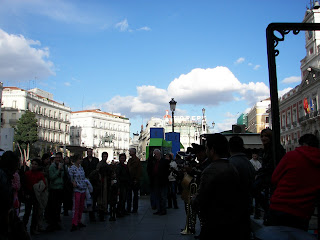 A Mariachi band on the fringe of Puerta de Sol, in the center of Madrid.
 Fountains on the paseos (sort of like boulevards) on the east side of the center of the city, near the Prado et al.
 This statue cuts a dashing figure in Plaza Mayor, also in the center of Madrid. At night there's a good game of "drunk kick the soccer ball around" here.
 A blown-up print of a Modigliani reclining nude painting. I took this mainly for my dad. Explains a lot, doesn't it?
 A fountain at the traffic circle closest to me on my way to work. Fountains are always photogenic, even when boring.
 See what I mean? But really, this is a pretty view looking East past the paseos. I think it's nice, at least.
 This photo is taken from the same place, but looking west, towards Gran Via, the "Broadway" of Madrid.
 Palacio Real behind a statue in Plaza Oriente. And apparently there's some light source from the sky that obscures the statue's face. Heavens, what might it be?
 And this is what I see out my window. At least when the weather is decent, as it has not been for two weeks. Ahh, but now starts the 24° weather, so the wait is worth it.
 A Mariachi band on the fringe of Puerta de Sol, in the center of Madrid.
 Fountains on the paseos (sort of like boulevards) on the east side of the center of the city, near the Prado et al.
 This statue cuts a dashing figure in Plaza Mayor, also in the center of Madrid. At night there's a good game of "drunk kick the soccer ball around" here.
 A blown-up print of a Modigliani reclining nude painting. I took this mainly for my dad. Explains a lot, doesn't it?
 A fountain at the traffic circle closest to me on my way to work. Fountains are always photogenic, even when boring.
 See what I mean? But really, this is a pretty view looking East past the paseos. I think it's nice, at least.
 This photo is taken from the same place, but looking west, towards Gran Via, the "Broadway" of Madrid.
 Palacio Real behind a statue in Plaza Oriente. And apparently there's some light source from the sky that obscures the statue's face. Heavens, what might it be?
 And this is what I see out my window. At least when the weather is decent, as it has not been for two weeks. Ahh, but now starts the 24° weather, so the wait is worth it.
16.4.08
The (Maybe not quite) Sweet Sounds of a Madrid Night
 Yeah, that's me. On stage, with my "axe", "rocking out." And a harmonica too. I'm playing a D-chord, it looks like, and behind me is one of the many pictures at the club that form a series of full-bodied naked women (including one delectable one where we saw only the back of the woman...except that she was seated upon a man, whose most characteristic organ was visible in joining with hers...but enough of that).
Oh, you need context? I bet you do. So, I played a show at a club called Nänai in Madrid. The club is a decent-sized Middle Eastern themed bar/restaurant, with a laidback dining feel to the room. Besides the interesting artwork, which Ben tells me changes every 2-3 weeks, Nänai boasted a creaky stage and hummus that looked really good. I didn't try any, but I salivated over it a little.
I got the show (because that was your next question, I'm sure) through connections and chance. Sometime during my first week in Madrid, while still settling in to my new apartment, I got a gchat from Ben about how a friend of his roommate was over. Ben had told him about my guitar playing, and this friend was interested. So, I walked the two minutes over to the apartment, went up to Ben's room, and found Arthur there.
Arthur is a young-looking guy with big, white-rimmed glasses. He is tall and skinny, and always either smiling or inquisitive. He has an earnest demeanor that comes off as goofy at times, but while he can be unintentionally entertaining every now and then, he never means ill. From Portland, OR, he has had quite a bit of experience abroad and is just settling into Madrid now after 7 months here.
More pertinently, he plays guitar and had managed to get himself a show to put together at Nänai. And he was enthusiastic about putting together an entertaining bill, because nothing is more important at a show than making sure the audience is entertained, as Arthur asserted.
I was supposed to audition for Arthur that night, but something got lost in the gchatting. So instead I dug up a version of "Julian of Norwich" that Bombadil had played, to show him that I've at least written a song, and that it's ok and, if I'm lucky, entertaining. Apparently, I sold myself well enough, because by the end of the night, Coal Burning Lamp was on the bill.
There was a large interim period between the negotiations and the concert date. In the meantime I went to Andalusia, entrenched myself in the English Teacher ranks (not hard to do), and continued to struggle with the Spanish language. But then we rehearsed last Friday night. Few words are sweeter than the ones I read from Arthur via text after I emailed him to check on rehearsal Friday morning: "Let's play some tunes."
Arthur lives nearby in Arguelles. So after relaxing and preparing on a Friday afternoon that marked the end of my first full working week in Spain, I went over to his place, guitar in tow. We started to play a little, then another friend of his, Chris, joined us, and soon we were trading songs and playing together in trios, Chris on the mandolin, Arthur and I on our respective guitars. And before we knew it, we had been playing for nearly three hours. It had been a while for me, anyways - I can go only so long without yelling at the top of my voice...err...singing emotively.
At the rehearsal we showed off our respective tunes and worked out an order for our sets. An Argentinian would play first, then I would play, then Chris and I would play, then all three of us, then just Arthur. At the end of the night, a talented Australian singer who goes by Igloo would close the show down. The order is more confusing to think about than to follow, by the way.
Sunday night came, the night of the show. I scribbled down a few phrases in poor Spanish to introduce myself to the crowd, and to present my songs. I expressly didn't show the phrases to Ben, so that they would maintain their naive brilliance. (After the show, Ben told me I didn't need to translate the titles into Spanish, for example. "Ahh, but that's the point," I said. "It's not supposed to sound right.")
We stopped by a poetry reading arranged by Ben's roommate (henceforward known as Kristi, which happens to be her name), and attended by some of her friends. It was a suitable way to enter into a higher artistic mindset, one that would be shattered as soon as I opened my mouth on stage. You know, sort of like the donkey in lion's clothing.
After we enjoyed the poets' company and Ben downed a beer and seltzer water cocktail, we set off to Nänai, which was only ten minutes away. We arrived to a small crowd, 10-15 people in the back of the restaurant where all the performing would go on. I tuned up and talked with Arthur and Chris. It appeared increasingly likely that the Argentinian would not show up, which of course meant that I would have to step in and take the opener bullet.

Fortunately, I've been in less appealing performing situations. That and I wasn't exactly worried about reaching a Spanish audience anyway (though to be fair, most of the people sitting close to the stage either were Americans or spoke English well). So, when Arthur told me that we should probably get this thing going, I agreed and asked him only to introduce me a little bit, so I wouldn't have to explain everything.
Arthur is nothing if not game, so he got up and opened the night with a few words. He is no fluent Spanish speaker either, but he has no fear on the stage, and so did a nice job. Then I went up, said some silly bit about myself and "Boat to Barcelona," and began my arpeggios.

It could be said that my performance was shocking. Largely self-educated in the Mangum school of laying it on the line, I like to make clear in my songs that I care about what I'm singing about. For that reason, I may flatten a few punchlines or startle a few members in the audience, but at the same time, it's probably at least entertaining to gawk at, if nothing else.
So I went through a three song set on my own, all fairly aggressive songs - "Boat to Barcelona", "Mystery Polka," and "Keep Me Clean." The latter especially involves yelling, banging my guitar, and moving around on stage in all fashions. For the show we had no microphone or sound system, which frees the performer to move around and act, as well as sing. My guitar playing might not be strong enough to sound beneath my voice, but it's close enough.
After the trio of openers, I invited Chris on stage, who played mandolin in support of "Julian of Norwich." I've played with many talented musicians on that song, and with many different instruments (bouzouki, accordion, drums, for example), and all of them supported the song nicely one way or another. The mandolin was similarly a very nice complement to a song about a medieval mystic from England. It just made sense, and Chris managed to pick up the not completely straightforward progressions quickly.
Chris took the lead next, and I plucked some simple guitar and bass lines to complement his 3-chord down home playing. I'm not going to confuse many people for a talented guitarist, but it was a fun sidelight, and the harmonica went nicely with the bit.
 This is Chris with me.
Then we returned to my last song, one of my newer songs, "This Morning's Tea" (which leaves me about two tea songs away from my Tea EP). Arthur came on stage for the last one, and we went through four verses and a big harmonica laden finish. My leading job done, I switched spots with Arthur and supported him on "The Fool" (you can check out his tunes at myspace.com/smidarthur). Then, as the plan suggested, I got off stage and just Chris supported Arthur on his next one, and then Chris left as well, and Arthur entertained on his own. He was quite entertaining, with a strange incarnation of Elvis as a hippie at times, and as I mentioned, Arthur was never afraid to lay it out on the line.
 On the other hand, this is Arthur behind me.
For the finale of our section of the show, Arthur invited Chris and I back on stage and we played "Good Night." On "The Fool" I played bass and sang harmonies on the "Oh Yeahs", but on "Good Night" I got to play a little arpeggiating riff along with the harmonies. So I added a little flexibility to the whole supporting thing, or in other words a little more flexibility than I have in my legs.
At last, the three of us vacated the stage, and Igloo took the stage. As evidenced by her myspace (myspace.com/iglooz), Igloo is quite polished and talented. She (her name is Josephine) is Australian and sounds a bit like Nedelle at times, with pretty folkie songs that were augmented nicely by a violist. She is also quite ambitious, as evidenced by the set list that she kept at her feet (she included the moments when she wanted to talk to the crowd, as well as a potential encore. She didn't take it.) As Arthur explained to me that first night we met, it takes a little bit of self-promotion to make it in this business, so more power to her. We enjoyed a free drink (mine for playing the show, Ben's for, umm, we're not sure why), and then once the show ended we went over to a legendary (in the Chang-Sobol family) tapas bar for some high-quality croquetas, and discoursed on divers and fascinating topics (including, for that matter, Quixote). We argued, we agreed, we disagreed, we shared our love for Madrid and croquetas, and then we went home, to shake off the glow of the evening. Or maybe just the stench of cigarettes on our clothes. Ahh, Madrid.

All photos courtesy of Mr. Benjamin Chang.
11.4.08
A Night of Flamenco

The bar is easily missed, a hole in the wall on one of the side streets in the Old Town of Sevilla, near Plaza Santa Cruz. But for a flier on the door, La Carbonerìa does not announce its existence, or that a show is on tonight. No more ostentatious is the outer room, where a doorman nods hello and old men play Othello, except on a board much larger than what you are used to seeing.
But the din of the crowd reaches that outer room, and when you enter the bar at five minutes to 11, it is full. A wide room with rows of tables, as well as an upper tier of nosebleed seats (though of course, the show is free for everyone), and bars on either end. The bar in the back serves food. The one in the front is reserved for drinks.
The bar is full with a clientele of three types. There are tourists, many of them middle-aged or older and from the U.S., or France, or other parts of Spain, for you hear all three tongues and others from their lips. Also among the tourists are the younger sorts, the backpackers and college students studying abroad, who have come in groups with their hostels or Let’s Go Europe! guidebooks. These tourists have affection for the second group: high school students, throngs of European high schoolers who go on field trips to all parts of Europe. They are supervised much of the time, but in this setting free to flirt and smoke and, for the older-looking ones among them, order alcohol.
Then there are the locals, who treat La Carbonerìa like any other dive. They tell stories by the bar for a laugh, and try to impress their lady friends, unconcerned with the anticipation that hangs over the room. Indeed, the level of excitement for the show decreases gradually from tourists to high school students to the locals.
By the bar there is a dressing room where the players wait backstage. The door is open at first, and the frills of the dancer’s traditional Sevillan dress can be seen. But as showtime nears, the door closes. Still, a steady clapping beat sounds inside the room, a final rehearsal of rhythms before the show.
As you wait outside with a sense of curiosity, or even anxiety, the time passes to 11:15, then 11:20. People continue filtering into the bar, finding seats with their friends who got their earlier, or else squeezing into open standing spaces from where they can see the stage. Along with the anticipation, the smog of everyone’s cigarettes thickens the air, so that each deep breath you take only quickens death’s onset. You breathe deeply and continue to wait.
At last the dressing room door reopens, and the group emerges. Two men and the woman dancer walk to the stage. She kisses a man at the table in between the dressing room and the stage, a table reserved for friends of the band. A 3rd man joins them on stage, getting up from that table and taking a seat on the far right of the stage. The dancer sits next to him, and then the singer and the guitarist.

The singer begins to speak as the crowd goes silent. It is clear he is the group’s leader, at least in spirit. He requests the crowd to be quiet during the show, to take all the pictures they want but no videos, and to not smoke during the songs, a request surely in vain. His introduction finished, he turns to the guitarist, who begins to pluck out a melody, while waiting for his three compatriots to clap the rhythm.
An intricate rhythm that contains a multitude of clapped beats begins, and over it the guitar floats and at the same time supports. The foundation is set. Now the tower of music can be built. The singer emits a wail, a long “A-hi” that rises and then falls, as he calls on the spirits, wordlessly. Then he sings words, in the same strong yet trembling voice, as if by the very words he sings he’s ripping himself asunder.
As the song develops over the initial strands, the three men fall into their different roles. The clapper, well dressed with his hair in a ponytail, solemnly keeps his time, showing neither pain nor joy, only smiling when he catches the eye of one of his colleagues, or of his friends at the table to his right. He is focused on the task at hand, and may as well be clapping in the middle of a desert, for all the attention he affords his surroundings.
In contrast, the guitarist is enjoying himself, a smile perpetually on his lips, his eyes always dancing. As he plays he cannot help but move, his head bobbing forwards and backs, his eyes bugging out as he looks at the singer next to him. He thrusts the guitar out at the crowd on key notes, teasing them with his music, as it seems he teases them when he hisses for silence, mocking the manner of the incessant worrywarts in the crowd. He is all tics and movement, his body as much in motion as his fingers as he goes from picking to strumming to both at the same time.

To his right the singer sits, and as he evokes the ghosts of past flamenco heroes, he serves as the emotional center for the men. His face is as pained as his voice, and as he sings the absurdly passionate romances that make up flamenco, he expresses that this is no pose, that this is art as life as art. He is the sign of devotion to flamenco as ART in the band, the adherent to the tradition.
All three are necessary, for flamenco’s essence is borne out by their collective roles. Flamenco descends from gypsy music. The Roma people brought it to Spain. But Spain added two key pieces to the formula. Flamenco is gypsy music plus humor and rhythm.
Well, there’s a third major piece as well, and that’s dance. And so when at last the dancer steps out of her chair and to the front of the stage, she embodies the essence of flamenco. She represents each of the men behind her, with a stern devotion to the act and a business-like attitude, but also a sense of the joy and passion behind the performance. She smiles at her friends, and she smiles at the feeling she gets from the performance, the memories it brings back.
The dancer is in at least her late 40s, and only looks that young because her long, curly hair remains boldly black. A cruel observer might say she looks a little like a female Mick Jagger, current edition, but that cruel observer would suffer from time just as much as she.
Once, she must have been a star, a high-profile dancer. Her grace and ability speak to this, if nothing else. Now, she performs at a small bar buried in the old town of Sevilla with three men, boys, who cannot be closer than 20 years to her age. She has to deal with a crowd of tourists and strangers who don’t understand when to clap and when to stay silent, the cadences deceiving them at every turn. She wears each disappointment on her face.
But, like the rest of the band, she performs with passion and rises above the inadequate aspects of their setting. To the unknowing eye her dancing is flawless, from the steps to the sashays of her skirt to the passion in her face. She dances and reminds us that before we dreamed of fame, of performing in front of the masses and earning their attention and applause, we danced in our room, alone, to the music in our head.

The dance goes about 10-15 minutes, and then she returns to her seat. Again, there is undesired clapping from the audience, and the singer calls for silence. There impatience in his voice, but eventually everyone, talkers and hissers alike, quiet down. They play a song that features the guitar, with hard chords and several near endings. The dancer sings quietly in harmony with the singer, so that you can see her lips moving but not make out the words.
Then it ends. The band goes to the front of the stage together, takes a bow, and exits stage right, back to their friends. No formal announcement came on whether the show would resume or not, but they have only played for 30 minutes, so it’s safe to expect more. Many in the crowd exit, and many others settle into the newly vacant seats. The night approaches midnight, still an infant in Spanish terms.
As the crowd waits and talks and smokes again, the band does the same. The guitarist sets up a “No Pasar” sign by the door leading to the courtyard, then goes out to smoke a cigarette and nurse a beer. The singer also imbibes, mingling a little bit with his friends but also soaking in the sweat and the alcohol. He lost a lot of weight on the stage, and needs to replenish. The dancer talks with a man by the bar, and the clapper again blends in with the crowd to join the hometown table.
Offstage, the respective images of the performers change. The guitarist looks small, slim, and perhaps petulant, rather than merry and brilliant. The singer smiles as he talks, the pain washed away. The clapper is just as much a part of the background as on stage, but he too is no longer solemn and committed to the beat. Only the dancer's on-stage mystique remains. She is tall, and as the only one dressed in Sevillan fashion, she looks just as she should, like she just stepped off the flamenco stage, and like she might step right back on.
The room stays full through the long wait, even if of a different populace. Their certainty that the show will go on is affirmed, as the band at last steps back on stage. Either the crowd is less aware of the issue or the novelty and respect has worn off, because it takes much longer for silence to be achieved. Once the singer is satisfied with the attention level, he turns to the guitarist, and they pick up right where they left off.
The second act largely mirrors the first in structure. The first song involves no dancing, with a focus on the singer. For a twist, the band asks a friend of theirs, Elena, to join the main dancer for a duet on the next song, the dance. The song is a romantic, finger-pointing song about what two characters have done right or wrong. For each verse, the dancers face off, then dance past each other, touching each other’s arms stretched above their heads as they pass by, before ending up on the opposite side. They then cycle back through in the same fashion to get back to where they started.

Elena is much younger, and also prettier than her counterpart. She is dressed in a modern outfit, jeans and a see-through white shirt over a tank top. But Elena is not just looks; she holds her own as a dancer. The dancer in the band is graceful though, and smiles more during this dance than she does the rest of the evening. She plays off her new partner’s energy, and they both come off looking better for it.

The duet ends and Elena returns to her seat, the dancer to hers. The band goes through a quick number, and then the singer announces that this will be the last song, and that someone will be playing flamenco in the outer room afterwards. You brace for another guitar-focused song like the first set, or maybe a romantic finish. It begins that way, and the end is near.
Then in a huff the dancer storms out of her seat. She moves to the front of the stage and starts a new dance to the song, a ferocious dance where she does not step as much as stomp through her paces, yet she maintains her technique and lightness of foot nevertheless. No more smiles are allowed on her face, and she is at her most passionate as she twirls from one side of the stage to another, all in time.
Her path takes her to the back part of the stage, near the seats. She storms back into her seat, the song ends, and the applause begins. The group gets up this time and in concert takes a bow to the audience before exiting. “Olès” and whistles are heard amongst the clapping. The band returns to their corner of the room, and the crowd ceases cheering and turns for the exits.
In the outer room, a man in the corner warms up on his guitar, ready to catch the masses as they leave. At the tables, the old men still sit, playing their Othello.
Subscribe to:
Posts (Atom)

