23.10.10

Mzingus Making Moves

This may come as no surprise, but I'll say it anyway: I've never felt like the "white man" like I did in Rwanda.

Come on, I bet you can barely tell which one is me.

Again, no shocker. Besides anything else, much of my traveling experience has been in the western world, namely the U.S. and Europe. There was a foray to Morocco, wherein I freaked out at the attention I drew in the Marrakesh souk but otherwise shrugged off the strangeness, blending in with plenty of other tourists in my own la-la land besides the Atlantic Ocean. There was last year's trip to Guatemala, but that country's proximity to the U.S. and its own racial makeup that includes plenty of European heritage makes white skin either something to ignore or something to resent.

The closest I've come to the reaction we received on this trip came from a trip I took after 8th grade to Japan with a group of kids from school. A cherished trip for me, our 8 days in Hokkaido saw our group take the lead in many of the "art camp" activities that we took part of. Vibrant, brash, and a little flamboyant, we got a little bit of a taste for the life of a rock star, as many of the Japanese kids followed us eagerly while we sang "New York, New York" and "Puttin' on the Ritz." (Did I mention we were flamboyant?)

This kid is the best.

In many ways, that trip was the travel experience I most recalled in seeking a comparison for the Rwanda trip: the school-related group trip, the assortment of activities that was loosely related to academics, and the way the group bonded to create a shared energy that one could not anticipate or predict. But I'm writing about being the white man, so let me return to that.

I've already written about the "mzingu", so let me further detail what it was like to be a mzingu. Kigali is a growing city, and may be ahead of many African cities in development and standard of living. At the same time, Rwanda remains remote, and the presence of a foreigner is still significant to many people. As such, seeing the "white man" is a new experience.

Children are most obvious in the way they acted around mzingus. Four of us went for a walk in the valley near our hostel early on in our trip. As we walked by people and waved, we could see parents indicating to their children that, "look, those are mzingus!" Subsequently, packs of children started chasing after us, shouting, "Mzingu, mzingu!" Once they reached us they were less sure of what to do, most of them standing there shyly and putting their hands out when we offered ours. We never shook hands, instead lightly touching palms. The bolder among our group would hug children.

Hot on the trail of the mzingus.


I mentioned also that there are different types of mzingus; in our group of 4 was a girl of half-Asian descent, her mother being from Malaysia. To her the children came running and shouting an extra word amidst their "Mzingu" calls. It took FGL Sara to interpret for us; they were shouting, "Mzingu nihao! Mzingu nihao!" The same girl later drew greetings of "konichiwa," as older Rwandans showed more cultural dexterity if not sensitivity.

That valley experience was not unique. After a morning of visiting genocide sites, we walked around a village that held several different schools with children getting out for lunch break and recess, which led to several iterations of hugging, throwing children around, taking pictures, and embracing mzinguness. In my trip to the market, I walked by a family in a corner. The adults were pointing at me and telling their 3-year old boy that, hey, look, that's a mzingu, a real live one. I turned the corner so that my back was to them, and a few seconds later I heard a little patter of feet; the little boy had run up to me. He put his hand on my pocket, as if to confirm I existed, and then quickly ran back.
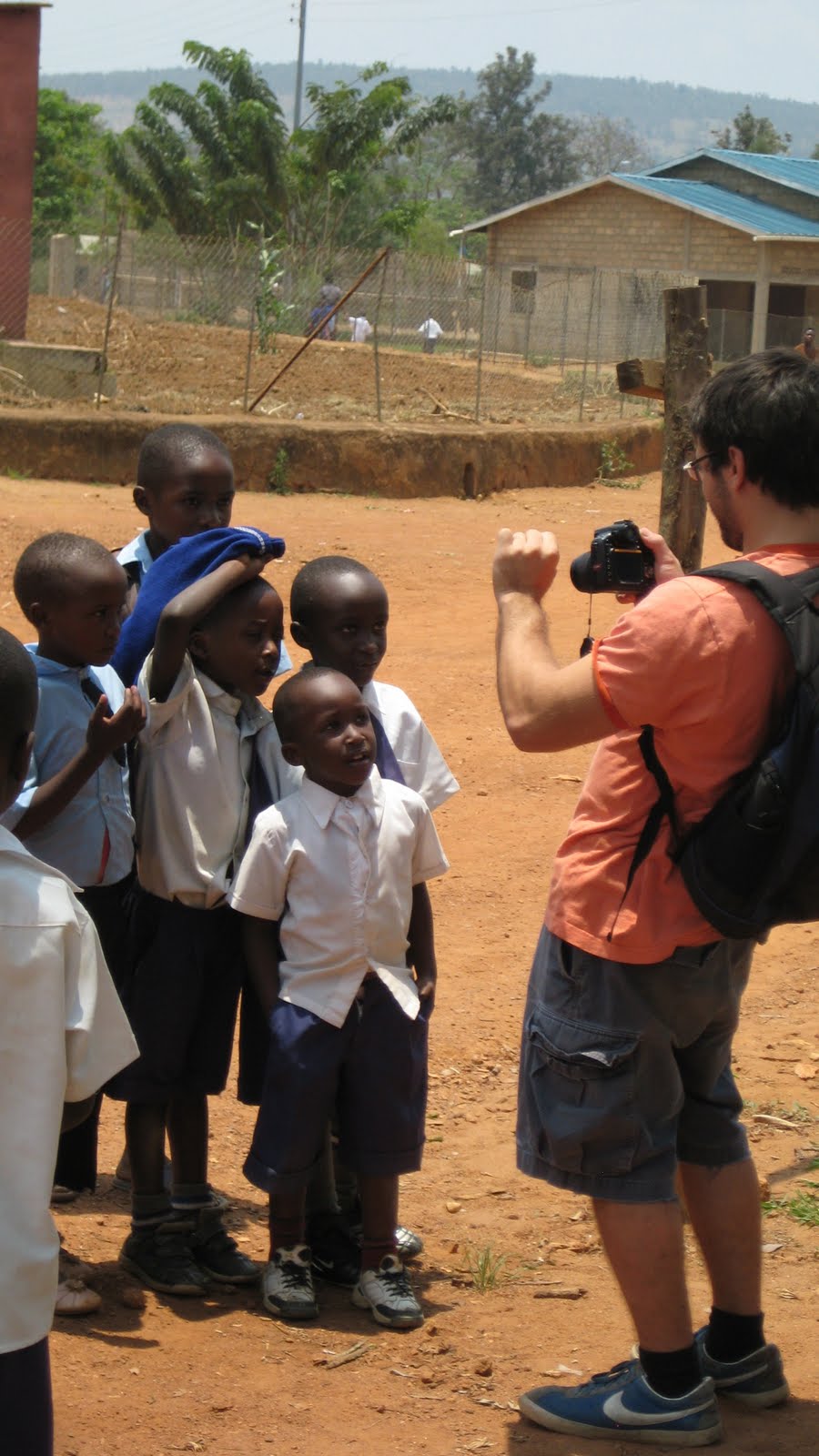

"Look at how well the mzingu dresses!"


This curiosity tinged with reverence was not limited to children. We went to paint a house one morning, and on the way, we stopped to buy the paint, rollers, and masks needed. As our van stood in the street, and I sat in the van, behind one of the girls in our group, a man came up to the window. The man, in a ratty long-sleeved shirt and plain pants, was probably a little older than me. He shook my hand through the window and then proceeded to ask how he could make friends with white people.

"It would be very good to have white friends," he said in decent English. I stammered a few answers. "I would very much like to have a white girlfriend," he said. "That would be very good." He then indicated the girl in front of me. "Is she your sister?"
"No, she's too pretty to be my sister," I said, awkwardly. He did not respond directly. "Is she your girlfriend?" No, I said.
"She is very beautiful." She giggled nervously at the attention.
The man repeated how much he'd like to have a white girlfriend. The other members of our van started to pile in as we at last had the necessary paint and rollers. "I would very much like to meet your sister," the man said as we prepared to leave, "I am sure she would be beautiful like you." It was my turn to giggle nervously. And off we drove, I wishing him well in his quest.

These positive feelings for visitors was a surprise to me, though it shouldn't have been. We were briefed that Rwandans were liable to be closed and suspicious of others, an understandable mode to adopt for citizens of a country 15 years away from civil war and genocide. Furthermore, we might have expected raw feelings over the way that the international community ignored the genocide. At first, I thought that there was a spectrum that spanned two main forms of response to our presence - there were Rwandans who waved eagerly at us, such as the gardener at our hostel who gave us a two handed wave just about every time he saw us for two weeks, and there were Rwandans who eyed us with a bit of distrust. But I later found that whenever we waved at a Rwandan, they waved back eagerly; whenever we spoke to or greeted a Rwandan, they responded with a happy tone; whenever we engaged in a conversation, we found an appreciative conversationalist to join us. They may not have been spilling out their whole life story, but everyone was happy to see us.

My guess is that people make simple associations. The foreigners they run into in Kigali are generally there to help out; whether they help successfully or not is a different issue. Nobody ties foreigners specifically to the international community - if anything, we make up for the past failure. And yes, the "mzingus" tend to have more money, which is viewed not as a threat or even an opportunity - some kids and people begged for money, but on a much lower scale than you would expect. I think more people asked me for money in New York this weekend than they did in my time in Kigali (to be fair, I didn't understand that "falanga" meant cash the first couple times I heard it in Kigali. Also, to be fair, New York City has about as many people as Rwanda).

Keepaway from the mzingus. A typical scene.


Whatever the reason for the reverence white people were accorded in Rwanda, or at least the reverence we were accorded with in Rwanda, it left us feeling like we were in a movie. Any movie set in Africa where the visiting do-gooding (or possibly secretly evil) white man is surrounded by eager African children who marvel at his western clothes and modern technologies: that was the sort of scene we replicated on several occasions. Western clothing is an assimilated part of the globalized Rwanda, but many children were eager to have photos taken by us or to take photos of us or to pose or whatever they could do, if just to see pictures of themselves in the viewfinder. One of our group members had been to parts of rural Ethiopia where children had never seen their own image, with no ready water supply or mirror to go all narcissistic in front of; Rwanda was not that removed from the modern day, but there was great eagerness to meet us. This can get wearying, as everybody who sees you wants a piece of you, almost literally - they want to touch you, talk to you, occasionally receive money from you, and in general bask in you (I hope this doesn't sound arrogant - there's nothing special about us or any white person that visits that merits such attention, or at least nothing special that had anything to do with our control, personal characteristics, or deeds. Rwandans, kids mostly, just appreciate what the mzingu represents). But the eagerness is generally welcoming and positive.

Especially for free plane rides are they enthusiastic.


And that eagerness for the west and modern culture was where the dancing came in. Well, that and my sweet moves.

Workin' it. Uhh. Yeah.


The first time I danced was just among our group at a bar in Kigali. Our main man Patrick took us out to a local establishment after we ate an overly mzingu meal with Israelis in the country at a Chinese restaurant (of all the combos in the world). Fueled by a devilish mixed drink I came up with - Fanta Fiesta (a new, black currant flavored Fanta that tasted like grape cough medicine if grape cough medicine tasted good; also, all soda in Rwanda used actual sugar instead of high fructose corn syrup, which didn't really mean soda was any healthier there, but meant it was a lot tastier) and Ugandan waragi (a clear alcoholic drink that I was warned about but that tasted like nothing more than, well, 80 proof alcohol, for better or worse), we started to bust out moves, but only for the amusement of ourselves and a few bystanders. A couple of the guys and a couple of the girls danced, but it was mostly a warm up night, a preview of things to come.

Those in the know are aware that this move is a Dave Frisch special.

The next night we went out to Papyrus. It was a Thursday night and we had a long Friday ahead of us, so we thought we'd have a nice meal and then go dancing. So we did it. We went dancing. And to Papyrus's credit, they were bumping killer jams for a long stretch, which made it easier to dance.

As anybody who has seen me dance at either a recent wedding or in general (chances are there aren't many of you) knows, when I dance, I bring energy, quasi-rhythm, and a bunch of enthusiastic but not exactly classy moves to the floor. Lots of side to side, lots of shoulder shimmying, lots of changing levels and hitting the floor. In other words, I dance like I wrestle, except with slightly less direction and a lot more spasticism.

"Bend down, then row it. Row it. Work that back. In the rhythm! And one! And two!"

There was no telling how this would play out on the Kigali dance floors. But within a few moves to Haddaway's classic, "What is Love?", I had helped form a circle and had a few young men from the area dancing along with me, mirroring my moves. I would dip to the left and pull my arms back in a fly lift sort of pattern, they would match. I would shake my right arm down in front of me and twist my body to the right, and two guys wearing baseball caps would be right with me. I would run around on my head to "It's Raining Men" on the floor and...well, I did that move alone. And the "chasing my head with my legs as I lied prone on the ground," that move was alone. But it was popular.

"Look at that crazy mzingu! I think he's having a seizure!"


This dancing dynamic was replicated at the Kigali Business Center night club (the KBC, as it's known) on our penultimate night, where I hit the floor out of duty when the DJ fulfilled my MJ or Prince request (though "Thriller" qualifies as the bare minimum fulfillment of that request, where "Little Red Corvette" or "Wanna Be Startin' Something" qualify as maximum fulfillment), and then later somehow ended up without a shirt dancing on the floor to another song that was familiar but that I can't quite name. These dancing dalliances also met with a strong crowd response from locals, including moments where a throng of girls jumped around me, and moments where a local lady of ill-repute danced behind me and rubbed my neck. She was not ready for the proverbial jelly, as it were.

Apparently, I was really easy to pose with when on the floor.


There's one other digression merited regarding dancing in Africa that makes it a little different. I will assume that Rwanda is not a very good place to be a homosexual: that is based solely on assumption and a little bit of asking around in Rwanda and of experts, but also on the idea that neighboring Uganda recently attempted to outlaw homosexuality, with death a potential penalty for some offenders. I'm presuming that Kigali, at the very least, is not trying to win Let's Go recognition as a gay capital, if you catch my drift.

Not that there's anything wrong with digging these moves or those pits.


That said, there is a frankness to showing affection that you would not see in the U.S. for sure, and in most places in the west. As one might find men holding hands in the Arabic world, you find it in Rwanda, more than you find men holding hands with women even. Women have a very strong position in Rwandan (or at least Kigalien) society, but there are still old-fashioned charms like triple kissing when you say hello or goodbye.

"Hey, how YOU doin?" (Also, sweaty much?)

This frankness extends to the dance floor, where guys dance with other guys just like they would with women. Which is weird, at first. At Papyrus, I thought I had stumbled upon a gay enclave as men bumrushed me to dance a little too close for comfort. By the time I danced at KBC, I was an old hand, and I didn't blink whether it was man, woman, group of women, group of men, or lady of ill repute who wanted to dance close with me. All of those constituencies were represented, by the by, which is another way of saying my dancing was a big hit.

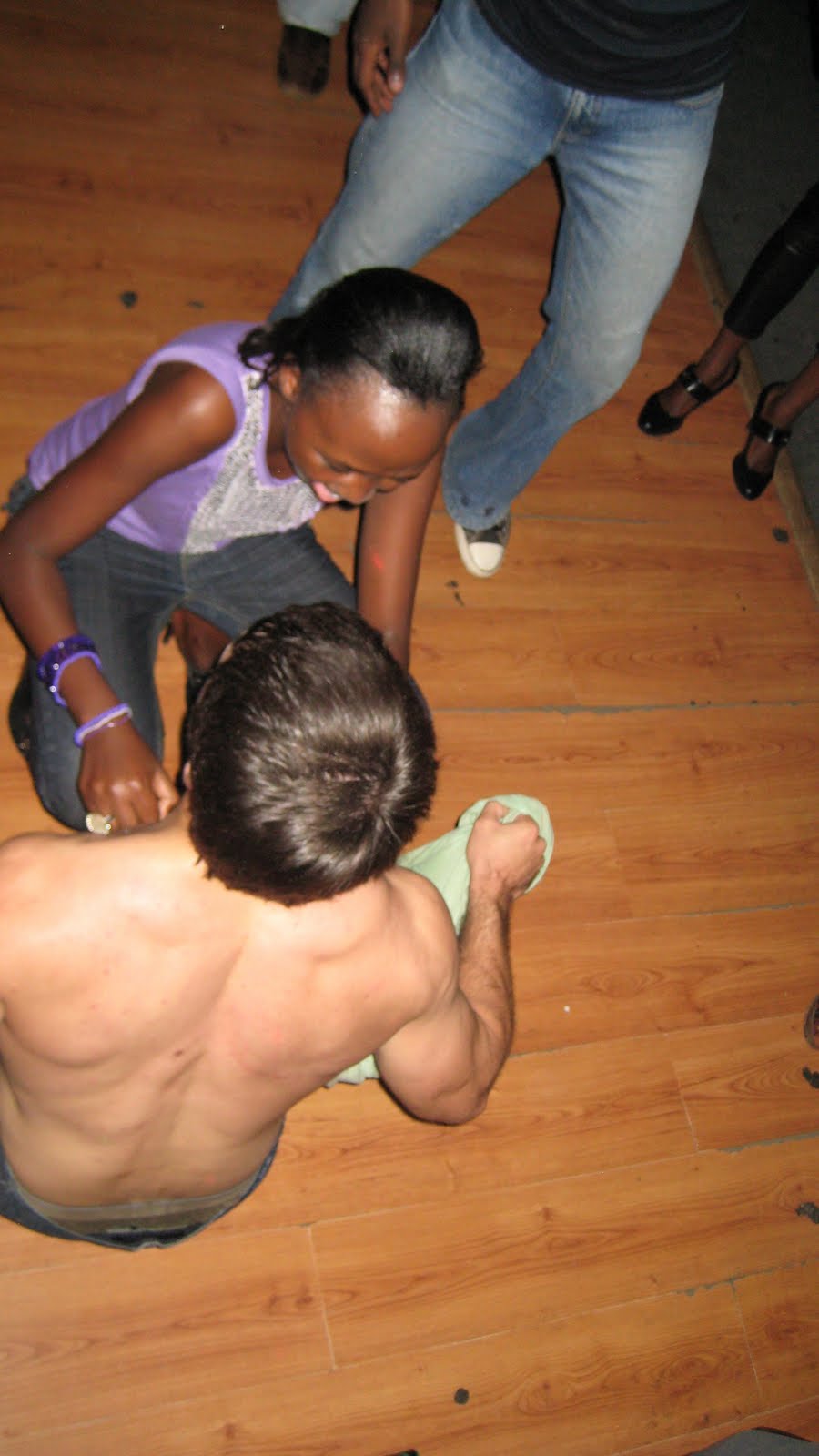
I made sure the number of photos of me dancing close with a girl double the number of me dancing close with a guy. In case you had doubts.


A final illustration of the open arms with which the mzingu and his strange habits were greeted in Rwanda could be found at a small church congregation of only 500 people or so on a Sunday morning. At this pentecostal gathering, inside a building whose inner walls and ceiling were fashioned, perhaps consciously, to look like a revival tent, we witnessed an impressive service. The service started with gospel rock offerings from a talented 5-piece band and a choir, giving the feel of a concert for 20+ minutes. Then a few quiet messages were passed and we were introduced as guests. We went on stage, gave a speech and taught a song and dance ("David Melech HaOlam") for kids to join us in, and then retreated to our seats.

"And make sure to donate to the collection basket, kids!"


A few more announcements were shared, and then the band kicked into another song. This time, the tech staff cranked up a computer and a projector and showed the words on a screen. So we could sing along, more or less. More and more, as the song went on, as it was pretty repetitive. This song in fact stretched into the epic territory, far outstripping "Freebird" or any Led Zeppelin classic in terms of length and righteousness, and at last coming to a halt somewhere in Grateful Dead noodling territory, but with less noodling.

Instead, there was a chorus line, and they were dancing. Men and women pulled out a few steps that they kept switching on and off like a new hat to try on in a store before taking it home. I, deciding to wear my kinesthetic learning hat, followed along with the steps, allowing myself to get into the groove of the service and the worship, even if my heart wasn't exactly into the worship and my thoughts, ala King Hamlet's, were not exactly rising heavenwards.

The chorus line proceeded to don a three step and kick maneuver in each direction. 1-2-3 kick, turn 1-2-3 kick, etc. I executed this maneuver dutifully from my seat, perhaps bumping into the interpreter the church seated next to me so I could understand the sermon. After a few minutes of auditioning, unwittingly, I found myself compelled to go up on the stage. Which is to say Eddy, our Rwandan friend who introduced us to this church, led me on stage. And left me there. One mzingu on the end of a Rwandan chorus line.

I couldn't find the video of me dancing, so here's the song we sang to. This song went on for over 20 minutes. I guess it made as much sense as "Hey Jude," at least.


So I continued to follow the step on stage, with great elan and exuberance, if a slight hesitation over my incongruous presence in front of everyone. And, well, it was an experience: I didn't ruin the show, but I didn't elevate it as much as fit into it. Which was fun.

Such is life being a mzingu in Rwanda: exhilarating, exhausting, exciting, and exorbitantly rewarding. At least, for a little while.


Let's slide in an epic performance of our inside joke song of the trip, "Hey, Mzingu."

11.10.10

On the Mzingu

I will talk about the experience of being a mzingu in a separate post. This focuses on the Kigali mzingu community itself. Enjoy.

Rwanda is in Africa. in Africa, or at least sub-Saharan Africa, most people are black. I trust these are simple enough statements.

The language of Rwanda is Kinyarwanda. The East African language is beautiful and full of sounds unfamiliar to our ears: "mwiliwe" and "ndakwashimeya," for example ("good afternoon," and "nice to meet you," respectively). Kinyarwanda has a beautiful word in it, a word all the more beautiful for its meaning and implications. The word is "mzingu" (pronounced "mi-zun-goo").

"Mzingu" best translates as "gringo." For English, the more direct translation is "foreigner," but it misses the curiosity, colloquial quality, and mild bemusement mixed with the slightest tint of disdain that I perceive in the term. There is also lost the sense of the universal, the usage of "mzingu" a label affixed to anybody who passes by and is clearly not from around these parts. To get the comparison right, I should imagine an American walking down a street in, say, Monterrey, and receiving loving cries and curious calls from children and adults alike of "gringo!" Maybe this happens just as or similar to how I imagine it.

Mzingu is not strictly a racial term, though white skin is the most obvious manifestation of mzingu-ness. I've been told that black Americans, for example, also draw mzingu cries. Asians of any sort get the mzingu chinai cry, in recognition of a notable Chinese presence here. But "mzingu" can be further found as a distinguishing factor in terms of way of life here in Kigali.

Man fourth from left? Mzingu total.

Take the typical "mzingu" male in Kigali (n.b. credit to fellow group member Ariana for first pointing out the following characteristics in the mzingu male. I have only developed and solidified her theory). He is white. He is of average or above-average height. Aged somewhere between 25 and 35. He dresses well, whether from a less formal foundation t-shirt, polo shirt, or argyle sweater with birkenstock wardrobe or a business outfit. His hair is often daintily ruffled, giving the impression of a low maintenance, never care attitude that undoubtedly takes a high degree of mainteance. The mzingu is handsome, whether in a stunning deep blue eyes with blessed reserve way or an awkward and lacksadaisical way.

There is also an aura that surrounds the mzingu. His deadpan smile and slack hands in his pockets say, "I don't care, I'm in Africa." I am in Africa, he says, and nothing can faze me. The cool pools of blue are filled with irony, the water of detachment, the sense that I am here to do well and live life to the fullest, so don't bother me with your limitations and your overly friendly nature and your foreign languages.

It should be said that the typical mzingu male represents a social class. He is generally American or British, from an upper middle class background or higher, and preppy. He appears to have eschewed his easy lifestyle of law school or corporate work to do good, good that involves travel and exoticisim. His investment in good comes with a mild, detached condescension, as if his upbringing cannot be forgotten; his high status and his good deeds elevate him higher, so that even those he helps can hardly be on a par with him, though the mzingu will never say this. Likely, the mzingu will continue his good work (and this description should not lead to the impression that the mzingu is not doing good deeds, or that he is even a bad guy: many mzingus are quite likable) for a few more years before wearing himself out and growing disillusioned, at which point he will retreat to his easy life, maintaining warm memories of his African days and a steady donation pattern (n.b. fellow group member Roei made this point).

Moving past the mzingu male ot the mzingu cultural life. Mzingu cultural life revolves around a narrow scene of nicer restaurants, white nightclubs, and creature cultural comforts. There is a hotly anticipated mzingu trivia night at an Italian restaurant on Monday nights. There is instant familiarity as the 200-300 members that make up the adult mzingu community (n.b. FGL Sara's estimate) know each other well, see each other almost nightly, and easily adjust to the permanent transience of the community.

The Mzingu Male observes nature.

A few Rwandans dot the community, and we would commit a grave error in calling the mzingu community exclusive. Certainly not de jure, and not de intention (n.b. I know). If it is de facto, it is mostly due to language, financial, and cultural considerations. When mzingus venture out to a Rwandan restaurant, for example, they are unable to beat the long wait for service, ruining any satisfaction that might come from the authenticity, quality, and price of the meal. Those Rwandans who are in the community often adopt mzingu manners of dress and cultural taste, though I imagine uneasily.

Mzingu communities are to be found globally. Kigali's may not be unique in ways beyond the language and obvious local peculiarities. One should not marvel at the size, considering the opposing forces of Rwanda's remoteness on one side and the need for development and post-genocide related support on the other.

We should not judge the mzingu community, but consider it and walk in its shoes for a mile or two. This will be the next post.


A short clip of the Mzingu male's strange mating ritual.

9.10.10

Rolling Up and Down Rwanda

Lake Kivu in the Northwest.

So this one time in Rwanda, I taught some dudes on the dance floor how to really bust a move...

Wait, I know what you're going to say.

"But Dan, you can't dance!"

No, wait that's not what I meant you to say. Jerk.

"Dudes? Bust a move? Did we turn the calendars back to 1991?"

Ok, fair statement. But still not it.

"What the hell are you doing in Rwanda?"

Yeah, that's what I meant you to say. Allow me to explain.

This academic year, spanning September 2009-October 2010, I have studied for an M.A. in Government at an university in Israel. As part of that program, I signed up for an internship revolving around Rwanda. In essence, we were to blog with M.A. students in Rwanda about issues related to genocide, conflict, post-conflict rebuilding, reconciliation, and general questions of how to build peace, drawing on the similar though not parallel situations of the Rwandan genocide of 1994 and the Holocaust. At the same time, we had the opportunity to learn about Rwanda, indirectly about Africa, and our eventual Fearless Group Leader Sara (hereon known as FGL Sara) dangled the possibility of visiting Rwanda when the program was over. 10 months of blogging, fundraising, and hoping wishing praying that it might come true later, 6 of us and FGL Sara made it to Rwanda, where we followed an intense 2-week itinerary of learning, service, eating, not sleeping, and yes, dancing.

Having introduced the reason for visiting Rwanda, I'd like to introduce the way I'm going to write up Rwanda on the blog. Similar to my previous trip, I am going to send up a flurry of posts post facto, even though some will have been written while I'm on the ground in Rwanda. While plans are always laughed at by the big amorphous power upstairs, here is what I plan on posting.

- Initial Impressions and General Thoughts. I.e. the second half of this post.

- On the Mzingu

- On Being the Mzingu

- Pictures/Artsiness

- Of the Genocide

- Of Experiencing the Genocide's memorialization

- Final Impressions

Ok, are we good? Yes, we're good. Let's get to the impressions.

***

The view from our hostel in Kigali.

Rwanda is beautiful. This sounds like a trite statement, an obvious one, maybe even, if you read into it too much, a condescending one. But the simplest way to say something is often the best, and there is no simpler way to express the point that Rwanda is beautiful than saying it. And showing photos.

Rwanda is known as the land of a thousand hills. At times, whether walking or driving around in Kigali or traveling through the country, it seems there could be no possibility of Rwanda having a flat stretch of ground that stretches for more than a kilometer. Those hills are green and lush, running into red dirt sections but always something out of a picture book. The beauty is almost repetitive, to the point where the unimaginative, ungenerous mind might think that all these hills are nice but look just the same. Then a new hill, a new view, a new landscape will wipe that miserly thought from the mind and even the most cruel hearted soul will concede that Rwanda is beautiful.

The way the country spreads out develops this diversity. In the East, the beauty was more of the flat hill variety, long stretches in the landscape and red earth on the ground. Visiting the South we saw vertical hills and green plantations, almost impossible to imagine how the crops grow at a greater than 45 degree angle to the ground. And in the Northwest, amid volcanoes and mountains, the ground turned darker, black earth and mystic beauty.

Another northwest shot.

Kigali too is beautiful, though more confusing. Kigali's beauty is reflective of Rwanda's beauty; driving around the city or sitting at our hostel, I find a scenic view of Kigali's hills inescapable. And indefatigably beautiful. The city is constructed amidst its hills, and the way the main roads circle around a few valleys, one full of lower-income housing and one holding the Kigali golf course, the city resembles a race track oval encircling several pits. The city is a nice size in theory, holding about a million people, but the figure is misleading I think. The number may include all the suburbs near Kigali that make up the Kigali city province, and even if it includes only the city outskirts, that number does not affirm the fact that the center of Kigali is small. Residents either know each other already or quickly acquaint themselves with one another. The center is well-connected, posing a challenge for anybody who wants to hide after joining the scene. At the same time, it spreads out in that race track way, stretching its geography to make the city feel bigger. We end up driving by the same billboards and the same buildings two or three times a day, and often get the sense that we're doing laps.

The prettier parts of Kigali.

Kigali is also a very nice city compared with what I expected. FGL Sara tells us that the city has grown and changed a ton in the last 3-6 years since she was here; construction is constant, those race track roads are recently paved, expanded, and extended, and there is no sign of that growth slowing down. As such, the city has become something of a fascimile of a western city, with relatively expensive prices, modern conveniences (ranging from running water to wi-fi internet) available in many if not most places, and the bustle of a real town. There are plenty of dirt and cobblestone roads in the city that are no fun to drive on, the standard of living and costs are still lower than in a western city, and the power goes out every now and then, but on the whole for central/east africa, Kigali is an oasis of sorts.


The people of Kigali also pool into a collective oasis. We have found them friendly, open, and eager to talk. There is a wide range from the well-dressed professional class to the poor neighborhood residents in terms of dress and well-being, but the range of their attitude towards us has been much narrower: most are restricted in the happy to see us category. I'll go into the dynamics of interaction between Rwandans and us more in the "On being the Mzingu" post, but I can say that I expected a more reserved, cautious group of people than we have found, and have as such been thrilled with the warm reception.

Speaking of warmth, Kigali has a perfect climate for late September/early October. At its most sweltering, day time temperatures in Kigali probably reach the mid 80s, a few notches below Jerusalem or Tel Aviv a week before, for example. At night, the air is cool but not cold, so either a long sleeve or a short sleeve shirt suffice depending on the mood of the wearer. Restaurants tend to have outdoor seating, and at dinner the biggest nuisance is the occasional mosquito. We arrived during the supposed rainy season, and when it did rain it rained with a fury unmatched by many women scorned (how we survived the twilight trip to Gisenyi on a winding one-lane highway through mountains where we couldn't see five meters in front of us I'm not sure), but it only rained two or three times all trip (one of those times being our last day). Not bad for being below the equator for the first time.


Oh, and there's that: this is my first visit to sub-Saharan Africa or the Southern Hemisphere (I've failed to check which way the toilets flush or remember which way they do in the Northern Hemisphere, so I'm not living up to that Simpsons episode well). World Cup 2010 and globalization aside, Africa is supposed to be a whole 'nother beast.

And it has been, in its way. Kigali is more familiar than I expected, and enough people spoke English to allow us to get by and feel at home more or less (FGL Sara speaks some Swahili for the times when an interpreter isn't around, another member of the group has school level French to draw on, and I led the way in Kinyarwanda words learned with about 10). But there is a different energy here. There are different living conditions to observe and comprehend. There is a different history, especially in Rwanda. People are at their essence familiar, but different in many ways, extending far past their skin color or language skills.

This was familiar.

There is nothing new under the sun, as the philosopher said. There is also nothing so vastly different from ourselves. In other words, wherever you go, there you are. So we can't pretend that Rwanda is an exotic cauldron of strange lands, customs, and people. Instead, we should consider a visit to a new, stranger place, as a look through a twisted mirror, showing ourselves in different guises and forms, but at the essence the same.

Sometimes the mirror is surprising.

Here is as good a case as any to travel; to look through this mirror to better understand ourselves and the world around us. This isn't easy, can't be done in two weeks, and works on varying depths and understandings. Nevertheless, as a traveler, I believe it must be done. So I propose to you a series of posts about Rwanda that at the same time are about you and me and dancing.

Especially dancing.

Especially when I'm showing off those moves in a nightclub or the front of the church.

Don't worry, the story will come soon.

23.9.10

Great Unexpectations in Denmark

Another reason to travel is to shock the soul and body out of routine. Go away for a few days, a week, two weeks, longer, and force yourself to adapt to new realities, locales, customs, and situations. A traveling routine is often established, and often quickly, but this routine in its essence has to make room for the unexpected and the unplanned, more so than in our day-to-day lives.

That isn't to say that there are no expected moments on a trip, though even these stretch towards surprise in the context of traveling. In Denmark we could expect colder climes and a preponderance of what a receptionist in our first hotel called "boring weather", but that doesn't mean it was not surprising that both Amy and I got sick at some point on the trip. We went to see the movie Salt knowing it would be bad but having no other options; we were still surprised with how bad it was, to the point where I was in such a giddy state that I had a laughing fit in the cab back to our hotel when our cordial Danish cab driver started rattling off facts about the weather and the castles in the country, before concluding that Salt was only made because Angelina Jolie is pretty.

There are unexpected moments that, once adjusted to, set up new expectations, which those original unexpected moments, now expected, subvert. If that syntax was twisted, an example: we adjusted to the "relaxed" (i.e. slow) wait service and the do it yourself nature of certain eateries, but then were pleased when a waiter at Cafe G was not only attentive and quick to help but also a rollie-polie ball of energy, cracking jokes about ninjas and screaming to the high heavens when I dared to try my 8 digit pin code on my card after my 4 digit one didn't work twice. "NOOOOO! What are you DOING?! You can't put in 8...oh, it worked." In that case, we should have known by his closely cropped mohawk. Similarly, I was pleasantly surprised by the high quality bathrooms on the Danish trains; that adjustment let me to be less pleasantly surprised when I peered in the toilet and saw the unexpected present the elderly gentleman who last used the bathroom left me.

These were all minor moments where the novelty and surprise of the road led to either positive or negative (or in the train toilet situation, both) feelings that enriched our traveling experience one way or another. The success of our stumbling upon Cafe Paludan, a cafe amidst a book store near Copenhagen University, was tempered by the realization that, yes indeed, this was a popular place not only for students, but for American students wielding Macbooks and providing no sense of escape. Ah well. We had more significant experiences of surprises for the better or the worse in Denmark, and I would like to explore those experiences here. Shall we?

A real Hippie's Paradise Gone Awry (-)

Christianshaven is a peninsula in Copenhagen across the canal from the main part of town. The area is replete with art nouveau red and orange splashed buildings, idyllic canal scenes, and several tourist attractions. Among these attractions is the neighborhood of Christiana.

Christiana, from what I gathered based on a guidebook or two, is meant to be something of an idyllic escape from the city, a community where residents can create art, live freely, and bond. And smoke pot. There are funky colors painted on the walls, t-shirt shops that go unattended, and symbols of a needle being broken to show that hard drugs are a no. And, presumably, pot smokers. Ben compared Christiana to the Wire's "Hamsterdam."

Fine, fine, we were already in Amsterdam, and had seen some of this movie before. Amsterdam had pot generally condoned and legalized, but also an island for the hipster community called NDSM wert. MTV's Europe headquarters were there, there was a skate park, and funky cars and tents and stuff. It was all very cliched, but whatever. Ben and I thought we should check out another, similar scene, and since it was a day before Amy came, it seemed like an appropriate time to do it (get all the drugs in before the girl comes, right?)


Our good vibes lasted until the point depicted above. About 15 seconds later, a large man approached Ben and told him it was not allowed to take photos here, so would he please comply. Ben agreed, a little put off I think, being an avid photographer. We strolled around then, wondering at this and at the attendant-less t-shirt shop, the unlikely mix of commercialism and supposed hippie ideals, and whether the vibrant colors made anything else work it. As we strolled down Pusher Street (thus named for those who formerly pushed drugs), we found another, gruffer gentleman to greet us.

"What are you, stupid?" he politely inquired of Ben. "Put the camera away, there's no taking pictures here." For Ben had his camera still draped around his neck, you see.

That combined with the touristy commercialism was enough to make this surprise a negative one. Christiana: proof that those on the "fringe" are no more tolerant than those in the middle.

ChristiansHaven's narrowing spiral (+)


Not far from Christiana was the Church of Our Saviour. There was not much to the church. You pay 25 Kroner (just over $5) to climb the church. It is 95 meters high. After a brief outdoor platform at about the 60 meter mark, you ascend a flight of stairs that is outdoors and spiraling, gradually narrowing as it reaches the top. There is a chest high (maybe waist-high on normal people, or else shoulder-high on me) yellow guard rail outside you, and gusty winds near the top. At some point, you can not ascend any higher, because the steps are too narrow. The views are appropriately scenic.

The view from the spire to the main part of Copenhagen.

For Ben and me, this experience brought some unexpected exhilaration. Ben feared for his camera and his life amidst the high winds; I wisely took off my broken glasses, knowing that the one earpiece-frame might not stay to my face, and that a 95 meter drop might lead to greater damage. There was little to do but cling to the rails when climbing. Traffic jams were inevitable, as only one person at a time could ascend or descend. I have climbed my fair share of tall churches and towers in Europe (Eiffel tower, a church in Prague, and the cathedral in Sevilla stand out at the moment), but I cannot remember any where the highest point was a stair and not a platform. So for a short experience, this was definitely a positive.

And then some tourists willfully cause huge traffic jams. Jerks.

The wrong day to visit Odense (-)

Traveling for longer than a few days, there is no avoiding the stops and starts of regular life in your visiting place. As great as it would be for all the museums, shops, restaurants, and sights to be open 24/7, there comes a time where a sight, a store, and sometimes even a city shuts down. This time might be weekly. It might be Mondays in Odense. Amy and I may have arrived in Odense for our only day there on Monday. This happens.

Odense is the third-largest city in Denmark, the largest city on the central island of Funen, and the birthplace of Hans Christian Andersen, the Danes' most famous literary and cultural product. We thought (I should say Amy thought, since she did the planning, but in my relinquishing of planning rights, I suppose I do not relinquish responsibility) that Odense would be a nice one-day stop, a place where we could see the HCA house, relax in a nice hotel room, and enjoy a break from Copenhagen. We even thought we might do laundry (and fatefully did not, as you will see below).


Odense proved as head scratching as this HCA statue of him barefoot, and with his head replicated on a stick.

Instead, we found the Hans Christian Andersen house to be closed. We found several shops, such as a dainty looking chocolate store, to be closed. It looked like the art museum was closed. And we didn't even bother to do our laundry.

Not even the Odense Bulldogs were in action on Mandag (Monday).

So Odense ended up being a middling way stop. We made the most of it, of course: Amy found a few stores open that satisfied her shopping curiosity, I rested and read, we posed with two strange statues, found another dainty chocolate shop open, and each enjoyed a smørrebrød (an open-faced sandwich, one of Denmark's specialty). We also probably could have done our research to know that Monday would be a rough day to see anything in Odense. That said, this one has to go in the minus column.

Well, there was at least one plus walking around Odense...

Bob Dylan doing something besides playing music? (+)

It just so happened that our time in Copenhagen coincided with Bob Dylan's second ever public art exhibition. This exhibit was called The Brazil Series. Being as I am a big Dylan fan, Amy a big Brazil fan, and Ben generally artsy, this seemed like an appropriate visit for the three of us to make. So we strolled on over, past FrederiksBorg (a Castle) and through a couple of gardens, and attended the art museum. There was enough modern art to make me want to rock out, Dylan's exhibit was quality, Ben and Amy loaded up on souvenirs, and we even found out there is an artist named Richard Mortensen, who happens to be lucky enough to share the name with Amy's grandfather. All in all, a plus.

The missing Little Mermaid (-)

In Israel, Amy and I have a Danish-Israeli colleague. I saw him recently and told him we were going to Copenhagen. "Don't see the Little Mermaid," he said. "They've stolen her about nine times and there's no need to see her." He was smiling. I didn't know any better. I reported this conversation to Amy, and she said that she had to see the Little Mermaid. "It was on all of my grandmother's china. I don't care if it's touristy. And my mom wants me to see it." Well then.

Amy's guide book had a little walk of Copenhagen plotted out, and it conveniently ended with the Little Mermaid. So we strolled along the Strøget (the pedestrian shopping area, apparently one of the first of its kind), past a couple imposing churches, a touristy section of the harbor known as Nyhaven, and the Danish Resistance Museum regarding WWII, which was worth it. This led us to the fringe of the Kastellet and the Little Mermaid, whither we intended all along to go.

One of our stops on the self-guided tour. Mmm.

Now, as was mentioned in several guide books, including Amy's, the Little Mermaid wasn't actually going to be there. She had been taken to Shanghai for the 2010 World Expo. I was aware of this. For whatever reason, Amy was not. I, knowing how important seeing the Little Mermaid was, and hoping there might be a replica and no signs indicating that it was a replica in place of the original, kept this information from Amy.

This was not the replica of the Little Mermaid. It could have been, though.

We walked along the path, following our guide book, to the bend on the shore line where the Little Mermaid was supposed to rest. As we rounded the bend, we noticed no statue where the Little Mermaid was to be, but instead a screen. Slowly, surprise dawned on Amy's face as she saw the lack of any emblem from her grandmother's china. She turned to me, expecting to find the same surprise on my face. Not finding it, she pried: "You knew?" I admitted I had. "You knew this whole time and didn't tell me?" This was, perhaps, not the happiest surprise for her. But we laughed. It turned out that the screen showed the Little Mermaid on display at the World Expo. There was no little humor in all of this. And then we walked around the Kastellet, a former military base still used as a barracks which was beautiful and serene, and it was all worth it. So even though officially I call this a minus, these pictures may give lie to that rating. (Eventually, we found the replica of the LM in the gardens of Tivoli. It was unspectacular).

Kastellet: obviously the place to be.

And isn't this purdy?

And after Dylan must come the Beatles, right? (+)

The other of our one day stops was in Kolding, a city on the mainland peninsula of Denmark, Jutland. Kolding's most notable quality for our purposes was as the city many of Amy's ancestors came from. The city also possessed a quaint center, a charming lake or fjord in the middle of it, a place to see a movie (even if it is only Salt), and the ability to do laundry (more on which in a second).

Upon arrival, we walked from our hotel through a nice park (home to "Crazy Golf" in the summer, apparently) and down to that lake. After the dullness of Odense, we were quite charmed by the green grass, the smooth lake, and the old-fashioned houses of the town. We joked about settling in Kolding someday (this was before Amy got a cold, and remember that we (read: she) struggled with the weather and it was only September). In walking around the lake, we decided to visit the town castle, overlooking the lake and known as the KoldingHus.

A Lake Vista.

Much to our surprise, the brick castle had modernized into an exhibition hall. Further to our surprise, the main exhibit when we arrived was on the Beatles and youth in the 60s, in Denmark and elsewhere. Not sure what else to do, we went in.


There weren't many new delights for Beatles fans; John Lennon and Yoko Ono came to Denmark at some point in early 1970, ok; there was a very nice live version of the Zombies' "Care of Cell 44" on one of the listening booth playlists ("Songs influenced by the Beatles", which I might dispute in this instance); and the exhibit as a whole was very well done. There were also some interesting tidbits on Danish youth of the 60's and the culture around them. Did you know that Denmark was the first country to legalize pornographic images, or that popular Danish sex manuals for teens in the 60's came with full photographic visuals of masturbation? Uhh, me neither.

But yes, on a journey where you don't always know what you're getting, a well-done and familiar cultural touchstone can provide entertainment, edification, and erudite enjoyment, and this is a good thing.

And a last word on the expensive side of things (-)

Copenhagen and Denmark as a whole are expensive. When we first arrived in the country, Ben spun me a yarn about a tennis pro he knows who spent a couple years in Denmark and appreciated the expense because it came with a high level of public services. This may be the case. Tourists get very few of these public services. I'm not meaning to complain but stating a fact.

Further, my levels of traveling shift based on my companion. With Ben, we have matured to the point of appreciating our own room and certain basic creature comforts of travel, but at the same time, both having earned our living for only a few years, we appreciate the need to be thrifty. So there is a middle ground we've forged, involving low-budget private rooms, a nice meal a day, and reasonable travel accommodations.

With Amy, the traveling gets upped a notch. Which is fine and understandable; due to age, experience, gender (I presume), and independence, Amy is less interested in the low-budget form of travel. This doesn't mean we are extravagant when we travel together, but we stay in nice hotels or pensions; Amy did not partake in any pølse meals (hot dog or sausage stands on the streets) but we did generally stick to only one nice meal a day (not really eating a second meal); and shopping is a significantly larger portion of our traveling than it is with Ben (though Ben too shops a little bit more than me, I should add).

That said, when you travel with the same person for a while, you learn how to adapt to their ways; you have to adapt if you're to continue traveling with them. With Ben, I have a book ready at all times and know that sometimes he will trail behind me taking photos, which is ok. He adjusts to me in ways I can't say (though they probably include an acceptance of foul smells). With Amy, we have a system: she goes shopping somewhere, I sit in a cafe or pleasant reading place nearby, so that she can come and check in. Similarly, she picks out the clothes, and I wear the clothes. This doesn't always work, but the mutual adjustments make a big difference in smoothing out the traveling experience.

But back to the expenses for a second. Both Amy and I have earned and received the money over our varying professional careers to be able to take a trip like this to an expensive place like Denmark. We are aware of the blessed natures of our lives. We accept this and mean to pay back the world in some way (I hope the subject of future blog posts this "school" year), and hope we have done ok so far. So if Denmark is expensive and that's where we're vacationing, so be it.

I still, more than she, feel the need to draw the line somewhere. And that line, on this trip, was laundry costs>$100.

You see, when we were in Kolding, we asked our hotel if they had a laundry service. I had many dirty clothes from my week in Amsterdam/Germany preceding Denmark, as well as the Copenhagen/Odense part of our trip in Denmark. Amy had a thing or two she wanted to wash as well. In my conception, they would throw these clothes in a washing machine, then dry them, and then return them to us folded. It seemed like a simple thing. They said that they could do it but that we needed to give them the clothes now, because the guy taking those clothes was coming soon. Not asking for a price list or questioning why they had to outsource their laundry service, we agreed to do so, and brought a bag full of clothes that needed essential washing(jeans, socks) and not so much (shirts). The only complication we could think of was that the clothes might not be ready when we wanted to leave.

The next day, I went to the front desk to pay for our room and inquire about the laundry. After paying for the room, I asked about the laundry. "Oh, it's here. I didn't charge you for that, so let's do that separately," the kind receptionist told me. She then pulled out the stack of our clothes, neatly folded, and placed them on the desk. The bill came with it. 530 Kroners. This equals $93. (N.b. I thought this actually equaled about $120. It turns out that my idea that the kroner was 4.82 to the dollar was about a kroner off: it's more like 5.68. I should have prepared better for this trip).

Regardless, this seemed like an astronomical amount to me. What did I know? I huffed at the desk, asked to speak to a supervisor, tried to remain polite but was clearly a little perplexed and irate. I left the laundry on the desk and went to speak with my partner in the room.

"The good news is that our laundry is here," I reported to her on returning to our room.

"Oh, good. Now we can go," she said, not picking up on my hint about the bad news.

"You know how much it costs?" I said. I didn't wait for an answer. I reported the price, interrupting the number with an expletive.

"I thought about that. We should have asked for the price. That was our mistake."

"Our mistake? They should have told us the price!" I said, though in slightly less polite language.

I continued to exhaust my anger for the next five minutes, kicking the air and swearing and acting out my, as Amy puts it, mad hornet mode. At last, calmed and cowed, I went back to the hotel lobby, apologized, paid, and we moved on from Kolding, the incident more a humorous episode than a blemish. Another learning experience. Another unexpected moment that could throw the most experienced traveler for a loop. And while it was a minus in and of itself, it's part of the broader plus of shocking the system, of challenging the self, of traveling.


Needless to say, this was a brighter part of Kolding (taken inside the KoldingHus).

22.9.10

Something About an Island

It's another post of poetry and "artsier" writing. All photos are from the island of Ærø. The essay about islands regards smaller islands in general; the large island of Zealand where Copenhagen is found, or Australia, for example, may not have the same qualities. Anyway, enjoy.


Babbling Hill


They babble on in Babylon.
All these tongues roll down the hill, over me
All these tongues to learn, all my goals
But all these tongues work at the same thing
Is it better to know five tongues and change how you think
Or know one tongue to express the purple light within?
Can the tongue express the purple light?
Can the sun fall on me right?
They babble on in Babylon.

White Sky

A white sky rises
from just below the commercial business roofs
The white sky will stay there
well into tomorrow too
And it is no use worrying
about what comes next
All could end
with a crack in the neck
The white sky will remain
the country's eternal coat
It should not be regarded with apprehension or disdain
But acceptance and a light trace of hope.

The Heat Within (White Sky Within)

The heat within
The white sky has settled in my head
I sit perched upon the bed
My back to the open window
I will seek the heat within
Seek to balance it, to spread it otu
To the edges of my body, to the pores of my skin
(Last night my sweat puddled my sheets
My body sought, it seems, to break the heat)
But heat and cold, uneven and perceived
Our desire to get it right is sometimes not believed
The wind and the sun work at opposite ends
Our perceptions are setenced to perpetual bends
But I will fight for my heat within
I will fight my heat within
I will know my heat within
The heat within is, or could be, where I begin.

Something About an Island


There's something about an island. The way water is never far, never really out of sight. How the sky is more mutable, a living and volatile being; sun shines through blue translucency, then light white clouds pass over, the wind quickly blowing those on before the ominous gray blocks settle above, except of course they settle not at all, thundering and pouring and gusting their innards out before the wind takes them too away, returning the sun blue sky to preeminence. Such are 15 minutes on an island. (Weather forecasts must work like probability density functions, providing general ranges for what the weather will be like in the next day, hour, or minute. Variance is great, and a fact of island life).


An island possesses its charm. As a rule, each island has its own charm, but there are charms that fall under the general island heading. One reaches an island by boat, by ferry, hence by means uncommon to a landlubber's daily routine. 1-2 hours of slow rocking, all ferry rides seem about this long, and a new port, a new ground, well-removed from before. Hardly as transportive, as transformative as air travel, a boat journey, a ferry ride brings space, comfort, and calm views.


Then there is the village on the island. Every island is removed from time. Not completely, for time stops for no island, and no minute is an island, as they say. But an island falls on its own pace and custom, a lag behind the mainland, the inevitable source of civic questioning. To wit: should we keep up with the times or keep on preserving. Nowhere is this clearer than the village.

Each island preserves its village in its own way. Nantucket makes it a rule that all new buildings in a certain area must be built in the gray cedar style predominant on the island. On Ærø, where we stayed for two days, wihtout the summering crowd, pink shirts, and Gatsby strut of the previous island, they forbid the construction of new buildings near the center. Gingerbread yellow red and orange houses stack up on the streets, their burnt orange shingled roofs sloping dangerously convex into each other, former sea captains' homes next door to homes fashioned out of one-time ship decks or poops or what have you: this is Ærøskøbing preserved since the 18th century. Many buildings have the year of their construction displayed on their outer wall, old styled black digits spelling out 1784. There is an old-fashioned windmill just above the center to the south. I should say: of course there is an old-fashioned windmill on Ærø, just near the village.


Every house in Ærøskøbing has antiques displayed in the window, dogs and china and sea relics. The displays are redundant: the town is an antique. Each shop has its opening hours displayed but on the tail end of the high season, those hours operate as a guide, a framework of when the store might be open, should customers be present and should the shop owner have no more pressing business than his/her business. Each shop may fill its own niche - pharmacy, book and school supplies store, gardening shop - but each store also sells souvenirs and services the outsiders, admitting in a charmingly open manner that outsiders dictate life on the village. Without knowing for sure, we sensed that everyone on the island, 7,000 residents, must know each other, and the outsiders as such must be easily marked. The open velkommen is usually felt, except when we poke our heads into the local watering hole and cannot decide which is less welcoming: the steady inquiry that confronts us from the gaze of every local in the full room, or the wall of cigarette stench that flooded our nostrils and eyes immediately. We did not enter the bar, ultimately.


We stayed on the island for about 42 hours. The weather was indecisive and tumultuous but on the whole ok. We only left the village once, on our walk to the windmill. Our experience was limited: walking, cute shops, nice dinners, a charming pension; in sum, a travel experience distilled. Sifted until the essence of a trip comes out: the romance of being alone with someone important, or of just being alone, in a new, beautiful, strange place.

There is something about an island.


21.9.10

That Strange German Charm

As we blitzed through Germany, our time on the ground amounting to about 33 hours if you generously include the 3 late night hours spent on the cold floor of the empty Neumunster railway station waiting for our connection to Copenhagen, I recalled that a friend of mine from Israel, and I couldn't think of who exactly, said that every German they knew was a little strange. Not in a bad way necessarily, and the comment was not perjorative or mean-spirited. Just a statement of opinion. (The friend is Amy, as it turns out).

Now, before I go any farther, let me posit two stipulations. First, of course this isn't always (or even largely) true. I know plenty of normal people who are German in one sense or another. Germans also tend to be nice. Again, this is not a perjorative statement. And number 2, I've spent an approximate total of 8 days in Germany over my life, not counting any connections in Frankfurt: two + days in Berlin 5 years ago, four days last November in Bonn, and the aforementioned 1 + days here this time. So I'm not drawing on a huge sample size, if you catch my drift.

Nevertheless, I would like to posit that, yes indeed, every German I met on this trip was a little off. To make this case, I will offer two examples of the strangeness, and then two counterexamples of normality to prove my point. I approach as a case study, as I find that will both best suit my time frame, experience, and needs and provide an appropriate understanding of German weirdness. I will let you draw your own conclusions (while also probably beating you over the head with mine).

Without further ado, our second strange host:

Name: Marco
City: Hamburg, Germany
Location: Apollo Optika in the Alstertal Einkaufszentrum near the Poppenbüttel train station (it's a mall)

Hamburg was our second (and final, not including that Neumunster railway station) short stop in Germany. We arrived in town on a mission: Ben wanted an unlocked I-phone, and his information suggested that Germany would be the place to do it. Being as we definitely communicated clearly about our joint desire to visit both Amsterdam and Copenhagen, Hamburg seemed like a logical German stop. We didn't do as well focusing on Hamburg, but that's another story...

So any way, we went up to the only Apple store in Hamburg, which happened to be on the end of a line that we caught at the central train station (the Hauptbanhof), near the final stop, Poppenbüttel. As we rode up on the charmingly clean and well-kempt train, I read a book, as I am prone to do. I also took off and put on my glasses repeatedly as my gaze lifted from the page and then returned to the page. I am also prone to do this. And sadly, while I am not necessarily prone to do this, it is not terribly surprising nor karmically unjust that in one of those removals of my glasses, I happened to snap one of the earpieces. All of a sudden, my glasses were in two. I didn't do anything wrong at that moment per se, but again, it was one of those things that was bound to happen to me, and that has happened before. Our mall visit now had two purposes. Also we wanted to abuse the Apple store's internet availability. Three purposes.

Our first purpose was plainly unsuccessful: Ben's info was wrong, and the I-phones there came with a contract. Disheartened, we ensured that our third objective would be satisfied and surpassed. Done.

This left the second purpose, fixing my glasses. We checked out the directory, cruised the mall, and tried one store. The nice lady said it would be a half hour so. I, wanting to maximize our Hamburg time, turned her down. Little did I know.

We went downstairs, where Ben wandered off to find a sports clothing store (failing at first). I entered Apollo Optika. Fairly crowded, the store presented a generic example of an optical store in the mall. I went up to the clerk, asked "Spriechen sie Englisch," (n.b.: maybe part of the reason Germans are so weird is that their language is so funny, and speaking it from a young age affects the mind), received a strongly affirmative answer, and was in business. This clerk was Marco.

First of all, Marco seems like a swell guy. He looked more or less our age (i.e. mid 20's), clean cut with trim mid-length dark hair, on the taller and skinnier side of things, and with a really open face; blue eyes, clean shaven, etc. He looked a little like our high school classmate and brief reality star Andrew Fenlon, except probably a little more "traditionally" good-looking.

Marco was very eager to help when I presented him with my dilemma. Not being the boss nor an overly experienced optician, he could not provide firm answers at first, but offered us drinks and attention while we waited for the older hands. His English was flawless, a product of his Hamburg international school upbringing, one connection between us (considering I worked at an international school in Israel. Not a close connection, but still). He sported a silver Star of David bracelet, a gift from his sister who had spent 10 years in Israel, another experiential and presumably religious-ethnic connection.


Even with these connections, the news his boss gave us that they couldn't fix the frame and would have to take out my lenses and find another frame that matched the shape of my lenses to put the lenses in made me uninterested in the services offered. Hamburg awaited, and surely I could not dilly-dally on this. Even a 50% discount on frames was not enough to entice me. "I'm going to hold off," I said. "Ok, good," the boss, not as fluent in English, responded, taking my glasses and going into the back. "That's good salesmanship," said Ben, impressed, and we were in the end bound to Apollo Optika for a little longer.

The rest of the story is not so significant (but what of this is?) except as a prologue to Marco's weirdness. Marco continued to be helpful, attentive in searching for the right frames, generous in offering us hot chocolate or whatever we might have, sociable as we worked, and sympathetic when we struggled to find a frame that wouldn't let air in between my lenses and the frame. At last, he found a pair that might work. "Another half hour, and then I can work on them," said the boss. At that point, I decided to cut my losses and leave; 45 minutes more and an expensive frame that might fit and might or might not be approved by my second traveling companion seemed a bit much to chance on.

So as we waited for Marco to put my glasses together, I asked him what we should see in Hamburg. It's a generic enough question.

"What kind of music are you into? What kind of clubs do you like to go to?" he asked. He had earlier laughed at Ben's praise of the Killers live disc playing on the store stereo.

"Umm, we're not really going to have the time to go out, I think," I said, a little surprised.

"How long are you staying in Hamburg?"

"Either until tonight, or," I added hopefully, "tomorrow night."

"Well, if you stay until tomorrow, night, my band's playing a show," Marco said. "On Reeperbahn, right near the train station, at 8pm. You should come." The Reeperbahn is the Red Light District in Hamburg, I should mention. Of course, we should have stayed.

"Alright, cool," I said. "What sort of music do you play?"

"Oh, we play a sort of alternative-techno-electronic-hard-death metal sort of thing."

Oh.

"You know, stuff like Chevelle. I'm the singer in the band."

"Oh, ok. What do you play, anything?"

"Not in this band," he said. "In my other band, I play guitar and sing."

"Cool. What sort of music is that?"

"Hardcore, you know, sort of a...(he rattled off a bunch of names I didn't know). It's melodic, though."

I dropped Husker Dü and Minor Threat on him, we shook hands, and no was all we said.

If none of that seems weird to you, I offer the myspace pages of the respective bands: Retain (the death metal one) and Let Them Fail. Marco, for those curious, is all the way on the right for Retain, and is the second one from the left in the lineup for LTF.

Don't get me wrong. I'm cheering for these bands. I'd like it if the next time we meet, Marco's on tour and my glasses are new, unbroken, and fancy. And as I will probably repeat, me calling someone weird is the pot calling the kettle black. Ne'ertheless, I said it.

There is nothing weird about this photo. Especially not the missing glasses earpiece to the viewer's right. Or the fu manchu.

Our two normal, non-German encounters:

Briefly, as contrapositive proof, I present the two normal people we met. In Hamburg, we met up with a friend of my friend, a Serbian-Canadian transplant in Hamburg named Nina. She was a gracious host, a good tour guide, and a welcome infusion of new personality and spirit into our two-man traveling operation. She was also, and this is meant with no patronization, a rather normal person. There was nothing, in our three hours or so of interaction, that set off alarms or fuzzy signals. She was an individual, and she was very interesting, but not as odd as some of the other people we met. And is it a surprise to find she's not German?

Contrapositive example 2: In Osnabrück, walking to our hotel but a bit off the Google Maps directions, we found our confidence flagging. Wandering through the wide streets, a shock in and of itself after three days in Amsterdam, we felt out of sorts. At least, I felt out of sorts. Germany as a country also gives me the creeps a bit. I felt it in Bonn and I felt it in Osnabrück. Maybe it's just that I'm well read enough to know about the history of Germany as a nation and as a setting for strange occurrences (I had just read about the assasination of a Turkish foreign minister in the 1920's). Maybe it's that in small cities like Osnabrück, everything is closed early and so the orderly dark feels all the spookier for its emptiness. It could be some ethnic/collective consciousness thing, drawing on either my Russian, Jewish, or American ties. Or it could just be that I didn't feel well.

But really, would you feel comfortable here?


Whatever it was, I felt a waning sense of surety in Ben's usually sound sense of direction. So we went into a pizzeria and asked a young guy there if he spoke English and if he could point out where our hotel was. He answered a little (many foreigners say they speak a little English and then speak the language impressively) and then told us we were going the right way and just had to turn at the church. We thanked him, confirming both Ben's sense of direction and the utility of asking every now and then, and went to the hotel.

When it came time for dinner, on account of little being open as well as our gratitude for the directions, we went back to the pizzeria. The young man took our orders, served us, and was generally helpful, as pizzeria workers tend to be. He was Turkish, as expressed by his personal, prideful input when Ben considered getting a kebab dish, which upon our friend's recommendation he did ultimately. There was a strange moment when he took our order and then seemed to march out of the pizzeria, and for a while we saw neither him nor our meal. But then both appeared, the food was delicious, and his company was reserved but welcome - we all watched the Germany-Azerbaijan football match in silence, if only out of respect for the Azeri team. And it was weird when the cops busted a perp right outside the pizzeria entrance, but that can be attributed to Germany, not our man. As such, another normal person in Germany, another non-German. Interesting.

This duck was probably German. Look at that look in its eye. Definitely weird.

You may find my argument unconvincing at this point. I cannot deny that for an outsider, this seems like flimsy grounds to build a case. Allow me to introduce our first weirdo, then, first in both a chronological and a qualitative sense. Let me show you to...

Name: Herr Concierge
City: Osnabrück, Germany
Location: Neudstadt Hotel in Osnabrück

As you may have noted earlier, we arrived to our hotel in Osnabrück after some struggling. We had missed the necessary train in Amsterdam that would have eventually brought us to Osnabrück at 6 rather than at 8, and so we were already late; our wandering tacked on additional fatigue. It was about 8:30, or 20:30, that we arrived at the hotel.

"I have a reservation," Ben said to the concierge after a simple exchange of hellos.

"What's the name?"

"Benjamin Chang."

"It can't be!" Herr Concierge answered. He had big clear framed glasses, a suit, and straw blond hair, and looked to be in his 50's. "You can't be arriving now!"

This raised our concern levels a bit. Maybe we screwed up the reservation and made it for a different day? Maybe the internets let us down?

"Ah, no, wait a second. You are Mr. Chang? It is a Mr. Kim who is arriving at midnight to stay here. We do have your room." Our hearts beat again. "How would you like to pay?"

I, in arrears on the trip, proffered up my Bank of America Visa.

"Bank of America?" He said, tilting his head as he looked at me in the eye with an impish smile. "We'll have to be careful with you." He took my card and led me to his office, kitty corner to the front desk, while Ben raised his eyebrows in mock alarm.

Inside his office, Herr Concierge talked about how to err is to be human. "Sometimes I make mistakes when I charge on the card. Sometimes instead of 49 € I charge .49 €, and sometimes I charge 490€. These machines can be difficult." It could be taken as something of a good thing, then, that my card failed to work for him. Nevertheless, he did screw up when charging Ben's card, first assessing him .49€ and then the appropriate 49 €. He compensated Ben with a 50 cent piece, leaving us 1 cent ahead.

Another encounter with Herr Concierge came before our dinner experience. First, he gave us a recommendation.

"We just have to go down to the corner and turn right," we said, guessing.

"No, it's not far," he responded. "Just go down to the corner and go right. You'll see a fat man, a chef, standing on paper. That's where you should go." He was talking about a statue, not a real fat man.

"Do you have internet in the hotel?" I asked, wanting to know where it was so I could avoid it.

"You know," he started, again tilting his head but with more anger in his face, "they say they are coming every week, and still I am waiting. They cannot come to install internet or cable. They do not come. I do not understand it." He may have gone on for another five minutes, but we moved away, slowly, and went to dinner. We also noted to ourselves the need to budget at least five minutes for talking to Herr C when we left the next morning.

Our last encounter with Herr Concierge topped them all. At breakfast, there was a bit of a kerfluffle between an old German who struggled to use the toaster and a young English couple. The male member of the couple asked the German if he might speak English or Spanish, to which the old German responded, in German, that in Deutschland, we only speak Deutsch. Herr Concierge, dressed down in a flannel shirt and not quite dress slacks, dressed down his compatriot, but to no avail. It was not the most pleasant moment, but hey, it happens.

Ben and I ate breakfast with Mr. Kim himself, a Korean student studying at a business program in Osnabrück. We were as such distracted from the fireworks at the toaster, more concerned with ascertaining the background of the mysterious Mr. Kim whose late arrival had thrown our plans in near disarray. Things were calm between us.

We were ready to leave about ten minutes before the 10:00 hour train left. We had hoped to catch it. I was at fault for our tardiness. We nevertheless could have made the train. And we wanted to rectify our google maps snafu from a day before. And even though Herr Concierge was off duty, he was nothing if not ready to help, and so we asked him how to get to the train station.

"Well," he said, rolling his eyes to the top of his head, and then sighing. "I would take a cab."

"We'd like to walk," we said, sticking true to our budget roots.
"You can walk, it would take you about 15-20 minutes. But I would take a cab."

At last we convinced him our aim was true in walking, and that our boots were made for nothing else, and he gave us an exact, easy route to follow (indeed, the google map version we failed to find the night before). The long explanation seemed like the end of it. We thanked him and started backing out towards the door.

"No, thank you," he said. He followed our backing, and we weren't sure what we were being thanked for. We smiled. "I'm sorry for what happened this morning," he went on, and for the first time, more than in the lament over the internet provider or his concern over the guy who had parked inappropriately in front of the hotel the night before, a note of solemnity crept into his expression. "There are 80 million people in Germany, and only two I-diots," he said, pronouncing it like an Apple product (i.e. "eye-dee-ott", Steve Jobs, think about it), "and we had one of the I-diots here today. It disgusts me. When we had the World Cup here four years ago, it was a big party, and everyone was happy to be here. The World Cup this year, there was a party in the streets for every game, and everyone was happy. The Women's World Cup is here next year, and we are very proud. But then those I-diots go and ruin it. Remember, it was the Austrians who got us into all that trouble, and then they just said they were Germans.
"You know, I was in the USA too," he went on. "I was there when President Kennedy was shot. I was in El Paso, Texas, training with the air force. So I know there are good people in other places. I'm open to foreigners. Most Germans are. Just those one or two I-diots."

Ben and I, speechless except for our thanks and goodbyes, made a note to ourselves: Hotel Neustadt comes with impromptu impassioned historically imbued speeches about New Germany should any I-diots show up. Duly noted. And after hearing that he was in El Paso for a year (also, understanding that he must be in his mid 60s at least, meaning ol' Herr Concierge looked good), we were a little more understanding on the weird. But weird it remained.

Ah, Germany: new or otherwise, always weird. And just how we like it.

And now for some Poetry, Dutch and Deutsch style!

The following is some slightly more artistic writing that I did, inspired by the Netherlands and Germany. Dig in. (And yes, there is product placement in the poetry, of sorts. Call it the new post post modern.)

Two Ends of a Bridge
Focus on the sun, the warmth on your eyes,
burning through the fall goosebumps breeze
See the blue dot behind your eyelids
Rising just out of view.
If the two ends of a bridge don't meet
It's probably to let a sailboat pass through
Unless the bridge over the river Drina has been blown in two
Think of Isidora's gift and her friend in Hamburg
Think of how amazing life is, or how
awful it can be, as in the genocide book
How life is often (always?) both


Untitled (06/09)


The mind craves change, but so much is the same
We are more attractive when with someone
When home, moving seems better
When away in a god place, everything feels like home
Just because I want something different, rarer
does not make me better
Just because i want someone to change does not
mean I must not accept them now.

Down at the Beach


Photo courtesy of Benjamin Chang. Check more of his photos here and here.

5x2 trampoline area. Yellow padding over the springs, green/purple/yellow/blue trim on black mats. A 12-year old boy jumps alone, tentatively, unimpressively. A girl steps on the second mat from the left, row farther from the sea. She is 16-25, probably towards the younger side, light brown hair in a ponytail, brown tank top, blue shorts. Her hops begin, probing and testing, never wasteful. She goes from corner to corner, lightly. Then she flips backwards. Her form is perfect, with straight legs, an unmoving upper body, and arching arms. When I do gymnastic movements, I achieve movement through force; short, explosive contortions or circles that signify power but cannot be pretty in observation. I land in spite of myself. She moves through grace, suggesting only the barest exertion. Her legs appear powerful from my stairway perch, but more as a result of her movement than as a tool to achieve that movement.


She spans the whole mat, perhaps 2mx4m. She flips forwards, she flips backwards, she lands on her butt and then twists off the bounce before landing again. She stands on her hands. Her training must be as a diver or a gymnast. Or as a trampoline artist. She disappointingly jumps a pedestrian 720 rotation. She atones by landing a backward flip with a twist, and again forwards. She may realize she is being watched.


The younger boy is off by now, outgunned and outshined. An older boy, abotu 25, the younger boy's brother for sure, blond, and long like a swimmer, dressed only in thigh low swim trunks and tall man musculature, rises from a chair nearby next to a pretty girl in a red bikini, and steps onto the mat two over from hers, on the same row. He briefly warms up and launches his body into back flips, front flips, and a double back flip, which he does not quite land.


Undoubtedly, he is also very skilled, and his grace is far greater than mine. But power infects his movements as well, allowing him more revoutions but robbing him of her elegance. He looks like a diver, and he appears to be showing off or competing in a way that she does nto. I am projecting, of course.


She steps off. The younger boy returns and emulates his brother, attempting a front flip. She is now on the sand, by two wooden bars; I realize the fenced in section of beach they are in holds a nearly full array of gymnastic equipment: rings, bars, and so on. She tries to do a one-armed cartwheel on the sand. She does not quite succeed. I can do a one-armed cartwheel (though maybe not on sand). I think this proves my point. She puts on sneakers, walks over to talk to the bikini girl, and then leaves the gymnastic compound.


The older brother continues for a couple more minutes and then sits and stretches. The little boy continues for a brief time alone before growing bored. The sea laps at the sand, unchanged, and the wind gusts, unchanged, knocking over my plate of fries so as to stain the concrete with sand-specked mayo and ketchup. The scene ends.


This, at least, is how I remember it.


Tyranny of the Next


The tyranny of the next
Release yourself from expectation
Detach from plans and schedules and details
Accept that the essence is the same
The company, the air, the direction.
The details are just details
The tyranny of the past
But I am just as at fault as any
And on the road, the blame is needless
Useless, in the way.
Let the mistakes go. Let tomorrow be.
Breathe. And again. Breathe.